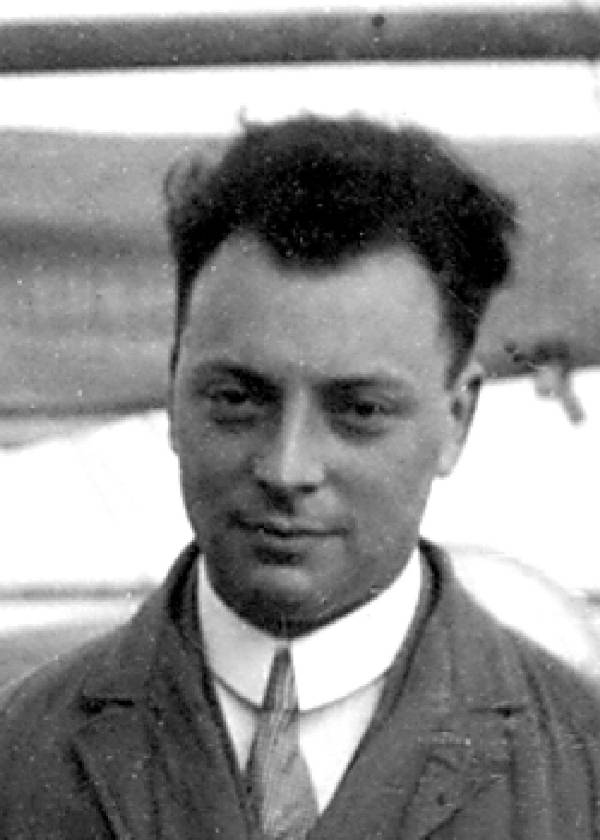
Wolfgang Pauli
theoretical physicist•university teacher
Birthday
April 25, 1900
Birth Sign
Sagittarius
Birthplace
Vienna, Austria-Hungary
Age
Died at 58
About
Wolfgang Pauli was an Austrian-Swiss theoretical physicist and one of the founding figures of quantum mechanics, regarded as one of the most brilliant and rigorous physicists of the twentieth century. Known for his sharp intellect and exacting standards, he made fundamental contributions to the understanding of the atomic and subatomic world. His precision and insight defined his work. Pauli's most famous contribution was the exclusion principle, the rule that no two electrons can occupy the same quantum state, a discovery that explains the structure of atoms and the periodic table and earned him the Nobel Prize in Physics, on a nomination from Albert Einstein. That principle is foundational to the modern understanding of matter. He also made a profound theoretical leap by proposing the existence of a tiny, neutral, nearly undetectable particle to explain a puzzle in radioactive decay, a particle later named the neutrino and not directly detected until decades afterward. That prediction was a landmark of theoretical physics. Famously critical and demanding, he was known among colleagues for his rigorous skepticism, and the so-called Pauli effect became a humorous legend. Brilliant, influential, and uncompromising, he was a central figure in the development of modern physics. Profound and rigorous, he shaped the field. Wolfgang Pauli is remembered as one of the great theoretical physicists of the quantum era.
Early Life & Background
Born in Vienna to Wolfgang Josef Pauli, a colloid chemistry professor, and Bertha Camilla Schütz, a journalist, Pauli was raised Roman Catholic with a godfather who happened to be the physicist and philosopher Ernst Mach. His sister Hertha later became a writer and actress. At the Döblinger Gymnasium, he was a child prodigy: at age twelve, his father took him to a lecture by physicist Arnold Sommerfeld, and Pauli pointed out an error in Sommerfeld's calculation. While still in gymnasium, he studied Einstein's papers on relativity, hiding them under his school desk during boring lessons. Two months after graduating with distinction in July 1918, he published his first paper on general relativity. He then studied at Ludwig-Maximilian University in Munich under Sommerfeld, earning his PhD summa cum laude in 1921 for a thesis on the quantum theory of ionized diatomic hydrogen. At Sommerfeld's suggestion, he wrote a 200-page article on relativity for the Encyklopädie der mathematischen Wissenschaften, a treatise still regarded as a classic.
Career Growth
After his doctorate, Pauli spent a year as an assistant to Max Born in Göttingen and another with Niels Bohr in Copenhagen. He completed his habilitation at the University of Hamburg in February 1924 and became a lecturer there until 1928. In 1925, he formulated the Pauli Exclusion Principle, a breakthrough that explained the structure of atoms and the periodic table. The following year, he used Werner Heisenberg's theory to derive the observed spectrum of the hydrogen atom. In 1928, he was appointed Professor of Theoretical Physics at ETH Zurich. In 1930, he postulated the existence of the neutrino to resolve the beta-decay energy crisis, a particle later named by Enrico Fermi and detected in 1956. During the 1930s, he held visiting positions at Princeton's Institute for Advanced Study and in 1940 became Chair of Theoretical Physics there. In 1945, he was awarded the Nobel Prize in Physics for the exclusion principle, nominated by Einstein. He returned to ETH Zurich in 1946, became a US citizen that year, and a Swiss citizen in 1949. He received the Max Planck Medal in 1958.
Career Timeline
Public Image & Style
Wolfgang Pauli is remembered as the brilliant, acerbic 'conscience of physics', a chain-smoking, intellectually uncompromising theorist who demanded rigor and famously dismissed sloppy work as 'not even wrong.' His public persona is that of a sharp-tongued critic who could be both intimidating and deeply insightful. Media and physicists alike portray him as a genius with a volatile temper, prone to the legendary 'Pauli effect' where lab equipment would malfunction in his presence. Despite his stern exterior, he had a private passion for music (especially Bach), psychology, and dream analysis, corresponding extensively with Carl Jung. There is no organized fandom with a specific name, but admirers in the scientific community often refer to themselves simply as physicists inspired by his legacy. Social media accounts run by institutions like ETH Zurich and CERN occasionally highlight his work, but he has no personal online presence. His aesthetic is that of a classic mid-century academic: formal suits, glasses, and a serious expression, captured in iconic black-and-white photographs.
Fame & Fandom (iFAMOUS Rankings)
Wolfgang Pauli commanded a global audience of unparalleled magnitude within the scientific community, though his reach in popular culture remains distinct from that of modern entertainers. His intellectual footprint defines the architecture of matter, yet his standing in contemporary fame metrics reflects a specialized rather than ubiquitous presence. The iFANN Global Fame Engine has evaluated Wolfgang Pauli, but he does not currently hold a placement in the published rankings, meaning no specific ordinal position is assigned to him in the Global Top 1,000 or any Top-100 scope list. This absence of a numerical rank indicates that while his historical contributions are absolute, his current volume of public engagement does not meet the threshold for a ranked listing in the general population. Consequently, there is no formal fandom name documented for his followers; the collective group honoring his legacy consists of physicists and historians rather than an organized fanbase with a designated title. No official organizations, chart pushes, or charity drives bear his name, and his influence is measured strictly through academic impact rather than social media engagement or consumer behavior. While streets like the Wolfgang-Pauli-Strasse at ETH Zurich stand as institutional tributes, these are honors bestowed by universities rather than acts of a fan movement. The absence of a named fandom underscores the distinction between a celebrated scientist whose work is revered and a celebrity whose persona drives a commercial following.
Interesting Facts and Legends
Pauli and Richard Kuhn, who later won the Nobel Prize in chemistry, were classmates at the Döblinger Gymnasium. Under the influence of physicist Otto Stern, he transitioned from a teetotaler to a champagne enthusiast. Even as a professor, he maintained a bohemian lifestyle, frequenting pubs and working late into the night. When asked to schedule a lecture at 8 AM, he famously replied that he could not stay up that long. His grandmother, a soprano at the royal opera house, sparked his lifelong enthusiasm for music, particularly the works of Bach. He left the Catholic Church at age 29. His extensive correspondence with psychoanalyst Carl Jung analyzed his own dreams and contributed significantly to Jung's concept of synchronicity. Beyond these biographical details, legends persist regarding his sharp intellect and perceived influence on physical reality. A widely retold story in the physics community describes the "Pauli Curse," a humorous folklore suggesting that his mere presence or critical comments caused laboratory equipment to malfunction. David Fathi documented this phenomenon in 2016, noting that instruments often broke when Pauli visited, leading physicists to jokingly blame him for experimental failures. Another enduring anecdote involves his acerbic wit; he is frequently cited for dismissing sloppy theoretical work as "not even wrong," a phrase that entered the cultural lexicon to describe hypotheses too poorly constructed to be falsified. These stories highlight his reputation as the conscience of physics, where his scrutiny seemed to physically disrupt the very experiments he observed.
Notable Quotes
“I do not mind your thinking slowly; I mind your publishing faster than you think.”
“Not even wrong.”
“What God has put asunder, let no man join together.”
“I cannot stay up that long.”
Family & Personal Life
Pauli's father, Wolfgang Josef Pauli (né Pascheles), was a professor of colloid chemistry at the University of Vienna. His mother, Bertha Camilla Schütz, worked as a journalist and writer. His paternal grandparents came from prominent Jewish families of Prague; his great-grandfather was the Jewish publisher Wolf Pascheles. His sister, Hertha Pauli, became a well-known writer and actress. Pauli had no children from either of his two marriages.
Notable Connections
Pauli's PhD supervisor was Arnold Sommerfeld. He worked closely with Max Born in Göttingen and Niels Bohr in Copenhagen. He corresponded extensively with Albert Einstein, who nominated him for the Nobel Prize, and with psychoanalyst Carl Jung on dream analysis and synchronicity. He was a contemporary and collaborator of Werner Heisenberg and Enrico Fermi, who named the neutrino after Pauli's proposal. His friend Otto Stern introduced him to champagne.
Relationships & Dating History
Pauli married Käthe Margarethe Deppner, a dancer, in 1929. The marriage was brief and ended in divorce in 1930. No children were born from this union. In 1934, he married Franziska Bertram. They remained married until Pauli's death on 15 December 1958. No children are recorded from this marriage either. As of his death, Pauli was married to Franziska Bertram.
- MarriedKäthe Margarethe Deppner1929 - 1930Married in 1929, divorced in 1930. No children.
- MarriedFranziska Bertram1934 - 1958Married in 1934, remained together until Pauli's death in 1958. No children.
Death & Aftermath
Died
December 15, 1958 (aged 58)
Death Place
Zurich, Switzerland
Cause of Death
Pancreatic cancer
Wolfgang Ernst Pauli passed away at the University Hospital in Zurich on December 15, 1958, following a period of declining health attributed to pancreatic cancer. Medical records from the facility confirm the diagnosis as the official cause, ending a life marked by recurring ailments and a long history of psychoanalysis with Carl Jung. Although he had largely stepped back from active teaching and research duties in his final years due to his deteriorating condition, he remained engaged with physics until shortly before his hospitalization. The scientific community responded with profound grief, recognizing the loss of one of quantum mechanics' primary architects. Albert Einstein, who considered Pauli his intellectual heir, mourned the physicist deeply, while institutions such as ETH Zurich observed moments of silence rather than public vigils.
His funeral was a private affair held shortly after his death in Zurich, attended by immediate family and close colleagues. He was cremated, and his ashes were interred in the Zollikerberg Cemetery. In the decades following his death, Pauli's legacy has been preserved through the establishment of the Wolfgang Pauli Institute in Vienna and various scholarships supporting students in physics. The exclusion principle remains a cornerstone of quantum mechanics, frequently cited in educational contexts. His papers and correspondence were archived at institutions like CERN and ETH Zurich, ensuring his intellectual property remained accessible to researchers. Streets bearing his name, such as Wolfgang-Pauli-Strasse at ETH Zurich, have undergone renovations, serving as lasting tributes to his contributions to science.
Net Worth (Estate Value)
Wolfgang Pauli died in 1958. As a university professor and theoretical physicist, he did not accumulate significant personal wealth by modern standards. His estate value is not publicly tracked by celebrity net worth sites. His wealth sources historically included his salary as Professor of Theoretical Physics at ETH Zurich, his salary at the Institute for Advanced Study in Princeton, the Nobel Prize prize money in 1945 (approximately $30,000 at the time), and book royalties from his published works. Pauli's scientific papers and correspondence are archived at CERN and ETH Zurich. The estate is not a commercial entity generating significant revenue. His estate value is not publicly available.
Awards Won (2)
Wolfgang Pauli won the Nobel Prize in Physics in 1945 for his discovery of the exclusion principle. He also received the Max Planck Medal in 1958 from the German Physical Society.
1958 · Physics
1945 · Physics
Discovery of the Exclusion Principle
Known For
Pauli Exclusion Principle
1925 · Discoverer
Neutrino
1930 · Postulated
Electron spin
1925 · Introduced
Keywords
Sources
Quick Facts
- Profession
- theoretical physicist, university teacher
- Born
- April 25, 1900
- Birthplace
- Vienna, Austria-Hungary
- Died
- December 15, 1958
- Death Place
- Zurich, Switzerland
- Gender
- Male
- Spouse
- Käthe Margarethe Deppner, Franziska Bertram
- Birth Sign
- Sagittarius
- Education
- PhD from University of Munich
Personal Details
- Full Name
- Wolfgang Ernst Pauli
- Spouse
- Käthe Margarethe Deppner, Franziska Bertram
- Education
- PhD from University of Munich
Frequently Asked Questions
How did Wolfgang Pauli die?
Was Wolfgang Pauli married?
What is the Pauli Exclusion Principle?
Did Wolfgang Pauli win a Nobel Prize?
What did Wolfgang Pauli discover?
Similar People
Join the community
fans discussing