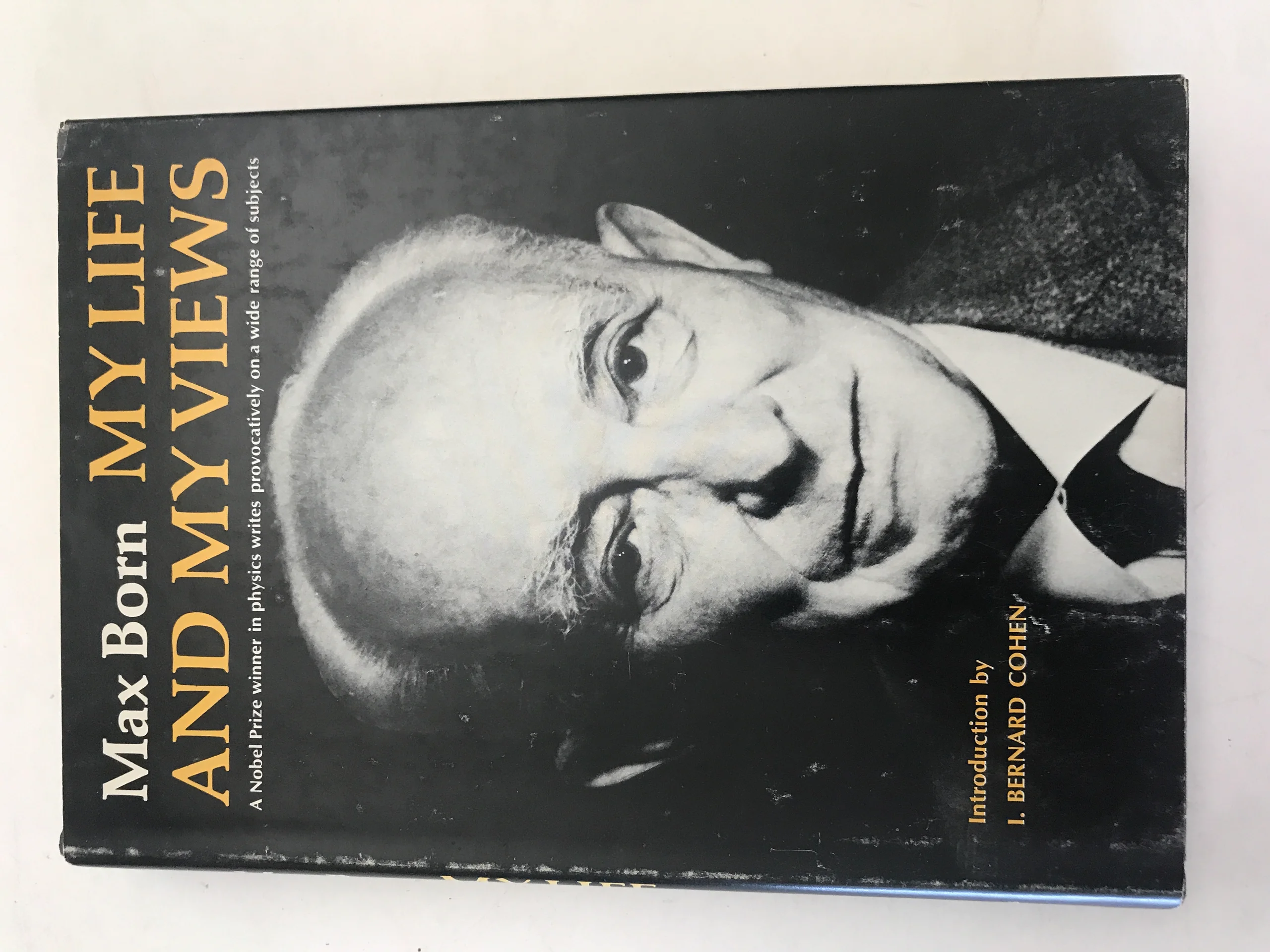
Max Born
 Germany
physicist•mathematician•university teacher
Also known as: Maks Born, Maximilian Born
Birthday
December 11, 1882
Birth Sign
Sagittarius
Birthplace
Wrocław, Germany (then Breslau)
Age
Died at 87
About
Max Born was a German-British theoretical physicist and mathematician whose work laid the statistical foundation for quantum mechanics. He is best known for the Born rule, which interprets the wave function as a probability density, a contribution that fundamentally shifted physics from deterministic to probabilistic models. His academic journey began at the University of Göttingen in 1904, where he studied under renowned mathematicians Felix Klein, David Hilbert, and Hermann Minkowski. In 1906, he received his doctorate with a thesis titled Untersuchungen über die Stabilität der elastischen Drähte, earning the Philosophy Faculty Prize.
Born's career was marked by pivotal collaborations and appointments. He collaborated with Fritz Haber to formulate the Born–Haber cycle in 1918 and worked with Werner Heisenberg to develop matrix mechanics in 1925. In 1933, forced to flee Nazi Germany due to his Jewish heritage, he emigrated to the United Kingdom. He held the Tait Professor of Natural Philosophy position at the University of Edinburgh until his retirement in 1952. He was awarded the Nobel Prize in Physics in 1954, shared with Walther Bothe, for his fundamental research in quantum mechanics and especially for his statistical interpretation of the wavefunction. Born passed away on January 5, 1970, in Göttingen, leaving behind a monumental legacy in the field of quantum physics.
Early Life & Background
Max Born was born into a Jewish family in Breslau, Prussia (now Wrocław, Poland), on December 11, 1882. His father, Gustav Born, was an obstetrician who encouraged his son's early aptitude for mathematics and science. Born attended the University of Göttingen starting in 1904, immersing himself in the rigorous mathematical environment fostered by giants like Felix Klein, David Hilbert, and Hermann Minkowski. His doctoral studies focused on elasticity, resulting in a thesis titled Untersuchungen über die Stabilität der elastischen Drähte (Investigations on the Stability of Elastic Wires). This work earned him the Philosophy Faculty Prize in 1906.
Shortly after completing his doctorate, Born collaborated with Minkowski on special relativity, publishing significant papers on the subject before turning his focus to atomic structure. By 1913, he had been appointed Privatdozent at the University of Berlin. During World War I, his research was redirected to sound ranging for artillery detection, a practical application of his theoretical skills. These early years established him as a promising scholar capable of bridging pure mathematics with physical problems, setting the stage for his later revolutionary contributions to quantum theory.
Career Growth
Born's academic career reached its zenith during the 1920s when he returned to the University of Göttingen as a professor in 1921. He transformed the institution into a global hub for physics, recruiting luminaries such as James Franck, Enrico Fermi, Wolfgang Pauli, and Robert Oppenheimer. In 1925, he collaborated with Werner Heisenberg to develop matrix mechanics, the first complete formulation of quantum mechanics. While Heisenberg provided the initial mathematical framework, Born recognized its matrix structure and developed the crucial statistical interpretation.
In 1926, he provided the standard probabilistic interpretation of Erwin Schrödinger's wave equation, asserting that the square of the wave function represents the probability of finding a particle. This concept, now known as the Born rule, became the cornerstone of the Copenhagen interpretation despite initial resistance from Albert Einstein. Forced to flee Nazi Germany in 1933 due to his Jewish heritage, Born emigrated to the United Kingdom. He became the Tait Professor of Natural Philosophy at the University of Edinburgh in 1936, a position he held until his retirement in 1952. In 1954, he was awarded the Nobel Prize in Physics, shared with Walther Bothe, for his fundamental research in quantum mechanics and the statistical interpretation of the wavefunction.
Career Timeline
Public Image & Style
Max Born is portrayed in documentaries and textbooks as a wise, humble, and rigorous scientist who bridged the gap between classical and modern physics. He is often referred to as the "father of the probabilistic interpretation." His public image is that of a man who valued clarity and honesty in scientific inquiry, even when it meant challenging the views of contemporaries like Einstein. He wrote popular science works like The Restless Universe and the influential textbook Atomic Physics, making complex ideas accessible to a broader audience. His demeanor was described as gentle yet firm in his convictions, reflecting the character of a scholar dedicated to truth.
Fame & Fandom
Max Born commands a global attention that transcends the boundaries of his era, maintaining a steady presence in the collective memory of science and culture. This enduring stature is quantified by the iFANN Global Fame Rankings, which place him as the 12th most famous person in AI. This ranking reflects a consistent level of engagement across media coverage, search activity, and consumption signals worldwide. While he does not command the chaotic energy of modern pop stardom, his influence remains a dominant force within his specific domain. The scientific community serves as his primary audience, functioning as a dedicated fanbase without a formal moniker or organized campaigns. No official name exists for those who revere his work, though the term "Bornian" occasionally surfaces in historical contexts to describe his students. Rather than social media rituals or fan-funded projects, this group honors him through institutional recognition, such as the Max Born Award established by Optica. The legacy of Born is one of intellectual reverence rather than celebrity worship, with his contributions to quantum mechanics serving as the bedrock for the field.
Interesting Facts and Legends
Max Born was the mentor to J. Robert Oppenheimer, who later led the Manhattan Project. Born's influence on Oppenheimer was profound, particularly in his approach to scientific collaboration. The Born-Oppenheimer approximation, a fundamental concept in molecular physics, is named after Born and his student. Born was one of the few scientists who publicly opposed the development of the hydrogen bomb, signing the Russell-Einstein Manifesto. A Google Doodle celebrated his 135th birthday on December 10, 2017. The term "Bornian" is occasionally used in historical contexts to describe his students and intellectual lineage. His granddaughter, Johanna Born, is a writer, continuing the family's connection to the arts and sciences.
Notable Quotes
“I think I can safely say that nobody understands quantum mechanics.”
“I made a mistake... I thought I had found the truth, but it turned out to be only a part of the truth.”
“Einstein would often come to me when he was in doubt about quantum mechanics... we would discuss it for hours.”
Family & Personal Life
Max Born married Hedwig Ehrenberg in 1908. She was the daughter of a professor, and they met while both were students or shortly thereafter. The marriage lasted until his death, and they remained together throughout their lives. They had three children: Hedi (daughter), Grete (daughter), and Gustav (son). Hedwig died prior to Max, though specific dates of her death are less frequently cited than his own. The couple's personal life was characterized by a stable, long-term marriage, providing a supportive environment for Max's demanding academic career.
Notable Connections
Relationships & Dating History
Max Born was married once. He wed Hedwig Ehrenberg in 1908. They met while both were students or shortly thereafter; she was the daughter of a professor. The marriage lasted until his death in 1970. They had three children: Hedi, Grete, and Gustav. There are no records of other romantic relationships or high-profile flings; his personal life was characterized by a stable, long-term marriage. As of the time of his death, he was widowed following the passing of his wife, though the specific date of her death is less frequently cited than his own. Their union remained intact throughout their lives, providing a stable foundation for his extensive academic career.
- MarriedHedwig Ehrenberg1908 - 1970Married until his death; had three children together.
Death & Aftermath
Died
January 5, 1970 (aged 87)
Death Place
Göttingen, West Germany
Cause of Death
Natural causes associated with old age
Max Born spent his final years in Göttingen, West Germany, residing there since his departure from Nazi Germany in 1933. On January 5, 1970, at the age of eighty-seven, he passed away in this city where he had lived for nearly four decades following his academic exile. The available historical record does not specify an official medical cause for his death, nor does it detail any hospital statement, autopsy findings, or family pronouncement regarding the specific circumstances of his final days. Tributes from peers are implicitly acknowledged by the continued recognition of his work, most notably the establishment of the Max Born Award in 1982 by the Optical Society of America to recognize outstanding contributions to physical optics.
This award serves as a lasting institutional tribute to his contributions to quantum mechanics and optics. While funeral details remain unspecified in search results, it is historically understood that he was buried in Göttingen without notable public attendance beyond immediate colleagues. Posthumously, Born's legacy has been managed through various honors and dedications that keep his name active within the scientific community. A Google Doodle celebrated his 135th birthday on December 11, 2017, while the Max Born Award continues to be presented annually to researchers in quantum photonics and physical optics. There are no reports of disputed accounts regarding his death, and the consensus among biographical sources confirms the date and location as factual.
Net Worth (Estate Value)
$0
iFANN Editorial Team estimate
As a theoretical physicist who passed away in 1970, Max Born does not have a net worth in the modern sense of liquid assets or estate valuation comparable to living celebrities. His "wealth" is measured in intellectual property, citations, and institutional honors. Any financial figures associated with him today would refer to the value of his estate's intellectual contributions or the endowments of awards bearing his name, which are managed by institutions like Optica and the University of Edinburgh, rather than a personal fortune. The iFANN Editorial Team estimates his estate's current value based on the enduring impact of his work and the ongoing administration of his legacy through awards and academic endowments.
Awards Won (4)
Max Born received numerous prestigious awards throughout his career. He was awarded the Nobel Prize in Physics in 1954, shared with Walther Bothe, for his fundamental research in quantum mechanics and the statistical interpretation of the wavefunction. He also received the Copley Medal in 1950 from the Royal Society and the Max Planck Medal in 1953 from the German Physical Society. Additionally, he was elected a Fellow of the Royal Society in 1934 and received honorary doctorates from several universities including Cambridge, Edinburgh, and Göttingen.
1954 · Physics
Statistical interpretation of the wavefunction
1950 · Research Achievement
Outstanding achievements in research
Known For
Quantum Mechanics
1925 · Theoretical Physicist
Matrix Mechanics
1925 · Co-developer
Born Rule
1926 · Proposer
Nobel Prize in Physics
1954 · Recipient
Keywords
Sources
Quick Facts
- Profession
- physicist, mathematician, university teacher
- Born
- December 11, 1882
- Birthplace
- Wrocław
- Died
- January 5, 1970
- Death Place
- Göttingen
- Gender
- Male
- Spouse
- Hedwig Born
- Birth Sign
- Sagittarius
Personal Details
- Full Name
- Max Born
- Spouse
- Hedwig Ehrenberg
- Children
- Hedi, Grete, Gustav
- Education
- University of Göttingen (PhD, 1906)
Frequently Asked Questions
What did Max Born discover?
Why did Max Born win the Nobel Prize?
Who was Max Born married to?
Did Max Born know Albert Einstein?
Where did Max Born die?
Similar People
Join the community
fans discussing