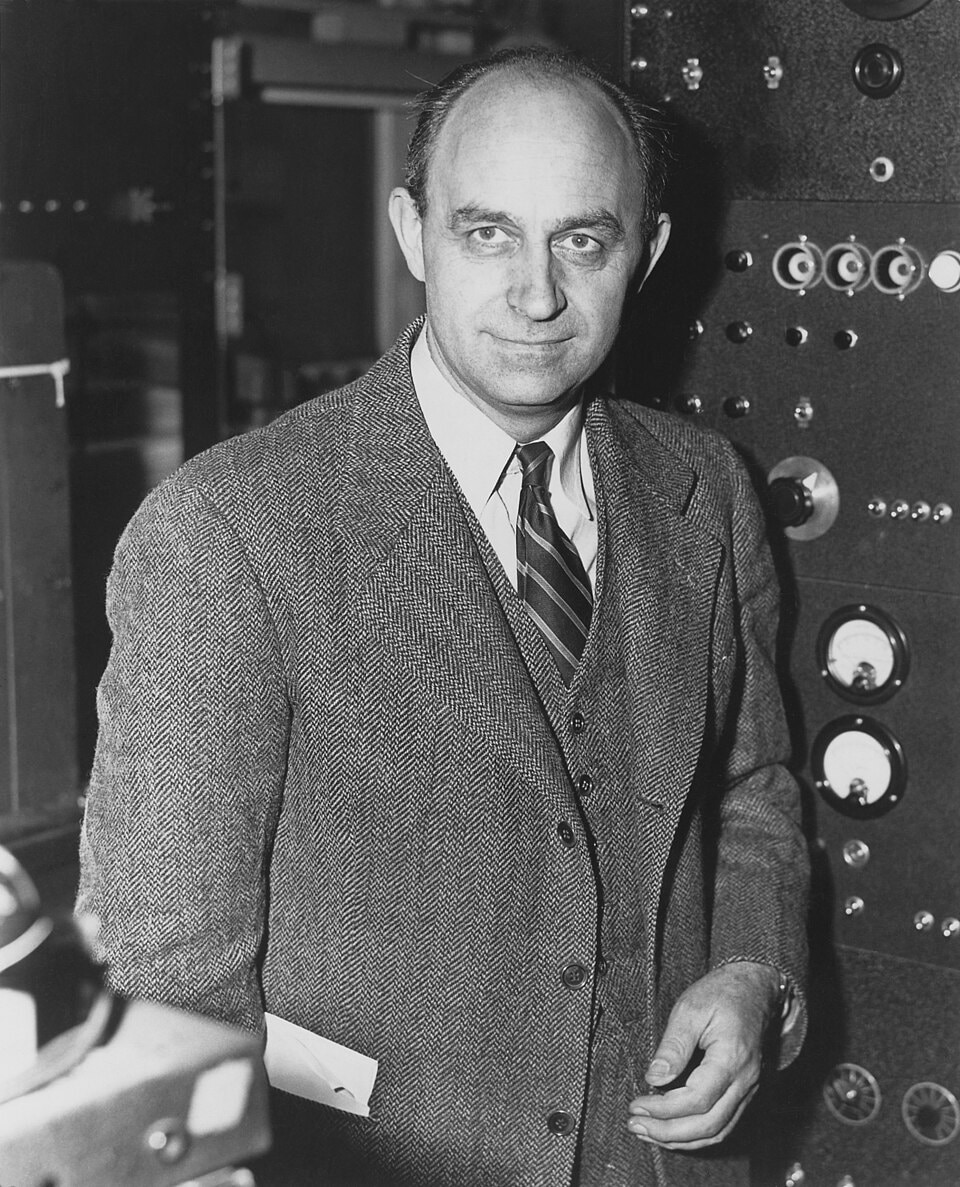
Enrico Fermi
 Italy
Italyphysicist•theoretical physicist•nuclear physicist
Birthday
September 29, 1901
Birth Sign
Libra
Birthplace
Rome, Italy
Age
Died at 53
Height
5 ft 9 in (1.75 m)
About
Enrico Fermi was an Italian-American physicist widely regarded as one of the most brilliant scientists of the 20th century. He is best known for building the world's first artificial nuclear reactor, Chicago Pile-1, and for his pivotal role in the Manhattan Project. Fermi won the 1938 Nobel Prize in Physics for his demonstrations of new radioactive elements produced by neutron irradiation and for discovering nuclear reactions caused by slow neutrons. His work laid the foundation for the nuclear age, and he is celebrated for his rare mastery of both theoretical and experimental physics.
Fermi's contributions span multiple fields. He formulated the Fermi-Dirac statistics, which describe particles called fermions, and developed a theory of beta decay that postulated the existence of the neutrino. His discovery that slow neutrons are more effective in nuclear reactions revolutionized nuclear physics. After emigrating to the United States in 1938, he joined the Manhattan Project, where he led the team that achieved the first self-sustaining nuclear chain reaction on December 2, 1942. Today, his legacy is honored through the Fermi National Accelerator Laboratory, the Enrico Fermi Award, and the Fermi Paradox, which stems from a casual question he posed about extraterrestrial life.
Early Life & Background
Fermi was born in Rome to Alberto Fermi, a chief inspector in the Ministry of Communications, and Ida de Gattis, a schoolteacher. His early life was marked by tragedy when his older brother Giulio died suddenly from a throat abscess in 1915. The loss drove him deeper into his studies. He discovered a passion for physics and mathematics by reading old books from a market stall in Campo de' Fiori, teaching himself complex concepts. By age 14, he was designing small electric motors and studying treatises on analytical mechanics.
Fermi found a kindred spirit in his friend Enrico Persico, with whom he would discuss physics problems for hours. After excelling in his studies, he won a scholarship to the prestigious Scuola Normale Superiore in Pisa. He earned his undergraduate degree in 1922 and a doctorate in physics in 1923 from the University of Pisa. His doctoral thesis on the scattering of X-rays demonstrated his early brilliance. A pivotal moment came when he secured a lectureship in mathematical physics at the University of Florence in 1924. Then, in 1926, he developed the statistical laws governing particles that obey the Pauli exclusion principle, now known as Fermi-Dirac statistics, which immediately established him as a leading theoretical physicist. That same year, he became a full professor of theoretical physics at the University of Rome La Sapienza, a position created specifically for him.
Career Growth
Fermi's career is a series of foundational breakthroughs. In 1933-34, he proposed a theory of beta decay postulating the existence of the neutrino and formulated Fermi's interaction, describing the weak nuclear force. In 1934, he discovered that bombarding elements with slow neutrons is far more effective than using fast neutrons, leading to the discovery of neutron-induced radioactivity. This work earned him the Nobel Prize in Physics in 1938. He used the prize money to escape Fascist Italy and move to the United States.
In 1942, at the University of Chicago, Fermi led the team that designed and built Chicago Pile-1, the world's first artificial nuclear reactor. On December 2, 1942, it achieved the first self-sustaining nuclear chain reaction. At Los Alamos Laboratory, he headed F Division, working on the theoretical aspects of the thermonuclear bomb. He was present at the Trinity test on July 16, 1945, where he famously estimated the bomb's yield by dropping scraps of paper during the blast wave. After the war, he became a professor at the Institute for Nuclear Studies at the University of Chicago and served on the General Advisory Committee of the Atomic Energy Commission, where he strongly opposed the development of the hydrogen bomb. He continued research in particle physics, studying pions, muons, and cosmic rays until his death in 1954.
Career Timeline
Public Image & Style
Fermi is portrayed as the quintessential 20th-century scientist: intense, focused, with a receding hairline, glasses, and a pipe often in his mouth. He is known for his incredible clarity of thought and his ability to solve complex problems with simple calculations. The media and biographers emphasize his dual expertise in theory and experiment, calling him the "pope of physics." He is consistently depicted as a genius, a brilliant problem-solver, and a calm, rational leader under pressure.
There is no formal fandom, but he is revered by physicists, historians of science, and engineering students. Fermi problems are a staple of physics and engineering education, and the Fermi Paradox is a major topic in popular science and science fiction. Institutional accounts at Fermilab and museums post about his legacy with a tone of reverence and educational fascination.
Fame & Fandom (iFAMOUS Rankings)
Enrico Fermi stands as a towering figure in the annals of science, yet his global fame operates on a different frequency than modern pop icons. As of August 2026, the iFANN Global Fame Engine has evaluated this legendary physicist, but he does not currently hold a placement in the published rankings, meaning no specific ordinal position or score is assigned to him within the top tiers of global celebrity. This absence from the charts reflects his unique status as a historical giant whose influence permeates every physics classroom and laboratory rather than dominating tabloid headlines or social media feeds. While he lacks a formal fanbase with an official name or organized campaigns, the intellectual community reveres him with a devotion that transcends typical fandom. His legacy is sustained by the enduring utility of his theories, which serve as the blueprint for modern technology, and by the cultural mythology surrounding his life. The story of his lunchtime query about extraterrestrial life remains a staple of scientific lore, retold by generations of students and researchers who find wonder in his simple question. Unlike celebrities who rely on public appearances, Fermi's presence is felt through the invisible architecture of his discoveries, creating a silent but profound connection with anyone who understands the universe.
Interesting Facts and Legends
Enrico Fermi possessed a remarkable ability to estimate quantities using simple calculations, a skill now taught globally as Fermi problems. At the Trinity test, he estimated the bomb's yield to be 10 kilotons of TNT by dropping small pieces of shredded paper and measuring how far they were blown by the shockwave. His estimate was remarkably close to the actual yield of 18.6 kilotons. During a lunch discussion with colleagues in 1950, he famously asked, "But where is everybody?" when discussing the probability of extraterrestrial life. This led to the Fermi Paradox. He is one of the very few physicists who was a world-class master of both theoretical and experimental physics. He learned English by reading scientific journals and listening to the radio, but he always spoke with a strong Italian accent. The element fermium (atomic number 100) is named after him. A central piece of cultural mythology involves the "Fermi Paradox," a question regarding the apparent contradiction between the high probability of extraterrestrial civilizations and the lack of evidence for them. This concept originated from a famous lunch conversation in 1950 at the Los Alamos National Laboratory in New Mexico. Another iconic moment occurred on December 2, 1942, at the University of Chicago, where Fermi led a team to successfully initiate the world's first artificial nuclear chain reaction using Chicago Pile-1. This event is widely cited as the birth of the nuclear age. While not a singular performance event, Fermi's Golden Rule and Fermi-Dirac statistics constitute his enduring intellectual legend, underpinning modern technology including smartphones and particle colliders.
Notable Quotes
“If I could remember the names of all these particles, I would have been a botanist.”
“It is no good to try to stop knowledge from going forward. Ignorance is never better than knowledge.”
“There are two possible outcomes: if the result confirms the hypothesis, then you've made a measurement. If the result is contrary to the hypothesis, then you've made a discovery.”
Family & Personal Life
Fermi married Laura Capon on July 19, 1928. Laura was the daughter of a prominent Jewish Italian naval officer. They had two children: a daughter, Nella (born 1931), and a son, Giulio (born 1936), named after Fermi's deceased brother. The family fled Italy in 1938 due to the Fascist regime's racial laws targeting Laura. Fermi was a dedicated family man, though his work often consumed his time. He died of stomach cancer on November 28, 1954, in Chicago, Illinois.
Notable Connections
Fermi worked closely with J. Robert Oppenheimer, the scientific director of the Manhattan Project, and later testified on his behalf. He collaborated with Leo Szilard on Chicago Pile-1. He led the division working on Edward Teller's thermonuclear bomb, though he later opposed its development. His wife, Laura Fermi, was his biographer. His daughter, Nella Fermi, became a prominent historian.
Relationships & Dating History
Fermi married Laura Capon on July 19, 1928. They met through mutual friends in Rome, where Laura was a literature student from a well-off Jewish family. They had two children, Nella and Giulio. Laura was his partner and biographer, writing Atoms in the Family about their life. The marriage was stable and lasted until his death on November 28, 1954. No other public romantic relationships are documented by credible historical sources. There are no records of affairs, engagements before Laura, or high-profile flings. His life was almost exclusively dedicated to his work and family.
- MarriedLaura Fermi1928 - 1954They met through mutual friends in Rome. Laura was a literature student from a well-off Jewish family. They had two children, Nella and Giulio. She was his partner and biographer.
Death & Aftermath
Died
November 28, 1954 (aged 53)
Death Place
Chicago, Illinois
Cause of Death
Stomach cancer
The scientific community reacted with immediate and profound solemnity to the loss of Enrico Fermi, recognizing him as an architect of the atomic age whose untimely death deprived the world of one of its most brilliant and productive physicists. Tributes poured in from peers and institutions alike, cementing his status as a titan of the twentieth century while Physics Today published a feature titled "Enrico Fermi 1901, 1954" to mark the occasion. The news confirmed that the physicist had passed away at his home in Chicago, Illinois, on November 28, 1954, following a battle with stomach cancer that had been diagnosed in 1953 after surgery for a tumor.
Despite treatment attempts, the condition proved fatal, and his final days were spent recovering from the progression of the disease before he succumbed. His funeral remained a private affair attended by family members and close colleagues from the University of Chicago and the Manhattan Project, reflecting the personal nature of his passing rather than a state-sponsored ceremony. Following the service, his ashes were interred at Forest Home Cemetery in Chicago. Posthumously, Fermi has been honored through numerous dedications and educational initiatives that continue to shape modern physics. The Enrico Fermi Institute was established at the University of Chicago, and the Fermi National Accelerator Laboratory in Batavia, Illinois, bears his name as a premier center for particle research.
The U.S. Department of Energy presents the annual Enrico Fermi Award to recognize outstanding contributions to nuclear science, while a scholarship foundation supports students in the field. His intellectual legacy endures through the Fermi Paradox, which remains a subject of intense discussion and publication decades later.
Net Worth (Estate Value)
$2 Million
iFANN Editorial Team estimate
Enrico Fermi was a salaried academic and government scientist who did not amass a significant personal fortune. His net worth at death was modest, and per iFANN's editorial analysis, the current estate value is estimated at $2 Million as of 2026. The estate earns modest royalties from his books, such as Thermodynamics and Nuclear Physics, and from patent rights, though the U.S. government took over most of his nuclear patents in 1944. The Fermi estate is managed by his descendants and is not a commercial enterprise, with no significant annual income stream beyond book royalties and personal property.
Awards Won (6)
Fermi won the Nobel Prize in Physics in 1938 for his work on neutron-induced radioactivity. He also received the Hughes Medal (1942), the Franklin Medal (1947), the Rumford Premium (1953), and the Max Planck Medal (1954). The Enrico Fermi Award was established in his honor, and he was its first posthumous recipient in 1954.
1938 · Physics
Demonstrations of new radioactive elements produced by neutron irradiation and discovery of nuclear reactions brought about by slow neutrons
1942 · Physics
Contributions to the development of the atomic bomb and nuclear physics
Known For
Chicago Pile-1 (first nuclear reactor)
1942 · Lead designer
Manhattan Project
1944 · Head of F Division
Nobel Prize in Physics
1938 · Recipient
Fermi-Dirac statistics
1926 · Developer
Beta decay theory (neutrino postulate)
1933 · Developer
Keywords
Quick Facts
- Profession
- physicist, theoretical physicist, nuclear physicist
- Born
- +1901-09-29
- Birthplace
- Rome
- Died
- +1954-11-28
- Death Place
- Chicago
- Gender
- Male
- Spouse
- Laura Fermi
- Birth Sign
- Libra
Personal Details
- Full Name
- Enrico Fermi
- Height
- 5 ft 9 in (1.75 m)
- Spouse
- Laura Fermi
- Children
- Nella Fermi (daughter), Giulio Fermi (son)
- Education
- Scuola Normale Superiore in Pisa (undergraduate and doctorate)
Frequently Asked Questions
What is Enrico Fermi famous for?
How did Enrico Fermi die?
What is the Fermi Paradox?
Did Enrico Fermi have a wife?
What is the Enrico Fermi Award?
Similar People
Join the community
fans discussing