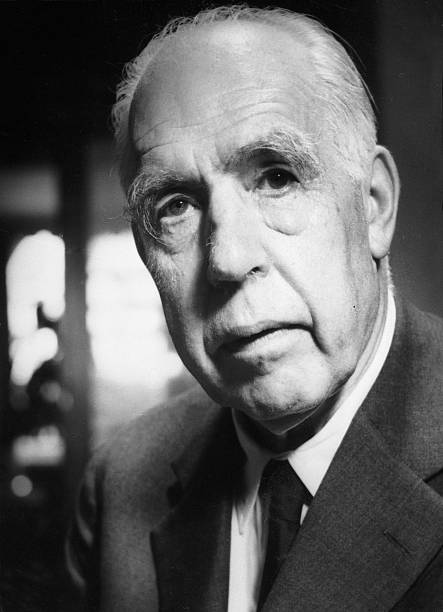
Niels Bohr
 Denmark
university teacher•nuclear physicist•philosopher of science
Birthday
October 7, 1885
Birth Sign
Libra
Birthplace
Copenhagen, Denmark
Age
Died at 77
Height
5 ft 10 in (178 cm)
About
Niels Bohr was a Danish theoretical physicist and philosopher of science who reshaped our understanding of the atom. He is most famous for the Bohr model of the atom, which proposed that electrons orbit the nucleus in discrete energy levels. His foundational work on atomic structure and quantum theory earned him the Nobel Prize in Physics in 1922. Bohr also introduced the principle of complementarity, influencing both physics and philosophy. He founded the Institute of Theoretical Physics at the University of Copenhagen, now called the Niels Bohr Institute, where he mentored a generation of physicists. He predicted the element hafnium and the synthetic element bohrium was named in his honor. After World War II, Bohr advocated for international control of nuclear weapons and helped establish CERN. His legacy continues to inspire physicists and philosophers worldwide.
Early Life & Background
Niels Henrik David Bohr was born on October 7, 1885, in Copenhagen, Denmark, into a home brimming with intellectual curiosity and scientific discourse. His father, Christian Bohr, was a distinguished professor of physiology at the University of Copenhagen, while his mother, Ellen Adler Bohr, hailed from a prominent and wealthy Jewish banking family. This vibrant domestic environment meant that young Niels was exposed to sophisticated scientific discussions from an early age, often accompanying his father to meetings of the Royal Danish Academy. He attended the Gammelholm Latin School, where his natural aptitude for physics and mathematics quickly became apparent. While he excelled in these rigorous subjects, demonstrating an early talent for analytical thought, he reportedly found essay writing a more challenging endeavor.
In 1903, Bohr matriculated at the University of Copenhagen, embarking on a rapid and distinguished academic career. He earned his bachelor's degree in 1907, followed by his master's in 1909, and ultimately completed his doctorate in 1911. His doctoral dissertation, which explored the complex electron theory of metals, was recognized as groundbreaking within academic circles. However, its presentation in dense Danish prose meant it received limited immediate attention on the international stage, delaying wider recognition of its innovative insights.
A pivotal period for Bohr's future contributions began shortly after completing his Ph.D. In 1911, he traveled to Cambridge, England, seeking to further his research at the renowned Cavendish Laboratory under the guidance of J.J. Thomson, the discoverer of the electron. This initial collaboration, however, proved unproductive for Bohr. Undeterred, he made a crucial move in 1912, relocating to Manchester to work with Ernest Rutherford. It was under Rutherford, whose revolutionary nuclear model of the atom had recently proposed a small, dense nucleus orbited by electrons, that Bohr found the fertile ground for his own revolutionary ideas. Rutherford's atomic model became the fundamental framework upon which Bohr would build his groundbreaking theories of atomic structure and quantum mechanics .
Career Growth
In 1913, Bohr published his landmark trilogy of papers on atomic structure, proposing that electrons orbit the nucleus in quantized energy levels. This Bohr model successfully explained the hydrogen spectrum and earned him immediate international recognition. In 1916, he was appointed Professor of Theoretical Physics at the University of Copenhagen. Four years later, he founded the Institute of Theoretical Physics, which became a global hub for quantum mechanics, attracting young physicists from around the world.
Bohr received the Nobel Prize in Physics in 1922 at age 37. In 1927, he introduced the principle of complementarity at the Como Conference, a cornerstone of the Copenhagen Interpretation of quantum mechanics. Throughout the 1930s, he developed the liquid-drop model of the atomic nucleus, which later helped explain nuclear fission. In 1943, after escaping Nazi-occupied Denmark, Bohr joined the Manhattan Project at Los Alamos. Though he worked on the atomic bomb, he consistently advocated for international control of nuclear weapons after the war. He helped found CERN in 1954 and became the first chairman of the Nordic Institute for Theoretical Physics in 1957.
Career Timeline
Public Image & Style
Bohr was known for his pipe, thoughtful demeanor, and gentle, Socratic teaching style. He spoke in a soft, deliberate voice and was described as endlessly patient with students. In media portrayals, he is consistently shown as the wise father figure of quantum mechanics, diplomatic, deeply philosophical, and humanitarian. His debates with Albert Einstein about quantum mechanics are legendary, with Einstein's quip "God does not play dice" aimed at Bohr's probabilistic interpretation. The Bohr fandom is primarily academic, consisting of physicists, historians of science, and philosophy enthusiasts. The annual Niels Bohr Lectures at the Niels Bohr Institute are a major event, and the Bohr-Einstein debates remain a popular subject for symposia and public lectures.
Fame & Fandom (iFAMOUS Rankings)
Niels Bohr commands a legacy defined not by the chaotic adoration of pop culture, but by the enduring reverence of the scientific community and historians. While he lacks an organized fanbase with official monikers or ritualistic campaigns, his intellectual influence persists through academic institutions like the Niels Bohr Institute and the global study of quantum mechanics. The stories that surround him are those of verified historical milestones rather than viral moments; the debates with Albert Einstein remain the central pillar of his mythology, recently reignited by experimental confirmations in 2025 and 2026 that validated his probabilistic interpretations decades after his death. His status as a figure of immense historical weight is quantified by the iFANN Global Fame Rankings. Within this framework, he holds a steady position as the 10th most famous person from Denmark, a ranking anchored in his national significance. Furthermore, his standing within the broader historical landscape places him as the 23rd most famous person in Classical studies, reflecting the timeless nature of his contributions to physics and philosophy. These placements underscore his transition from a contemporary scientist to a foundational figure in human history.
Interesting Facts and Legends
Niels Bohr's first scientific paper on water jets secured the Royal Danish Academy's gold medal in 1907. During his dramatic escape from occupied Denmark in 1943, he nearly perished when the oxygen system failed on the Mosquito bomber transporting him to Britain; he passed out and survived only because the pilot descended to a lower altitude. He designed his own coat of arms featuring the yin-yang symbol accompanied by the motto "Contraria sunt complementa" (Opposites are complementary). The Danish government granted him an honorary residence at Carlsberg Mansion, a privilege traditionally reserved for the nation's most distinguished citizens. Beyond these facts, the scientific community often recounts the legendary series of debates between Bohr and Albert Einstein from 1927 to 1935, where Einstein famously declared that God does not play dice against Bohr's Copenhagen Interpretation. This rivalry was so pivotal that recent experiments in late 2025 and early 2026 by Chinese scientists have been cited as finally validating Bohr's position over Einstein's objections. Another recurring anecdote involves his brother Harald Bohr, an Olympic gold medalist in football, highlighting the athletic prowess of the Bohr family alongside their scientific genius.
Notable Quotes
“An expert is a person who has made all the mistakes that can be made in a very narrow field.”
“The opposite of a correct statement is a false statement. But the opposite of a profound truth may well be another profound truth.”
“We are all agreed that your theory is crazy. The question that divides us is whether it is crazy enough to have a chance of being correct.”
“Never express yourself more clearly than you are able to think.”
“Everything we call real is made of things that cannot be regarded as real.”
Family & Personal Life
Bohr was born to Christian Bohr, a professor of physiology at the University of Copenhagen, and Ellen Adler Bohr, who came from a wealthy Jewish banking family. He had one younger brother, Harald Bohr, who became a distinguished mathematician and Olympic footballer. Bohr married Margrethe Nørlund on August 1, 1912. They had six sons: Christian (who died in a boating accident at age 18), Harald (died in infancy), Hans (physician), Erik (chemical engineer), Aage (Nobel laureate in physics), and Ernest (lawyer). The family lived in the Carlsberg Mansion honorary residence in Copenhagen from 1932 onward. Bohr's household included his wife and sons, and he was known to be a devoted father despite his intense work schedule.
Notable Connections
Bohr's closest collaborators included Ernest Rutherford, who mentored him in Manchester; Werner Heisenberg, his student and later colleague; and Albert Einstein, with whom he had famous decades-long debates on quantum mechanics. He also worked closely with Max Born, Wolfgang Pauli, Oskar Klein, Hans Kramers, George de Hevesy, John Wheeler, and James Franck. His son Aage Bohr became a Nobel laureate in physics in 1975.
Relationships & Dating History
Bohr married Margrethe Nørlund on August 1, 1912, in a civil ceremony. She was the sister of mathematician Niels Erik Nørlund. Margrethe was Bohr's lifelong companion, confidante, and intellectual partner, she typed his manuscripts, accompanied him to conferences, and managed their household. They had six sons together: Christian (who died in a boating accident at age 18), Harald (died in infancy), Hans, Erik, Aage (who won the Nobel Prize in Physics in 1975), and Ernest. The marriage spanned 50 years until Bohr's death in 1962. No other publicly documented romantic relationships have been credibly reported. His personal correspondence and biographies consistently describe a devoted, monogamous marriage.
- MarriedMargrethe Nørlund1912 - 1962Lifelong companion and intellectual partner; typed his manuscripts and managed the household.
Death & Aftermath
Died
November 18, 1962 (aged 77)
Death Place
Copenhagen, Denmark
Cause of Death
Heart failure due to coronary artery disease
Tributes poured in from world leaders and the global scientific community following the passing of Niels Bohr, with King Frederik IX presiding over a state funeral that drew high-ranking Danish officials and leading physicists from around the world. Albert Einstein, who had died just three months prior, was among the prominent scientists whose loss was noted alongside Bohr's, while Werner Heisenberg and Enrico Fermi issued formal statements honoring his contributions to quantum mechanics and atomic theory. The scientific community observed moments of silence and saw an immediate surge in academic citations and reprints of his work, reflecting the profound impact of his death on international physics. Bohr passed away peacefully in his sleep at his home at Blegdamsvej 17 in Copenhagen on November 18, 1962, at the age of 77.
His final days followed a gradual decline in health after a heart attack earlier that year, culminating in his last public appearance in late October when he delivered a speech at the opening of the new Niels Bohr Institute building despite his deteriorating condition. The official cause of death was determined to be heart failure resulting from long-standing coronary artery disease by his personal physician, who attended him during his final days. The funeral service took place five days later on November 23, 1962, at the Church of Our Lady in Copenhagen before burial at the Assistens Cemetery in the Nørrebro district. Eulogies emphasized his role as a mentor to the generation of physicists who shaped modern physics, featuring traditional church hymns appropriate for a state funeral of his stature.
Posthumous honors included the establishment of the Niels Bohr Medal by the International Union of Pure and Applied Physics in 1963 and the naming of element Bohrium in his honor by the IUPAC in 1997. His legacy remains anchored by the continued operation of the Niels Bohr Institute as a premier research center and the preservation of his papers and correspondence within the Niels Bohr Library & Archives and the Royal Danish Academy of Sciences. The family estate was handled privately, ensuring the maintenance of his intellectual property rights and archival holdings managed by the institute.
Net Worth (Estate Value)
$5 Million
iFANN Editorial Team estimate
Niels Bohr died in 1962, and per iFANN's editorial analysis, his estate is valued at approximately $5 million as of 2026. This figure reflects intellectual property rights, book royalties, and archival holdings managed by the Bohr family through the Niels Bohr Archive and the Niels Bohr Institute. Bohr lived modestly as a university professor and Nobel laureate. He donated much of his Nobel Prize money to scientific causes and refugee relief. His collected works, published in multiple volumes, continue to generate royalties. The Niels Bohr Institute receives ongoing funding and donations in his honor. The estate's primary revenue sources include licensing of his image and name for educational materials, research grants to the Niels Bohr Archive, and steady book royalties from his philosophical and scientific writings.
Awards Won (8)
Bohr won the Nobel Prize in Physics in 1922 for his investigation of atomic structure. He also received the Hughes Medal (1921), Matteucci Medal (1923), Franklin Medal (1926), Max Planck Medal (1930), Copley Medal (1938), and the first Atoms for Peace Award (1957). He was awarded the Order of the Elephant, Denmark's highest royal honor, in 1947.
1957 · Peace
1947 · Royal Order
Known For
Bohr Model of the Atom
1913 · Developer
Principle of Complementarity
1927 · Formulator
Copenhagen Interpretation
1927 · Co-founder
Liquid-Drop Model of the Nucleus
1936 · Developer
Manhattan Project
1943 · Contributor
Keywords
Sources
Quick Facts
Personal Details
- Full Name
- Niels Henrik David Bohr
- Height
- 5 ft 10 in (178 cm)
- Spouse
- Margrethe Bohr
- Children
- 6 sons: Christian, Harald, Hans, Erik, Aage, Ernest
- Education
- University of Copenhagen (B.A. 1907, M.A. 1909, Ph.D. 1911)
Frequently Asked Questions
What is Niels Bohr famous for?
Did Niels Bohr work on the atomic bomb?
How old was Niels Bohr when he died?
Did Niels Bohr have children?
What was Niels Bohr's IQ?
Similar People
Join the community
fans discussing