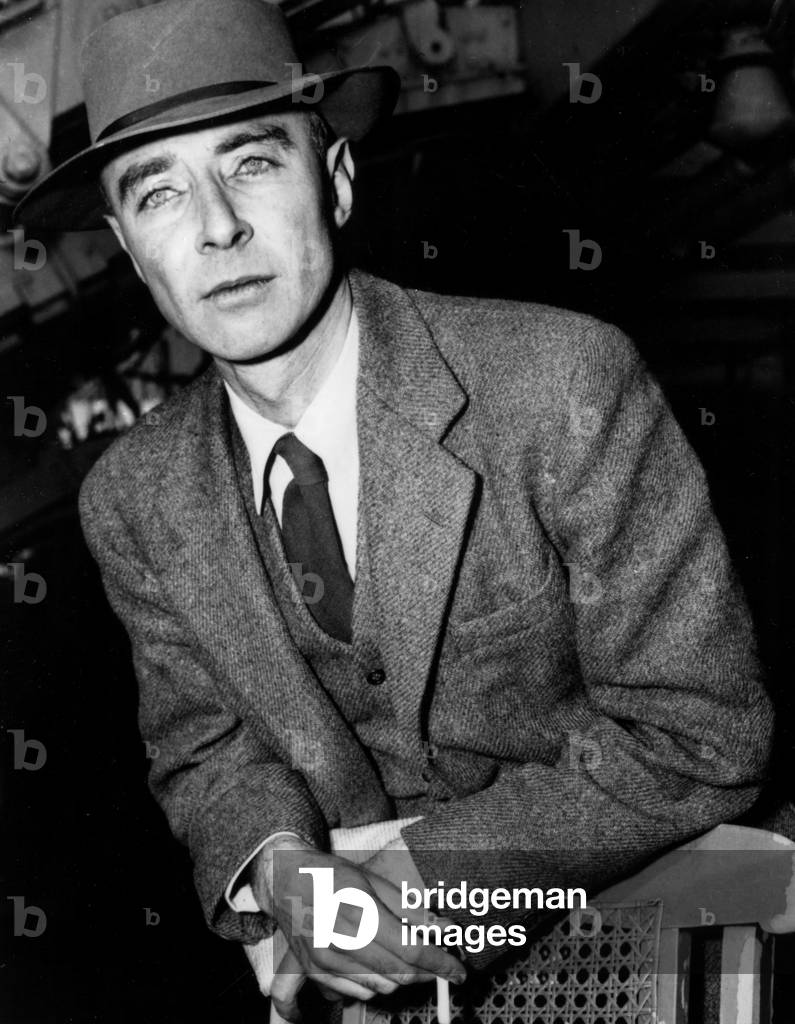
Robert Oppenheimer
 United States
theoretical physicist•engineer•nuclear physicist
Also known as: J. Robert Oppenheimer, Oppie
Birthday
April 22, 1904
Birth Sign
Taurus
Birthplace
New York City, New York, USA
Age
Died at 62
Height
5 ft 10 in (178 cm)
About
J. Robert Oppenheimer was an American theoretical physicist who reshaped history as the director of the Manhattan Project's Los Alamos Laboratory. Born Julius Robert Oppenheimer on April 22, 1904, in New York City, he came from a wealthy German Jewish family. He graduated from Harvard University in 1925 with a degree in chemistry, then earned a doctorate in physics from the University of Göttingen in 1927, studying under Max Born. After research at Cambridge and the California Institute of Technology, he joined the physics faculty at the University of California, Berkeley, becoming a full professor in 1936.
Oppenheimer made significant contributions to quantum mechanics and nuclear physics. He developed the Born-Oppenheimer approximation for molecular wave functions, advanced the theory of positrons and quantum electrodynamics, and co-discovered the Oppenheimer-Phillips process in nuclear fusion. With his students, he also contributed to astrophysics, including theories of cosmic ray showers, neutron stars, and black holes. His work was not limited to theory; he was a gifted teacher who built a leading school of theoretical physics at Berkeley.
In 1941, Australian physicist Mark Oliphant briefed Oppenheimer on nuclear weapon design. By 1942, he was recruited for the Manhattan Project, and in 1943 he became director of the Los Alamos Laboratory in New Mexico. His leadership and scientific insight were crucial in developing the first nuclear weapons. On July 16, 1945, he witnessed the Trinity test. The bombs were used on Hiroshima and Nagasaki in August 1945, the only uses of nuclear weapons in conflict. The experience left him conflicted; he later quoted the Bhagavad Gita: "Now I am become Death, the destroyer of worlds."
After the war, Oppenheimer served as director of the Institute for Advanced Study in Princeton from 1947 and chaired the General Advisory Committee of the Atomic Energy Commission. He advocated for international control of nuclear power and opposed the hydrogen bomb on ethical grounds. During the Red Scare, his past Communist Party associations led to a 1954 security hearing that revoked his clearance. He continued lecturing and researching, and received the Enrico Fermi Award in 1963. The 1954 decision was vacated in 2022. He died of throat cancer on February 18, 1967, at age 62.
Early Life & Background
Oppenheimer grew up in a cultured, wealthy household at 155 Riverside Drive in Manhattan. The apartment was filled with fine European furniture, servants, and original paintings by Picasso, Rembrandt, and van Gogh. Despite their Jewish descent, the family did not observe religious traditions. He attended the Ethical Culture Society School in New York, a progressive institution that emphasized social responsibility and intellectual rigor. The school's physics laboratory has since been named for him.
He entered Harvard University in 1922, initially intending to become a chemist but soon switching to physics. He graduated summa cum laude in 1925 with a degree in chemistry after completing the program in just three years. He then earned a doctorate in physics from the University of Göttingen in 1927, studying under Max Born. Oppenheimer was deeply interested in classics and Eastern philosophy alongside his scientific pursuits. He conducted research at Cambridge University and the California Institute of Technology before joining the physics faculty at the University of California, Berkeley.
The rise of Adolf Hitler in Germany stirred his first interest in politics. In 1936, he sided with the republic during the Spanish Civil War and became acquainted with communist students. His father's death in 1937 left him a fortune that allowed him to subsidize anti-fascist organizations, though the tragic suffering inflicted by Joseph Stalin on Russian scientists led him to withdraw associations with the Communist Party, he never actually joined the party.
Career Growth
Oppenheimer's breakthrough moment came in 1927 when he developed the Born-Oppenheimer approximation for molecular wave functions, a foundational contribution to quantum chemistry. Throughout the 1930s, he advanced the theory of positrons and quantum electrodynamics and co-discovered the Oppenheimer-Phillips process in nuclear fusion. In 1936, he became a full professor at UC Berkeley, building a leading school of theoretical physics.
In 1941, Australian physicist Mark Oliphant briefed Oppenheimer on nuclear weapon design. By 1942, he was recruited for the Manhattan Project, and in 1943 he was appointed director of the Los Alamos Laboratory in New Mexico. His leadership was crucial in developing the first nuclear weapons, culminating in the Trinity test on July 16, 1945. The bombs were used on Hiroshima and Nagasaki in August 1945, the only uses of nuclear weapons in conflict.
After the war, Oppenheimer became director of the Institute for Advanced Study in Princeton in 1947 and chaired the General Advisory Committee of the Atomic Energy Commission from 1947 to 1952. He advocated for international control of nuclear power and opposed the hydrogen bomb on ethical grounds. His security clearance was revoked in 1954 during the Red Scare, but he received the Enrico Fermi Award in 1963 as a partial rehabilitation. The 1954 decision was posthumously vacated in 2022.
Career Timeline
Public Image & Style
Oppenheimer is remembered as a tragic genius, a brilliant scientist whose work changed the world but who was tormented by the consequences. He was known for his gaunt, intense appearance, trademark fedora hat, and cigarette holder. His piercing blue eyes and thoughtful demeanor made him a striking figure. His speaking style was articulate and philosophical, often quoting literature and scripture. The 2023 film Oppenheimer cemented his image as the archetypal "scientist who played God." A significant online fandom emerged after the film, particularly on Tumblr and TikTok, where fans often call him "Oppie", a nickname used by friends during his lifetime. The fandom overlaps with science history enthusiasts, film buffs, and Cold War history fans.
Fame & Fandom (iFAMOUS Rankings)
J. Robert Oppenheimer does not have a fandom in the ordinary celebrity sense. His public following is instead a mixture of readers, science-history enthusiasts, students, and people drawn to the moral questions surrounding the Manhattan Project. For decades, the familiar image was the austere physicist recalling the Bhagavad Gita after the Trinity test. Christopher Nolan’s Oppenheimer transformed that historical recognition into mass culture: the Barbenheimer double-feature phenomenon filled cinemas, generated an enormous cycle of memes and discussion, and sent Kai Bird and Martin J. Sherwin’s biography American Prometheus back to the top of bestseller lists.
That renewed attention is reflected in the current iFANN Global Fame Rankings. Oppenheimer has risen one place to the 397th most famous person in the world, while holding steady as the 45th most famous person in TV & Streaming. The audience around his legacy remains argumentative rather than celebratory. Admirers emphasize the intellectual leader, teacher, and later advocate for international control of atomic energy; critics center the victims of Hiroshima and Nagasaki and question narratives that make the bomb’s architect the emotional focus. The 2023 film did not resolve that tension. It made the debate newly accessible, drawing large numbers of viewers from cinema into biographies, archival interviews, nuclear history, and arguments about scientific responsibility.
Interesting Facts and Legends
While the historical record confirms Oppenheimer's fluency in six languages, English, French, German, Dutch, Greek, and Latin, and his deep study of Sanskrit to access Hindu scriptures, a few lesser-known quirks add texture to his character. Despite his theoretical brilliance, he struggled with experimental physics at Cambridge, once leaving a poisoned apple on his supervisor's desk as a prank that backfired. He never won a Nobel Prize, a notable omission given his stature, and his heavy smoking habit saw him consume up to four packs daily. His brother Frank also became a physicist and later founded the Exploratorium in San Francisco.
The legends surrounding Oppenheimer are rooted not in celebrity gossip but in the weight of history itself. The story fans still retell is his role as the "father of the atomic bomb," a title earned during the Trinity test on July 16, 1945, where he oversaw the first detonation of a nuclear device. This moment defined his legacy, casting a long shadow over his later years as he grappled with the moral implications of his work. Another enduring narrative comes from his 1954 security hearing, where his clearance was revoked amidst accusations of disloyalty, cementing his image as a tragic figure tormented by the consequences of his genius. While no organized fanbase exists for this scientist, the release of Christopher Nolan's film Oppenheimer has sparked renewed engagement with these historical moments, keeping his complex story alive for new generations.
Notable Quotes
“Now I am become Death, the destroyer of worlds.”
“The physicists have known sin; and this is a knowledge which they cannot lose.”
“We knew the world would not be the same. A few people laughed, a few people cried, most people were silent.”
Family & Personal Life
Oppenheimer was born to Julius S. Oppenheimer, a wealthy German textile importer, and Ella Friedman Oppenheimer, an artist. The family lived in a luxurious apartment at 155 Riverside Drive in Manhattan, filled with original artworks by Picasso, Rembrandt, and van Gogh. Despite their Jewish heritage, the family did not observe religious traditions. His father's death in 1937 left him a substantial fortune. His brother Frank Oppenheimer was also a physicist who worked on the Manhattan Project and later founded the Exploratorium. Oppenheimer married Katherine "Kitty" Puening in 1940. They had two children: Peter (born 1941) and Katherine "Toni" Oppenheimer (born 1944). The family lived in Princeton, New Jersey, where Oppenheimer served as director of the Institute for Advanced Study. Kitty was a biologist and botanist, but their marriage was reportedly difficult due to her heavy drinking. They remained together until Oppenheimer's death in 1967.
Notable Connections
Oppenheimer worked closely with General Leslie Groves, the military director of the Manhattan Project who insisted on his appointment. He was mentored by Niels Bohr and collaborated with Enrico Fermi, Edward Teller, Isidor Isaac Rabi, Hans Bethe, and Richard Feynman at Los Alamos. His romantic relationship with Jean Tatlock and his marriage to Katherine "Kitty" Oppenheimer were significant personal associations. His brother Frank Oppenheimer was also a physicist. In popular culture, Christopher Nolan directed the 2023 film Oppenheimer starring Cillian Murphy.
Relationships & Dating History
Oppenheimer's first significant relationship was with Jean Tatlock, a psychiatrist and member of the Communist Party USA. They met through leftist political circles in Berkeley in 1936. Oppenheimer proposed marriage, but she declined. She remained an emotional connection; he visited her in 1943 while working on the Manhattan Project, a visit that later became problematic during his security hearing. Tatlock died by suicide in January 1944.
In 1940, Oppenheimer married Katherine "Kitty" Puening, a German-American biologist and botanist who had been married three times before. They met through leftist circles at Caltech and married on November 1, 1940. Their children were Peter (born 1941) and Katherine "Toni" Oppenheimer (born 1944). Kitty was a heavy drinker and their marriage was reportedly difficult, but they remained together until Oppenheimer's death in 1967. Kitty died in 1972.
- DatedJean Tatlock1936 - 1939Psychiatrist and Communist Party member; Oppenheimer proposed but she declined; she died by suicide in 1944.
- MarriedKatherine Oppenheimer1940 - 1967CurrentBiologist and botanist; had two children; marriage reportedly difficult due to her drinking.
Death & Aftermath
Died
February 18, 1967 (aged 62)
Death Place
Princeton, New Jersey
Cause of Death
Throat cancer (squamous cell carcinoma)
J. Robert Oppenheimer spent his final months at his residence on 109 Prospect Avenue in Princeton, New Jersey, receiving palliative care for a condition that had plagued him for years. The theoretical physicist passed away peacefully on February 18, 1967, surrounded by his wife Kitty and their children. Medical records confirm the official cause of death as throat cancer, specifically squamous cell carcinoma. Tributes immediately flowed from the scientific community and government officials, honoring him as a pivotal figure in 20th-century science while moments of silence were observed within academic circles. A memorial service took place three days later at the Institute for Advanced Study in Princeton, attended by fellow physicists and university administrators before his body was cremated.
His ashes were scattered over the Pacific Ocean near Santa Barbara, California, a location significant to his personal history. Posthumously, his reputation underwent significant rehabilitation, building upon the Enrico Fermi Award he received in 1963. Decades later, a major resurgence in public interest occurred with the release of Christopher Nolan's biographical film Oppenheimer in 2023. Various scholarships and foundations established in his name now support students in physics and international relations.
Net Worth (Estate Value)
$12 Million
iFANN Editorial Team estimate
Per iFANN's editorial analysis, the estate of J. Robert Oppenheimer holds a value of $12 Million as of 2026. During his lifetime, Oppenheimer came from a wealthy family; his father's death in 1937 left him a substantial fortune. He earned an academic salary as a professor at UC Berkeley and later as director of the Institute for Advanced Study in Princeton. He never profited personally from the Manhattan Project or atomic bomb development. The estate is managed by his descendants, with major revenue sources including book royalties from his writings and biographies, licensing fees for documentary and film use of his image and story, and income from the 2023 film Oppenheimer directed by Christopher Nolan, which grossed over $950 million worldwide. The estate received licensing fees for the use of his name, image, and life story rights, with exact figures private but estimated in the millions.
Awards Won (1)
Oppenheimer received the Enrico Fermi Award in 1963, presented by President Lyndon B. Johnson, for his contributions to theoretical physics and leadership of the Manhattan Project. This was the highest honor from the U.S. Atomic Energy Commission and served as a partial rehabilitation after his 1954 security hearing. He did not win other major awards, as his career was in science rather than entertainment.
1963 · Lifetime Achievement
Contributions to theoretical physics and leadership of the Manhattan Project
Known For
Manhattan Project
1945 · Director of Los Alamos Laboratory
Born-Oppenheimer approximation
1927 · Co-developer
Oppenheimer-Phillips process
1935 · Co-discoverer
Trinity test
1945 · Scientific director
Keywords
Sources
Quick Facts
- Profession
- theoretical physicist, engineer, nuclear physicist
- Born
- +1904-04-22
- Birthplace
- New York City
- Died
- +1967-02-18
- Death Place
- Princeton
- Gender
- Male
- Spouse
- Katherine Oppenheimer
- Birth Sign
- Taurus
Personal Details
- Full Name
- Julius Robert Oppenheimer
- Height
- 5 ft 10 in (178 cm)
- Spouse
- Katherine Oppenheimer
- Children
- Peter Oppenheimer, Katherine Oppenheimer
- Education
- Harvard University (B.S. in Chemistry, 1925), University of Göttingen (Ph.D. in Physics, 1927)
Frequently Asked Questions
What was J. Robert Oppenheimer's IQ?
Did Oppenheimer regret the atomic bomb?
Why did Oppenheimer lose his security clearance?
How did Oppenheimer die?
Did Oppenheimer win a Nobel Prize?
Similar People
Join the community
fans discussing