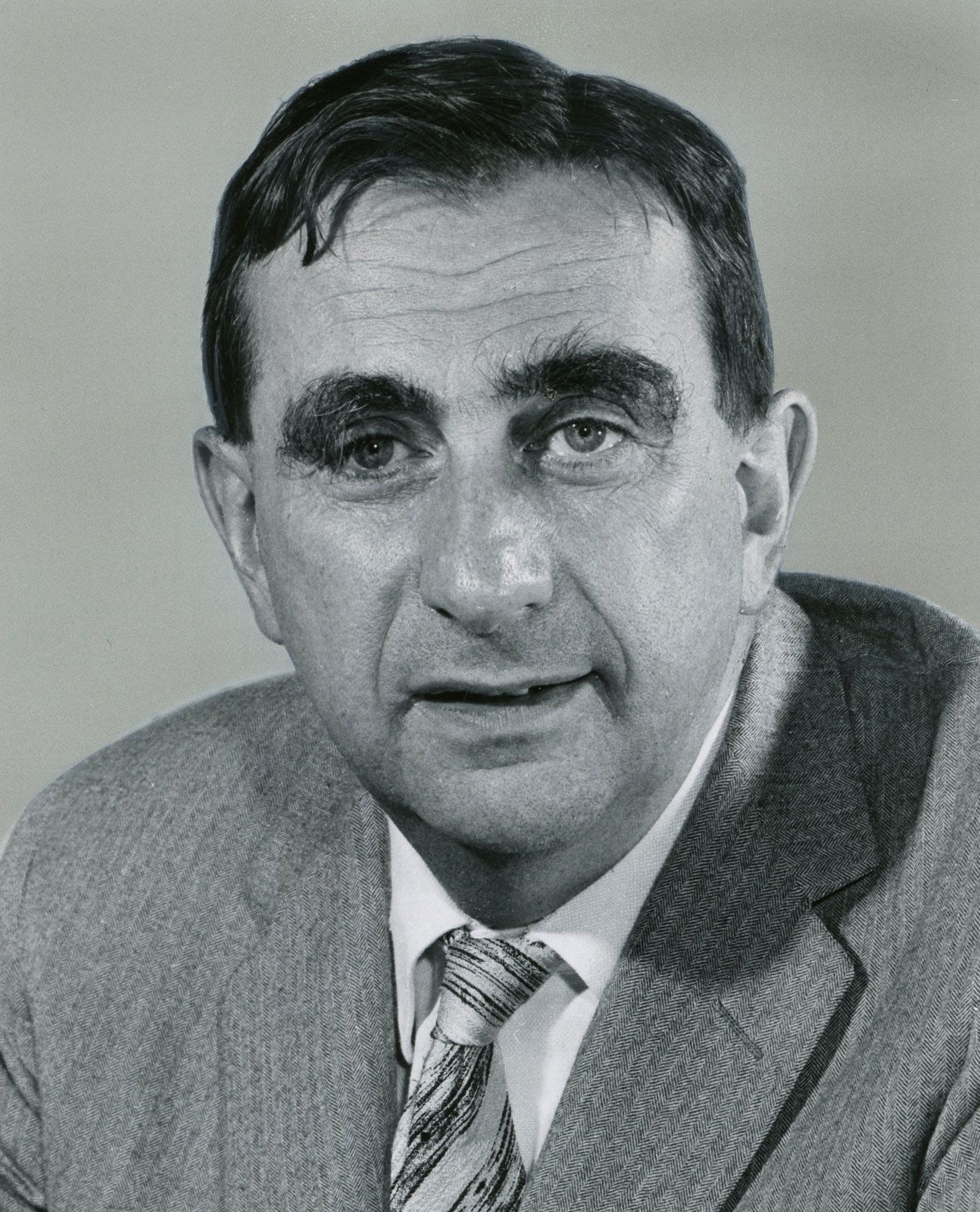
Edward Teller
nuclear physicist•non-fiction writer•university teacher
Also known as: Teller Ede, Father of the hydrogen bomb
Birthday
January 15, 1908
Birth Sign
Capricorn
Birthplace
Budapest
Age
Died at 95
About
Edward Teller, born Teller Ede on 15 January 1908 in Budapest, was a Hungarian-American theoretical physicist and chemical engineer. He earned the nickname "father of the hydrogen bomb" for his central role in developing thermonuclear weapons. Teller fled Europe in the 1930s, joining a wave of Hungarian scientific emigres sometimes called the "Martians." His early work in physics was foundational: the Jahn-Teller effect, which explains how molecular geometry distorts under electron configurations, remains a core concept in chemistry. The Brunauer-Emmett-Teller (BET) theory, which he helped develop, is still used to measure surface areas of materials. Teller also extended Enrico Fermi's beta decay theory, leading to the Gamow-Teller transitions that proved crucial for nuclear physics. In 1953, he co-authored a landmark paper with Nicholas Metropolis and others that introduced the Monte Carlo method to statistical mechanics, a technique now ubiquitous in computational science.
Teller joined the Manhattan Project in 1942, working on the atomic bomb. But his true passion was the hydrogen bomb, a fusion weapon far more powerful than fission bombs. After World War II, he pushed for its development, despite initial resistance. The breakthrough came with the Teller-Ulam design, inspired by Stanislaw Ulam, which used radiation implosion to ignite thermonuclear fuel. Teller helped secure support by contributing to the George shot in Operation Greenhouse in 1951, the first test of thermonuclear burn. He co-founded the Lawrence Livermore National Laboratory in 1952 and served as its director or associate director for years. Livermore became the rival to Los Alamos, focused on nuclear weapons innovation.
Teller's influence extended beyond the lab. He was a vocal advocate for nuclear power and a strong nuclear arsenal, and he pushed for vigorous testing. In the 1950s, he proposed Project Chariot, a plan to use a thermonuclear bomb to carve a harbor in Alaska, which was never executed. Later, he championed Ronald Reagan's Strategic Defense Initiative, a missile defense system critics called "Star Wars." Teller received the Enrico Fermi Award and the Albert Einstein Award. He died on 9 September 2003 at age 95, leaving a legacy as one of the most influential and controversial figures of the nuclear age.
Early Life & Background
Teller grew up in a well-to-do Jewish family in Budapest. His father, Miksa Teller, was a lawyer, and his mother, Ilona Deutsch, came from a banking family. Young Edward showed an early aptitude for mathematics and languages, speaking Hungarian, German, and French by his teens. He attended the Minta Gymnasium in Budapest, known for its rigorous science curriculum. In 1926, he left Hungary to study chemical engineering at the Karlsruhe Institute of Technology in Germany, where he earned his diploma in 1928. His interest shifted to physics after attending lectures by Werner Heisenberg. Teller moved to the University of Leipzig, earning his PhD in physics under Heisenberg in 1930, with a dissertation on the hydrogen molecular ion. The rise of the Nazis pushed him to leave Europe. With the help of the International Rescue Committee, he secured a position at George Washington University in Washington, D.C., arriving in 1935. Those early years in America were marked by intense collaboration with George Gamow and others, leading to the Jahn-Teller effect and the BET theory.
Career Growth
Teller's breakthrough moment came in 1942 when he joined the Manhattan Project at Los Alamos. While his work on the atomic bomb was important, his mind was already on a bigger weapon: the hydrogen bomb. After the war, he lobbied tirelessly for its development, facing skepticism from many scientists, including J. Robert Oppenheimer. The turning point came in 1951 when Stanislaw Ulam proposed a new design, and Teller refined it into the Teller-Ulam configuration. The George shot in May 1951 proved the concept, and the first full-scale thermonuclear test, Ivy Mike, followed in November 1952. Teller co-founded the Lawrence Livermore National Laboratory in 1952, which became a center for nuclear weapons design. He served as its director from 1958 to 1960 and remained influential for decades. In the 1980s, he became a key advocate for the Strategic Defense Initiative, promoting the idea of space-based lasers to intercept missiles. Teller also advised the Israeli nuclear program and continued publishing scientific papers into his 90s.
Career Timeline
Public Image & Style
Teller cultivated a public persona as a tireless advocate for nuclear strength. He was known for his energetic, sometimes combative style in debates. His critics painted him as a warmonger, especially after his controversial testimony in the Oppenheimer security hearing. Teller's supporters saw him as a realist who understood the necessity of deterrence. He appeared often in media, writing op-eds and giving interviews. His thick Hungarian accent and animated gestures made him a recognizable figure. In his later years, he became a sort of elder statesman of science, advising presidents and appearing at public events. The nickname "father of the hydrogen bomb" stuck, though he shared credit with Ulam. Teller's legacy is deeply polarized: he is either a hero who helped win the Cold War or a figure who accelerated the arms race.
Fame & Fandom (iFAMOUS Rankings)
Edward Teller stands as a figure whose name is inextricably linked to the dawn of the thermonuclear age, yet he currently holds no placement in the published iFANN Global Top 1,000 rankings. The evaluation process confirms that while his historical footprint is massive, he does not secure a numeric rank within the current scope lists. This absence from the leaderboard reflects his status as a polarizing historical figure rather than a contemporary pop culture icon with a measurable daily consumption score. His fame rests on the weight of scientific legacy and ethical debate rather than viral metrics or modern media saturation. The audience surrounding Edward Teller lacks a formal designation; there is no organized fanbase, no registered club, and no collective identity known by a specific name. Unlike entertainers who cultivate devoted followings, Teller's admirers are scattered across academic circles, history enthusiasts, and those interested in Cold War politics. Any tributes found online typically originate from institutions like the National Nuclear Museum or university departments honoring his chair, rather than grassroots movements driven by fans. There are no documented rituals, birthday campaigns, or fan-funded projects dedicated to him. The engagement he receives is strictly professional or educational, characterized by the study of his work at Los Alamos and Lawrence Livermore National Laboratory. While the recent release of the film Oppenheimer has sparked renewed public interest in his testimony against J. Robert Oppenheimer, this surge represents historical curiosity rather than the formation of a new fandom.
Interesting Facts and Legends
Teller's colleagues often joked that he was one of the "Martians," a group of brilliant Hungarian scientists who fled Europe, including John von Neumann and Leo Szilard, who supposedly came from Mars and spoke with accents. He had a lifelong fear of flying and rarely traveled by plane. Teller was a skilled pianist and considered a career in music before choosing physics; he played at parties and even composed a short piece. The Jahn-Teller effect, which he co-discovered, is taught in every introductory chemistry course. His 1953 paper on the Monte Carlo method is one of the most cited in physics. Despite his hawkish reputation, he opposed the use of nuclear weapons in the Vietnam War. He was a consultant for the 1983 film The Day After.
One of the most retold stories is his proposal to use nuclear bombs for peaceful excavation, such as digging harbors and moving mountains, a scheme that became part of Project Plowshare and is often cited as an example of Cold War-era hubris. Another legendary moment is his testimony at the Oppenheimer security hearing, where he said he would "feel personally safer" without Oppenheimer's involvement, effectively ending his colleague's career and casting Teller as a villain in popular culture, a narrative amplified by the 2023 film Oppenheimer. More recently, his 1959 warning to the American Petroleum Institute about carbon dioxide causing global warming has been celebrated as ahead of its time.
Notable Quotes
“The objective of weapon development is to have the capacity to deter war.”
“If you want to destroy this country, you must destroy its freedom.”
“I have always considered myself a scientist, not a politician.”
“The hydrogen bomb is the most powerful weapon ever invented. It is also the most moral.”
Family & Personal Life
Teller married Augusta "Mici" Harkanyi in 1934. She was the sister of a friend and a fellow Hungarian emigre. The couple had two children: a son, Paul, and a daughter, Wendy. Paul Teller became a physicist and worked at the University of Chicago. Mici was a supportive partner who managed their household and social life. The Tellers lived in various places, including Los Alamos, New Mexico, and later in Stanford, California, where Edward worked at the Hoover Institution. They owned a modest home and enjoyed hosting dinner parties for scientists and politicians. Mici passed away in 2000, three years before Edward. Teller's parents and most of his extended family perished in the Holocaust, a tragedy that deeply affected his views on Soviet communism and the need for a strong American defense.
Notable Connections
Teller worked closely with Stanislaw Ulam, whose idea inspired the Teller-Ulam design for the hydrogen bomb. He collaborated with Nicholas Metropolis on the Monte Carlo method paper. Enrico Fermi was a mentor and colleague; Teller extended Fermi's beta decay theory. He had a complex relationship with J. Robert Oppenheimer, testifying against him during the security hearing. Teller also advised Israeli physicists and maintained correspondence with Hungarian scientists. His wife Augusta was a constant companion and supporter.
Relationships & Dating History
Teller married Augusta "Mici" Harkanyi in 1934. They met through a mutual friend in Germany and shared a Hungarian background. The couple had two children, Paul and Wendy. Their marriage lasted 66 years until Mici's death in 2000. There are no known extramarital relationships or scandals. Teller remained devoted to his wife throughout his life, often crediting her for his stability and success. After Mici's passing, Teller did not remarry. He died in 2003.
- MarriedAugusta H. Teller1934 - 2000Married for 66 years until her death; had two children together.
Death & Aftermath
Died
September 9, 2003 (aged 95)
Death Place
Stanford, California
Cause of Death
Reported as natural causes associated with old age, specifically a heart attack or cardiac arrest
In his final years, Edward Teller lived quietly at his home in Stanford, California, having largely stepped back from active scientific leadership while remaining a respected figure in nuclear policy discussions. He passed away there on September 9, 2003, at the age of 95, with his family and affiliated institutions like Lawrence Livermore National Laboratory confirming the event as a natural occurrence linked to old age. Reports described the immediate cause as a heart attack or cardiac arrest, leaving the specific medical details within the realm of private family knowledge rather than official record.
The scientific community responded with tributes acknowledging his complex legacy; Science magazine published an obituary highlighting his pivotal role in the Manhattan Project and the hydrogen bomb, while the American Physical Society and the Atomic Heritage Foundation issued statements honoring his intellect and contributions despite his controversial advocacy for weapons development. His funeral was a private ceremony held shortly after his death, attended by colleagues from Lawrence Livermore and former collaborators who focused on his scientific achievements rather than public spectacle. Posthumously, his influence endured through the establishment of the Edward Teller Award at Lawrence Livermore, which continues to recognize outstanding contributions to national security and physics, with Hye-Sook Park noted as a recent recipient in 2025.
His life story gained renewed attention in 2023 when Benny Safdie portrayed him in the film Oppenheimer and he appeared in documentaries such as To End All War: Oppenheimer & the Atomic Bomb. While specific details regarding the handling of his estate remain private family matters, scholarships and foundations bearing his name continue to support education in physics and engineering.
Net Worth (Estate Value)
$10 Million
iFANN Editorial Team estimate
At the time of his death in 2003, iFANN's editorial research estimates Edward Teller's net worth at $10 million. His income primarily came from his salary as a physicist and director at Lawrence Livermore National Laboratory, book royalties, and speaking fees. Teller authored several books, including The Legacy of Hiroshima and Conversations on the Dark Secrets of Physics. He also received substantial awards, such as the Enrico Fermi Award, which came with a cash prize. Teller lived modestly, investing in stocks and real estate. His estate was managed by his children. As of 2026, the estate's value has likely appreciated due to copyright royalties and licensing of his image and work.
Awards Won (2)
Teller received the Enrico Fermi Award in 1991 for his contributions to nuclear physics and national security. He also won the Albert Einstein Award and the National Medal of Science. These honors recognized his scientific achievements and his influence on defense policy.
1991 · Science and Technology
Contributions to nuclear physics and national security
1958 · Science
Contributions to theoretical physics
Known For
Father of the hydrogen bomb
1952 · Lead physicist and advocate
Jahn-Teller effect
1937 · Co-discoverer
BET theory
1938 · Co-developer
Lawrence Livermore National Laboratory
1952 · Co-founder and director
Keywords
Quick Facts
- Profession
- nuclear physicist, non-fiction writer, university teacher
- Born
- +1908-01-15
- Birthplace
- Budapest
- Died
- +2003-09-09
- Death Place
- Stanford
- Gender
- Male
- Spouse
- Augusta H. Teller
- Birth Sign
- Capricorn
Personal Details
- Full Name
- Teller Ede
- Spouse
- Augusta H. Teller
Frequently Asked Questions
Who is Edward Teller?
What was Edward Teller's net worth in 2026?
What is the Teller-Ulam design?
Was Edward Teller involved in the Manhattan Project?
Is Edward Teller considered a controversial figure?
Similar People
Join the community
fans discussing