Richard Feynman
 United States
physicist•quantum physicist•inventor
Birthday
May 11, 1918
Birth Sign
Taurus
Birthplace
Far Rockaway, Queens, New York City, USA
Age
Died at 69
Height
5 ft 8 in (173 cm)
About
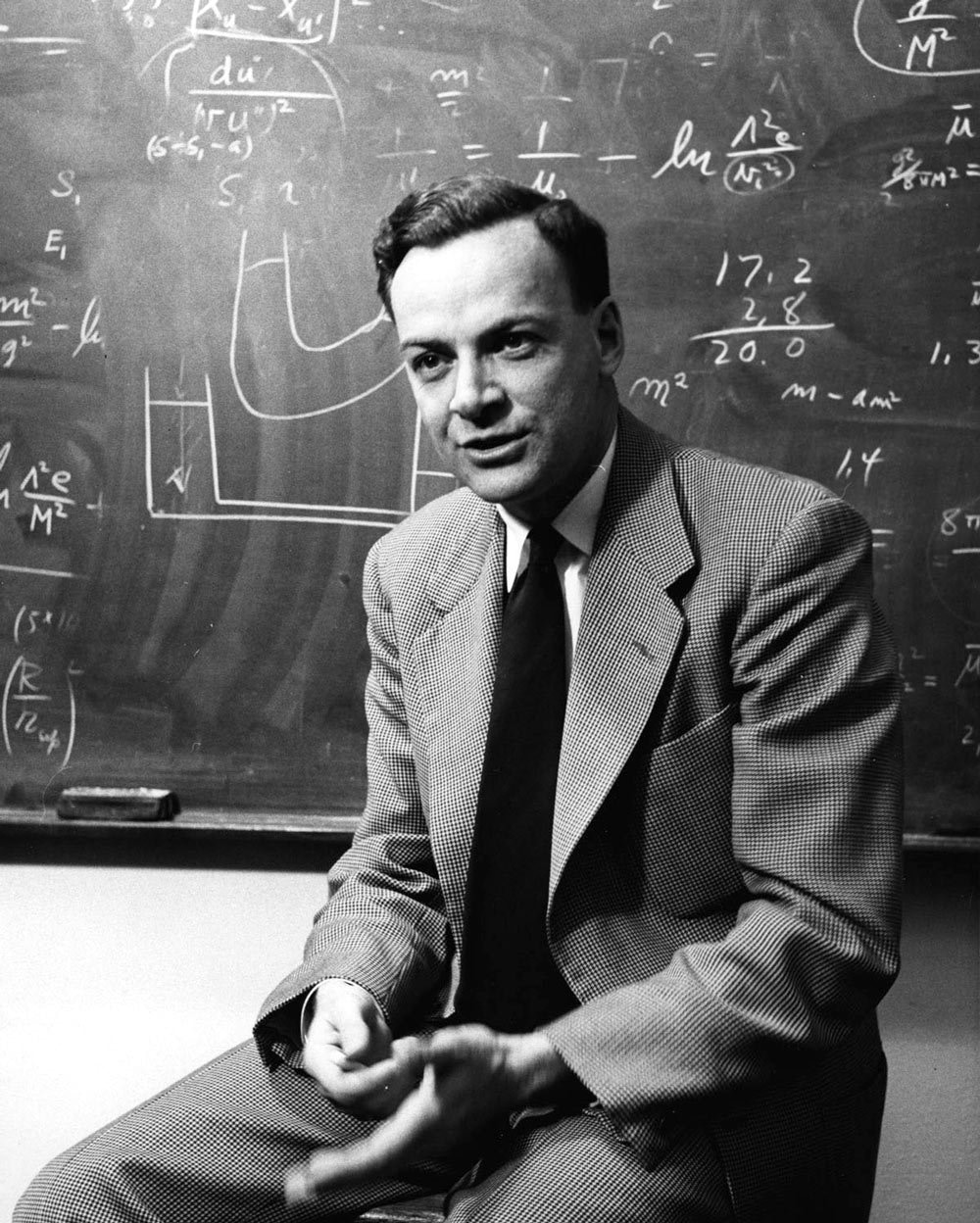
Richard Feynman was an American theoretical physicist regarded as one of the most brilliant and influential scientists of the twentieth century, as celebrated for his irrepressible personality as for his work. He shared a Nobel Prize for his contributions to quantum electrodynamics, the theory describing how light and matter interact, and his elegant pictorial method for representing particle interactions, known as Feynman diagrams, became an indispensable tool used by physicists everywhere. His work reshaped how the subatomic world is understood and calculated.
Feynman's range was extraordinary, touching on superfluidity, the physics of the atomic nucleus, and prescient early ideas about quantum computing and nanotechnology. He took part in the Manhattan Project as a young man and later reached the wider public through his gifts as a teacher and communicator, his famous lectures and witty, irreverent memoirs introducing generations to the joy of scientific thinking. Few scientists have so successfully conveyed the pleasure of curiosity.
He became a household name in his final years as a member of the commission investigating the Challenger space shuttle disaster, where he memorably demonstrated the failure of a crucial seal with a simple glass of ice water. Playful, iconoclastic, and endlessly curious, he embodied science as an adventure. Richard Feynman endures as a beloved icon of physics and intellectual delight.
Early Life & Background
Feynman grew up in Far Rockaway, Queens, in a Jewish family of Russian and Polish descent. His father Melville, a uniform salesman, encouraged him to question everything and think critically. His mother Lucille gave him his sense of humor. As a boy, he set up a home lab, repaired radios for neighbors, and taught himself calculus. He attended Far Rockaway High School, where his math skills stood out.
At MIT, Feynman started in mathematics but switched to physics. In his senior year, he won the Putnam Mathematical Competition, the top undergraduate math contest in the US. His thesis developed a new method for calculating molecular forces. In 1939, he moved to Princeton for graduate studies under John Wheeler. His first seminar there was attended by Albert Einstein, Wolfgang Pauli, and John von Neumann. He earned his Ph.D. in 1942, with a thesis on the principle of least action in quantum mechanics.
Career Growth
Feynman was recruited for the Manhattan Project straight out of Princeton. At Los Alamos, he became the youngest group leader in the theoretical division, working directly under Hans Bethe. Together they devised the Bethe-Feynman formula for calculating nuclear bomb yield. He also ran the project's primitive computing effort and witnessed the Trinity test in July 1945.
After the war, he taught at Cornell and then moved to Caltech in 1950. In 1948, he published the path integral formulation of quantum mechanics and introduced Feynman diagrams, which revolutionized particle physics. His 1959 lecture There's Plenty of Room at the Bottom is considered the intellectual foundation of nanotechnology. From 1961 to 1964, he delivered the undergraduate lectures that became The Feynman Lectures on Physics, still a classic. In 1965, he shared the Nobel Prize in Physics for his work on quantum electrodynamics.
In the 1980s, he turned to writing for the public. His memoir Surely You're Joking, Mr. Feynman! (1985) became a bestseller. In 1986, he served on the Rogers Commission investigating the Challenger disaster, famously demonstrating the O-ring failure with a glass of ice water. He died of abdominal cancer in 1988.
Career Timeline
Public Image & Style
Feynman cultivated the persona of a playful, irreverent genius. He dressed casually, often in shirtsleeves, and was rarely seen without a mischievous grin. His lectures were legendary for their clarity and enthusiasm, using everyday analogies to explain deep physics. He refused to take authority seriously, which endeared him to students and the public. Media portrayals consistently highlight his combination of raw intelligence, childlike curiosity, and iconoclastic humor. His books are conversational and full of anecdotes. Fans, often called Feynman enthusiasts, celebrate his birthday on May 11 by sharing quotes and lecture clips. His Feynman technique for learning is widely adopted by students.
Fame & Fandom (iFAMOUS Rankings)
Richard Feynman's legacy endures not through a cohesive cult of personality or organized fan clubs, but through the quiet reverence of academics, students, and science enthusiasts who keep his spirit alive via textbooks and memoirs. Unlike modern icons with dedicated armies tracking every move, his admirers are scattered across lecture halls and bookstores, united by a shared appreciation for his iconoclastic approach to physics and his refusal to accept authority without evidence. There is no formal moniker for this global audience, nor are there documented rituals like birthday billboards or fan-funded campaigns; instead, the fandom exists in the continued sales of *Surely You're Joking, Mr. Feynman!* and the enduring relevance of his lectures. While recent analyses have revisited his anecdotes about beating abacus champions or solving the "restaurant dilemma," these moments remain part of scientific folklore rather than drivers of a digital movement. His influence is characterized by deep admiration for his ability to explain complex concepts simply, a trait that transcends generations without requiring social media engagement. Despite his massive cultural footprint, iFANN's Global Fame Engine has evaluated this person, but they do not currently hold a placement in the published rankings (Global Top 1,000 or a Top-100 scope list).
Interesting Facts and Legends
During his time at Los Alamos, Feynman taught himself to crack safes, leaving notes inside colleagues' cabinets as pranks. He played bongo drums at parties and even performed with a ballet company. He often did physics calculations at strip clubs, claiming the atmosphere helped him concentrate. He drove a beat-up van decorated with Feynman diagrams. His lifelong dream of visiting Tannu Tuva, a tiny Siberian republic, was never fulfilled but became the subject of the book *Tuva or Bust!*. He reportedly scored 125 on an IQ test in school, but biographers dismiss that as unreliable. His blackboard at the time of his death read: What I cannot create, I do not understand. Legends surrounding him include his impromptu demonstration during the Challenger disaster investigation, where he placed O-ring material in ice water to prove its loss of elasticity in cold temperatures. A persistent story involves his work on the "silly sprinkler" problem, which physicists recently solved in July 2026, settling decades of debate. Another tale recounts his victory over an abacus champion in mental arithmetic, a feat often cited in comparisons between human intuition and AI reasoning.
Notable Quotes
“I think I can safely say that nobody understands quantum mechanics.”
“What I cannot create, I do not understand.”
“The first principle is that you must not fool yourself, and you are the easiest person to fool.”
“There's plenty of room at the bottom.”
“Physics is like sex: sure, it may give some practical results, but that's not why we do it.”
“I'm smart enough to know that I'm dumb.”
“The problem is not to find the answer, it's to face the answer.”
Family & Personal Life
Feynman's father Melville was born in Minsk and worked selling uniforms. His mother Lucille Phillips was a homemaker. He had a younger brother Henry who died as an infant, and a sister Joan, who became a physicist. Feynman married his high school sweetheart Arline Greenbaum in 1942, despite her tuberculosis diagnosis. She died in 1945. He had a brief marriage to Mary Louise Bell in the early 1950s that ended in divorce. In 1960, he married Gweneth Howarth, an Englishwoman. They had a son Carl (born 1962) and an adopted daughter Michelle. The family lived in Altadena, California. Gweneth survived him.
Notable Connections
Feynman worked closely with Hans Bethe at Los Alamos and Cornell, co-developing the Bethe-Feynman formula. His Ph.D. advisor was John Wheeler. He shared the 1965 Nobel Prize with Julian Schwinger and Sin-Itiro Tomonaga. At Caltech, he was a colleague of Murray Gell-Mann. He co-authored The Feynman Lectures on Physics with Robert B. Leighton and Matthew Sands. His later memoirs were written with Ralph Leighton.
Relationships & Dating History
Feynman married his high school sweetheart Arline Greenbaum in 1942, knowing she had tuberculosis. She died in 1945 while he was at Los Alamos. He later married Mary Louise Bell in the early 1950s, but the marriage ended quickly in divorce. In 1960, he married Gweneth Howarth, an Englishwoman he met in Switzerland. They had a son Carl and an adopted daughter Michelle. Feynman remained married to Gweneth until his death in 1988. As of 2026, he is deceased, having been married to Gweneth at the time of his passing.
- MarriedArline Greenbaum1942 - 1945Married despite her tuberculosis; she died while he worked on the Manhattan Project.
- DivorcedMary Louise Bell1952 - 1956Brief marriage that ended in divorce.
- MarriedGweneth Howarth1960 - 1988Married in 1960; had two children; remained together until his death.
Death & Aftermath
Died
February 15, 1988 (aged 69)
Death Place
Los Angeles, California, USA
Cause of Death
Retroperitoneal fibrosis leading to kidney failure
Nobel laureates Julian Schwinger and Shin'ichirō Tomonaga issued statements honoring the brilliance and iconoclastic nature of their colleague as news of his passing spread through the global scientific community. Caltech and Cornell University held memorial services while former students organized gatherings to celebrate a life that reshaped how the subatomic world is understood. The public reaction triggered an immediate surge in sales for his books, particularly Surely You're Joking, Mr. Feynman! and The Character of Physical Law, which saw renewed interest among readers worldwide. Feynman passed away at his home in Elysian Park, Los Angeles, California, on February 15, 1988, at the age of 69. In his final days, he suffered from severe pain and declining health due to tumor-like growths associated with retroperitoneal fibrosis, a rare condition where scar tissue forms around blood vessels and organs.
This ruling was established based on a medical diagnosis confirmed by his family and attending physicians. His last public appearance prior to this illness occurred in early 1987, though he remained active in writing and correspondence until his condition forced him into bed. A private funeral ceremony was held shortly after his death, with details regarding the specific location of burial or cremation kept confidential by his family. Posthumous releases and honors have since solidified his legacy, including the release of the documentary Tales of the Quantum in 2014 and his induction into the National Inventors Hall of Fame in 1999. The Richard P. Feynman Foundation was established to promote science education, offering scholarships and grants.
Net Worth (Estate Value)
$8 Million
iFANN Editorial Team estimate
iFANN currently estimates Richard Feynman's estate value at $8 Million. During his life, he earned a modest income as a Caltech professor, with a salary estimated at $30,000 to $50,000 per year in the 1960s through 1980s. His Nobel Prize in 1965 came with about $55,000 in prize money, which he shared. The bulk of his wealth came from book royalties. The Feynman Lectures on Physics remains a standard textbook worldwide, generating steady income. His memoirs *Surely You're Joking, Mr. Feynman!* and *What Do You Care What Other People Think?* continue to sell. The estate, managed by his children Carl and Michelle, also earns from licensing his name and image for documentaries, merchandise, and educational materials. The Feynman Lectures have been adapted into digital formats, adding to ongoing revenue. He had no major business ventures or real estate investments of note.
Awards Won (5)
Feynman won the Nobel Prize in Physics in 1965 for his work on quantum electrodynamics. He received the E. O. Lawrence Award in 1962, the Albert Einstein Award in 1954, the Oersted Medal in 1972, and the National Medal of Science in 1979. He was elected to the National Academy of Sciences and as a Foreign Member of the Royal Society.
1965 · Physics
Quantum Electrodynamics
1979 · Science
Theoretical Physics
Known For
Quantum Electrodynamics
1965 · Nobel Prize
Feynman Diagrams
1948 · Inventor
The Feynman Lectures on Physics
1963 · Author
Manhattan Project
1943 · Group Leader
Challenger Investigation
1986 · Commission Member
Keywords
Sources
Quick Facts
- Profession
- physicist, quantum physicist, inventor
- Born
- +1918-05-11
- Birthplace
- Far Rockaway, Queens, New York City, USA
- Died
- +1988-02-15
- Death Place
- Los Angeles, California, USA
- Gender
- Male
- Spouse
- Gweneth Howarth
- Birth Sign
- Taurus
- Height
- 5 ft 8 in (173 cm)
- Education
- MIT (SB, 1939); Princeton (Ph.D., 1942)
Personal Details
- Full Name
- Richard Phillips Feynman
- Height
- 5 ft 8 in (173 cm)
- Spouse
- Gweneth Howarth
- Children
- 2 (Carl, Michelle)
- Education
- Massachusetts Institute of Technology (SB, 1939); Princeton University (Ph.D., 1942)
Frequently Asked Questions
How did Richard Feynman die?
What is Richard Feynman's net worth in 2026?
Did Richard Feynman have children?
What was Richard Feynman's IQ?
Why did Richard Feynman put a rubber ring in ice water?
Social Media
Join the community
fans discussing