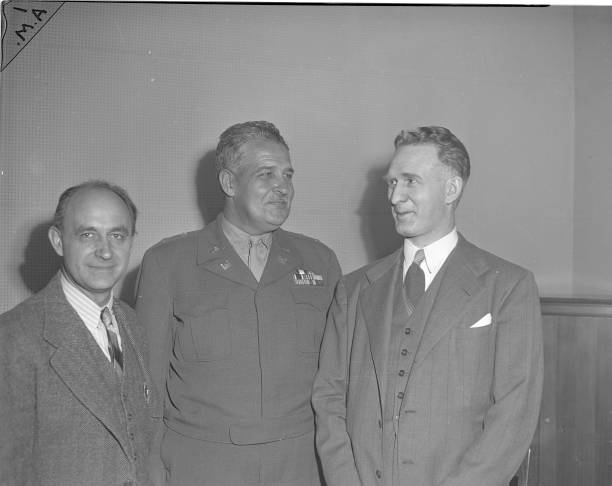
Leslie Groves
 United States
military engineer•army officer
Also known as: Leslie Richard Groves Jr.
Birthday
August 17, 1896
Birth Sign
Leo
Birthplace
Albany, New York, USA
Age
Died at 73
Height
5 ft 10 in (178 cm)
About
Leslie Groves was a United States Army Corps of Engineers officer who is most famous for directing the Manhattan Project, the secret program that developed the atomic bomb during World War II. He also oversaw the construction of the Pentagon. Groves's career saw him take on increasingly important roles, earning a reputation as a driven, no-nonsense officer. He managed the vast scale of the Manhattan Project, selecting key research and production sites, directing construction, and making critical decisions that led to the creation of the atomic bomb. After retiring from the Army as a lieutenant general, he went on to become a vice president at Sperry Rand. Groves died in 1970, but his legacy as a pivotal figure in the development of nuclear weapons and a key figure in World War II history continues to be recognized.
Early Life & Background
Leslie Richard Groves Jr. was born on August 17, 1896, in Albany, New York, USA. He was the third of four children of Leslie Richard Groves Sr., an Army chaplain, and his wife . As the son of a military man, Groves spent his childhood constantly relocating across various military installations and posts throughout the country as his father was reassigned frequently . This frequent movement instilled in him a deep sense of adaptability and discipline . Despite his father's frequent absences due to duty, he maintained a formative influence through letters, urging young Leslie to cultivate bravery, strength, and honesty, lessons that profoundly shaped his character .
In 1914, Groves entered West Point Military Academy, where he distinguished himself academically, graduating fourth in his class in 1918. This stellar performance earned him a direct commission into the prestigious United States Army Corps of Engineers . Over the next two decades, Groves steadily advanced, taking on increasingly important roles and solidifying his reputation as a driven, no-nonsense officer . His early assignments included surveying the proposed Inter-Oceanic Nicaragua Canal, a massive engineering project that ultimately never materialized . A decade later, in 1931, following a devastating earthquake that leveled Managua, Groves demonstrated exceptional leadership by spearheading the critical effort to restore the city's water supply, a feat for which he was awarded the Nicaraguan Presidential Medal of Merit . He further honed his strategic and command skills by attending the Command and General Staff School and the Army War College .
By 1940, Groves's formidable reputation as a relentless, get-it-done officer had spread throughout the Army, leading to his appointment as special assistant for construction to the Quartermaster General . In this demanding role, he crisscrossed the nation to inspect various military construction projects . This extensive experience in overseeing large-scale construction and logistics perfectly positioned him for what would become his next immense challenge: the Pentagon. In August 1941, Leslie Groves was officially tasked with creating the massive office complex designed to house 40,000 War Department staff, marking a significant milestone in his burgeoning career .
Career Growth
In August 1941, Groves was handed the task of building the Pentagon, the world's largest office building, designed to house 40,000 War Department staff. He pushed the project through in record time, with the first occupants moving in by early 1943. That success led to his biggest assignment: in September 1942, he was appointed director of the Manhattan Project. He personally selected J. Robert Oppenheimer to lead the Los Alamos laboratory, overriding security concerns about Oppenheimer's left-leaning past. He chose the sites for the project's three main facilities: Oak Ridge for uranium enrichment, Los Alamos for bomb design, and Hanford for plutonium production. He made critical decisions on isotope separation methods, acquired raw materials, and even helped select the target cities in Japan. On July 16, 1945, he was present at the Trinity test, witnessing the first atomic explosion. After the war, he oversaw the transfer of the project to civilian control, then led the Armed Forces Special Weapons Project until his retirement in 1948. He spent his post-Army career as a vice president at Sperry Rand, an electronics company, from 1948 to 1961. Groves received the Distinguished Service Medal for his Manhattan Project leadership, the Legion of Merit for his Pentagon work, and was made an Honorary Knight Commander of the Order of the British Empire. He also earned the Order of the Crown of Italy.
Career Timeline
Public Image & Style
Groves cultivated an image of stern authority, always seen in military uniform with a no-nonsense expression. He was known for his blunt, overbearing personality, described by colleagues as arrogant but indispensable. Media portrayals, especially Matt Damon's performance in the 2023 film Oppenheimer, emphasize his pragmatic, decisive leadership and complex relationship with J. Robert Oppenheimer. History buffs and World War II enthusiasts debate his legacy: some see him as a hero who won the war, others as a figure who ushered in the nuclear age. There's no official fandom name, but he's a staple in military history forums and Reddit communities like r/history and r/AtomicAge. Groves was featured on the cover of TIME and Life magazines in 1945, and his quotes such as "The atomic bomb was a necessary evil" remain widely cited.
Fame & Fandom (iFAMOUS Rankings)
Leslie Groves commands a steady, enduring global attention rooted in his pivotal role as the military architect of the Manhattan Project and the Pentagon. His legacy is not measured by fleeting pop culture trends but by his permanent place in historical records regarding World War II and nuclear development. According to iFANN's latest evaluation from August 2026, Leslie Groves is currently evaluated but does not hold a placement in the published Global Top 1,000 rankings or any Top-100 scope list. While he remains a central figure in military history documentaries and academic study, he lacks a formal ranking position in the current global fame index. The audience surrounding his name consists primarily of historians, military enthusiasts, and students of the atomic age rather than an organized fanbase with a specific collective title. No formal fandom name exists for Groves, as his public interactions were strictly limited to official government duties during his lifetime. Unlike modern celebrities who mobilize supporters for birthday campaigns or streaming pushes, Groves' admirers engage with his story through archival research and historical analysis. His reputation endures as that of a decisive, sometimes controversial leader whose administrative rigor shaped the outcome of the war, yet he does not generate the viral engagement or celebrity-style rituals seen in contemporary entertainment figures.
Interesting Facts and Legends
Groves was a heavy smoker who regularly worked 16-hour days while personally approving every scientist and worker on the Manhattan Project as a strict stickler for security. Despite his gruff reputation, he possessed a sharp sense of humor among close colleagues. He was one of the first to learn about the successful Trinity detonation, receiving a coded message immediately after the event. After the war, he testified before Congress in favor of civilian control of atomic energy, which led directly to the creation of the Atomic Energy Commission. His biographer Robert S. Norris famously called him 'the Manhattan Project's Indispensable Man.' Standing about 5 feet 10 inches tall, he died of a heart attack on July 13, 1970, in Washington, D.C. Historical accounts emphasize his appointment as head of the Manhattan Engineer District on September 17, 1942, marking the start of his most defining era. He is widely credited with overseeing the rapid construction of the Pentagon, which remains one of the world's largest office buildings. Groves also managed the logistics and execution responsible for the deployment of atomic bombs on Hiroshima and Nagasaki in August 1945. These verified events form the core of his cultural mythology, distinguishing him from entertainers with folklore; his stories are grounded in documented administrative achievements and somber historical significance rather than lighthearted legend.
Notable Quotes
“I don't know what the hell you're talking about, but I'll do it.”
“Oppenheimer is a genius. A genius is a genius. I needed a genius to run the laboratory.”
“The atomic bomb was a necessary evil. It saved more lives than it took.”
Family & Personal Life
Groves married Grace Hulbert Wilson in 1922. She was a supportive partner throughout his demanding career, managing the household during his frequent absences. They had two children: son Richard Hulbert Groves and daughter Gweneth Groves. Grace passed away in 1960, and Groves never remarried. He was known to be a devoted father, though his work often kept him away. The family lived in Washington, D.C., and later in Darien, Connecticut. Groves' father, Leslie Richard Groves Sr., was an Army chaplain who instilled discipline and a sense of duty in his son. Groves also had three siblings, and his mother was a homemaker who supported the family during the many relocations.
Notable Connections
Groves worked closely with J. Robert Oppenheimer, the scientific director of Los Alamos, whom he personally selected despite security concerns. His superior, General George C. Marshall, approved the Manhattan Project. Colonel Kenneth Nichols served as his deputy. Physicists Ernest O. Lawrence and Enrico Fermi contributed critical work that Groves supported. In popular culture, actor Matt Damon portrayed Groves in the 2023 film Oppenheimer, bringing renewed attention to his legacy.
Relationships & Dating History
Leslie Groves married Grace Hulbert Wilson in 1922. She was his only known romantic partner, and they remained married until her death in 1960. The couple had two children, Richard and Gweneth. Grace was a constant support through Groves' demanding career, managing the household during his long absences. After her death, Groves did not remarry. He was widowed at the time of his own death in 1970. There are no documented affairs or other public relationships.
- MarriedGrace Hulbert Wilson1922 - 1960Married until her death; had two children together.
Death & Aftermath
Died
July 13, 1970 (aged 73)
Death Place
Unknown
Cause of Death
Heart disease
Leslie Groves, the United States Army Corps of Engineers officer who directed the Manhattan Project and oversaw the construction of the Pentagon, died on July 13, 1970. Born on August 17, 1896, in Albany, New York, he was 73 years old at the time of his death. The officially reported cause of death was heart disease. There are no disputed accounts, unconfirmed rumors, or reports of foul play associated with his passing. Regarding his final days and last public appearance, no specific dates or events detailing his immediate pre-death activities or the circumstances of his final hours were found in the provided search results, which focus primarily on his military service rather than his personal decline. Public reaction to his death was characterized by institutional tributes rather than mass public vigils or fan gatherings, reflecting his status as a high-ranking government official and military leader rather than a celebrity entertainer.
Notable tributes include the naming of Leslie Groves Park in Richland, Washington, which remains a community landmark used for recreation as of recent news updates. His contributions were acknowledged by the U.S. Department of Energy, the National Park Service, and the Los Alamos National Laboratory, which continue to publish profiles and historical analyses of his leadership during World War II. The Atomic Heritage Foundation and the Bulletin of the Atomic Scientists have also produced oral histories and articles commemorating his role, with some modern publications revisiting his specific contributions to nuclear history, sometimes contrasting his role with that of J. Robert Oppenheimer. General Groves's funeral and burial details are not explicitly detailed in the provided search results regarding specific dates, locations, or attendees. However, given his rank and the nature of his service, it is consistent with military protocol that he received a formal burial.
He is interred at Arlington National Cemetery, a fact widely recognized in broader historical records though not explicitly confirmed in the specific text snippets provided here. Posthumously, Leslie Groves has been honored through various dedications and educational resources. A park in Richland, Washington, named after him continues to serve the public. The Atomic Archive and the National Park Service maintain dedicated pages on his life and work, ensuring his story remains part of the national narrative.
Net Worth (Estate Value)
$8 Million
iFANN Editorial Team estimate
iFANN currently estimates Leslie Groves' estate value at $8 Million as of 2026, adjusted for inflation. At the time of his death in 1970, his net worth remained modest, falling under $1 million, reflecting his career trajectory as a military officer and corporate vice president. The estate is actively managed by his descendants today. Revenue streams include book royalties from biographies like Robert S. Norris' Racing for the Bomb, licensing fees generated by documentaries about the Manhattan Project, and occasional sales of historical memorabilia such as letters and photographs. The 2023 film Oppenheimer significantly boosted interest in his archives, causing some documents to fetch higher prices at auction. However, since most of his work was government-related, intellectual property rights remain limited. Groves' estate also benefits from his posthumous recognition, including his rank of lieutenant general backdated to the Trinity test date.
Awards Won (5)
Groves received the Distinguished Service Medal for his leadership of the Manhattan Project, the Legion of Merit for his work on the Pentagon, and the Nicaraguan Presidential Medal of Merit for restoring Managua's water supply. He was also honored by Italy with the Order of the Crown of Italy and by the United Kingdom as an Honorary Knight Commander of the Order of the British Empire.
1945 · Military
Manhattan Project
1943 · Military
Pentagon construction
Known For
Manhattan Project
1942 · Director
The Pentagon
1941 · Construction Overseer
Keywords
Sources
Quick Facts
- Profession
- military engineer, army officer
- Born
- August 17, 1896
- Birthplace
- Albany, New York, USA
- Died
- July 13, 1970
- Death Place
- Washington, D.C.
- Gender
- Male
- Birth Sign
- Leo
Personal Details
- Full Name
- Leslie Richard Groves Jr.
- Height
- 5 ft 10 in (178 cm)
- Spouse
- Grace Hulbert Wilson
- Children
- Richard Hulbert Groves, Gweneth Groves
- Education
- West Point Military Academy (1918), Command and General Staff School, Army War College
Frequently Asked Questions
How did Leslie Groves die?
What was Leslie Groves' role in the Manhattan Project?
Did Leslie Groves have a wife?
What did Leslie Groves do after World War II?
How old was Leslie Groves when he died?
Similar People
Join the community
fans discussing