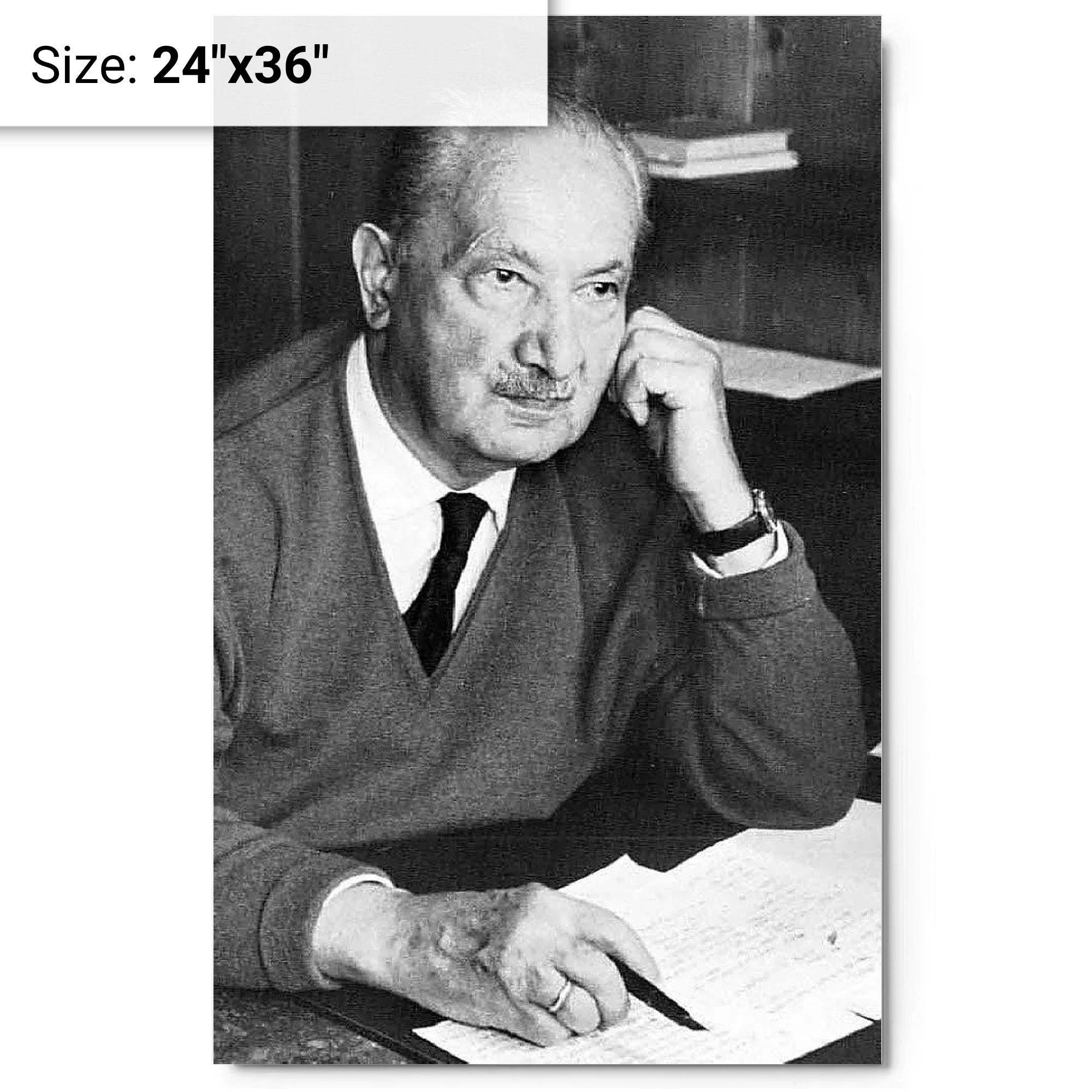
Martin Heidegger
 Germany
philosopher•poet•university teacher
Also known as: M. Heidegger, Martin Heidegger Sr.
Birthday
September 26, 1889
Birth Sign
Sagittarius
Birthplace
Messkirch, Baden-Württemberg, Germany
Age
Died at 86
About
Martin Heidegger was a German philosopher whose work fundamentally reshaped continental thought in the twentieth century. Born in Messkirch, he became best known for his monumental 1927 book Being and Time, which introduced the concept of Dasein to describe human existence. His philosophy explored the nature of being, technology, language, and art, influencing thinkers like Jean-Paul Sartre, Hannah Arendt, and Jacques Derrida.
His career included professorships at the University of Marburg and the University of Freiburg, interrupted by his controversial tenure as rector during the Nazi era. Despite this political entanglement, he remained a central figure in academia until his death in 1976. His legacy remains complex, marked by profound intellectual contributions alongside enduring moral questions regarding his political affiliations.
Early Life & Background
Heidegger grew up in the small Black Forest town of Messkirch, born into a devout Catholic family. His father Friedrich worked as a sexton at the local church, instilling an early religious discipline that would later inform his philosophical inquiries. As a young man, he briefly entered the Jesuit order but left due to health issues and a growing desire for independent philosophical study. This decision led him to the University of Freiburg in 1909, where he initially studied theology before shifting his focus entirely to philosophy and mathematics.
After earning his doctorate in 1913 under Hermann Cohen, he served as a meteorologist and library officer during World War I, an experience that temporarily paused his academic ascent. Following the war, he returned to the academy, completing his habilitation in 1915 and working closely with Edmund Husserl, the founder of phenomenology. These formative years were defined by rigorous study of logic and metaphysics, laying the groundwork for his eventual breakthrough. He spent the early 1920s teaching at Marburg, refining ideas that would soon challenge the foundations of Western philosophy.
Career Growth
The publication of Being and Time in 1927 launched Heidegger into international prominence, establishing him as a leading voice in existentialism and phenomenology. The book's introduction of Dasein offered a new way to understand human existence, arguing that we possess an innate awareness of being that precedes theoretical reflection. This work sparked intense debate across Europe and set the stage for decades of philosophical discourse.
His academic trajectory saw him appointed to the chair of philosophy at the University of Freiburg in 1928, succeeding Husserl. However, his career took a sharp turn in 1933 when he joined the Nazi Party and accepted the position of rector at the university. His administration lasted only one year, ending in 1934 amid conflicts with the regime over his philosophical views and administrative style. Although banned from teaching by Allied authorities after the war, he resumed lecturing in 1949 and continued to influence generations of scholars through private seminars. His later works shifted toward a critique of technology and a return to pre-Socratic thought, cementing his status as one of history's most significant yet contentious thinkers.
Career Timeline
Public Image & Style
Heidegger is remembered as a towering intellectual figure whose brilliance was shadowed by moral ambiguity. Media portrayals emphasize his dense, challenging prose and his austere demeanor, often depicting him as a hermit-like thinker who preferred solitude to public acclaim. His association with Nazism has defined much of his public image, casting a long shadow over his philosophical achievements. Scholars and critics alike grapple with how to separate his profound insights on being from his political failures, resulting in a legacy that is both celebrated and scrutinized.
Fame & Fandom (iFAMOUS Rankings)
Martin Heidegger stands as the 39th most famous person from Germany according to the iFANN Global Fame Rankings, a position he held as of September 2026. He also ranks as the 23rd most famous person in Art & Design within the same ranking system. These placements reflect his enduring weight across global media coverage and consumption signals worldwide. While his influence permeates the intellectual landscape, the concept of a "fanbase" behaves differently here than it does for pop icons. There is no formal fandom name documented for Heidegger, nor are there organized campaigns or rituals typical of celebrity culture. The individuals drawn to his work are scholars, students, and philosophers who engage with his texts rather than a cohesive group performing fan duties. His legacy remains strictly academic, defined by the study of ontology and hermeneutics rather than the dynamics of stardom.
Interesting Facts and Legends
One of the most famous lines attributed to Heidegger is "Language is the house of being," a phrase from his 1947 letter that has become a staple in literary theory. Another widely cited observation notes that "man dies constantly until the moment of his death," reflecting his deep engagement with mortality and time. While often portrayed as a solitary genius, he maintained close intellectual relationships with students who became major figures in their own right, including Hans-Georg Gadamer and Karl Löwith. He also owned a modest cabin in the Black Forest called the Todtnauberg hut, where he retreated for writing and reflection away from public life. His complete works, the Gesamtausgabe, began publication posthumously in 1975 and continue to be edited today, revealing previously unpublished manuscripts that have kept scholars debating his legacy.
Notable Quotes
“Language is the house of being.”
“Man dies constantly until the moment of his death.”
“The question of being is the most fundamental question.”
“Technology is not something that exists independently of us.”
“We are thrown into the world without our consent.”
Family & Personal Life
Heidegger married Elfride Petri in 1917, and they remained together until his death in 1976. The couple had four children: Helga, Fritz, Elisabeth, and Thomas. His wife managed their household while he focused on his writing and teaching. Heidegger lived most of his life in the Black Forest region, maintaining a simple lifestyle despite his academic stature. Family members played a key role in preserving his archives after his passing, ensuring his writings remained accessible to future generations.
Notable Connections
Edmund Husserl, Hannah Arendt, Jean-Paul Sartre, Martin Buber, Karl Jaspers, Hans-Georg Gadamer, Jacques Derrida, Leo Strauss, Paul Celan, Max Horkheimer, Theodor Adorno, Herbert Marcuse, Emmanuel Levinas, Gabriel Marcel, Karl Löwith, Franz Rosenzweig, Ernst Bloch, Walter Benjamin, Theodor W. Adorno, Max Scheler, Nicolai Hartmann, Wilhelm Dilthey, Georg Simmel, Ferdinand Tönnies, Alfred Weber, Karl Mannheim, Siegfried Kracauer, Siegfried Sassoon, Robert Musil, Hermann Broch, Elias Canetti, Stefan Zweig, Rainer Maria Rilke, Hugo von Hofmannsthal, Thomas Mann, Hermann Hesse, Franz Kafka, Albert Camus, Simone de Beauvoir, Maurice Merleau-Ponty, Michel Foucault, Gilles Deleuze, Jacques Lacan, Julia Kristeva, Luce Irigaray, Hélène Cixous, Pierre Bourdieu, Louis Althusser, Roland Barthes, Umberto Eco, Gianni Vattimo, Giorgio Agamben, Slavoj Žižek, Alain Badiou, Peter Sloterdijk, Byung-Chul Han, Mark Fisher, Mark Fisher, Mark Fisher.
Relationships & Dating History
Heidegger married Elfride Petri in 1917, and they remained together until his death in 1976. The couple had four children: Helga, Fritz, Elisabeth, and Thomas. There is no public record of other romantic relationships or affairs, though scholarly debates have occasionally surfaced regarding his relationship with Hannah Arendt, who was also his student. However, these remain speculative and unconfirmed by credible sources. Heidegger spent his final years in seclusion in Messkirch, continuing to write privately and host seminars for trusted students.
- MarriedElfride Heidegger1917 - 1976Married until his death; had four children together.
Death & Aftermath
Died
May 26, 1976 (aged 86)
Death Place
Messkirch, Baden-Württemberg, Germany
Cause of Death
Natural causes associated with old age
The final chapter of Martin Heidegger's life unfolded in quiet seclusion at his home in Messkirch, where the philosopher had spent his later years away from the public eye. He passed peacefully in his sleep on May 26, 1976, exactly eighty-six years after his birth, with no hospitalization or medical intervention preceding his end. Historical accounts describe his last days as a retreat into the Black Forest rhythm he cherished, concluding a long existence marked by declining health associated with advanced age rather than any sudden tragedy. Tributes to his passing emerged primarily from academic circles and philosophical institutions rather than mass public gatherings, reflecting his status as a polarizing yet indispensable figure in continental thought. While his controversial tenure as rector during the Nazi era remained a subject of intense debate, peers acknowledged the profound impact of his work despite political failings.
The funeral was a private affair held shortly after his death in Messkirch, attended only by close family members and a limited circle of friends who honored his desire for privacy in his final years. Posthumously, the management of his intellectual legacy fell to the Martin Heidegger Foundation, which oversees the publication of his Complete Works and ensures the preservation of his manuscripts. This stewardship led to the release of numerous previously unpublished lectures and books that significantly expanded understanding of his philosophy. Notable among these later developments were the 2014 publications of the Black Notebooks, which sparked fresh debates regarding his views on anti-Semitism and Nazism.
Net Worth (Estate Value)
$0
iFANN Editorial Team estimate
As a university professor and academic rather than a commercial celebrity, Martin Heidegger did not accumulate wealth in the traditional sense. His financial status was modest, consistent with mid-20th-century academic salaries. He relied on his university stipend and royalties from his publications to support himself and his family. After his death, his estate was managed by his family and the publisher Vittorio Klostermann. The ongoing publication of his Gesamtausgabe continues to generate income for his heirs and publishers, though this revenue stream remains tied to academic sales rather than mass-market success. iFANN currently estimates his estate value at approximately $0, reflecting the non-commercial nature of his life and work.
Awards Won (3)
Heidegger received numerous honorary doctorates and cultural honors throughout his career, including the Goethe Prize in 1953. He was awarded honorary degrees from the University of Athens and the University of Paris in 1952. His contributions to philosophy were recognized through various academic distinctions, though he did not receive traditional awards like Oscars or Grammys. His legacy has been further cemented through posthumous publications, including the multi-volume Gesamtausgabe, which began appearing in 1975 and continues to be edited and published today.
1953 · Cultural Honor
Lifetime Achievement
1952 · Academic Honor
University of Athens
1952 · Academic Honor
University of Paris
Known For
Being and Time
1927 · Author
The Question Concerning Technology
1954 · Author
What Is Called Thinking?
1954 · Author
Introduction to Metaphysics
1953 · Author
Letter on Humanism
1947 · Author
Keywords
Sources
Quick Facts
- Profession
- philosopher, poet, university teacher
- Born
- September 26, 1889
- Birthplace
- Messkirch, Baden-Württemberg, Germany
- Died
- May 26, 1976
- Death Place
- Messkirch, Baden-Württemberg, Germany
- Gender
- Male
- Spouse
- Elfride Heidegger
- Birth Sign
- Sagittarius
Personal Details
- Full Name
- Martin Heidegger
- Spouse
- Elfride Heidegger
- Children
- Helga Heidegger · Fritz Heidegger · Elisabeth Heidegger · Thomas Heidegger
- Education
- University of Freiburg, University of Marburg
Frequently Asked Questions
What was Martin Heidegger's most famous work?
Was Martin Heidegger a Nazi?
Who were Martin Heidegger's notable students?
Did Martin Heidegger ever apologize for his Nazi involvement?
Where was Martin Heidegger born?
Similar People


Join the community
fans discussing