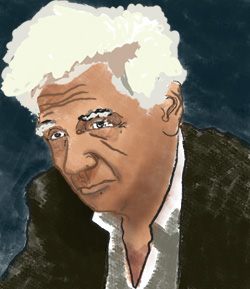
Jacques Derrida
 France
philosopher•literary critic•university teacher
Birthday
+1930-07-15
Birth Sign
Cancer
Birthplace
El Biar
Age
Died at 74
About
Jacques Derrida, born Jackie Élie Derrida on July 15, 1930, in El Biar, Algeria, was a French philosopher whose name became synonymous with deconstruction. This method of critical analysis, which he developed through meticulous readings of Ferdinand de Saussure's linguistics and the phenomenology of Husserl and Heidegger, challenged the very foundations of Western thought. Though often grouped with post-structuralists and postmodernists, Derrida kept his distance from both labels, preferring to carve his own path. Over a career spanning five decades, Derrida published more than 40 books and hundreds of essays, leaving an indelible mark on fields as varied as philosophy, literature, law, anthropology, and architecture. His 1967 trilogy, Speech and Phenomena, Of Grammatology, and Writing and Difference, are considered cornerstones of his thought, though he continued to produce influential work until his death on October 8, 2004, at the age of 74. For the last two decades of his life, he held a professorship in humanities at the University of California, Irvine, while also teaching in Paris. Derrida's influence extended far beyond academia. His ideas shaped deconstructivism in architecture, inspired the musical genre of hauntology, and fueled activist movements. Yet his dense, often opaque writing style made him a lightning rod for controversy, drawing both fierce criticism and devoted followers. In the Anglophone world, his impact was most deeply felt in literary studies, where his focus on language resonated strongly. By the 2000s, his work remained a dominant force in continental philosophy across Europe, the Americas, and beyond, shaping debates on ethics, aesthetics, and the philosophy of language.
Fame & Fandom
Jacques Derrida never had a fandom in the way pop stars do. No crowds fainted at his lectures, no street shutdowns occurred during his tours, and no fan clubs organized campaigns to keep his ideas alive. His audience remained strictly within the walls of academia, where scholars debated deconstruction rather than singing about it. The mythology surrounding him stems from intellectual disruption, not viral moments or ritualistic behaviors typical of entertainment culture. There is no documented name for any fanbase because none exists; the community that engages with his work operates through university departments and specialized journals rather than social media groups or fan fiction archives. In August 2026, the iFANN Global Fame Engine evaluated Jacques Derrida's standing in the modern cultural landscape. The assessment concluded that he currently holds no placement in the published rankings, meaning he does not appear in the Global Top 1,000 or any Top-100 scope list. This absence reflects his status as a figure whose influence has settled into the foundations of philosophy and literary theory rather than competing for contemporary celebrity metrics. While his name carries immense weight in academic circles, it does not translate into the mass consumption signals required for a ranked position in the global fame index. The evaluation process confirms that while Derrida remains a pivotal historical figure, his fame is specialized and enduring rather than trending or broadly measured by public engagement algorithms.
Interesting Facts and Legends
Born Jackie Élie Derrida in El Biar, Algeria, he later adopted the name Jacques Derrida. He passed away from pancreatic cancer in Paris on October 9, 2004. A pivotal moment in his career occurred during his 1967 lecture at Johns Hopkins University, titled 'The Structure, Sign, and Play in the Discourse of the Human Sciences.' This event is widely cited as the catalyst that introduced post-structuralism to American academia. Another significant chapter unfolded during his 1972 US tour, which fueled the rise of the Yale School of criticism. Unlike entertainers whose legends involve fainting crowds or street shutdowns, Derrida's mythology stems from intellectual disruption. His theories created a massive divide in the humanities known as the Theory Wars, pitting him against critics like Allan Bloom. The story of how his ideas challenged the stability of Western metaphysics remains the central narrative of his life. His books, including Of Grammatology and Writing and Difference, are still foundational texts used in philosophy and literature courses worldwide. Even after his death, discussions regarding his theories on hospitality, archives, and grief appear in contemporary academic circles.
Death & Aftermath
Died
+2004-10-08 (aged 74)
Death Place
Paris, France
Cause of Death
Pancreatic cancer
Tributes poured into academic journals and major newspapers from London to New York the moment news broke, with institutions like the University of California issuing memorials that highlighted a career spanning five decades. The philosopher Jacques Derrida had become synonymous with deconstruction, and his passing marked the end of an era for post-structuralist thought. He died on October 8, 2004, in Paris, France, following a long battle with pancreatic cancer. His wife Peggy Derrida confirmed the illness had been present for some time before he passed away while receiving palliative care at a Parisian hospital.
The funeral service remained a private affair, consistent with the wishes of many prominent intellectuals who preferred privacy in their final rites. Following his death, the Jacques Derrida Foundation was established to preserve his archives and support ongoing research. His estate managed the release of remaining works, including the book The Animal That Therefore I Am, which appeared in 2006 alongside various collections of his seminars. Peggy Derrida served as executor, ensuring the integrity of his unpublished manuscripts and correspondence remained intact for future scholars.
Awards & Accolades
Keywords
Quick Facts
- Profession
- philosopher, literary critic, university teacher
- Born
- +1930-07-15
- Birthplace
- El Biar
- Died
- +2004-10-08
- Death Place
- 5th arrondissement of Paris
- Gender
- Male
- Spouse
- Marguerite Aucouturier
- Birth Sign
- Cancer
Personal Details
- Spouse
- Marguerite Aucouturier
Join the community
fans discussing