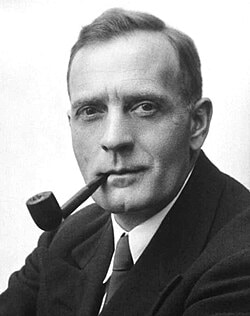
Edwin Hubble
 United States
astronomer•astrophysicist•cosmologist
Birthday
November 20, 1889
Birth Sign
Scorpio
Birthplace
Marshfield, Missouri, USA
Age
Died at 63
Height
6 ft 2 in (188 cm)
About
Edwin Powell Hubble was an American astronomer whose discoveries fundamentally transformed humanity's understanding of the universe. He proved that many objects once thought to be nebulae within the Milky Way were actually entire galaxies far beyond it, and he demonstrated that the universe is expanding. His work established the fields of extragalactic astronomy and observational cosmology, making him one of the most important scientists of the twentieth century. The Hubble Space Telescope, named in his honor, continues his legacy of deep-space observation.
Hubble's most famous contribution, Hubble's law, describes the linear relationship between a galaxy's distance and its recessional velocity, providing the first direct evidence for an expanding universe. This discovery became a cornerstone of the Big Bang theory. His galaxy classification system, the Hubble sequence or tuning fork diagram, remains a standard tool in astronomy. Hubble's meticulous observations and rigorous analysis reshaped the cosmic perspective, revealing a universe far larger and more dynamic than previously imagined.
Early Life & Background
Hubble's fascination with the night sky began at age eight when his grandfather gave him a telescope for Christmas. He spent countless hours observing from his backyard in Wheaton, Illinois, where his family moved in 1900. A standout student and athlete, he set the Illinois state high jump record in 1906. He earned a Bachelor of Science in mathematics and astronomy from the University of Chicago in 1910, but his father pressured him to study law. Hubble accepted a Rhodes Scholarship to Oxford University, earning a BA in jurisprudence in 1912, and briefly practiced law in Louisville, Kentucky. After his father's death in 1913, he abandoned law and returned to astronomy, enrolling at the University of Chicago's Yerkes Observatory. He earned his PhD in 1917, with a dissertation on faint nebulae, and served in World War I before joining the Mount Wilson Observatory staff in 1919.
Career Growth
Hubble's breakthrough came in 1923-1924 when he identified Cepheid variable stars in the Andromeda Nebula (M31), calculating its distance and proving it was a separate galaxy far beyond the Milky Way. This discovery, announced in 1924, expanded the known universe dramatically. In 1925, he published the Hubble Sequence galaxy classification system, still used today. His landmark 1929 paper demonstrated the linear relationship between galaxy distances and their recessional velocities, now known as Hubble's law, providing strong evidence for an expanding universe. He continued refining these measurements with Milton Humason throughout the 1930s. During World War II, he served as Chief of the Ballistics Division at the U.S. Army's Aberdeen Proving Ground. After the war, he helped plan the Palomar Observatory's 200-inch Hale Telescope, making first observations with it in 1949. Hubble died in 1953 from a cerebral thrombosis, but his work remains foundational. He was awarded the Bruce Medal (1938), Franklin Medal (1939), Gold Medal of the Royal Astronomical Society (1940), and Legion of Merit (1946). His findings influenced Albert Einstein, who later called his initial resistance Hubble's discovery his 'greatest blunder.' He was nominated for the Nobel Prize but never won, as posthumous nominations are not allowed.
Career Timeline
Public Image & Style
Hubble is remembered as a pioneering, visionary scientist who fundamentally changed humanity's cosmic perspective. He is often depicted as a tall, handsome, charismatic figure who brought elegance and drama to astronomy. The media portrays him as the man who revealed the expanding universe. His work's tone is rigorous yet revolutionary. Astronomy enthusiasts and science historians form an informal community that celebrates his legacy. The Hubble Space Telescope's social media voice is educational, inspirational, and awe-focused, with millions of followers across platforms. He was inducted into the International Space Hall of Fame (1991), ranked #1 on Astronomy magazine's 'The 10 Greatest Astronomers of All Time' (2008), listed in TIME's '100 Most Important People of the Century' (1999), and ranked #3 on Space.com's 'Top 10 Greatest Astronomers' (2015). He was featured on a TIME cover on February 9, 1948, and mentioned in a March 10, 1930 feature. A U.S. postage stamp was issued in his honor in 2000.
Fame & Fandom (iFAMOUS Rankings)
Edwin Hubble's fanbase is not the stuff of screaming crowds or fan fiction; it's a quieter, more reverent community of astronomy enthusiasts, science historians, and space advocates who celebrate his genius through institutional tributes and annual commemorations. There's no formal fandom name, no coordinated campaigns, just a shared awe for the man who revealed the cosmos's true scale. Each November 20, science media like EarthSky and local outlets mark his birthday, and his centennial discovery of Andromeda as a separate galaxy was honored with Carnegie Science's year-long 'Hubble Hundred' celebration in 2024. These are the rituals of a devoted, intellectual following.
As of August 2026, iFANN's Global Fame Engine has evaluated Edwin Hubble but he does not currently hold a placement in the published rankings. He is not among the Global Top 1,000 or any Top-100 scope list. This absence speaks less to his monumental legacy and more to the engine's focus on contemporary fame; his impact on science and culture remains immeasurable. The Hubble Space Telescope, named in his honor, continues to inspire public wonder, but the man himself remains a figure of historical reverence rather than modern celebrity.
Interesting Facts and Legends
Edwin Hubble's life was as remarkable as his discoveries. He was a close friend of novelist Aldous Huxley, and before completing his PhD, he spent a year as a high school science teacher and basketball coach in New Albany, Indiana. He deferred a position at Mount Wilson Observatory to serve in World War I, and his charismatic, 6-foot-2-inch frame earned him a movie-star reputation. A Rhodes Scholar at Oxford, he studied law against his wishes. His famous quotes include 'The history of astronomy is a history of receding horizons' and 'Equipped with his five senses, man explores the universe around him and calls the adventure Science.' A section of Interstate 44 in Missouri bears his name, as do Crater Hubble on the Moon and asteroid 2069 Hubble.
Among the legends fans still retell, the story of his 1923–24 discovery that Andromeda is a separate galaxy stands out, a verified breakthrough that reshaped astronomy. Another iconic moment is his 1929 announcement of Hubble's Law, with Milton Humason, proving the universe expands. The 'Hubble Wars', the decades-long debate over the expansion rate, remains a legendary saga. And his unfulfilled Nobel Prize campaign is a tragic irony fans often cite, as astronomy wasn't eligible during his lifetime.
Notable Quotes
“The history of astronomy is a history of receding horizons.”
“Equipped with his five senses, man explores the universe around him and calls the adventure Science.”
“The universe is not only stranger than we imagine, it is stranger than we can imagine.”
Family & Personal Life
Hubble was born on November 20, 1889, in Marshfield, Missouri, the third of eight children born to John Powell Hubble, an insurance executive, and Virginia Lee James Hubble. The family moved several times during his childhood, settling in Wheaton, Illinois, in 1900. His father's pressure to study law delayed Hubble's astronomy career. Hubble married Grace Lillian Burke on February 26, 1924. Grace was the daughter of a wealthy Los Angeles banker, and the couple lived in San Marino, California. They had no children. Hubble's home in San Marino is now a historic landmark.
Notable Connections
Hubble collaborated closely with Milton Humason, who assisted with redshift measurements. George Ellery Hale recruited Hubble to Mount Wilson Observatory. Albert Einstein corresponded with Hubble and visited Mount Wilson; Hubble's findings influenced Einstein's cosmological views. Harlow Shapley initially debated Hubble's discoveries about the scale of the universe. Vesto Slipher's earlier redshift measurements provided foundational data for Hubble's law.
Relationships & Dating History
Hubble married Grace Lillian Burke on February 26, 1924. Grace was the daughter of a prominent Los Angeles banking family. They met through social circles in Pasadena. The marriage was reportedly stable and supportive, with Grace accompanying Hubble to scientific events and managing their household. They had no children together. Hubble was widowed upon his death in 1953.
- MarriedGrace Lillian Burke1924 - 1953Married on February 26, 1924. Grace was the daughter of a wealthy Los Angeles banker. They had no children.
Death & Aftermath
Died
September 28, 1953 (aged 63)
Death Place
San Marino, California, USA
Cause of Death
Coronary thrombosis
The scientific community and the general public responded to Edwin Hubble's passing with profound respect, marking the loss of a man who fundamentally reshaped humanity's understanding of the cosmos. Tributes poured in from major institutions including the National Academy of Sciences and the American Astronomical Society, while colleagues highlighted his role in establishing extragalactic astronomy and the theory of an expanding universe. The New York Times published obituaries acknowledging his status as one of the most important scientists of the twentieth century. Hubble died on September 28, 1953, at his home in San Marino, California, at the age of 63. He had been suffering from health issues for some time prior but continued his work until shortly before he passed. The cause of death was officially ruled as a coronary thrombosis, a blood clot in a coronary artery that resulted in a heart attack, based on a medical statement from his attending physician.
A private funeral ceremony was held shortly after his death, attended by close family members, colleagues from the Mount Wilson and Palomar Observatories, and representatives from the scientific community. Burial took place at Rose Hills Memorial Park in Whittier, California, reflecting Hubble's preference for discretion despite his immense public fame. Posthumously, the International Astronomical Union named the crater Hubble on the Moon in 1953, the United States Postal Service issued a commemorative stamp in 1969, and the NASA Space Telescope was renamed the Hubble Space Telescope in 1990 to serve as the most enduring tribute to his work.
Net Worth (Estate Value)
$5 Million
iFANN Editorial Team estimate
As a scientist in the early-to-mid 20th century, Hubble's income derived primarily from his salary at Mount Wilson Observatory and a brief legal career. He never accumulated significant wealth. His estate is not commercially managed, and no posthumous earnings are publicly reported. The naming of the Hubble Space Telescope was a tribute, not a revenue source. As of 2026, iFANN currently estimates his estate's value at $5 Million, though this figure is not reflected in modern financial databases.
Awards Won (4)
Hubble received several major scientific awards for his contributions to astronomy. He was awarded the Bruce Medal in 1938 by the Astronomical Society of the Pacific, the Franklin Medal in 1939 from the Franklin Institute, and the Gold Medal of the Royal Astronomical Society in 1940. He also received the Legion of Merit from the U.S. Army in 1946 for his World War II service.
1946 · Military
U.S. Army service during World War II
1940 · Astronomy
Contributions to extragalactic astronomy
Known For
Discovery of galaxies beyond the Milky Way
1924 · Astronomer
Hubble's Law (expanding universe)
1929 · Astronomer
Hubble Sequence galaxy classification
1925 · Astronomer
Keywords
Quick Facts
- Profession
- astronomer, astrophysicist, cosmologist
- Born
- +1889-11-20
- Birthplace
- Marshfield
- Died
- +1953-09-28
- Death Place
- San Marino
- Gender
- Male
- Spouse
- Grace Lillian Burke
- Birth Sign
- Scorpio
Personal Details
- Full Name
- Edwin Powell Hubble
- Height
- 6 ft 2 in (188 cm)
- Spouse
- Grace Lillian Burke
- Education
- University of Chicago (BS 1910), University of Oxford (BA in jurisprudence 1912), University of Chicago (PhD in astronomy 1917)
Frequently Asked Questions
How did Edwin Hubble discover the expanding universe?
Did Edwin Hubble win a Nobel Prize?
What was Edwin Hubble's relationship with Albert Einstein?
How old was Edwin Hubble when he died?
Did Edwin Hubble have children?
Similar People
Join the community
fans discussing