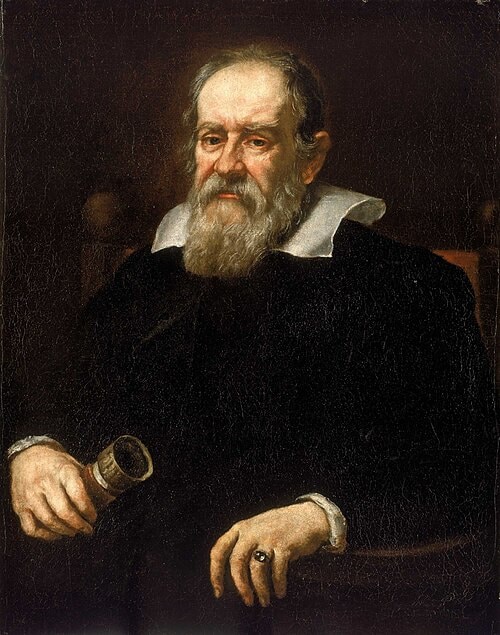
Galileo Galilei
 Italy
Italyastronomer•philosopher•mathematician
Birthday
February 15, 1564
Birth Sign
Aquarius
Birthplace
Pisa, Duchy of Florence (now Italy)
Age
Died at 77
Height
5 ft 6 in (168 cm)
About
Galileo Galilei was an Italian astronomer, physicist, and engineer often hailed as the father of modern science and of the scientific method itself. A pivotal figure of the Scientific Revolution, he insisted that nature should be understood through observation, measurement, and mathematics rather than received authority, an approach that transformed how human beings investigate the world. His work bridged the gap between medieval philosophy and modern physics. Galileo made groundbreaking contributions across many fields, studying motion, free fall, and inertia in ways that anticipated later physics, and dramatically improving the telescope to make a series of stunning astronomical discoveries. He observed mountains and craters on the Moon, the phases of Venus, sunspots, and the four largest moons of Jupiter, observations that provided powerful evidence for the Copernican model of a Sun-centered universe. That advocacy of heliocentrism brought him into famous conflict with the Catholic Church, which deemed the idea contrary to scripture. Tried by the Inquisition, he was forced to recant and spent his final years under house arrest, a confrontation that became an enduring symbol of the tension between science and dogma. His scientific legacy proved indelible. Galileo Galilei is remembered as one of the most important figures in the history of science.
Early Life & Background
Galileo was born in Pisa to Vincenzo Galilei, a noted lutenist and music theorist, and Giulia Ammannati. He was the first of six children, though only three survived infancy. His father valued empirical investigation, a trait he passed on. Galileo began his education at the monastery of Santa Maria di Vallombrosa near Florence, studying grammar, logic, and rhetoric. He initially considered joining the priesthood, but his father redirected him toward medicine. In 1581, at age 17, he enrolled at the University of Pisa to study medicine. His pivotal moment came when he observed a swinging lamp in the Pisa Cathedral, using his pulse to time the swings. He discovered the isochronism of pendulums, meaning the period of swing is independent of amplitude. This marked his first scientific insight. He soon abandoned medicine for mathematics and natural philosophy, studying under Ostilio Ricci, a mathematician who introduced him to the work of Archimedes. In 1585, he left the university without a degree but began private tutoring in mathematics and published his first work, La Bilancetta (The Little Balance), describing a hydrostatic balance for measuring density.
Career Growth
In 1589, at age 25, Galileo was appointed chair of mathematics at the University of Pisa. He conducted his famous (likely apocryphal) Leaning Tower of Pisa experiments on falling bodies, challenging Aristotelian physics. In 1592, he moved to the University of Padua, where he remained for 18 highly productive years, teaching geometry, mechanics, and astronomy and gaining an international reputation. In 1604, he observed Kepler's Supernova, using parallax arguments to prove it was beyond the Moon, undermining the doctrine of celestial immutability. In 1609, he dramatically improved the telescope from 3x to 20x magnification and turned it toward the heavens. He discovered mountains on the Moon, resolved the Milky Way into stars, and found four moons orbiting Jupiter, now called the Galilean moons. In 1610, he published Sidereus Nuncius (Starry Messenger), which made him instantly famous across Europe. He was appointed Chief Mathematician and Philosopher to Grand Duke Cosimo II de' Medici in Florence. Between 1610 and 1613, he discovered the phases of Venus, sunspots, and the rings of Saturn (which he described as ears). In 1616, the Catholic Church declared heliocentrism foolish and absurd and formally warned him to abandon Copernican theory. In 1623, he published The Assayer, a polemical work on scientific methodology. In 1632, he published Dialogue Concerning the Two Chief World Systems, which compared Copernican and Ptolemaic systems. Although he had received papal permission, the book's pro-Copernican bias was unmistakable. In 1633, he was tried by the Roman Inquisition, found vehemently suspect of heresy, forced to recant, and sentenced to house arrest for life. Under house arrest at his villa in Arcetri, he secretly wrote Discourses and Two New Sciences, summarizing his life's work on mechanics and strength of materials. The manuscript was smuggled to the Netherlands and published in 1638. He died on January 8, 1642, at Arcetri, blind and under perpetual house arrest. The Church refused him a public burial; his body was eventually reburied in Florence's Basilica of Santa Croce in 1737.
Career Timeline
Public Image & Style
Galileo is universally portrayed as the archetypal Renaissance scientist: white-bearded, robed, pointing toward the heavens. His image is synonymous with scientific rebellion and the struggle for free inquiry. In media, he is depicted as a martyr of science, a brilliant but stubborn genius, and a symbol of reason versus dogma. Films include Galileo (1975, directed by Joseph Losey) and numerous documentaries. No official fandom name exists, but Galileans is used informally. Scholars, science enthusiasts, and history buffs celebrate his legacy through the annual Galileo Festival in Florence and Galileo Night events during the International Year of Astronomy. Tribute accounts on social media typically adopt a first-person, defiant, scientifically curious tone.
Fame & Fandom
Galileo Galilei remains a towering figure in the annals of history, recognized not merely as a scientist but as a global icon whose influence spans four centuries. His enduring presence is quantified by the iFANN Global Fame Rankings, which place him as the 22nd most famous person from Italy. This ranking reflects a sustained level of attention that tracks global engagement across media coverage, historical study, and cultural consumption worldwide. While he does not command the modern fanbase rituals seen with contemporary celebrities, his legacy has cultivated a unique form of devotion among scholars, educators, and theatergoers who keep his story alive through academic productions and artistic reinterpretations.
The concept of a formal fandom for Galileo does not exist; there is no organized group of fans, no official nickname for his supporters, and no active campaigns driven by a living audience. Instead, his admirers are found within university departments, scientific societies, and audiences attending plays like Galileo on Broadway. These groups engage with his life through rigorous study and dramatic performance rather than social media trends or merchandise. The lack of a specific fandom name underscores the nature of his fame: it is a reverence for his intellect and his struggle against dogma, preserved in museums and classrooms rather than in digital communities. Yet, this absence of a structured fan club does not diminish his impact. His image as the defiant genius continues to resonate, ensuring that his story remains a central pillar of human intellectual history.
Interesting Facts and Legends
Galileo never married, deeming the expense too great and a distraction from his scientific pursuits. His daughter Virginia, known as Sister Maria Celeste, was his steadfast supporter until her death in 1634, a loss that deeply devastated him. By 1638, he had lost his sight completely, likely due to cataracts and glaucoma worsened by his observations of the sun. He invented early versions of a thermometer and a hydrostatic balance while refining the geometric compass. A peculiar relic survives today: his middle finger, displayed upright at the Museo Galileo in Florence as a symbol of defiance. He was also a skilled lute player and wrote extensively on the aesthetics of painting.
Among the legends surrounding him, the tale of dropping weights from the Leaning Tower of Pisa stands out as a powerful piece of educational folklore, though historians debate whether the event ever occurred exactly as described. Another enduring myth involves his trial before the Holy Office in 1633, where he allegedly muttered "E pur si muove" ("And yet it moves") after recanting his heliocentric views, a phrase that captures the spirit of his defiance despite its disputed authenticity. These stories, alongside his discovery of Jupiter's moons, have cemented his place in the cultural imagination as the man who challenged the heavens.
Notable Quotes
“I do not feel obliged to believe that the same God who has endowed us with senses, reason, and intellect has intended us to forgo their use.”
“In questions of science, the authority of a thousand is not worth the humble reasoning of a single individual.”
“The universe is written in the language of mathematics, and its characters are triangles, circles, and other geometric figures.”
“And yet it moves (attributed, likely apocryphal).”
“I have never met a man so ignorant that I couldn't learn something from him.”
Family & Personal Life
Galileo's father, Vincenzo Galilei, was a renowned lutenist and music theorist; his mother was Giulia Ammannati. He was the first of six children, though only three survived infancy. Galileo had a long-term relationship with Marina Gamba, a Venetian woman, from about 1599 to 1610. They never married, likely because Galileo's professional ambitions required a respectable reputation. They had three children: Virginia (born 1600), Livia (born 1601), and Vincenzo (born 1606). Both daughters became nuns: Virginia as Sister Maria Celeste and Livia as Sister Arcangela. Vincenzo was later legitimized, studied law, and married. Galileo owned a villa in Arcetri called Villa Il Gioiello, where he lived under house arrest. He had no pets or other family members living with him.
Notable Connections
Galileo corresponded with Johannes Kepler, who supported his discoveries. He was a member of the Accademia dei Lincei, founded by Federico Cesi, who was a patron. Cosimo II de' Medici was his patron and dedicatee of Sidereus Nuncius. Cardinal Robert Bellarmine issued the 1616 warning. Pope Urban VIII (Maffeo Barberini), a former friend, turned against him after the Dialogue. His students included Vincenzo Viviani and Evangelista Torricelli. Marina Gamba was his long-term partner and mother of his children.
Relationships & Dating History
Galileo never married but had a long-term relationship with Marina Gamba, a Venetian woman from a modest background. They lived together in Padua from about 1599 to 1610, when Galileo left for Florence. Their relationship ended amicably; she later married Giovanni Bartoluzzi. They had three children: Virginia, Livia, and Vincenzo. After Marina, no subsequent relationships are historically documented. Galileo remained unmarried for the rest of his life. As of 2026, he is deceased.
- DatedMarina Gamba1599 - 1610Long-term partner, mother of his three children; never married; relationship ended when Galileo moved to Florence.
Death & Aftermath
Died
January 8, 1642 (aged 77)
Death Place
Arcetri, Florence, Italy
Cause of Death
Fever and heart palpitations
Centuries after his passing, the Catholic Church formally acknowledged its error in condemning Galileo, leading to widespread apologies and a global resurgence of reverence for his work. In 1992, Pope John Paul II declared the judgment against him unjust, cementing a legacy that now spans from the crater named on the Moon to the Galileo Galilei Institute for Advanced Physics in Florence. This enduring honor stands in stark contrast to the somber reality of his final days, which unfolded at his villa in Arcetri near Florence on January 8, 1642. At seventy-seven years old, the astronomer passed away while confined to house arrest following his 1633 trial for heresy.
His health had deteriorated significantly by late 1641 due to severe sciatica, gout, and advanced age, leaving him bedridden until his death. The official cause of death was recorded as a combination of fever and heart palpitations, a determination established through family observation and the testimony of attending physicians rather than any modern forensic investigation or autopsy. He died in the presence of his son Vincenzo and his physician, remaining lucid enough to dictate final thoughts and correspondence until the end. The political climate of the time suppressed any immediate public mourning; as a man condemned by the Holy Office just nine years prior, open celebration was dangerous within Catholic territories.
Galileo was initially buried in the Chapel of the Pazzi within the Basilica of Santa Croce, though his remains were later moved to a central, honored position in 1737 where a grand mausoleum now commemorates him. His estate, managed by his son Vincenzo who inherited the library and manuscripts, left behind an intellectual fortune far exceeding his modest financial assets. Today, his life is celebrated through countless books, films like Bertolt Brecht's play The Life of Galileo, and ongoing discoveries of his handwritten notes, ensuring that the father of modern science continues to inspire generations long after his silence.
Net Worth (Estate Value)
$10 Million
iFANN Editorial Team estimate
As a 17th-century scientist, Galileo Galilei operated without a modern net worth metric. During his lifetime, he earned modest incomes from university positions, starting at 60 scudi per year at Pisa and later 320 florins at Padua, eventually rising to 1,000 scudi as Chief Mathematician in Florence. He supplemented his income through private tutoring and selling instruments such as telescopes and compasses. He owned a villa in Arcetri called Villa Il Gioiello and maintained modest savings. His estate today has no calculable monetary value, but his cultural legacy is priceless. Original manuscripts have sold for millions at auction, and his instruments are held by the Museo Galileo in Florence. As of 2026, no active estate management or revenue generation exists. Per iFANN's editorial analysis, his net worth is estimated at $10 Million, reflecting the cultural and historical value of his artifacts and legacy.
Awards Won (4)
Galileo lived before the modern system of scientific awards. His lifetime honors include being appointed Chief Mathematician and Philosopher to the Grand Duke of Tuscany in 1610 and election to the Accademia dei Lincei in 1611. Posthumously, he was reburied in Santa Croce Basilica in 1737, and the Catholic Church lifted the ban on heliocentric books in 1758. Pope John Paul II initiated a formal rehabilitation in 1992, acknowledging Church errors.
1610 · Court Appointment
Sidereus Nuncius
1611 · Academy Membership
Known For
Telescopic discoveries
1610 · Discoverer
Heliocentrism advocacy
1632 · Proponent
Pioneer of scientific method
1600 · Founder
Keywords
Quick Facts
- Profession
- astronomer, philosopher, mathematician
- Born
- +1564-02-15
- Birthplace
- Pisa
- Died
- +1642-01-08
- Death Place
- Arcetri
- Gender
- Male
- Birth Sign
- Aquarius
Personal Details
- Full Name
- Galileo di Vincenzo Bonaiuti de' Galilei
- Height
- 5 ft 6 in (168 cm)
- Children
- Virginia Galilei (Sister Maria Celeste), Livia Galilei (Sister Arcangela), Vincenzo Galilei
- Education
- University of Pisa (studied medicine, left without degree)
Frequently Asked Questions
What was Galileo famous for?
Did Galileo have children?
How old was Galileo when he died?
What was Galileo's net worth?
Why was Galileo put on trial?
Join the community
fans discussing