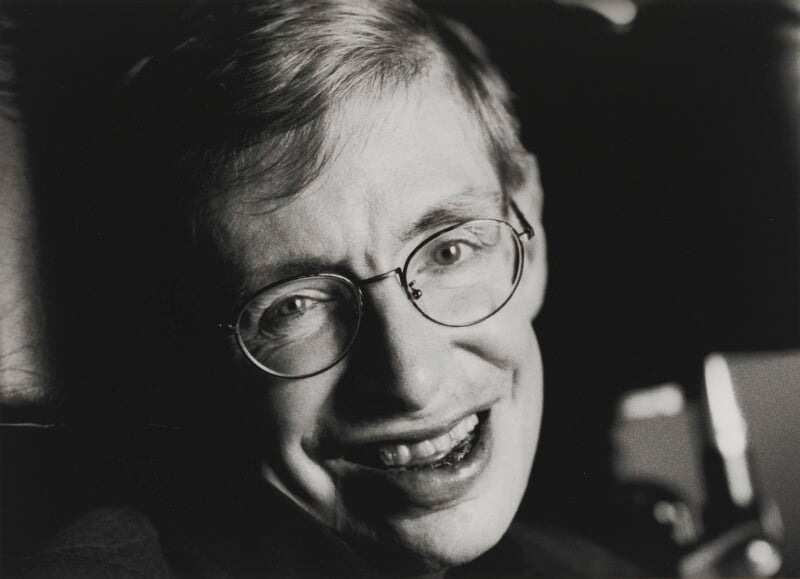
Stephen Hawking
 United Kingdom
theoretical physicist•cosmologist•astrophysicist
Birthday
January 8, 1942
Birth Sign
Capricorn
Birthplace
Oxford, England
Age
Died at 76
Height
5 ft 7 in (170 cm)
About
Stephen William Hawking was an English theoretical physicist, cosmologist, and author. He is best known for his work on black holes and the theory of Hawking radiation, which revolutionized modern physics. As director of research at the Centre for Theoretical Cosmology at the University of Cambridge and Lucasian Professor of Mathematics from 1979 to 2009, he held one of the most prestigious academic chairs in the world.
Hawking's book A Brief History of Time became a global phenomenon, spending 237 weeks on the Sunday Times bestseller list and selling over 10 million copies. His ability to explain complex scientific ideas to the general public made him a cultural icon. Despite being diagnosed with motor neurone disease at age 21 and given only two years to live, he defied the odds for more than five decades, continuing his research and public engagement.
His legacy extends beyond science: he appeared on television shows like The Simpsons and The Big Bang Theory, and his life story was portrayed in the Oscar-winning film The Theory of Everything. Fans admire him not only for his intellect but for his resilience and wit. The Stephen Hawking Foundation continues his mission to advance cosmology and support people with ALS.
Early Life & Background
Hawking grew up in a highly intellectual family in St Albans, Hertfordshire. His father Frank was a medical researcher, and his mother Isobel was a medical secretary. As a child, he was curious about how things worked, often taking apart clocks and radios. He was nicknamed "Einstein" by schoolmates, though his early grades were average.
He attended St Albans School, where he developed a passion for mathematics and physics, despite his father's wish for him to study medicine. At 17, he won a scholarship to University College, Oxford, graduating in 1962 with a first-class degree in physics. He then began his PhD at Trinity Hall, Cambridge, focusing on cosmology and general relativity. A pivotal moment came in 1963, when he was diagnosed with ALS and given two years to live. The diagnosis galvanized his focus; he later said it made him appreciate life and pursue his work with urgency.
Career Growth
Hawking's breakthrough came in 1970 when he collaborated with Roger Penrose on the singularity theorems, proving that the universe began with a Big Bang. In 1974, he proposed the theory of Hawking radiation, showing that black holes emit radiation and eventually evaporate. This was initially controversial but later accepted as a major breakthrough.
In 1979, he was appointed Lucasian Professor of Mathematics at Cambridge, a post once held by Isaac Newton. He held the chair until 2009. His 1988 book A Brief History of Time made him a household name, spending 237 weeks on the bestseller list. He later published The Universe in a Nutshell (2001) and Brief Answers to the Big Questions (2018). In 2007, he fulfilled a lifelong dream by experiencing weightlessness on a Zero Gravity flight. His final paper, "Black Hole Entropy and Soft Hair," was published days before his death in 2018.
Career Timeline
Public Image & Style
Hawking's public image was that of a brilliant, defiant, and witty mind trapped in a failing body. Media often portrayed him as a secular saint or a symbol of human perseverance. His signature aesthetic was his wheelchair-mounted speech synthesizer and his glasses. Fans, often called "Hawkingites" or simply physics enthusiasts, celebrate his birthday on 8 January with online events. His social media voice, managed posthumously, is inspirational and educational. He appeared on The Simpsons, Star Trek: The Next Generation, and The Big Bang Theory, endearing himself to pop culture audiences. His humor and directness in interviews made him relatable despite his towering intellect.
Fame & Fandom
Stephen Hawking commands a global audience defined not by organized fan clubs or ritualistic gatherings, but by a diffuse community of students, scientists, and general admirers united by his scientific contributions and personal resilience. Unlike pop culture icons who cultivate specific collective names for their followers, his supporters remain an unbranded assembly of those inspired by his defiance of physical limitations and his accessible explanations of the cosmos. This lack of a formal fandom name reflects the serious nature of his legacy, which is celebrated through academic appreciation rather than chart pushes or birthday billboards. Despite this organic following, his standing in the cultural consciousness remains formidable according to the iFANN Global Fame Rankings. Current data places him as the 224th most famous person in the world, a position holding steady from the previous cycle. Within his home nation, he ranks as the 49th most famous person in United Kingdom, while originating from that same country, he holds the 32nd most famous person from United Kingdom title. His influence extends across the continent where he is identified as the 59th most famous person in Europe. In the specific domain of creative output, he stands as the 12th most famous person in Books & Literature. These placements reflect a sustained presence tracked across media coverage and consumption signals worldwide, cementing his status as a figure whose fame transcends the boundaries of active fandom.
Interesting Facts and Legends
Hawking's voice synthesizer was originally developed for a speech therapy device; he retained it specifically because he preferred its robotic tone. A lifelong smoker, he continued the habit even after his diagnosis. He made notable cameo appearances on The Simpsons, Star Trek: The Next Generation, and The Big Bang Theory . Born exactly 300 years after Galileo's death, he passed away on Albert Einstein's birthday. In 2004, he lost a bet with John Preskill regarding black hole information loss. As a student, he served as coxswain for the Oxford University Boat Club. Cultural legends often recount his diagnosis at age 21 with amyotrophic lateral sclerosis, a condition that paralyzed him yet did not halt his work as Lucasian Professor of Mathematics, a chair once held by Isaac Newton. The publication of A Brief History of Time transformed him into a household name, making complex cosmology accessible to millions. Another iconic moment occurred during a 1993 appearance on Star Trek: The Next Generation, where he played poker alongside fictionalized physicists, bridging science fiction and reality. His death in 2018 triggered a global outpouring of grief marked by tributes from world leaders. Recent revelations from diaries suggest he was once feared to be lazy, adding a humanizing layer to his biography.
Notable Quotes
“However difficult life may seem, there is always something you can do and succeed at.”
“We are just an advanced breed of monkeys on a minor planet of a very average star. But we can understand the Universe. That makes us something very special.”
“The greatest enemy of knowledge is not ignorance, it is the illusion of knowledge.”
Family & Personal Life
Hawking was born to Frank Hawking, a medical researcher, and Isobel Hawking, a medical secretary. He had two younger sisters, Mary and Philippa, and an adopted brother, Edward. He grew up in a highly intellectual household in St Albans. He married Jane Wilde in 1965, and they had three children: Robert (b. 1967), Lucy (b. 1970), and Timothy (b. 1979). After divorcing Jane in 1995, he married Elaine Mason, his former nurse; they divorced in 2006. As of 2026, his estate is managed by his children through the Stephen Hawking Foundation.
Notable Connections
Hawking collaborated closely with Roger Penrose on the singularity theorems. His first wife Jane Hawking wrote a memoir about their life together. Eddie Redmayne portrayed him in the film The Theory of Everything. He also worked with Kip Thorne on black hole physics and had a famous bet with John Preskill over information loss.
Relationships & Dating History
Hawking married Jane Wilde in 1965 after meeting at a party in 1962. They had three children: Robert (b. 1967), Lucy (b. 1970), and Timothy (b. 1979). Jane was his primary caregiver during his early illness. The marriage ended in divorce in 1995, partly due to the strain of his condition and her relationship with organist Jonathan Jones. In 1995, Hawking married Elaine Mason, his former nurse. The marriage was controversial; Hawking was hospitalized with injuries in 2004, which he attributed to his condition, but police found no evidence of wrongdoing. They divorced in 2006. As of 2026, Hawking is deceased; his estate is managed by his children and a trust.
- MarriedJane Wilde Hawking1965 - 1995Met at a party in 1962; had three children; divorced due to strain of his illness and her relationship with Jonathan Jones.
- MarriedElaine Mason1995 - 2006She was his nurse; marriage controversial; divorced in 2006.
Death & Aftermath
Died
March 14, 2018 (aged 76)
Death Place
Cambridge, England
Cause of Death
Complications from amyotrophic lateral sclerosis
Stephen Hawking spent his final days at his home in Cambridge, England, having last appeared publicly in October 2017 when he joined the Breakthrough Prize launch via hologram. The University of Cambridge confirmed on March 14, 2018, that he passed away peacefully at the age of 76 from complications arising from amyotrophic lateral sclerosis, a condition that had progressively paralyzed him for over five decades. Tributes arrived immediately from global leaders including UK Prime Minister Theresa May and US President Donald Trump, while scientific institutions such as CERN and the Royal Society issued formal honors for his contributions to cosmology.
Digital downloads of his lectures spiked following the news, and his book A Brief History of Time re-entered bestseller lists globally. Vigils were held outside his former residences and at Cambridge University, where students gathered to light candles, and a memorial mural depicting the physicist became a site for spontaneous public remembrance. A private funeral service took place on April 3, 2018, at St Mary the Great church in Cambridge, attended by government officials, fellow scientists, and members of the British royal family. Following the ceremony, which featured readings from his work and music by the Cambridge University Choir, Hawking was cremated and his ashes interred in Westminster Abbey near the graves of Isaac Newton and Charles Darwin.
Posthumous releases included the documentary Stephen Hawking: Master of the Universe and the 2021 publication You and the Universe, while his theories continue to be revisited by physicists in recent studies regarding black hole entropy. The Stephen Hawking Foundation remains active in providing scholarships to students with disabilities, and his estate is managed by his children to oversee licensing and educational projects ensuring his legacy endures.
Net Worth (Estate Value)
$30 Million
iFANN Editorial Team estimate
Per iFANN's editorial analysis, the estate of Stephen Hawking is valued at $30 Million. At the time of his death in 2018, his net worth was estimated at $20 million. The estate has grown through posthumous book sales, including Brief Answers to the Big Questions, licensing deals for his image and voice, and the continued sale of A Brief History of Time . The estate is managed by his children, Robert, Lucy, and Timothy, through the Stephen Hawking Foundation. Revenue streams also include documentary rights, the sale of personal effects at auction (such as his wheelchair and thesis), and royalties from his published works. The foundation funds research in cosmology and ALS support.
Awards Won (18)
Hawking won numerous prestigious awards, including the Wolf Prize in Physics (1988), the Copley Medal (2006), the Presidential Medal of Freedom (2009), and the Fundamental Physics Prize (2013). He also received the Albert Einstein Medal, the Eddington Medal, and the Shaw Prize in Astronomy. His awards recognize his groundbreaking contributions to theoretical physics and cosmology.
1999 · Physics
Excellence in physics teaching
2013 · Fundamental Physics
Discovery of Hawking radiation
Known For
Hawking radiation
1974 · Discoverer
A Brief History of Time
1988 · Author
Singularity theorems
1970 · Co-discoverer
Keywords
Quick Facts
Personal Details
- Full Name
- Stephen William Hawking
- Height
- 5 ft 7 in (170 cm)
- Spouse
- Jane Hawking, Elaine Mason
- Children
- Robert Hawking, Lucy Hawking, Timothy Hawking
- Education
- University College, Oxford (BA), Trinity Hall, Cambridge (PhD)
Frequently Asked Questions
What did Stephen Hawking die of?
Did Stephen Hawking believe in God?
What is Hawking radiation?
How did Stephen Hawking talk?
How many children did Stephen Hawking have?
Similar People
Join the community
fans discussing