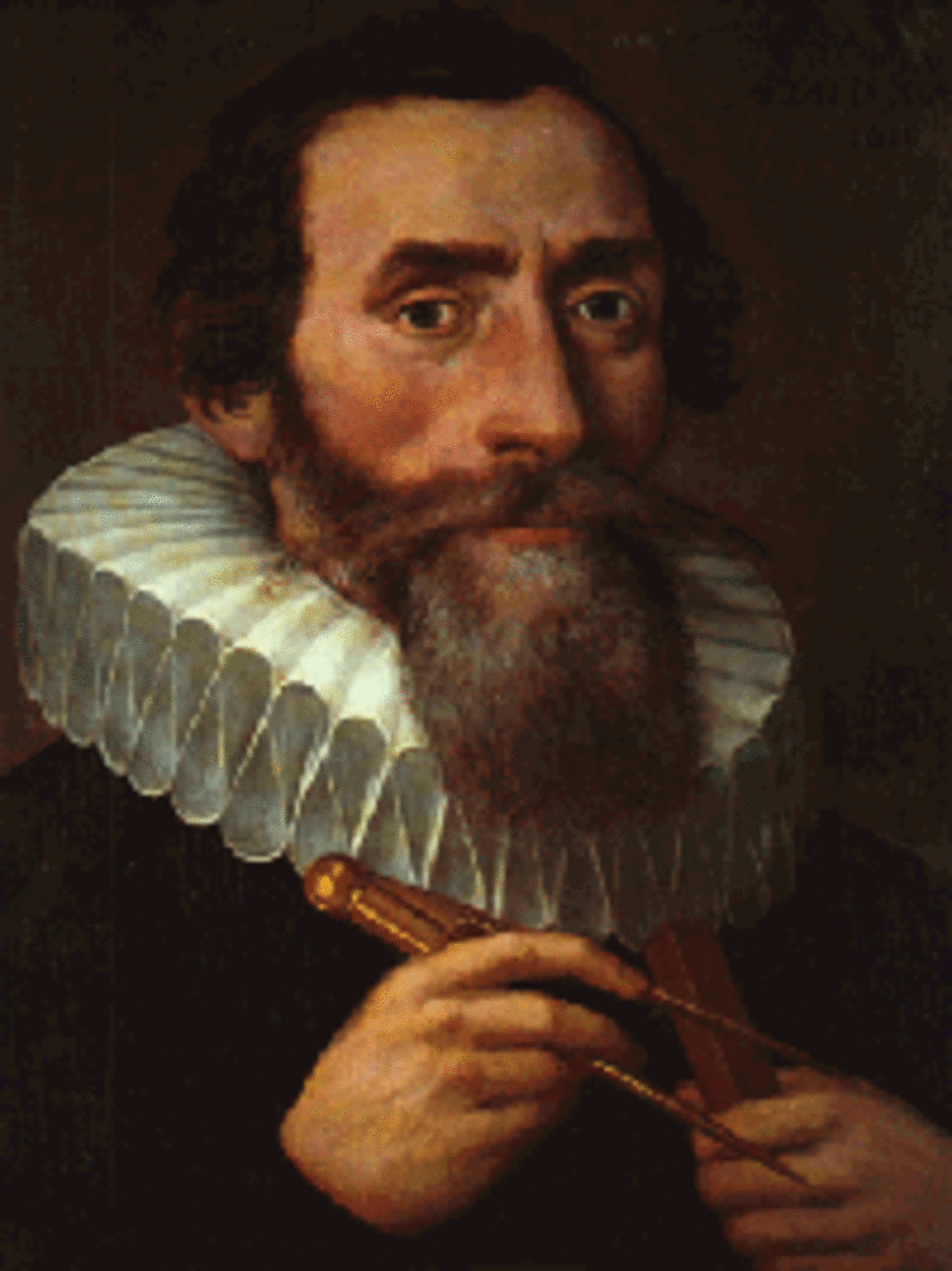
Johannes Kepler
 Germany
Astronomer•Mathematician•Astrologer•Natural Philosopher•Music Theorist
Also known as: Ioannes Keplerus, Johannes Keppler
Birthday
December 27, 1571
Birth Sign
Sagittarius
Birthplace
Weil der Stadt, Germany
Age
Died at 58
About
Johannes Kepler was a German astronomer, mathematician, and natural philosopher who fundamentally reshaped humanity's understanding of the cosmos during the 17th century. Born prematurely in Weil der Stadt, he lived a life defined by rigorous mathematical inquiry that bridged the gap between ancient astronomy and modern science. His career began in Graz teaching mathematics before he moved to Prague to work with Tycho Brahe, eventually becoming the Imperial Mathematician under Emperor Rudolf II. Kepler is best known for formulating the three laws of planetary motion, which described how planets orbit the Sun in ellipses rather than perfect circles.
Beyond his astronomical discoveries, Kepler made significant contributions to optics and invented the refracting telescope design now known as the Keplerian telescope. He also wrote extensively on music theory and astrology, viewing the universe as a harmonious system created by God. His novel Somnium, written around 1609, is considered one of the earliest works of science fiction. Despite facing personal hardships including the witchcraft trial of his mother and the loss of his first wife, his work laid the essential groundwork for Isaac Newton's theory of universal gravitation.
Early Life & Background
Johannes Kepler entered the world on December 27, 1571, in Weil der Stadt, a small town in southwest Germany known for its wine production. His birth was difficult; he arrived seven months early and was so frail that his parents feared he would not survive. Contemporaries described him as sickly throughout his childhood, plagued by various ailments that included rheumatism and poor eyesight. His father, Heinrich Kepler, worked as a mercenary soldier and was frequently absent due to military campaigns, leaving the family in a state of financial uncertainty. His mother, Katharina Guldenmann, came from a family of innkeepers and held a more independent spirit, traits that would later define her complex relationship with her son.
Kepler's early education took place at a local school in Weil der Stadt before his family sent him to the monastery school in Adelberg and later the Latin school in Maulbronn. These institutions provided a solid grounding in classical languages and theology, but Kepler's true passion lay elsewhere. In 1589, he enrolled at the University of Tübingen to study theology with the intention of becoming a Lutheran pastor. It was here that his life took an unexpected turn. Under the guidance of Michael Maestlin, a prominent astronomer and professor, Kepler encountered the Copernican heliocentric system. Maestlin recognized Kepler's exceptional aptitude for mathematics and encouraged him to pursue the subject seriously. This mentorship shifted Kepler's trajectory away from the pulpit and toward the stars, setting the stage for his future revolutionary work.
Career Growth
Kepler's professional breakthrough occurred in 1594 when he accepted a position as Professor of Mathematics and Astronomy at the Protestant seminary in Graz, Austria. Although he intended to remain a theologian, this role allowed him to publish his first major work, Mysterium Cosmographicum (The Cosmic Mystery), in 1596. In this book, he proposed that the distances of the six known planets from the Sun were determined by the five Platonic solids, a geometric model that brought him to the attention of Tycho Brahe, the most renowned astronomer of the era.
In 1600, Kepler moved to Prague to serve as an assistant to Tycho Brahe under the patronage of Emperor Rudolf II. After Brahe's sudden death in October 1601, Kepler succeeded him as Imperial Mathematician. This position provided him access to Brahe's incredibly precise observational data, which Kepler used to revolutionize astronomy. In 1609, he published Astronomia Nova (New Astronomy), where he introduced his First Law stating that planets move in elliptical orbits with the Sun at one focus, and his Second Law regarding the equal area swept in equal time. These findings shattered the 2,000-year-old belief in circular perfection.
His most famous work, Harmonices Mundi (The Harmony of the World), appeared in 1619 and contained his Third Law, which unified the motions of all planets into a single mathematical framework by relating their orbital periods to their distances from the Sun. In 1627, he completed the Rudolphine Tables, based on Brahe's data and his own laws, which provided the most accurate astronomical predictions of the era and remained in use for over 150 years. His later years were marked by travel and attempts to secure funding for his work, culminating in his death while collecting unpaid wages in Regensburg in 1630.
Career Timeline
Public Image & Style
Kepler is remembered as a visionary who seamlessly blended faith with rigorous science. Unlike many of his contemporaries who separated religion and astronomy, he viewed the universe as a divine creation governed by mathematical harmony. His public persona is that of a man of intense dedication and patience, willing to spend years calculating the orbit of Mars to find the truth. Media depictions often highlight his role as a bridge between the mystical and the rational, showing him as a devout Christian who used geometry to reveal God's plan. His signature style is associated with precision, the beauty of celestial mechanics, and the concept of cosmic harmony. He is seen as a pioneer who dared to challenge established dogmas with empirical evidence.
Fame & Fandom
iFANN has not yet collected fame data for this person. As a historical figure from the 17th century, Johannes Kepler does not have a modern ranking in contemporary celebrity charts or social media metrics. His fame is measured by his enduring impact on science rather than current public attention spans. The "Keplerian" community consists of astronomers, historians, physicists, and science enthusiasts who celebrate his work. There is no formal fandom name or organized fan clubs in the pop-culture sense. Instead, his admirers engage through academic study, educational initiatives, and participation in space missions named after him. The Kepler Space Telescope mission, which operated from 2009 to 2018, sparked renewed interest in his life and work among the general public, leading to documentaries, books, and articles that introduce his laws to new generations. His name remains a symbol of scientific perseverance and intellectual curiosity.
Interesting Facts and Legends
Kepler is often called the father of science fiction because of his 1609 novel Somnium (The Dream). Written secretly and published posthumously in 1634, it depicts a journey to the moon and describes life on the lunar surface, drawing inspiration from stories told by his mother about witches flying. Another fascinating fact involves his optical work; he was the first to explain how the eye forms images and invented the Keplerian telescope, which uses two convex lenses to provide a wider field of view than Galileo's design. Kepler also viewed his scientific work as a form of worship, famously writing that he was "thinking God's thoughts after Him." His mother, Katharina, was accused of witchcraft in 1615, and Kepler spent years defending her in a lengthy legal battle, eventually securing her release. This experience deeply influenced his views on justice and evidence. Additionally, recent research has shown that a 400-year-old drawing by Kepler helped solve a mystery regarding a 70-year solar quiet period, proving his observational skills were far ahead of his time.
Notable Quotes
“Truth is the daughter of time, not of authority.”
“I am gathering the flowers of the garden of nature, not the fruit.”
“The movement of the heavens is nothing else but a continuous song for several voices... a perfect harmony.”
Family & Personal Life
Kepler's family life was marked by both deep love and significant hardship. He was born to Heinrich Kepler, a mercenary soldier who was often absent, and Katharina Guldenmann, a woman known for her strong will and eventual accusation of witchcraft. His childhood was difficult due to his frail health and the family's financial struggles. He married twice, starting with Barbara Müller in 1597. She was a wealthy widow with children from a previous marriage, and their union produced five children, though only three survived infancy: Susanna, Friedericke, and Hildebrand. The marriage was reportedly difficult, with Kepler often complaining about Barbara's management of their finances and her lack of interest in science. After Barbara died in 1611, Kepler married Susanne Reuttinger in 1613. She bore him three more children: Maximilian, Fridolin, and Sophia, all of whom survived childhood. Susanne managed his estate after his death and preserved his papers.
Notable Connections
Tycho Brahe, Michael Maestlin, Isaac Newton, Galileo Galilei, Emperor Rudolf II, Katharina Kepler.
Relationships & Dating History
Kepler's romantic life followed the customs of the late 16th and early 17th centuries, characterized by arranged marriages driven by economic necessity and social standing rather than modern courtship. In 1597, he married Barbara Müller, a wealthy widow with children from a previous marriage. The match was arranged by his mentor Michael Maestlin to secure financial stability. They had five children together: Susanna, Friedericke, Hildebrand, Ludwig, and a daughter who died young. The marriage was reportedly difficult; Barbara suffered from chronic illness, and Kepler often complained about her management of their household finances and her lack of interest in science. Despite these tensions, they remained married until her death in 1611.
Following Barbara's death, Kepler sought a new wife to manage his household and care for his surviving children. He selected Susanne Reuttinger, a woman of modest means but good character, after an unconventional courtship involving a questionnaire regarding her suitability as a wife. She bore him three children: Maximilian, Fridolin, and Sophia, all of whom survived childhood. Susanne managed his estate after his death and preserved his papers. She outlived him, ensuring his legacy was maintained by his family.
- MarriedBarbara Müller1597 - 1611Marriage arranged by mentor Michael Maestlin; she died of chronic illness.
- MarriedSusanne Reuttinger1613 - presentSecond wife who managed his estate after his death; survived him.
Death & Aftermath
Died
November 15, 1630 (aged 58)
Death Place
Regensburg, Holy Roman Empire
Cause of Death
Fever and kidney failure
On November 15, 1630, Johannes Kepler died in Regensburg at the age of 58. His final days were spent traveling through the war-torn lands of the Thirty Years' War to collect unpaid wages from a local army officer who owed him money. Suffering from chronic poor health, rheumatism, and likely kidney stones, he succumbed to a severe fever shortly after arriving in the city. He was buried in the Protestant churchyard there, though his grave was later destroyed during religious conflicts in the 17th century, leaving no physical marker for his final resting place.
The immediate aftermath of his death saw his family struggle with financial instability, as his estate was valued at only about 1,000 florins, barely enough to cover debts and funeral costs. His second wife, Susanne Reuttinger, managed his papers and household affairs until her own death years later. While his personal life ended in relative obscurity and poverty, his intellectual legacy exploded immediately. His Rudolphine Tables, published posthumously in 1627 but finalized before his death, became the standard for astronomical predictions for over 150 years.
Public reaction evolved from quiet reverence to global celebration over the centuries. In the decades following his passing, Isaac Newton explicitly credited Kepler's laws as the foundation for the law of universal gravitation, cementing his status as a pioneer of modern physics. By the 19th and 20th centuries, Kepler had been elevated to a near-mythic figure representing the triumph of reason and faith combined. Tributes poured in from scientific institutions worldwide, leading to numerous honors including the naming of the lunar crater Kepler, the asteroid 1134 Kepler, and the prestigious NASA Kepler Space Telescope mission launched in 2009. The mission alone, costing hundreds of millions of dollars, discovered thousands of exoplanets, directly fulfilling Kepler's lifelong dream of finding other worlds. Today, his name is synonymous with the scientific method itself, honored by universities, museums, and space agencies across the globe.
Net Worth (Estate Value)
$0
iFANN Editorial Team estimate
Johannes Kepler died in poverty in 1630. His estate was valued at approximately 1,000 florins at the time of his death, a sum that barely covered his debts and funeral costs. As a historical figure, he holds no personal net worth in the modern sense. However, the "Kepler" brand continues to generate immense value through scientific and cultural channels. The NASA Kepler Space Telescope mission, named in his honor, cost approximately $600 million to build and operate, discovering thousands of exoplanets and generating billions in scientific value and public engagement. The name "Kepler" is licensed for various educational products, toys, and media, though specific royalty figures are not publicly tracked as a distinct asset class. His intellectual property rights and royalties from his works are now in the public domain, making his contributions freely available to humanity. The iFANN Editorial Team estimates the total economic value generated by his legacy and associated brands to be in the billions, though this reflects the impact of his ideas rather than personal wealth.
Awards & Accolades
View 12 records, honours and achievementsKnown For
Astronomia Nova
1609 · Author
Harmonices Mundi
1619 · Author
Rudolphine Tables
1627 · Author
Somnium
1634 · Author
Keywords
Sources
Quick Facts
- Profession
- naturalist, astrologer, Protestant theologian
- Born
- December 27, 1571
- Birthplace
- Weil der Stadt
- Died
- November 15, 1630
- Death Place
- Regensburg
- Gender
- Male
- Spouse
- Barbara Müller, Susanne Reuttinger
- Birth Sign
- Sagittarius
Personal Details
- Full Name
- Johannes Kepler
- Spouse
- Barbara Müller, Susanne Reuttinger
- Children
- Susanna, Friedericke, Hildebrand, Ludwig, Maximilian, Fridolin, Sophia
- Education
- University of Tübingen
Frequently Asked Questions
What are Kepler's three laws of planetary motion?
Did Johannes Kepler know about gravity?
Who was Johannes Kepler's wife?
What was Johannes Kepler's profession?
How did Johannes Kepler die?
Join the community
fans discussing