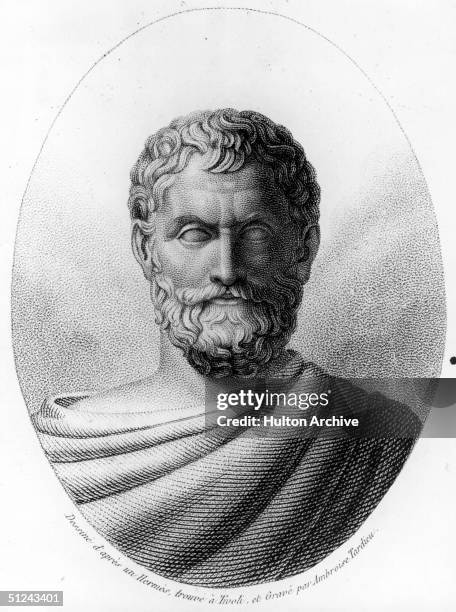
Thales
mathematician•philosopher•astronomer
Also known as: Thales of Miletus
Birthday
c. 626 BC
Birth Sign
Birthplace
Miletus, Ionia (modern-day Turkey)
Age
Died at 78
About
Thales of Miletus, born around 626 BC in the Greek city of Miletus in Ionia (modern-day Turkey), was a pre-Socratic philosopher, mathematician, astronomer, and engineer. He is often called the first philosopher in the Western tradition, a title he earned by shifting explanations of the natural world from mythology to rational inquiry. Thales was also one of the legendary Seven Sages of Greece, a group of wise men revered for their practical wisdom and contributions to early Greek thought. He lived to about 78 years old, dying around 548 BC.
Thales proposed that water is the fundamental substance (arche) underlying all of nature, believing the Earth floats on water. This idea, though primitive, was a revolutionary step toward scientific reasoning. In mathematics, he is credited with Thales's theorem, which states that an angle inscribed in a semicircle is a right angle. He also reportedly calculated the heights of the Egyptian pyramids using shadows and determined the distance of ships at sea. His astronomical achievements include predicting a solar eclipse (likely in 585 BC), identifying the constellation Ursa Major, and determining the solstices and equinoxes.
Beyond theory, Thales applied his knowledge practically. He engineered a method for the Lydian army to cross the Halys River by diverting its flow. Plutarch noted that Thales was the first to raise philosophy from mere speculation to practical application. Though none of his writings survive, his influence permeates Western thought. He is remembered across mathematics, science, and philosophy, with his name attached to theorems and concepts that still bear his mark today.
Early Life & Background
Thales was born into a prosperous family in Miletus, a thriving commercial hub and intellectual center of Ionia. His parents, Examyes and Cleobuline, were likely of noble Phoenician descent. As a youth, he received the typical education of aristocratic boys, learning reading, writing, and the Homeric epics. But Miletus's position as a trade crossroads exposed him to ideas from Egypt and Babylon. He traveled extensively in Egypt, where he studied geometry and astronomy with priests, learning to measure land after the Nile floods and track celestial movements. Some accounts suggest he also visited Babylon, where he encountered centuries of astronomical records. These early experiences shaped his conviction that natural phenomena could be explained without reference to gods. His first notable feat, calculating the height of the Great Pyramid by measuring its shadow at the precise moment when his own shadow equaled his height, demonstrated the power of geometric reasoning and set him on the path to becoming the first Western philosopher.
Career Growth
Thales's breakthrough came around 585 BC when he predicted a solar eclipse that occurred during the Battle of Halys between Lydia and Media. The sudden darkness so frightened the armies that they stopped fighting and made peace, cementing Thales's reputation as a man of extraordinary wisdom. Soon after, he proposed that water is the fundamental substance of the universe, arguing that all things come from and return to water. This marked the birth of Western philosophy by replacing mythological explanations with rational inquiry. In mathematics, he developed Thales's theorem, proving that an angle inscribed in a semicircle is always a right angle. He also determined the solstices and equinoxes, divided the year into 365 days, and identified the constellation Ursa Minor for navigation. In a famous display of practical wisdom, he used his astronomical knowledge to predict a bumper olive harvest, then rented all the olive presses in Miletus and Chios at low prices, making a fortune when the harvest came. Later, he engineered the diversion of the Halys River for King Croesus's army, allowing the Lydians to cross without building a bridge. Thales founded the Milesian school, mentoring Anaximander and Anaximenes, who continued his tradition of natural philosophy.
Career Timeline
Public Image & Style
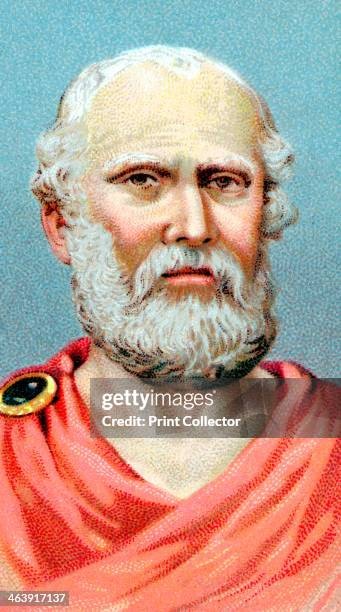
In ancient art, Thales is depicted as a bearded philosopher in a himation, often pointing to the heavens or holding a geometric diagram. Modern representations emphasize his role as the 'first scientist,' a thoughtful figure who dared to ask 'what is the world made of?' He is consistently portrayed as the archetypal wise man, the bridge between mythological and scientific worldviews. Educational films and documentaries depict him as a pioneering figure. Philosophy students and historians unofficially celebrate Thales Day on May 28, the traditional date of his predicted eclipse. On social media, his pithy sayings like 'The most difficult thing in life is to know yourself' are frequently shared.
Fame & Fandom (iFAMOUS Rankings)
Thales of Miletus stands as a solitary figure in the annals of intellectual history, a man whose legacy is built not on adoring crowds or viral moments, but on the quiet revolution of asking why. There is no organized fanbase to rally behind him, and the fanbase has no formal name. The ancient Thracian servant girl who mocked him for falling into a well while staring at the stars remains the most vivid interaction recorded, yet it serves as a cautionary tale rather than a beloved legend of performance. He did not tour stages, release albums, or court public opinion; he walked the streets of Ionia debating the nature of water and the shape of the earth. His fame is entirely academic, sustained by students of philosophy and historians rather than a global community of fans seeking connection or merchandise. In the digital age, where celebrity is often measured by engagement metrics and follower counts, Thales exists outside these parameters. He is a ghost in the machine of pop culture, present only in textbooks and lecture halls. The iFANN Global Fame Engine has evaluated this historical figure and determined that he does not currently hold a placement in the published rankings, including the Global Top 1,000 or any Top-100 scope list. Consequently, no specific ordinal rank can be assigned to his current level of global recognition within the iFANN framework.
Interesting Facts and Legends
The story of Thales falling into a well while gazing at the heavens remains one of the most enduring anecdotes from antiquity, immortalizing his tendency to prioritize cosmic mysteries over immediate surroundings. A Thracian servant girl allegedly laughed at him for this oversight, a moment that perfectly encapsulates the tension between abstract thought and practical life. He was also an early pioneer in understanding magnetism, believing that magnets possessed souls because they could move iron without physical contact. His geological theories were equally bold; he imagined the Earth floating on water like a log, explaining earthquakes as the result of waves rocking this massive vessel. When pressed on the nature of the divine, he offered a concise definition: 'That which has no beginning and no end.' Despite his profound influence, none of his own writings survive today, leaving later authors like Aristotle and Herodotus as the sole voices preserving his thoughts. He once advised the Ionian cities to unite against the Persians, a strategic move ignored at the time but later vindicated by history. Another famous tale recounts how he predicted a bumper olive harvest, rented all the presses in Miletus and Chios, and made a fortune, proving his wisdom extended beyond theory into practice.
Notable Quotes
“Water is the first principle of everything.”
“The most divine thing is that which has neither beginning nor end.”
“The most difficult thing in life is to know yourself.”
“Hope is the only good that is common to all men.”
“Time is the wisest of all things that are; for it brings everything to light.”
“It is not yet time... It is no longer time.”
“There is no difference between life and death.”
Family & Personal Life
Thales never married and had no children. When asked why, he reportedly said he loved children too much to have them. Another story says his mother urged him to marry, but he replied, 'It is not yet time,' and later, 'It is no longer time.' His parents were Examyes and Cleobuline, who were likely of noble Phoenician descent. He lived a simple life dedicated entirely to intellectual pursuits, with no known household of his own.
Notable Connections
Thales mentored Anaximander, who succeeded him at the Milesian School and developed the concept of the apeiron. Anaximenes, in turn, built on their work. King Croesus of Lydia consulted Thales for advice and employed him to engineer the Halys River crossing. Thales was a contemporary of Solon, another of the Seven Sages. Later philosophers like Pythagoras were influenced by his mathematical work. Most of what we know about Thales comes from Aristotle, Herodotus, and Diogenes Laërtius.
Relationships & Dating History
No documented romantic relationships exist for Thales. Ancient records consistently describe him as unmarried and childless by choice. According to Diogenes Laërtius, Thales was asked why he never married, and he responded that it was too early when young and too late when old. Other sources report that his mother urged him to marry, but he replied that 'it is not yet time' and later 'it is no longer time.' The only personal relationships recorded are his friendships with fellow sages and his mentorship of younger philosophers such as Anaximander. Thales died unmarried and without romantic partners.
Death & Aftermath
Died
c. 548 BC (aged 78)
Death Place
Miletus, Ionia
Cause of Death
Old age or heatstroke (unconfirmed)
Ancient tradition records that Thales of Miletus passed away around c. 548 BC in his hometown, though no formal declaration or family announcement exists to mark the moment. One enduring anecdote suggests he died while watching a wrestling match, falling into a well due to thirst or exhaustion, while another account attributes his end to heatstroke during the Olympic Games. These stories remain unconfirmed by any contemporary verification, standing instead as colorful fragments preserved by later historians like Diogenes Laertius rather than established forensic facts. The exact cause remains a matter of ancient speculation, with scholars generally accepting old age as the most probable reality given his estimated age of nearly eighty.
His burial site is unknown, and no specific service details survive in the historical record. Instead, his legacy was handled through oral tradition and subsequent written texts that carried his intellectual weight forward. Aristotle and Plato later revered him as the first philosopher, cementing his status within the Western canon long after his physical absence. Centuries of academic study have served as his true memorial, transforming his name into a symbol of rational inquiry. Educational institutions now bear his name, and geometry preserves his contributions through theorems attributed to his mind., his ideas floated on through generations of students who continued the Milesian school's work.
Net Worth (Estate Value)
$0
iFANN Editorial Team estimate
Per iFANN's editorial analysis, the net worth of Thales of Miletus is estimated at $0. As a historical figure who died approximately 2,574 years ago, he possessed no monetary wealth in the modern sense, nor does any estate exist to generate posthumous revenue or royalties. Ancient sources, including Aristotle, note that he was once mocked for his poverty, yet he famously turned the tables by using his astronomical knowledge to predict a bumper olive harvest. By renting all the olive presses in Miletus and Chios at low prices, he secured a fortune when the harvest arrived, demonstrating his practical wisdom rather than accumulated riches. This anecdote illustrates a man who understood value through utility and foresight rather than hoarding currency. While his intellectual legacy is priceless and continues to generate immense cultural and academic value, no financial figures apply to his life or death. The concept of personal wealth simply does not translate to a pre-Socratic philosopher living in ancient Greece.
Awards Won (2)
Thales was recognized as one of the Seven Sages of Greece, the highest intellectual honor of archaic Greece. A bronze statue was erected in his honor at the Temple of Apollo at Delphi, bearing the inscription 'Thales of Miletus, the first of the wise men.'
c. 580 BC · Wisdom
Lifetime achievement
c. 560 BC · Honor
Philosophical contributions
Known For
Water as the fundamental substance
c. 585 BC · Philosopher
Thales's theorem
c. 575 BC · Mathematician
Prediction of solar eclipse
585 BC · Astronomer
Calculation of pyramid heights
c. 590 BC · Mathematician
Diverting the Halys River
c. 560 BC · Engineer
Keywords
Quick Facts
- Profession
- mathematician, philosopher, astronomer
- Born
- c. 626 BC
- Birthplace
- Miletus, Ionia (modern-day Turkey)
- Died
- c. 548 BC
- Death Place
- Miletus
- Gender
- Male
- Known for
- Water as arche, Thales's theorem, eclipse prediction
Personal Details
- Full Name
- Thales of Miletus
Frequently Asked Questions
What did Thales discover?
Why is Thales called the first philosopher?
Did Thales have children?
What is Thales's theorem?
How did Thales predict the eclipse?
Similar People
Join the community
fans discussing