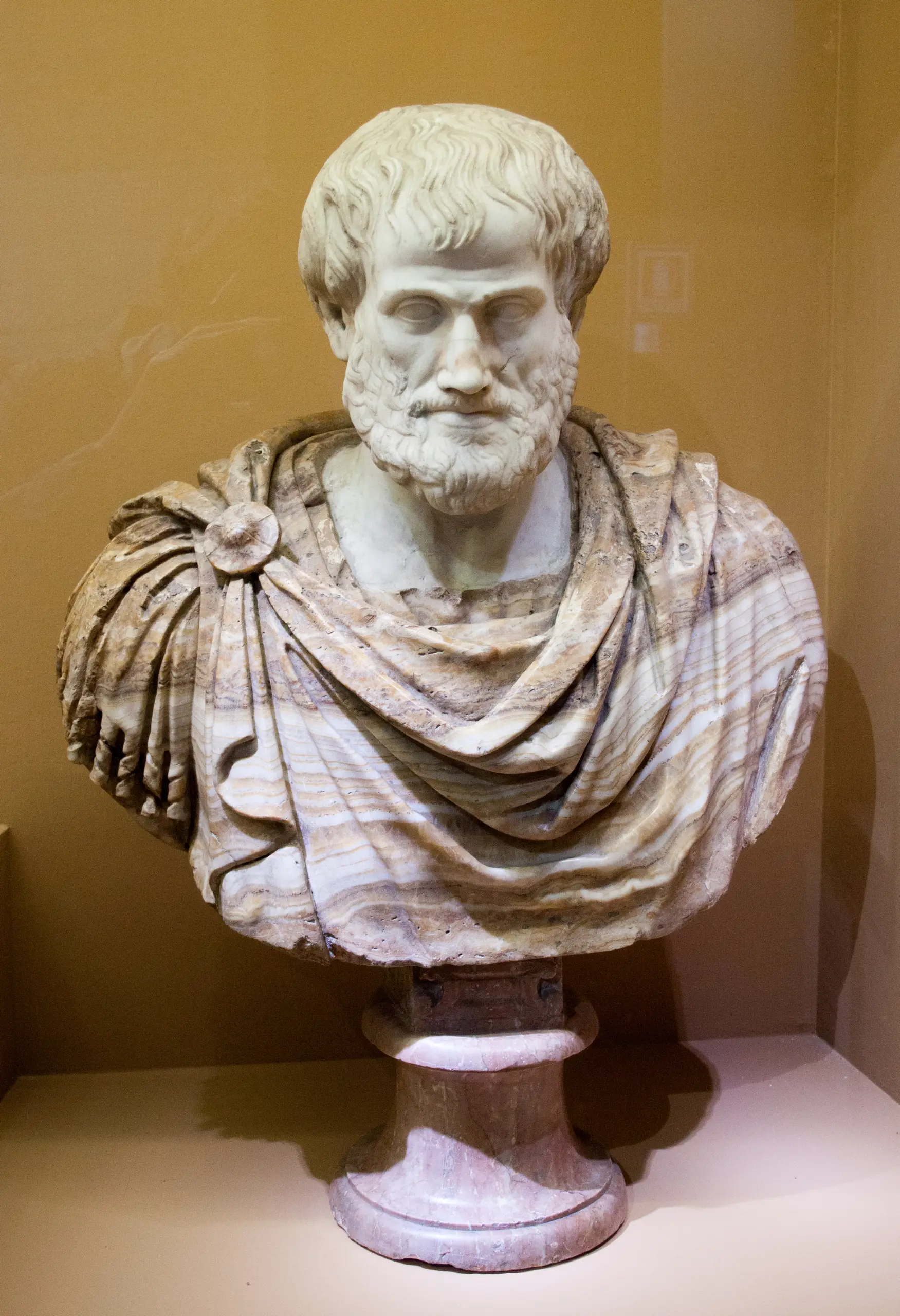
Aristotle
 Greece
Also known as: The Stagirite, The Philosopher, The First Teacher
Birthday
384 BC
Birth Sign
Birthplace
Stageira, Chalcidice, Greece
Age
Died at 62
About
Aristotle was an ancient Greek philosopher and polymath whose work laid the foundations for Western science, logic, ethics, politics, and metaphysics. Born in 384 BC in Stageira, he studied under Plato and later tutored Alexander the Great. He founded the Lyceum in Athens, where he wrote extensively on biology, physics, and ethics. His works, though only partially surviving, have shaped intellectual thought for over two millennia.
Known as "The Philosopher" in medieval Christian tradition and "The First Teacher" in the Islamic world, Aristotle's influence is unmatched. His empirical approach to studying nature earned him the title of the first true scientist. Even today, his ethical theories and logical frameworks remain central to philosophical discourse.
Early Life & Background
Aristotle was born in 384 BC in Stageira, a Greek colony in Thrace. His father, Nicomachus, served as the personal physician to King Amyntas III of Macedon, a connection that would later shape his destiny. After his father's death, Aristotle was raised by a guardian, Proxenus of Atarneus, who married his mother, Phaestis.
At about eighteen, Aristotle moved to Athens to join Plato's Academy, where he remained for twenty years as a student and later a lecturer. During this period, he developed his own philosophical framework, emphasizing empirical observation over Plato's idealism. His early interest in biology and natural history, likely influenced by his father's medical background, began to take root.
After Plato's death in 347 BC, Aristotle left Athens, traveling to Assos and then Mytilene, where he continued his research on marine biology. These years of travel and study prepared him for the pivotal role that awaited him in Macedon.
Career Growth
Aristotle's career can be divided into three major phases. The first was his time at Plato's Academy, where he honed his skills and began his systematic investigations. The second phase began in 343 BC when Philip II of Macedon invited him to tutor his son, Alexander the Great. This royal appointment placed Aristotle at the heart of a rising empire, and he maintained his intellectual independence while shaping the mind of a future conqueror.
The third and most productive phase came in 335 BC when Aristotle returned to Athens and founded the Lyceum, also known as the Peripatetic School. Here, he established a library and conducted extensive research across biology, physics, and ethics. He walked while lecturing, earning the school its name. During this period, he wrote many of his surviving works, including the Nicomachean Ethics, Politics, Metaphysics, and Poetics.
His influence spread through the Islamic world, where his works were translated into Arabic, and later through Christian Europe, where Thomas Aquinas integrated his philosophy into theology. Aristotle's legacy as a teacher and thinker has never been surpassed.
Career Timeline
Public Image & Style
Aristotle's public image is that of the quintessential philosopher, the archetypal thinker whose works have been studied for centuries. In medieval Europe, he was simply "The Philosopher," a testament to his supreme status. In the Islamic world, he was "The First Teacher." His image is one of intellectual rigor and empirical inquiry, a man who walked while he taught, embodying the peripatetic tradition. Today, he is often portrayed as a towering figure of antiquity, with his bust in museums and his ideas in every philosophy course.
Fame & Fandom (iFAMOUS Rankings)
Aristotle remains a figure of enduring global prominence, his name recognized across cultures and centuries as a defining pillar of Western thought. According to the iFANN Global Fame Rankings, he holds the position of the 332nd most famous person in the world, a standing he has maintained since the previous cycle. His dominance is even more pronounced within his region of origin, where he ranks as the 1st most famous person from Greece. In the specific domain of Books & Literature, his influence secures him the 17th most famous person in that industry. These placements reflect sustained worldwide attention driven by academic study and historical record rather than contemporary celebrity activity. The fanbase for this ancient polymath does not possess a formal name; adherents are generally identified as scholars, students, or followers of Aristotelianism. There are no organized campaigns, ritualistic gatherings, or social media movements dedicated to his legacy, as his life concluded millennia before the advent of modern fandom culture. While the name appears in fictional contexts and recent business news, the philosopher himself commands respect through his surviving works and historical impact alone.
Interesting Facts and Legends
Aristotle established the first great library in the Western world at the Lyceum, a repository holding thousands of scrolls that preserved knowledge for future generations. His biological work was unprecedented; he dissected over 50 animal species and described hundreds more, earning him the title of the first true biologist. He invented the syllogism, the foundation of formal logic, which served as the standard method of reasoning until the 19th century. Only about one-third of his original output survives today, consisting largely of lecture notes, while many of his dialogues remain lost. Known as "The Stagirite" after his birthplace, his geographical observations were recently validated by an underwater discovery near Istanbul in 2026 confirming a 2,300-year-old copper mine. The story of his death in 322 B.C. is often retold alongside accounts of his final days spent studying marine life. Recent cultural attention in 2026 also highlighted the death of author Benjamin Alire Sáenz, whose novel *Aristotle and Dante Discover the Secrets of the Universe* kept the name relevant in literary circles.
Notable Quotes
“It is the mark of an educated mind to be able to entertain a thought without accepting it.”
“We are what we repeatedly do. Excellence, then, is not an act, but a habit.”
“The whole is greater than the sum of its parts.”
“Happiness depends upon ourselves.”
Family & Personal Life
Aristotle's father, Nicomachus, was a physician to the Macedonian court, and his mother, Phaestis, came from a wealthy family. After his father's death, Proxenus of Atarneus became his guardian and married his mother. Aristotle married Pythias, with whom he had a daughter, also named Pythias. After her death, he took a partner, Herpyllis, who bore him a son, Nicomachus. His son later edited the Nicomachean Ethics. Aristotle's family life was rooted in the intellectual and medical traditions of his lineage.
Notable Connections
Aristotle's life intersected with some of the most influential figures of antiquity. Plato, his teacher, shaped his early thinking, though Aristotle eventually diverged from Plato's idealism. He tutored Alexander the Great, whose conquests spread Greek culture and later preserved Aristotle's works. His father, Nicomachus, and his son, also named Nicomachus, played significant roles in his life. His successor at the Lyceum, Theophrastus, continued his work. These connections highlight the intellectual and political networks that surrounded him.
Relationships & Dating History
Aristotle's personal life, as recorded by history, included two significant relationships. He married Pythias, a woman from Chalcis, and they had a daughter, also named Pythias. Pythias died before Aristotle, and he later took a partner named Herpyllis, who bore him a son, Nicomachus. There is no evidence of modern-style dating or flings; his relationships were consistent with the social norms of 4th-century BC Greece. At the time of his death, he was with Herpyllis, who was provided for in his will.
- MarriedPythias-360 - -340Aristotle's wife, mother of his daughter Pythias.
- DatedHerpyllis-340 - -322CurrentPartner and mother of his son Nicomachus; she was provided for in his will.
Death & Aftermath
Died
322 BC (aged 62)
Death Place
Chalcis, Euboea, Greece
Cause of Death
Stomach ailment (disputed suicide)
The preservation of Aristotle's intellectual legacy began immediately after his passing, as his successor Theophrastus assumed leadership of the Lyceum to safeguard the library and continue the teacher's empirical inquiries. This stewardship ensured that works such as the Nicomachean Ethics and Politics would survive to influence medieval Christian theology and Islamic scholarship for centuries, cementing a posthumous status that far outstripped any contemporary mourning rituals. The philosopher himself passed away in 322 BC at the age of sixty-two within the city of Chalcis on the island of Euboea, having relocated there to distance himself from the anti-Macedonian sentiment in Athens following the death of Alexander the Great. Ancient biographical traditions, notably those recorded by Diogenes Laertius, report that he suffered from a chronic stomach ailment and voluntarily ingested hemlock to avoid facing charges of impiety similar to those brought against Socrates, though modern scholars widely regard this account of suicide as unconfirmed or potentially conflated with later historical narratives.
Historical records do not preserve details regarding a public funeral, the specific location of his burial, or any organized tributes beyond the continued operation of his school by his students. His estate was managed by his son Nicomachus, who later edited key ethical texts, while the physical collection of books eventually moved from Athens to Rome under the direction of Sulla.
Net Worth (Estate Value)
Aristotle lived over two thousand years ago, so he has no net worth in the modern sense. His 'estate' consists of his intellectual property, which is incalculable in monetary terms. His works are in the public domain, and while publishers and universities generate revenue from them, no heirs benefit. There are no financial entities named 'Aristotle Capital Management' that belong to him; these are modern corporations using his name. His true wealth lies in his enduring influence on philosophy and science.
Awards & Accolades
View 5 records, honours and achievementsKnown For
Nicomachean Ethics
c. 340 BC · Author
Politics
c. 330 BC · Author
Metaphysics
c. 330 BC · Author
Poetics
c. 335 BC · Author
Keywords
Sources
Quick Facts
- Profession
- Philosopher, Polymath
- Born
- 384 BC
- Birthplace
- Stageira, Greece
- Died
- 322 BC
- Death Place
- Chalcis, Greece
- Gender
- Male
- Spouse
- Pythias
Personal Details
- Full Name
- Aristotle of Stageira
- Spouse
- Pythias
- Children
- Pythias (daughter), Nicomachus (son)
- Education
- Plato's Academy
Frequently Asked Questions
Who was Aristotle?
Did Aristotle have kids?
Where was Aristotle born?
What did Aristotle die of?
Is Aristotle still alive?
Join the community
fans discussing