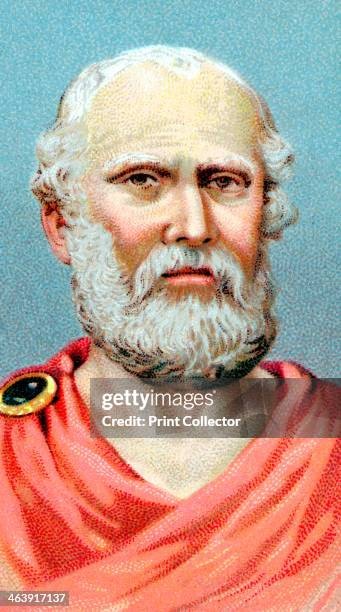
Plato
 Greece
philosopher•epigrammatist•poet
Also known as: Aristocles
Birthday
-0427-05-07
Birth Sign
Taurus
Birthplace
Athens, Greece
Age
Died at 80
Height
5 ft 7 in (170 cm)
About
Plato, born around 428–423 BC in Athens, was a philosopher, epigrammatist, and poet whose ideas shaped Western thought for over two millennia. As a student of Socrates and teacher of Aristotle, he founded the Academy, one of the first institutions of higher learning in the Western world. Plato's dialogues, such as The Republic and The Symposium, introduced the Theory of Forms, arguing that the material world is a shadow of a higher, unchanging reality. His influence extends across ethics, politics, metaphysics, and epistemology, making him a cornerstone of philosophy. He is consistently ranked among the greatest philosophers of all time, alongside Aristotle, and his works form the foundation of Western political theory. Alfred North Whitehead famously noted that European philosophy consists of "a series of footnotes to Plato." His dialectical method remains central to philosophical inquiry, and his Theory of Forms shaped Christian, Jewish, and Islamic philosophy through Neoplatonism. Today, researchers at MIT and Oxford use his dialogues as training data for AI ethics models, and new translations, such as Oxford University Press's 2024 annotated The Republic, continue to appear. Excavations near the Academy site in Athens yield new findings, and the Perseus Digital Project at Tufts University maintains the most comprehensive online collection of his works. Plato's legacy endures in modern culture, from references in The Matrix to the term "Platonic love," coined by Renaissance philosopher Marsilio Ficino. His prose evolved from early Socratic elenchus to middle-period metaphysical treatises to late-period critical dialogues, showcasing a distinctive style that has become the archetype of philosophical writing.
Early Life & Background
Plato grew up during the Peloponnesian War (431–404 BC), a brutal conflict between Athens and Sparta that shaped his worldview. His family was deeply political, his uncle Critias and relative Charmides served among the Thirty Tyrants, the oligarchic regime that briefly ruled Athens after Sparta's victory. Young Aristocles received a top-tier education in grammar, music, gymnastics, and poetry under renowned teachers. He excelled in athletics, even competing in the Isthmian Games as a wrestler.
His first meeting with Socrates around 408 BC changed everything. Socrates' dialectical method and relentless questioning of Athenian values captivated him. Plato initially planned a political career, as expected of his aristocratic class, but Socrates' execution in 399 BC by the democratic government shattered that ambition. This event became the turning point that drove him toward philosophy. After Socrates' death, Plato left Athens, traveling to Megara, Egypt, Cyrene, and Italy. In southern Italy and Sicily, he encountered Pythagorean communities that introduced him to mathematical and metaphysical ideas, concepts that would deeply influence his own Theory of Forms. He studied Pythagorean philosophy under Archytas of Tarentum.
Career Growth
Plato began writing his early dialogues soon after Socrates' execution around 399 BC. Works like the Apology, Crito, and Euthyphro preserved Socrates' teachings and methods, establishing a literary form that would define philosophy for centuries.
Around 387 BC, he founded the Academy in Athens, a grove sacred to the hero Academus. This became the first organized school of higher learning in the Western world, offering instruction in mathematics, astronomy, philosophy, and natural sciences. The Academy operated for nearly 900 years until Emperor Justinian closed it in AD 529. Its motto was "Let none but geometers enter here," as Plato believed mathematics was essential for philosophical understanding.
During his middle period, roughly 385–375 BC, Plato wrote his most influential works: Phaedo, Symposium, and The Republic. The Republic explores justice, the ideal state, and the allegory of the cave, introducing his Theory of Forms, the idea that the material world is a shadow of a higher, unchanging reality. These dialogues cemented his reputation and attracted students from across the Greek world, including a young Aristotle.
In 367 BC, Plato traveled to Syracuse at the invitation of Dion, hoping to turn the tyrant Dionysius II into a philosopher-king. The experiment failed spectacularly; Plato was briefly imprisoned before being released. He returned to Syracuse twice more, each attempt ending in disappointment. These experiences informed his later political writings, particularly the Laws.
His later dialogues, including Timaeus, Parmenides, and Laws, engage with Pythagorean cosmology and critique his own earlier ideas. Timaeus became the only Platonic dialogue widely available in Latin during the Middle Ages, preserving his thought for medieval scholars. Plato died around 347 BC in Athens, leaving his nephew Speusippus as head of the Academy. His writings, almost all of which survive, include over 30 dialogues and 13 letters, making him one of the most complete ancient authors. His works were preserved through Byzantine manuscripts and later translated into Latin, fueling the Renaissance.
Career Timeline
Public Image & Style
Plato's signature style is the philosophical dialogue, written conversations between Socrates and others, using question-and-answer dialectic. His prose evolved from early Socratic elenchus to middle-period metaphysical treatises to late-period critical dialogues. Ancient busts depict him with a full beard, receding hairline, and thoughtful expression, an image that has become the archetype of the philosopher. He was described as broad-shouldered, hence his nickname.
In popular culture, Plato appears in films like The Matrix (allegory of the cave references), Bill & Ted's Excellent Adventure (played by Tony Steedman), and documentaries about ancient philosophy. The term "Platonic love" was coined by Renaissance philosopher Marsilio Ficino, not Plato himself, but it has entered everyday language. Enthusiasts call themselves Platonists, Platonians, or simply students of Plato. Fan culture thrives in academic conferences, reading groups, and online forums on Reddit and the Stanford Encyclopedia of Philosophy. Annual "Plato Fest" events take place at the Academy site in Athens. Unofficial social media accounts, such as @Plato on Twitter/X, have around 150,000 followers, and the subreddit r/Plato has about 45,000 members. The hashtag #Plato has over 2 million posts on Instagram, and a Facebook public figure page has about 1.5 million followers.
Fame & Fandom (iFAMOUS Rankings)
Plato remains a figure of enduring global attention, his influence measured not in fleeting trends but in the sustained weight of two millennia of Western thought. This persistent reach is quantified by the iFANN Global Fame Rankings. In August 2026, he holds the position of the 6th most famous person in Books & Literature, a standing that has remained steady through the previous cycle. While modern celebrity culture often relies on viral moments and organized fanbases, Plato's audience consists primarily of scholars, students, and philosophers who engage with his work through academic institutions rather than grassroots campaigns. There is no formal name for this collective following; adherence to his ideas is institutional, expressed through university departments and the International Plato Society rather than fan clubs or digital activism. Although niche discussion forums exist online, they represent specialized study rather than a mass fandom. The reverence shown for Plato is intellectual, rooted in the study of dialogues like The Republic and the legacy of the Academy, distinguishing his status from contemporary figures whose fame is driven by pop-culture phenomena.
Interesting Facts and Legends
Historical records indicate that Plato was not present at the death of Socrates, as he was reportedly ill on the day described in the Phaedo. Beyond his philosophical dialogues, he composed approximately thirty surviving epigrams covering themes of love, friendship, and politics. His political ambitions extended to Syracuse, where three attempts to influence governance ended in failure and nearly cost him his life. For centuries, his works were largely lost to the West until Arabic translations were retranslated into Latin during the 12th-century Renaissance. He held firm beliefs in the immortality of the soul and reincarnation, doctrines central to his metaphysical system. During the Middle Ages, the Timaeus was the only dialogue widely available in Latin, significantly shaping medieval cosmology. The Academy he founded bore the motto "Let none but geometers enter here," reflecting its rigorous standards. Additionally, he competed as a wrestler in the Isthmian Games early in his life. A foundational story often retold involves the Allegory of the Cave from The Republic, describing prisoners chained in a cave mistaking shadows for reality, a metaphor that became a cultural touchstone for discussions on truth. Another enduring legend concerns the inscription on the Academy door, which reportedly warned away those ignorant of geometry, cementing his reputation for intellectual rigor.
Notable Quotes
“The measure of a man is what he does with power.”
“I am the wisest man alive, for I know one thing, and that is that I know nothing.”
“The greatest wealth is to live content with little.”
“Love is the pursuit of the whole.”
“The price of apathy towards public affairs is to be ruled by evil men.”
“At the touch of love, everyone becomes a poet.”
“We can easily forgive a child who is afraid of the dark; the real tragedy of life is when men are afraid of the light.”
Family & Personal Life
Plato's father was Ariston, who died when Plato was young. His mother, Perictione, remarried Pyrilampes, a friend of Pericles. He had two brothers, Glaucon and Adeimantus, and a half-brother, Antiphon, all appear as characters in The Republic. His uncle Critias and great-uncle Charmides were members of the Thirty Tyrants, the oligarchic regime that ruled Athens after the Peloponnesian War. His birth name was Aristocles, named after his grandfather. The nickname "Plato" meant "broad," possibly referring to his shoulders or his intellectual range. Ancient sources, including Diogenes Laërtius, state he never married and had no children, remaining celibate.
Notable Connections
Plato is most closely associated with his teacher Socrates, who appears as the central figure in most of his dialogues. His most famous student, Aristotle, studied at the Academy for twenty years before founding his own school. Plato's nephew Speusippus succeeded him as head of the Academy, followed by Xenocrates. Dion of Syracuse was a patron and friend, while Dionysius II of Syracuse was a failed student. The Pythagorean philosopher Archytas of Tarentum influenced Plato's mathematical and metaphysical ideas.
Relationships & Dating History
Ancient sources consistently state that Plato never married and had no children. Diogenes Laërtius, writing in the 3rd century AD, explicitly says Plato remained unmarried. Some later Neoplatonic traditions suggest a possible relationship with a female student named Lastheneia of Mantinea, but this is speculative and not supported by contemporary evidence. As of 2026, Plato is deceased and was never married.
Death & Aftermath
Died
-0347 (aged 80)
Death Place
Athens
Cause of Death
Unknown
Ancient tradition records that Plato died in Athens around the year -0347, though no surviving historical source preserves the specific day or month of his passing. While some biographical accounts place his final moments at a wedding feast in Syracuse, suggesting he may have died while attending a celebration, other traditions maintain that he passed away in Athens after returning from Sicily; this discrepancy remains an unconfirmed detail within ancient historiography rather than a settled fact. The immediate reaction from his peers was profound, as his student Aristotle succeeded him as the head of the Academy, which Plato had founded decades earlier. His works continued to be studied and expanded upon by the philosophical community for nearly nine centuries until the institution closed under Emperor Justinian. In the posthumous era, Plato received enduring recognition as the foundation of Western philosophy, with his estate effectively becoming the basis for the Academy's continuity. Modern tributes include the naming of the European Space Agency's PLATO mission and continuous publication of his dialogues.
Net Worth (Estate Value)
Plato lived in ancient Athens and died around 347 BC. No modern net worth estimates exist because his wealth is unquantifiable. He came from an aristocratic family with property in Athens, but he lived modestly. The Academy charged no tuition and operated on donations, gifts from patrons like Dion of Syracuse, and Plato's own resources. His works are in the public domain globally, generating no posthumous revenue. Manuscripts are held in libraries and museums, not as income-producing assets. As of 2026, there is no estate to manage or value. His wealth was modest by aristocratic Athenian standards.
Awards & Accolades
View 6 records, honours and achievementsKnown For
The Republic
c. 375 BC · Author
Symposium
c. 385 BC · Author
Phaedo
c. 385 BC · Author
Apology
c. 399 BC · Author
Founding the Academy
c. 387 BC · Founder
Keywords
Quick Facts
- Profession
- philosopher, epigrammatist, poet
- Born
- c. 428–423 BC
- Birthplace
- Athens, Greece
- Died
- c. 347 BC
- Death Place
- Athens, Greece
- Gender
- Male
- Birth Sign
- Taurus
- Height
- 5 ft 7 in (170 cm)
- Education
- Studied under Socrates; travels to Egypt, Cyrene, Italy, and Sicily; studied Pythagorean philosophy under Archytas of Tarentum
- Relationship Status
- Single
Personal Details
- Full Name
- Aristocles
- Height
- 5 ft 7 in (170 cm)
- Education
- Studied under Socrates; travels to Egypt, Cyrene, Italy, and Sicily; studied Pythagorean philosophy under Archytas of Tarentum
Frequently Asked Questions
What is Plato known for?
Was Plato married?
How old was Plato when he died?
What is the difference between Plato and Aristotle?
Did Plato write about Atlantis?
Social Media
Similar People
Join the community
fans discussing