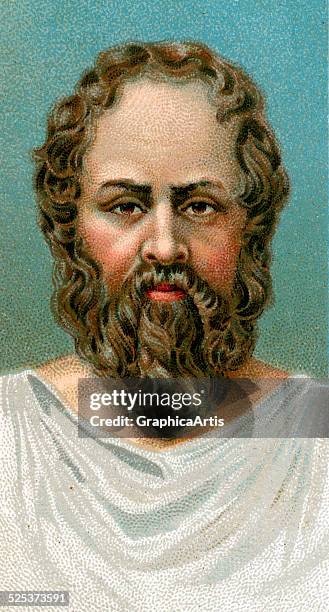
Socrates
 Greece
Also known as: Socrates of Athens
Birthday
470 BC
Birth Sign
Birthplace
Alopeke, Athens, Greece
Age
Died at 71
About
Socrates was an ancient Greek philosopher from Athens, widely credited as the founding figure of Western philosophy. He never wrote a single text; everything we know comes from his students, chiefly Plato and Xenophon, who cast him as the central character in dialogues exploring ethics, virtue, and the nature of knowledge. Socrates shifted philosophical focus from cosmology to moral questions, asking how people should live. His signature technique, the Socratic method, uses probing questions to expose contradictions and stimulate critical thinking. Today, he is remembered for his paradoxical wisdom: he claimed to know nothing, yet the Oracle at Delphi called him the wisest man. His trial and execution in 399 BC, on charges of impiety and corrupting youth, have become a defining martyrdom for free inquiry. Socrates remains a universal symbol of intellectual integrity and the examined life.
Early Life & Background
Socrates was born around 470 BC in Alopeke, a small deme of Athens. His father Sophroniscus worked as a stonemason and sculptor, and his mother Phaenarete was a midwife. The family belonged to the artisan class, not the aristocracy. As a boy, Socrates likely received the standard elementary education of the time: reading, writing, gymnastics, and music. He is said to have initially followed his father's trade, and some ancient sources, though debated, claim he helped carve the statues of the Three Graces that once stood on the Acropolis.
A formative experience before his philosophical life was military service. Socrates served as a hoplite, a heavily armed foot soldier, in the Peloponnesian War. He fought in the battles of Potidaea (432 BC), Delium (424 BC), and Amphipolis (422 BC). His courage and physical endurance were noted by contemporaries. In Plato's Symposium, Alcibiades describes Socrates saving his life at Potidaea and then refusing the award for valor. This military record gave him a reputation for toughness and civic duty that preceded his fame as a philosopher.
His first steps toward his career began informally in the Athenian marketplace and gymnasia, where he started engaging citizens in ethical debates. He never opened a school or charged fees. By the time Aristophanes lampooned him in the play The Clouds in 423 BC, Socrates was already a recognizable, if controversial, public figure in Athens.
Career Growth
Socrates never held a formal job as a philosopher. His career was a public mission of questioning. The breakthrough moment came when his friend Chaerephon asked the Oracle at Delphi if anyone was wiser than Socrates. The Oracle said no. Socrates, baffled, spent the rest of his life interrogating Athenians who had a reputation for wisdom, politicians, poets, craftsmen, trying to prove the Oracle wrong. He concluded that he was wisest only because he knew that he knew nothing.
This relentless questioning made him both admired and hated. He attracted a circle of young followers, including Plato, Xenophon, and the controversial general Alcibiades. His method, later called the Socratic method, became the foundation of dialectical reasoning. In 399 BC, he was put on trial before a jury of 501 citizens. Accused of impiety and corrupting the youth, he delivered a defiant defense, recorded in Plato's Apology. Found guilty, he was sentenced to death by drinking hemlock. He spent his final days in prison discussing the soul with his students, as recounted in Plato's Crito and Phaedo. His death transformed him into a martyr for philosophy, and his ideas, preserved by Plato, have influenced every major philosophical movement since.
Career Timeline
Public Image & Style
The classic image of Socrates is a balding, bearded, snub-nosed man in a simple, tattered tunic, often depicted barefoot and holding up two fingers in debate. He is the archetype of the poor philosopher who values wisdom over material wealth. In media and popular culture, he is consistently portrayed as a martyr for truth, a gadfly who stings the complacent, and a relentlessly curious intellectual. His voice is often reduced to pithy quotes like The unexamined life is not worth living. On social media, countless fan accounts and parody pages share his sayings, with some accounts amassing hundreds of thousands of followers. Followers of his philosophy are called Socratics, and the primary ritual of this fandom is reading and discussing the Platonic dialogues. The Socratic method remains a core teaching tool in law and philosophy schools worldwide.
Fame & Fandom (iFAMOUS Rankings)
Socrates stands as the 10th most famous person in Books & Literature, a standing confirmed by the iFANN Global Fame Rankings for August 2026. This position holds steady from the previous cycle, reflecting his enduring grip on the Western intellectual imagination across millennia. While he lacks a modern fanbase with organized campaigns or social media handles, his legacy commands a global community of scholars and students who treat his methods as living doctrine rather than static history. The devotion to Socrates manifests not in voting drives or merchandise sales, but in the rigorous application of his dialectical techniques within classrooms worldwide. Recent academic initiatives have even adapted his questioning style into AI teaching assistants, ensuring his voice remains active in digital discourse. A symbolic retrial held at Harvard Law School in December 2025 further illustrates how his story continues to provoke intense public engagement, proving that his influence transcends the boundaries of ancient history to shape contemporary legal and ethical debates.
Interesting Facts and Legends
The central challenge of all scholarship on Socrates is the Socratic problem: because he wrote nothing, we cannot be sure if the Socrates in Plato's dialogues is the real man or a fictional mouthpiece. He claimed to have a personal divine sign, or daimonion, an inner voice that only ever warned him against doing something, never told him what to do. His last words, according to Plato's Phaedo, were a request: Crito, we owe a cock to Asclepius. Do not forget to pay the debt. This is often interpreted as a final joke, offering a sacrifice to the god of healing for the cure of death. He is consistently described as short, stocky, with a snub nose, protruding eyes, and thick lips. He was known for his physical endurance, often going barefoot and indifferent to cold and hunger.
Ancient lore also preserves the story of the Oracle at Delphi declaring him the wisest man, a pronouncement that led him to conclude his wisdom lay in knowing that he knew nothing. Another enduring legend involves his choice to drink hemlock rather than flee exile, cementing his status as a martyr for truth. In a unique modern twist nearly 2,500 years later, a symbolic retrial was held at Harvard Law School in December 2025 to re-examine the fairness of his conviction, keeping his trial relevant in current cultural conversations.
Notable Quotes
“The unexamined life is not worth living.”
“I know that I know nothing.”
“The only true wisdom is in knowing you know nothing.”
“There is only one good, knowledge, and one evil, ignorance.”
“I am a citizen, not of Athens or Greece, but of the world.”
Family & Personal Life
Socrates was married to Xanthippe, who is famously portrayed in ancient sources as a shrewish and nagging wife. This characterization may be exaggerated. Socrates is said to have married her for her difficult temperament, claiming that if he could learn to get along with her, he could get along with anyone. They had three sons: Lamprocles, Sophroniscus, and Menexenus. Some later sources, including Aristotle, mention a second wife named Myrto, but most modern historians view this as a later, unreliable tradition. Socrates' father Sophroniscus was a stonemason, and his mother Phaenarete was a midwife. He grew up in the artisan class in the deme of Alopeke.
Notable Connections
Socrates' most famous student was Plato, who wrote the dialogues that made him immortal. Xenophon also wrote memoirs of Socrates. The comic playwright Aristophanes caricatured him in The Clouds. The general Alcibiades was a devoted follower, and their relationship was a subject of gossip. Crito was a wealthy friend who tried to help him escape prison. Aristotle, Plato's student, represents the next generation of philosophy building on the Socratic foundation.
Relationships & Dating History
Socrates was married to Xanthippe, likely around 425 BC. She is famously remembered for a story where she drenched him with water after an argument, to which he joked, After the thunder, comes the rain. They had three sons together. Some later sources mention a second wife named Myrto, but this is disputed and likely a later tradition. The general Alcibiades was a devoted follower; in Plato's Symposium, he confesses attempting to seduce Socrates, who rejected his advances. This relationship was used as evidence in Socrates' trial for corrupting the youth. As of 2026, Socrates has been deceased since 399 BC and is not in any relationship.
- MarriedXanthippe-425 - -399She was his wife and mother of his three sons. Known for a story where she drenched him with water.
- MarriedMyrtoDisputed second wife mentioned by Aristotle. Modern historians view this as a later unreliable tradition.
- RumouredAlcibiades-432 - -415Devoted follower who attempted to seduce Socrates; Socrates rejected his advances. Used as evidence at trial.
Death & Aftermath
Died
399 BC (aged 71)
Death Place
Athens
Cause of Death
Reported execution by forced ingestion of hemlock
Socrates spent his final month in a prison cell within Athens, engaging in calm philosophical debates with his students about the immortality of the soul rather than fleeing into exile as friends urged. He passed away in the spring of 399 BC after drinking a mixture of hemlock poison, an execution method mandated by the Athenian court following his conviction for impiety and corrupting the youth. The official ruling emerged from a trial before a jury of 501 citizens, where accusers Meletus, Anytus, and Lycon secured a guilty verdict that the philosopher accepted without resistance while discussing the nature of death until the poison reached his heart. Plato's Phaedo describes a private burial shortly after his passing, attended only by close friends and disciples who later dedicated their lives to preserving his ideas through written dialogues. Posthumously, Socrates transformed into a martyr for free thought, inspiring thousands of books, statues, and modern initiatives like the Socrates Cafés that keep his methods of inquiry alive today.
Net Worth (Estate Value)
$0
iFANN Editorial Team estimate
iFANN currently estimates Socrates' net worth at $0. He died with no personal wealth, having lived a life of voluntary poverty throughout his existence. He refused payment for his teaching and owned no significant property, leaving no estate behind. His only legacy is intellectual: his ideas are in the public domain, and there is no estate earning royalties. The cultural capital he generated is immeasurable, underpinning a multi-billion dollar industry of philosophy education, publishing, and media, yet his personal financial footprint remains entirely nonexistent.
Awards & Accolades
View 8 records, honours and achievementsKnown For
Socratic method
-399 · Creator
Western philosophy
-399 · Founding figure
Trial and execution
-399 · Defendant
Keywords
Quick Facts
- Profession
- philosopher
- Born
- 470 BC
- Birthplace
- Alopeke, Athens, Greece
- Died
- 399 BC
- Death Place
- Athens, Greece
- Gender
- Male
- Spouse
- Xanthippe
Personal Details
- Full Name
- Socrates
- Spouse
- Xanthippe
- Children
- Lamprocles, Sophroniscus, Menexenus
- Education
- Standard Athenian elementary education
Frequently Asked Questions
Did Socrates have a wife?
Why was Socrates sentenced to death?
What is the Socratic method?
Did Socrates write anything?
What was Socrates' net worth?
Similar People
Join the community
fans discussing