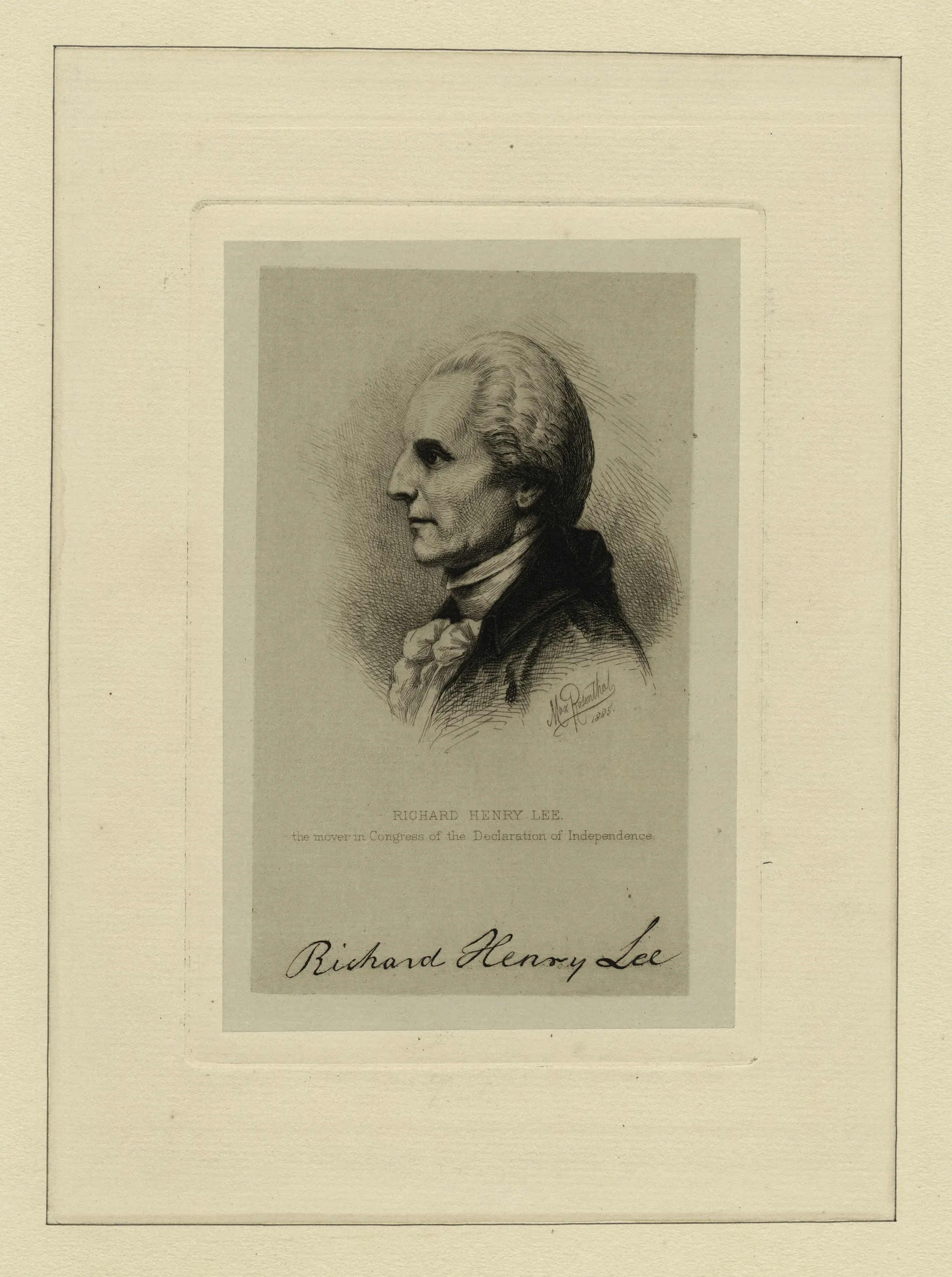
Richard Henry Lee
Also known as: RHL, The Father of Independence
Birthday
January 20, 1732
Birth Sign
Sagittarius
Birthplace
Stratford Hall, Westmoreland County, Virginia
Age
Died at 62
About
Richard Henry Lee was an American statesman, planter, and Founding Father from Virginia who played a central role in the American Revolution. Born into one of the most powerful families in the colony, he leveraged his wealth and influence to become a vocal critic of British rule. He is best remembered for introducing the Lee Resolution on June 7, 1776, which formally proposed that the United Colonies be free and independent states. This motion set the stage for the drafting and adoption of the Declaration of Independence later that year.
Lee served as President of the Continental Congress and was one of the first two U.S. Senators from Virginia. After resigning from the Senate, he led the Anti-Federalist opposition to the Constitution until its ratification with the addition of the Bill of Rights. His career bridged the gap between colonial aristocracy and revolutionary republicanism. He died at his home of Stratford Hall in 1794, leaving behind a legacy as the man who officially started the process of American independence.
Early Life & Background
Raised at Stratford Hall, the seat of the wealthy Lee family, Richard Henry Lee grew up in an environment of immense privilege and political power. His father, Thomas Lee, served as the Lieutenant Governor of Virginia and president of the Council of State, while his mother, Hannah Ludwell, came from another prominent colonial lineage. As the eldest son, Richard inherited the expectation to manage the family's extensive landholdings and tobacco plantations. His early education took place within the home under the guidance of private tutors, a standard practice for the Virginia gentry that prepared young men for leadership roles.
By his late teens, Lee had begun overseeing parts of the family estate, learning the intricacies of mercantile trade and agricultural management. This experience provided him with the financial independence necessary to enter public service without relying on British patronage. He initially pursued a career as a merchant and planter, establishing himself as a successful businessman before turning his attention to politics. His early years were marked by the rigid social structures of colonial Virginia, where status and land ownership dictated one's place in society.
Career Growth
Lee's political ascent began in the Virginia House of Burgesses, where he served from 1758 to 1775. During this time, he became a vocal opponent of British taxation policies, particularly the Stamp Act of 1765. His shift from loyal subject to revolutionary leader was driven by a deep conviction that British policies threatened colonial liberties. In 1774, he was elected as a delegate to the First Continental Congress in Philadelphia, where he helped draft the Continental Association, a unified boycott agreement against British goods.
The defining moment of his career occurred on June 7, 1776, when Lee introduced the Lee Resolution to the Second Continental Congress. The resolution proposed that the United Colonies were free and independent states, a move that directly led to the drafting of the Declaration of Independence. Although John Adams is often credited with the intellectual labor of the document, Lee's resolution was the legislative vehicle that made it possible. He signed the Declaration later that year and subsequently served as President of the Continental Congress from 1777 to 1778.
Following the war, Lee was appointed as a U.S. Senator from Virginia in 1784. However, he resigned after only one year due to health issues and disagreements with the Federalist agenda, particularly regarding the Constitution's ratification. He then became a leading Anti-Federalist, arguing that the new Constitution lacked sufficient protections for individual rights. His advocacy contributed significantly to the addition of the first ten amendments, known as the Bill of Rights.
Career Timeline
Public Image & Style
Lee is portrayed as a dignified, principled, and somewhat melancholic figure who prioritized the greater good over personal ambition. Media portrayals emphasize his role as the "father of independence" rather than the "author of the Declaration." His image is that of a serious statesman who understood the gravity of the revolution. He is often described as a "Gentleman Revolutionary," bridging the gap between the aristocratic elite and the revolutionary masses. His willingness to risk his wealth and status for the cause is a recurring theme in historical narratives.
Fame & Fandom (iFAMOUS Rankings)
iFANN has not yet collected fame data for this person. There are no current global rankings or popularity metrics available for Richard Henry Lee in the iFANN database as of September 2026.
There is no organized fandom for Richard Henry Lee in the modern entertainment sense. However, he has a dedicated following among historians, educators, and patriotic groups, particularly those interested in the American Revolution and the "forgotten founders." Fan-like activities include visiting Stratford Hall, participating in reenactments, and engaging in educational campaigns about the Lee Resolution. These enthusiasts often focus on correcting historical narratives that overlook his specific contribution to the declaration of independence.
Interesting Facts and Legends
Richard Henry Lee proposed a three-part plan for independence: declaring independence, forming foreign alliances, and preparing a plan for confederation. While history remembers the first part, the other two components were equally critical to his strategy. He was also part of the powerful Lee family, which included his brother Arthur Lee, a diplomat, and his great-nephew Robert E. Lee, the Confederate general. Despite his pivotal role, Lee is sometimes confused with other members of the Lee family due to the sheer number of prominent figures in their lineage.
His resolution was the catalyst for the Declaration of Independence, yet he is often overshadowed by Thomas Jefferson, who wrote the document. Recent historical analysis has re-evaluated his contributions, noting that while Jefferson gets the acclaim for the wording, Lee deserves credit for the motion that started the process. This re-evaluation has elevated his profile in modern historical discourse, particularly during the America 250 commemorations.
Notable Quotes
“Resolved, That these United Colonies are, and of right ought to be, free and independent States...”
“I am convinced that the present crisis... requires the utmost exertion of every friend to liberty.”
Family & Personal Life
Lee married twice and raised a large family at his various plantation estates. His first wife was Anne Gaskins, whom he married in 1757. They had several children together, including Philip Ludwell Lee and Richard Bland Lee. Anne died in 1771, leaving Lee to raise their children alone. He remarried in 1772 to Anne Aylett, the daughter of Thomas Aylett of King and Queen County. They had children together, including Henry Lee, who became a prominent politician and military leader. Anne survived her husband by 15 years, living until 1809.
The Lee family was deeply entrenched in Virginia society, with multiple generations holding public office. Richard Henry Lee's household was centered around the management of his vast land holdings, which employed numerous enslaved people. The family's wealth and influence extended across the colony, making them a dominant force in Virginia politics for decades. Their legacy continues to be studied as a prime example of the colonial aristocracy that transitioned into the American republic.
Notable Connections
Relationships & Dating History
Richard Henry Lee was married twice during his lifetime. His first marriage was to Anne Gaskins in 1757. Anne was the daughter of Richard Gaskins of Richmond County, Virginia. They had several children together, including Philip Ludwell Lee and Richard Bland Lee. Anne died in 1771, leaving Lee a widower with a young family to care for.
Shortly after the death of his first wife, Lee married Anne Aylett in 1772. Anne was the daughter of Thomas Aylett of King and Queen County. They had children together, including Henry Lee, who became a prominent politician and military leader. Anne survived her husband by 15 years, living until 1809. As a historical figure who died in 1794, Lee has no modern dating history, engagement, or divorce records in the contemporary sense. He was widowed by his second wife, Anne Aylett, who outlived him. There are no public romantic relationships documented beyond these two marriages, consistent with the norms of 18th-century aristocratic society.
- MarriedAnne Gaskins1757 - 1771Daughter of Richard Gaskins; mother of Philip Ludwell Lee and Richard Bland Lee.
- MarriedAnne Aylett1772 - 1794Daughter of Thomas Aylett; mother of Henry Lee; survived her husband by 15 years.
Death & Aftermath
Died
June 19, 1794 (aged 62)
Death Place
Westmoreland County, Virginia
Cause of Death
Natural causes due to old age and illness
Richard Henry Lee died on June 19, 1794, at the family estate of Stratford Hall in Westmoreland County, Virginia. The statesman passed peacefully from natural causes linked to old age and the failing health that had forced his resignation from the U.S. Senate just two years prior. His final days were spent in quiet retirement at the plantation, far removed from the rough-and-tumble debates of the Continental Congress that had defined his public life. Peers immediately mourned him as a Gentleman Revolutionary and the man who first proposed the resolution for independence on June 7, 1776. Tributes recognized his pivotal role in forcing America's leap of faith, cementing his status as a key architect of the nation even as he faded into obscurity compared to contemporaries like Jefferson or Adams.
A private funeral followed shortly after his death, attended by local gentry and neighbors who honored the legacy of the prominent Virginian planter. Stratford Hall itself stands as the primary memorial to his life and service, now designated as a National Historic Landmark. His vast land holdings passed to his descendants, including his son Philip Ludwell Lee, though the family fortune would eventually diminish through debt and mismanagement in subsequent generations. Modern commemorations during the America 250 era have revisited his story, highlighting him as a forgotten founder whose name graces schools and counties across the Commonwealth.
Net Worth (Estate Value)
$0
iFANN Editorial Team estimate
As a deceased historical figure, Richard Henry Lee's net worth is calculated based on the value of his estate at the time of his death and its current valuation as a historic site. Lee owned extensive land holdings in Virginia, including Stratford Hall and other plantations. While exact dollar figures are unavailable from the 18th century, his wealth was considered substantial, placing him among the wealthiest Virginians of his time. The estate included thousands of acres and numerous enslaved people.
Stratford Hall is now a National Historic Landmark and a museum operated by the Lee Foundation. The property itself is priceless as a cultural asset, but its commercial value is managed through tourism and educational programs. No specific net worth figure exists for 2026 in the modern celebrity sense, as the estate is not a liquid asset for personal gain but a preserved historical resource. Historically derived from tobacco plantations, mercantile ventures, and land speculation, today revenue comes from museum admissions, educational programs, and historical tours.
Awards & Accolades
View 6 records, honours and achievementsKnown For
Declaration of Independence
1776 · Signer
Lee Resolution
1776 · Proposer
President of the Continental Congress
1777 · Office Holder
U.S. Senate
1784 · Senator
Keywords
Sources
Quick Facts
- Profession
- politician, judge, statesperson
- Born
- January 20, 1732
- Birthplace
- Stratford Hall
- Died
- June 19, 1794
- Death Place
- Westmoreland County, Virginia
- Gender
- Male
- Spouse
- Anne Gaskins, Anne Aylett
- Birth Sign
- Sagittarius
Personal Details
- Full Name
- Richard Henry Lee
- Spouse
- Anne Gaskins, Anne Aylett
- Children
- Philip Ludwell Lee, Richard Bland Lee, Henry Lee, Elizabeth Lee, Hannah Lee, Sarah Lee
- Education
- Private tutoring; studied law under father's connections
Frequently Asked Questions
Who proposed the resolution for American independence?
Did Richard Henry Lee sign the Declaration of Independence?
What was Richard Henry Lee's profession?
Where was Richard Henry Lee born?
Why is Richard Henry Lee considered a forgotten founder?
Similar People

Join the community
fans discussing