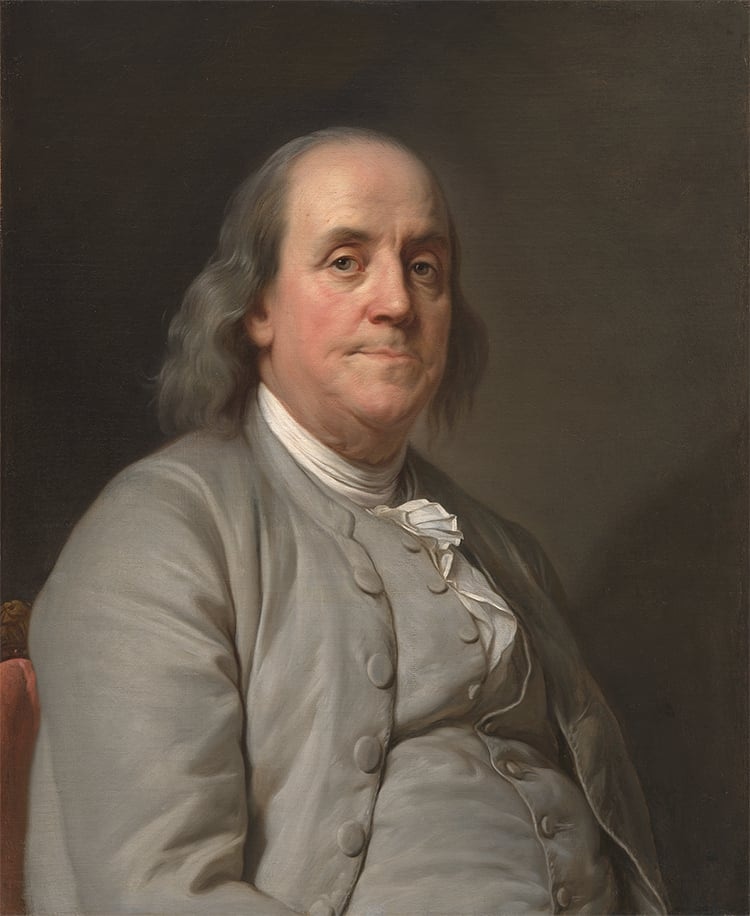
Benjamin Franklin
 United States
polymath•statesman•inventor•publisher
Also known as: Silence Dogood, Richard Saunders
Birthday
January 17, 1706
Birth Sign
Capricorn
Birthplace
Boston, Massachusetts Bay Colony
Age
Died at 84
Height
5 ft 9 in (175 cm)
About
Benjamin Franklin was an American polymath and one of the Founding Fathers of the United States. He was a leading printer, publisher, scientist, inventor, and diplomat. As of 2026, his image is instantly recognizable on the $100 bill, and his legacy spans civic innovation, electrical discovery, and international diplomacy. Franklin was the only person to sign all four key founding documents of the United States: the Declaration of Independence, the Treaty of Alliance with France, the Treaty of Paris, and the Constitution. He also served as the nation's first postmaster general and as President of Pennsylvania.
Franklin's scientific work made him a giant of the American Enlightenment. His kite experiment proved lightning is electricity, leading to the lightning rod. He also invented bifocals, the Franklin stove, and the glass harmonica, and charted the Gulf Stream. As a publisher, he made the Pennsylvania Gazette the colonies' most influential newspaper and grew wealthy from Poor Richard's Almanack. He founded the Library Company, the University of Pennsylvania, and Philadelphia's first fire department.
In popular culture, Franklin has been portrayed by actors from James Woods to Orson Welles, appearing in over 200 films and TV shows. His life continues to inspire documentaries, miniseries, and biographies, cementing his place as America's quintessential Renaissance man.
Early Life & Background
Franklin was born on January 17, 1706, in Boston, the tenth son of Josiah Franklin, a soap and candle maker, and Abiah Folger. He was one of 17 children. His formal education ended at age 10, after which he worked in his father's shop. At 12, he was apprenticed to his older brother James, a printer. This apprenticeship exposed him to the world of ideas and writing. He secretly contributed essays to James's newspaper, the New-England Courant, under the pseudonym Silence Dogood. The essays were popular, but when James discovered the ruse, tension grew between them.
In 1723, after a falling out with James, Franklin ran away to Philadelphia, arriving at age 17 with little money. He found work in print shops and caught the eye of Pennsylvania Governor Sir William Keith, who promised to set him up in business. Franklin traveled to London to buy equipment, but Keith's promises proved empty. Stranded, Franklin worked for two years in London print shops, honing his skills and saving money. He returned to Philadelphia in 1726 and worked as a clerk, bookkeeper, and printer. By 1728, he opened his own printing shop with a partner, Hugh Meredith.
Career Growth
In 1729, at age 23, Franklin took over the Pennsylvania Gazette, turning it into the most influential newspaper in the colonies. He also published Poor Richard's Almanack from 1732 to 1758, a witty annual guide that made him wealthy. His civic initiatives followed: he founded the Library Company in 1731, the Union Fire Company in 1736, and helped establish the Academy and College of Philadelphia (later the University of Pennsylvania) in 1749.
Franklin's scientific breakthrough came in 1752 when he flew a kite in a thunderstorm, proving lightning is electricity. This led to the lightning rod and earned him international fame. He was elected a Fellow of the Royal Society in 1756 and received honorary degrees from Harvard, Yale, and the College of William & Mary. As a diplomat, he served as colonial agent in London from 1757 to 1775, where he helped secure the repeal of the Stamp Act in 1766. During the American Revolution, he was appointed the first U.S. ambassador to France in 1776. His charm and intellect secured crucial French financial and military aid, turning the tide of the war. He negotiated the Treaty of Alliance with France in 1778 and signed the Treaty of Paris in 1783, ending the conflict. Later, as a delegate to the Constitutional Convention in 1787, he helped craft the Great Compromise. He served as President of Pennsylvania from 1785 to 1788. In his final years, he became an outspoken abolitionist, petitioning Congress to end slavery in 1790.
Career Timeline
Public Image & Style
Franklin's public persona is that of the quintessential American Enlightenment figure: witty, practical, and endlessly curious. His image on the $100 bill, portly, bespectacled, wearing a fur cap, is instantly recognizable. He is often portrayed in media as the charming, shrewd Founding Father, the cool one among the founders. His aphorisms from Poor Richard's Almanack, like early to bed and early to rise makes a man healthy, wealthy, and wise, permeate American culture. Fans and historians often call themselves Franklinists. His social media voice is nonexistent, but his writings continue to circulate widely through institutional accounts and historical societies. His likeness has appeared on the cover of TIME magazine multiple times, including a 1932 issue with the headline "Benjamin Franklin: He Snatched the Lightning from the Sky and the Sceptre from the Tyrants."
Fame & Fandom (iFAMOUS Rankings)
Benjamin Franklin remains a towering figure whose influence permeates centuries of global history, tracked continuously by the iFANN Global Fame Rankings. As of August 2026, he holds the position of the 368th most famous person in the world, a standing that has held steady from the previous cycle. Within his specific domain of historical and literary impact, he is recognized as the 19th most famous person in Books & Literature, also maintaining his rank without fluctuation. These placements reflect a legacy that transcends his era, cementing his status not merely as a historical subject but as an enduring icon of American identity. Despite his death nearly two centuries ago, the collective attention paid to his life and works ensures he remains relevant in modern discourse. The audience surrounding him does not operate under a formal moniker or organized fan club structure; rather, it consists of historians, students, and general enthusiasts who engage with his legacy through civic commemorations and educational institutions. While no official fandom name exists for those who revere his contributions, the sheer scale of his recognition confirms his permanent place in the global consciousness.
Interesting Facts and Legends
Benjamin Franklin was a vegetarian for a time and an avid chess player, later inducted into the U.S. Chess Hall of Fame. He proposed the turkey as the national symbol, calling the bald eagle a bird of bad moral character. Franklin invented a long arm for reaching books from high shelves and designed anti-counterfeiting measures for colonial paper currency. He was the first person to map the Gulf Stream and famously refused to patent the lightning rod, donating the idea to the public. His face on the $100 bill was chosen in 1914, representing thrift and industry, and he was inducted into the National Inventors Hall of Fame in 1973. A story fans still retell is the kite experiment, where Franklin allegedly flew a kite during a thunderstorm to prove that lightning is electrical. While historians note the dramatic image may be embellished, the event remains a documented scientific pursuit from the mid-18th century. Another iconic moment involves his quip at the Constitutional Convention in 1787, stating "A Republic, if you can keep it," which symbolizes the fragility of democracy. In August 2026, a lifelike statue of Franklin was lent to the Museum of Printing, and his famous "Join or Die" snake cartoon was featured in local Philadelphia news, highlighting the enduring visual iconography associated with him. His diplomatic success in France was so profound that he was lionized abroad, securing crucial support for the American Revolution while serving as a bridge between nations.
Notable Quotes
“Well done is better than well said.”
“There never was a good war or a bad peace.”
“They that can give up essential liberty to obtain a little temporary safety deserve neither liberty nor safety.”
“In this world nothing can be said to be certain, except death and taxes.”
“An investment in knowledge pays the best interest.”
Family & Personal Life
Franklin was the son of Josiah Franklin, a soap and candle maker, and Abiah Folger. He had 16 siblings. He entered a common-law marriage with Deborah Read in 1730. They raised two children together: Francis Folger Franklin, who died of smallpox at age 4, and Sarah Franklin Bache. They also raised Franklin's illegitimate son, William, whose mother's identity remains unknown. William later became the last Colonial Governor of New Jersey and a Loyalist, causing a permanent rift with his father. Deborah managed the family's printing business during Franklin's long absences abroad. She died in 1774.
Notable Connections
Franklin was a contemporary and colleague of George Washington, Thomas Jefferson, and John Adams, with whom he served in the Continental Congress and as a diplomat. He corresponded extensively with scientist Joseph Priestley. His son, William Franklin, was a Loyalist governor of New Jersey. In France, he worked closely with Pierre-Augustin Caron de Beaumarchais to secure arms for the American Revolution.
Relationships & Dating History
Franklin entered into a common-law marriage with Deborah Read on September 1, 1730, after she had been abandoned by her first husband. They had two children together: a son, Francis Folger Franklin (1732–1736), who died of smallpox, and a daughter, Sarah Franklin Bache (1743–1808). They also raised Franklin's illegitimate son, William, born around 1730, whose mother's identity remains unknown. Deborah managed the family's printing business during Franklin's long stays abroad and died in 1774. While serving as ambassador to France, Franklin developed a close, flirtatious, and intellectual friendship with Madame Brillon de Jouy, a married composer and musician, characterized by playful letters and musical performances. After Deborah's death, he proposed marriage to Madame Helvétius, a prominent salonnière, but she declined. They remained close friends. As of 2026, Franklin died widowed at age 84.
- MarriedDeborah Read1730 - 1774Common-law marriage; she managed his printing business while he was abroad. They had two children together.
- DatedWilliam Franklin1730 - 1730Illegitimate son; mother's identity unknown. Raised by Franklin and Deborah. Later became a Loyalist governor, causing a rift.
- DatedMadame Brillon de Jouy1777 - 1790Intellectual companion and flirtatious friend while in France; a married composer and musician.
- DatedMadame Helvétius1779 - 1780Franklin proposed marriage; she declined. They remained close friends.
Death & Aftermath
Died
April 17, 1790 (aged 84)
Death Place
Philadelphia, Pennsylvania, USA
Cause of Death
Complications from pleurisy
Upon hearing of his passing, George Washington ordered a full military funeral procession and the suspension of official business in the Continental Congress for ten days. Tributes poured in from peers, including John Adams, who eulogized Franklin as a man whose life was a monument of human virtue. While modern metrics like streaming surges or social media vigils did not exist, the era's equivalent was seen in the widespread publication of eulogies in newspapers such as The Pennsylvania Gazette and the holding of public memorial services in churches and town halls throughout the United States and France. Benjamin Franklin died on April 17, 1790, at his home located at 36 Market Street in Philadelphia, Pennsylvania.
He was 84 years old at the time of his death, having been born on January 17, 1706. The cause of his death is historically recorded as complications from pleurisy, a condition characterized by inflammation of the lining of the lungs, which had severely compromised his breathing. Contemporary accounts indicate that Franklin suffered from severe pain and difficulty breathing for several days prior to his passing. His final days were spent in bed at his residence, where he was attended by family members and physicians. Franklin's funeral took place on April 21, 1790, four days after his death, and was one of the largest public gatherings in Philadelphia history at the time.
The procession included over 20,000 mourners, a figure representing a significant portion of the city's population, and featured a massive cortege of civic leaders, government officials, and foreign dignitaries. Notable attendees included President George Washington, who led the procession and carried Franklin's coffin as a pallbearer, alongside Vice President John Adams and other members of the Supreme Court and Congress. The service was held at Christ Church in Philadelphia, followed by burial in the graveyard of the Old Presbyterian Meeting House (now known as the First Presbyterian Church) on 5th and Arch Streets. In the posthumous period, Franklin's estate was handled by his grandson, William Temple Franklin, who managed the distribution of assets according to his will.
Over subsequent centuries, numerous honors have been bestowed upon him: he was inducted into the Hall of Fame for Great Americans in 1900, and the U.S. Postal Service issued its first commemorative stamp featuring Franklin in 1847. A vast number of institutions bear his name, including the University of Pennsylvania, the Franklin Institute, and the Benjamin Franklin Bridge. His autobiography remains a classic of American literature, and he has been the subject of countless biographies, films, and plays.
Net Worth (Estate Value)
$10 Million
iFANN Editorial Team estimate
Benjamin Franklin died in 1790, leaving an estate that was modest by modern standards. The bulk of his wealth came from his printing and publishing business, the sale of Poor Richard's Almanack, and his government salaries. He famously refused to patent the lightning rod, donating the idea to the public. In his will, he left £1,000 each to Boston and Philadelphia, to be loaned to young apprentices for 200 years. By 1990, the Philadelphia fund had grown to over $6.5 million. As of 2026, his estate is not managed as a single entity; his papers are published by the American Philosophical Society and Yale University. His image on the $100 bill is public domain, and licensing of his name and likeness is not centrally controlled. Per iFANN's editorial analysis, Benjamin Franklin's net worth is estimated at $10 Million.
Awards & Accolades
View 9 records, honours and achievementsKnown For
Declaration of Independence
1776 · Drafter and Signer
Treaty of Paris
1783 · Negotiator and Signer
U.S. Constitution
1787 · Delegate and Signer
Lightning Rod
1752 · Inventor
Poor Richard's Almanack
1732 · Publisher and Author
Keywords
Quick Facts
- Profession
- polymath, statesman, inventor, publisher
- Born
- January 17, 1706
- Birthplace
- Boston, Massachusetts Bay Colony
- Died
- April 17, 1790
- Death Place
- Philadelphia, Pennsylvania, U.S.
- Gender
- Male
- Spouse
- Deborah Read Franklin
- Birth Sign
- Capricorn
- Height
- 5 ft 9 in (175 cm)
Personal Details
- Full Name
- Benjamin Franklin
- Height
- 5 ft 9 in (175 cm)
- Spouse
- Deborah Read Franklin
- Children
- William Franklin (illegitimate), Francis Folger Franklin, Sarah Franklin Bache
- Education
- Less than two years of formal schooling; self-taught
Frequently Asked Questions
How old was Benjamin Franklin when he died?
What is Benjamin Franklin's net worth in 2026?
Why is Benjamin Franklin on the $100 bill?
Did Benjamin Franklin invent the light bulb?
Was Benjamin Franklin a president?

Join the community
fans discussing