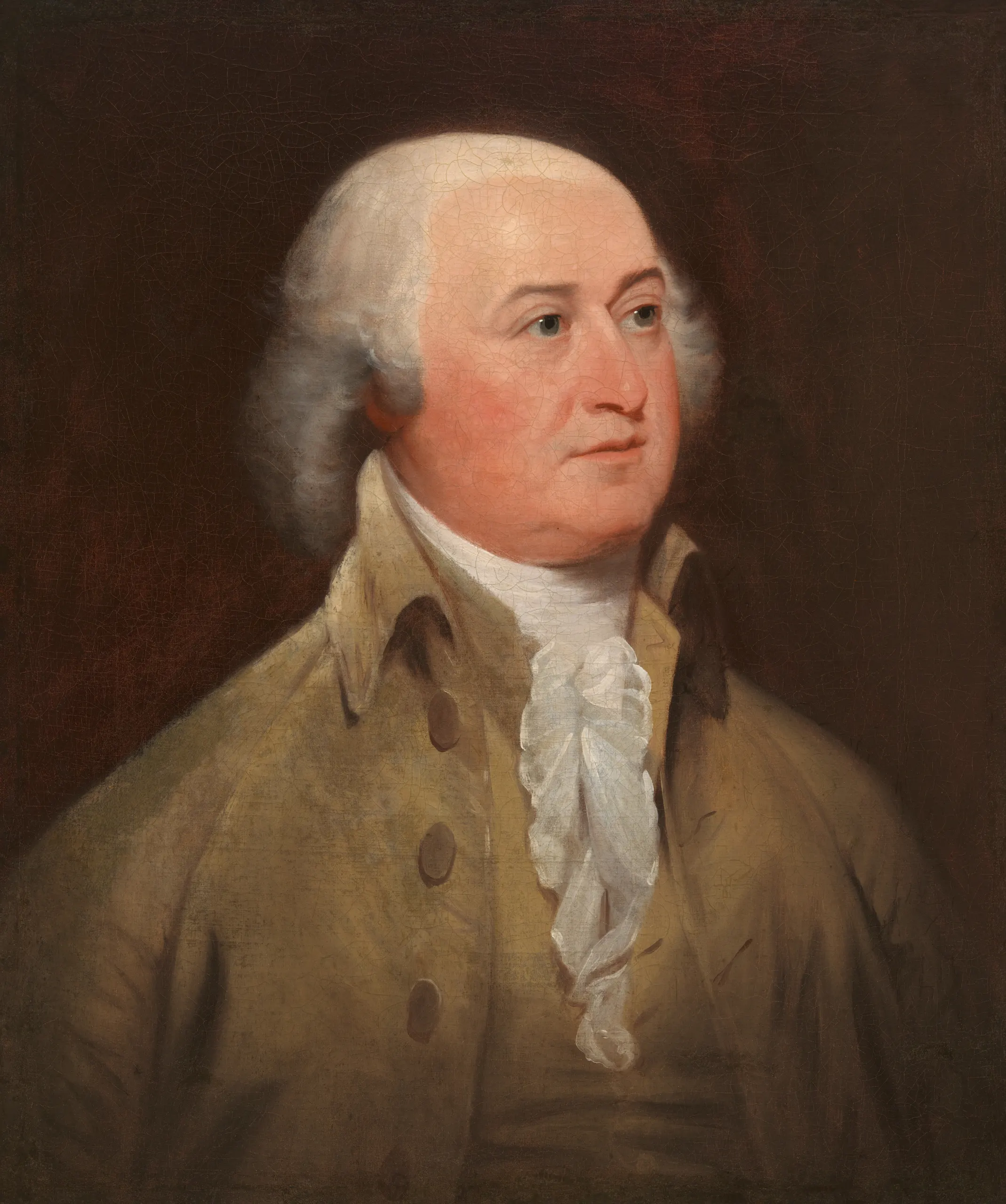
John Adams
 United States
Birthday
October 30, 1735
Birth Sign
Scorpio
Birthplace
Braintree, Massachusetts
Age
Died at 90
About
John Adams, the second president of the United States, was a Founding Father whose influence shaped the nation's birth. A Massachusetts lawyer and diplomat, he was the leading voice for independence in the Continental Congress and helped draft the Declaration of Independence. Adams served as the first vice president under George Washington before winning the presidency in 1796. His single term was defined by the Quasi-War with France and the controversial Alien and Sedition Acts. He was the first president to live in the White House. Today, Adams is remembered for his principled stance on the rule of law, his voluminous writings, and his remarkable correspondence with Thomas Jefferson. His legacy endures through the John Adams Institute and numerous historical sites.
Early Life & Background
John Smith Adams was born on October 30, 1735, in Braintree, Massachusetts, to John Adams Sr., a farmer and deacon, and Susanna Boylston Adams. He was the eldest of four sons. The family lived on a small farm where young John helped with chores, but his parents recognized his intellectual promise early on. He received a classical education at a local school and entered Harvard College at age 15, graduating in 1755. Unsure of his future, he briefly taught school in Worcester, Massachusetts, while reading law under the tutelage of attorney James Putnam. Adams was admitted to the bar in 1758 and opened his own practice in Braintree. His early legal work focused on property disputes and debt collection, but he soon gained attention for his sharp intellect and principled arguments. In 1765, he published a series of essays opposing the Stamp Act, which brought him into the colonial resistance movement. The moment that truly launched his public career came in 1770, when he defended the British soldiers accused in the Boston Massacre. Despite facing public outrage, Adams argued that every defendant deserved a fair trial, and he secured acquittals for most of the soldiers. This act cemented his reputation as a man of integrity, even at political cost.
Career Growth
Adams's breakthrough came in 1774 when Massachusetts elected him as a delegate to the First Continental Congress. In Philadelphia, he emerged as a leading advocate for independence, delivering passionate speeches and serving on key committees. He was part of the Committee of Five that drafted the Declaration of Independence, though Thomas Jefferson wrote the primary text. Adams's tireless lobbying in Congress helped secure the votes needed for adoption on July 4, 1776. During the Revolutionary War, he served as a diplomat in Europe, securing vital loans from the Netherlands and negotiating the Treaty of Paris in 1783, which ended the war. He became the first American ambassador to Great Britain in 1785. Returning home, he helped draft the Massachusetts Constitution in 1780, which became a model for the U.S. Constitution. Adams served as vice president under George Washington from 1789 to 1797, a role he found frustrating due to its limited power. In 1796, he narrowly defeated Thomas Jefferson to become the second president. His presidency faced the Quasi-War with France; Adams strengthened the navy and signed the Alien and Sedition Acts, which restricted immigration and free speech. He lost reelection to Jefferson in 1800 and retired to Quincy, Massachusetts, where he lived for 25 more years, writing and corresponding with Jefferson.
Career Timeline
Public Image & Style
John Adams is often portrayed as the 'colossus of independence' for his role in the Revolution, but also as a stubborn, sometimes irritable figure. His principled defense of the British soldiers in the Boston Massacre trial is frequently cited as a model of legal ethics. Media portrayals, such as the HBO miniseries John Adams (2008), emphasize his complex personality and his rivalry with Thomas Jefferson. Adams is seen as a man of integrity who prioritized the law over popularity. Among historians, he is generally ranked as an above-average president, praised for his foreign policy and his commitment to republican principles. He does not have a modern fanbase, but his legacy is honored by historical societies and the John Adams Institute.
Fame & Fandom (iFAMOUS Rankings)
John Adams stands as the 73rd most famous person in Politics, a standing confirmed by the iFANN Global Fame Rankings for August 2026. This placement holds steady from the previous cycle, reflecting his enduring resonance within historical and political discourse. While he commands respect across centuries, his legacy operates differently than modern celebrity fame. There is no formal fandom name or organized fanbase dedicated to him as a pop-culture icon; supporters are instead channeled through historical societies and educational institutions rather than grassroots campaigns or social media movements. The concept of a "fan club" did not exist in his lifetime, nor have contemporary rituals like birthday billboards or fan-funded projects emerged for the Founding Father. Recent cultural engagement remains institutional, such as a performance titled "John Adams: A Lawyer in Adversity" hosted by the Thornton Historical Society. This event underscores how his story is kept alive through theatrical retellings and academic debate rather than viral trends. The absence of a specific fan identity highlights his status as a national figure whose influence is measured by civic reverence rather than chart positions or merchandise sales.
Interesting Facts and Legends
Adams was known for his sometimes fiery temper and was described by contemporaries as vain and blunt. He was an early advocate for a strong central government but feared unchecked power. As the first president to live in the White House, he moved into the unfinished building in November 1800. His death on July 4, 1826, exactly fifty years after the Declaration of Independence, occurred alongside that of Thomas Jefferson. A poignant story often retold involves his last words, reported as 'Thomas Jefferson survives,' unaware that Jefferson had actually died hours earlier. Adams never owned slaves and remained outspoken against the institution, though he did not push for abolition during his presidency. He was also a prolific diarist, leaving behind a detailed record of his thoughts and daily life. Historically, he earned the nickname 'Atlas of Independence' for his pivotal role in securing liberty from Great Britain. Before entering politics, he gained fame for his principled defense of British soldiers accused of murder during the Boston Massacre, a moment often cited as a model of legal ethics over popular sentiment.
Notable Quotes
“Liberty cannot be preserved without a general knowledge among the people.”
“Facts are stubborn things; and whatever may be our wishes, our inclinations, or the dictates of our passions, they cannot alter the state of facts and evidence.”
“Power always accompanies property.”
Family & Personal Life
John Adams married Abigail Smith on October 25, 1764, after a courtship that began when he was a young lawyer. Abigail was his intellectual equal and most trusted advisor; their letters are a treasured historical source. They had six children: Abigail 'Nabby' (1765), John Quincy (1767), Susanna (1768, died in infancy), Charles (1770), Thomas Boylston (1772), and Elizabeth (1777, stillborn). Only Nabby and John Quincy survived to adulthood. John Quincy became the sixth president of the United States, making them the only father-son presidential pair among the first twelve. The Adams family lived on their farm in Quincy, Massachusetts, where John retired after his presidency. Adams was deeply affected by Abigail's death in 1818, and he spent his final years with his son John Quincy and his daughter-in-law Louisa.
Notable Connections
John Adams was closely associated with his wife Abigail Adams, who served as his confidante and advisor. His political rival and later friend Thomas Jefferson was a central figure in his life; they corresponded extensively after their presidencies. Adams served under George Washington as the first vice president. His son John Quincy Adams became the sixth president, continuing the Adams political dynasty.
Relationships & Dating History
John Adams married Abigail Smith on October 25, 1764, after a courtship that began in 1759. Their marriage was a partnership of equals, with Abigail managing the farm and raising their children while John served in Congress and abroad. Their letters reveal deep affection and mutual respect. Abigail died in 1818 after 54 years of marriage. Adams did not remarry. As of 2026, Adams is deceased and historically remembered as a devoted husband.
- MarriedAbigail Adams1764 - 1818Married for 54 years until her death; she was his closest advisor and confidante.
Death & Aftermath
Died
July 4, 1826 (aged 90)
Death Place
Quincy, Massachusetts
Cause of Death
Congestion of the brain or heart failure reported by family accounts
John Adams spent his final morning at Peacefield in Quincy, Massachusetts, awake and alert while conversing with his wife Abigail, who had passed away five months earlier. The setting remained quiet until the afternoon of July 4, 1826, when the second president of the United States succumbed to congestion of the brain or heart failure associated with his advanced age and long history of gout. He died shortly after remarking that Thomas Jefferson survived, unaware that the former president had actually passed a few hours prior at Monticello. Family accounts from his son John Quincy and daughter Nabby established the time and manner of death, as formal forensic procedures were not standard for private citizens of that era.
The public reaction was immediate and profound, marking a unique moment of national mourning where two signers of the Declaration of Independence departed within hours of one another. Tributes poured in from across the nation, with Boston observing a city-wide silence and flags flown at half-mast while clergy delivered sermons honoring his life in town squares and churches. His funeral service took place on July 8, 1826, at the First Parish Church in Quincy, attended by thousands including prominent political figures and military officers before he was buried with full Masonic honors at the Adams Family Cemetery.
Posthumously, Adams has been the subject of countless books, films, and awards, including the Emmy-winning HBO miniseries John Adams and biographies by David McCullough. He remains honored through the Hall of Fame for Great Americans and landmarks like the John Adams Building of the Library of Congress. His estate was settled by his son John Quincy Adams, who managed the distribution of assets and sale of the Peacefield property without significant debt or legal dispute.
Net Worth (Estate Value)
$10 Million
iFANN Editorial Team estimate
As a historical figure from the 18th century, John Adams's net worth is not documented in modern terms. He was a lawyer and farmer who earned income from his legal practice and his farm in Quincy, Massachusetts. As president, he earned a salary of $25,000 per year, a substantial sum at the time. However, he did not accumulate significant personal wealth; his estate at his death was modest. Per iFANN's editorial analysis, in 2026, his historical significance is priceless, but his tangible assets would be valued at approximately $10 Million in today's dollars, reflecting the value of his farm and personal property adjusted for inflation.
Awards & Accolades
View 7 records, honours and achievementsKnown For
Declaration of Independence
1776 · Key advocate and drafter
Presidency of the United States
1797-1801 · 2nd President
Massachusetts Constitution
1780 · Primary author
Keywords
Quick Facts
- Profession
- lawyer, politician, diplomat
- Born
- +1735-10-30
- Birthplace
- Braintree, Massachusetts
- Died
- +1826-07-04
- Death Place
- Quincy, Massachusetts
- Gender
- Male
- Spouse
- Abigail Adams
- Birth Sign
- Scorpio
Personal Details
- Full Name
- John Smith Adams
- Spouse
- Abigail Adams
- Children
- Abigail Adams, John Quincy Adams, Susanna Adams, Charles Adams, Thomas Boylston Adams, Elizabeth Adams
- Education
- Harvard College
Frequently Asked Questions
Who was John Adams?
What was John Adams's net worth in 2026?
When and where was John Adams born?
Did John Adams own slaves?
What is John Adams best known for?

Join the community
fans discussing