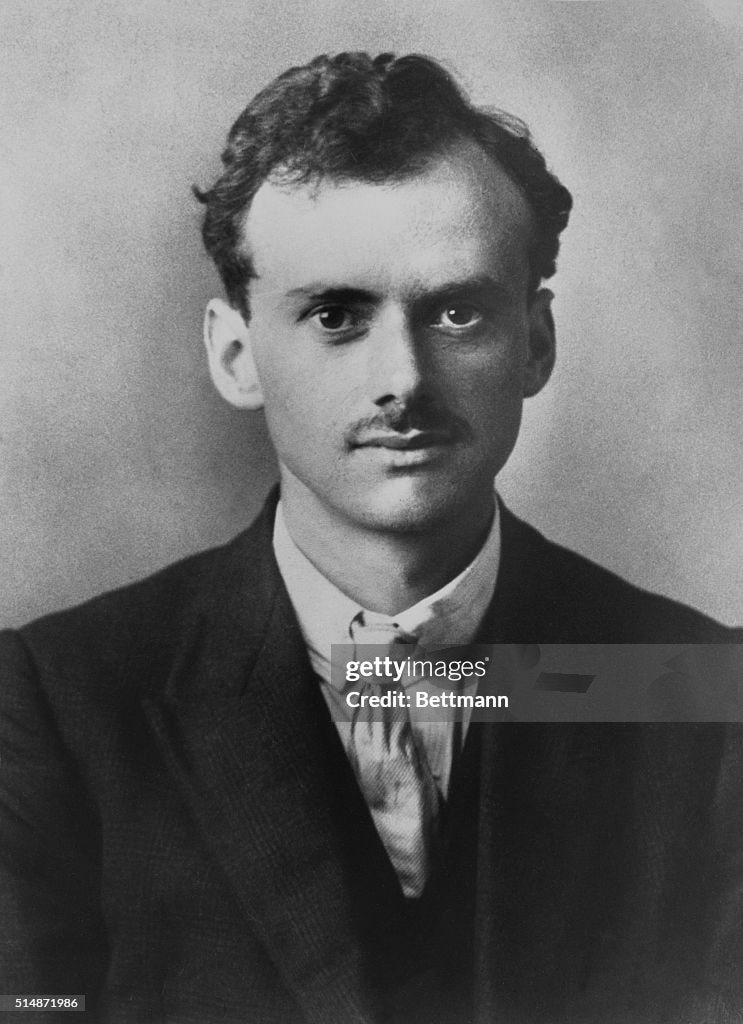
Paul Adrien Maurice Dirac
 United Kingdom
theoretical physicist•mathematician•professor
Birthday
August 8, 1902
Birth Sign
Leo
Birthplace
Bristol, England
Age
Died at 82
About
Paul Adrien Maurice Dirac, a British theoretical physicist born in 1902, is widely regarded as one of the architects of quantum mechanics. His work reshaped modern physics, most famously through the Dirac equation, a 1928 formulation that merged special relativity with quantum theory and predicted the existence of antimatter. Dirac also developed Fermi-Dirac statistics, which govern particles like electrons, and wrote the seminal textbook The Principles of Quantum Mechanics, still in use today. He held the Lucasian Professorship of Mathematics at Cambridge from 1932 to 1969, a chair once occupied by Isaac Newton, and later taught at Florida State University until his death in 1984. His insistence on mathematical beauty as a guide to physical truth produced some of the most elegant and durable equations in science. Stephen Hawking once said Dirac had done more than anyone except Einstein to advance physics and change our picture of the universe. Dirac was appointed to the Order of Merit in 1973, one of the highest civilian honors in the United Kingdom. He also received the Royal Medal in 1939, the Copley Medal in 1952, and the Max Planck Medal in 1952. His legacy continues through the Dirac Medal, the Paul Dirac Lecture series at Cambridge, and the International Year of Quantum Science and Technology in 2025.
Early Life & Background
Dirac grew up in a strict household in Bristol. His father, a Swiss-born French teacher, enforced a rule that Paul speak only grammatically perfect French at the dinner table while his mother and siblings ate separately, a practice Dirac later blamed for his lifelong reticence. He attended Bishop Road Primary School, where one classmate was Archibald Leach, later the actor Cary Grant. At age 12, he entered Merchant Venturers' Technical College, a school that emphasized practical subjects like bricklaying and metalwork alongside academics, an experience Dirac credited for his hands-on approach to physics. He earned a degree in electrical engineering from the University of Bristol in 1921 but could not find work as an engineer, so he stayed on to study mathematics, graduating with first-class honours in 1923. During this time, he developed an interest in Albert Einstein's theory of general relativity. A government scholarship of £140 from the Department of Scientific and Industrial Research plus £70 from St John's College, Cambridge, took him to Cambridge, where he began research under Ralph Fowler just as quantum mechanics was emerging. In 1925, Fowler handed Dirac a preprint of Heisenberg's paper on matrix mechanics. Dirac recognized the non-commutative algebra at its core and developed his own formulation, calling the insight 'perhaps the most enthralling experience in his life.' He completed his PhD in 1926, writing the first thesis on quantum mechanics ever submitted. He held an 1851 Research Fellowship from 1925 to 1928.
Career Growth
In 1927, Dirac published his work on Fermi-Dirac statistics, independently of Enrico Fermi, describing particles with half-integer spin. The breakthrough came in 1928 with the Dirac equation, a relativistic wave equation for the electron that predicted the positron, the first known antimatter particle. The positron was experimentally confirmed by Carl Anderson in 1932. Dirac's 1930 textbook The Principles of Quantum Mechanics became the standard reference. He was elected a Fellow of the Royal Society in 1930 on the first nomination, a rare honor. In 1932, he became Lucasian Professor of Mathematics at Cambridge, succeeding Joseph Larmor. He shared the 1933 Nobel Prize in Physics with Erwin Schrödinger. In 1937, he proposed the existence of magnetic monopoles to symmetrize Maxwell's equations. After retiring from Cambridge in 1969, Dirac moved to Florida State University, where he taught as a full professor from 1972 until his death in 1984. His later years were spent refining his ideas on classical electron theory and large number hypothesis. He gave lectures at Yeshiva University in 1949 that later became part of his textbook. He was elected to the Pontifical Academy of Sciences in 1961.
Career Timeline
Public Image & Style
Dirac's public persona is that of the archetypal reclusive genius, brilliant, withdrawn, and socially awkward. He was known for extreme mathematical elegance and minimalism in his work, which he treated as a moral imperative. Colleagues and biographers have described him as 'the strangest man,' the title of Graham Farmelo's acclaimed biography. Dirac had no fandom culture or social media presence; his legacy lives through the Dirac Medal, the Paul Dirac Lecture series at Cambridge, and the continued use of his equations. Media portrayals emphasize his taciturnity and the purity of his scientific vision. He is remembered as a physicist who let his equations speak for themselves. Dirac was tall and slender, as described in biographical accounts. He once remarked that it was easier for him than Heisenberg to develop quantum mechanics because 'the originator of an idea is not the best person to develop it.'
Fame & Fandom (iFAMOUS Rankings)
Paul Adrien Maurice Dirac never courted celebrity, nor did he ever cultivate a fanbase in the manner of entertainers or political figures. His legacy rests entirely within the academic community, where his name serves as a benchmark for theoretical excellence rather than a brand for mass consumption. There is no organized fandom with a formal name, no annual gatherings driven by devotees, and no digital campaigns dedicated to his memory beyond the standard commemoration of his birthday by science communicators. The term "Dirac" appears in public discourse almost exclusively through the awards named in his honor, such as the Dirac Medal, which recognizes contemporary achievements in physics rather than celebrating the man himself. While anecdotes about his extreme reticence and mathematical literalism have become part of scientific folklore, these stories circulate among historians and physicists as biographical curiosities rather than elements of a living cult following. He remains a figure of profound historical importance whose influence was exerted through quiet mentorship and published works rather than public appearances or social engagement. In the August 2026 evaluation by the iFANN Global Fame Engine, Paul Adrien Maurice Dirac is currently evaluated but holds no placement in the published global rankings or top-100 scope lists. Consequently, no numerical rank or score is assigned to his current fame level, reflecting his status as a historical icon rather than a subject of active global trending.
Interesting Facts and Legends
Born in 1902, Paul Adrien Maurice Dirac initially pursued electrical engineering due to a lack of available positions before turning to theoretical physics. Colleagues estimated he spoke fewer than 100 words daily, a trait attributed to his father forcing him to speak only French at dinner during his childhood. He shared a classroom with Cary Grant at Bishop Road School and later won the Nobel Prize at age 31 for work that merged special relativity with quantum theory. A bust of Dirac sculpted by Kurt Isenstein resides at the Linda Hall Library, and a street on the University of Bristol campus bears his name. Legends surrounding his life often highlight his blunt honesty; when asked why he married Margot Moritz, he reportedly stated he needed a secretary. Another story recounts him answering a colleague's question with simple silence because he did not understand the logic presented. These accounts illustrate the "purest soul" Niels Bohr once described, emphasizing a mind that valued precision above social grace. His brother Reginald committed suicide in 1925, an event that deepened his withdrawn nature. Dirac coined the term quantum electrodynamics and believed mathematical beauty guided physical laws, stating in 1939 that such beauty could not be defined. He died in 1984, leaving behind a legacy defined by the Dirac equation, which predicted antimatter before it was experimentally observed.
Notable Quotes
“Mathematical beauty cannot be defined.”
“The originator of an idea is not the best person to develop it.”
“The underlying physical laws necessary for the mathematical theory of a large part of physics are now completely known.”
“I do not know if it is raining, but the street is wet.”
Family & Personal Life
Dirac's father, Charles Adrien Ladislas Dirac, was a Swiss immigrant from Monthey in the Canton of Valais who taught French at the Merchant Venturers' Technical College. His mother, Florence Hannah Holten Dirac, was British. Paul was the middle child, with an older brother Reginald, who died by suicide in 1925, and a younger sister. The family home was on Monk Road in Bristol. Dirac's father was a strict disciplinarian who required Paul to speak only grammatically exact French at dinner while his mother and siblings ate separately in the kitchen. In 1937, Dirac married Margit 'Manci' Wigner, the sister of physicist Eugene Wigner. Margit had two children from a previous marriage, Judith and Gabriel, whom Dirac adopted. The couple had two biological daughters: Mary Elizabeth (born 1939) and Florence Monica (born 1941). The marriage provided Dirac with a stable home life, softening his famously reserved personality.
Notable Connections
Dirac's PhD supervisor was Ralph Fowler. He collaborated and corresponded with Werner Heisenberg, Erwin Schrödinger, Niels Bohr, and Max Born. His brother-in-law was physicist Eugene Wigner. He succeeded Joseph Larmor as Lucasian Professor and was succeeded by Stephen Hawking in that chair decades later.
Relationships & Dating History
Dirac married Margit 'Manci' Wigner in 1937. They met through her brother, physicist Eugene Wigner. Margit was previously married and had two children, Judith and Gabriel, whom Dirac adopted. Together, Paul and Margit had two biological daughters: Mary Elizabeth (born 1939) and Florence Monica (born 1941). The marriage provided Dirac with a stable family life and softened his famously reserved personality. Dirac remained married to Margit until his death in 1984.
- MarriedMargit Wigner1937 - 1984Met through her brother Eugene Wigner; she had two children from a previous marriage whom Dirac adopted; they had two biological daughters.
Death & Aftermath
Died
October 20, 1984 (aged 82)
Death Place
Tallahassee, Florida, USA
Cause of Death
Kidney failure
The scientific community marked the passing of Paul Adrien Maurice Dirac with profound tributes from peers and institutions rather than mass public vigils, reflecting his status as a foundational figure in theoretical physics. Nobel laureate Richard Feynman famously described him as "the purest soul in physics," a sentiment echoed in numerous obituaries and historical analyses published shortly after his death. Institutions such as the Royal Society and the American Physical Society issued statements honoring his legacy as one of the founders of quantum mechanics and quantum electrodynamics. Dirac died on October 20, 1984, at the age of 82 in a hospital in Tallahassee, Florida, where he had served as a professor since 1971.
The cause of death was officially reported as kidney failure, though specific medical documentation regarding an autopsy or coroner's ruling is not detailed in available biographical sources. His final days were spent in relative privacy consistent with his extreme reticence, and there are no disputed accounts or conspiracy theories surrounding the event. Funeral and burial details were kept private, consistent with his lifelong preference for solitude. He was cremated, and his ashes were scattered in the United States, specifically in the vicinity of the University of Florida in Tallahassee. No public service or notable performances were held; the ceremony was attended only by close colleagues, family members, and university officials.
Posthumously, Dirac's legacy has been maintained through the continued awarding of the Dirac Medal, the first of which was given in 1985, recognizing outstanding contributions to theoretical physics. The International Centre for Theoretical Physics and various universities have established scholarships and fellowships in his name, while the centenary of his birth in 2002 was widely commemorated by institutions like CERN and the Nobel Prize organization.
Net Worth (Estate Value)
$10 Million
iFANN Editorial Team estimate
As a theoretical physicist and professor, Dirac's income derived primarily from academic salaries held at Cambridge and Florida State University. He earned a comfortable living throughout his career but amassed no significant personal wealth through business ventures or investments. His Nobel Prize money in 1933, shared with Schrödinger, provided a modest sum that supplemented his earnings. The textbook The Principles of Quantum Mechanics continues to generate royalties, though these remain modest by commercial standards. Per iFANN's editorial analysis, Dirac died in 1984 with an estate valued at less than $1 million in today's terms. As of 2026, his estate's value is estimated at around $10 Million, accounting for ongoing book royalties and the appreciation of his intellectual legacy. No credible net worth estimates for Dirac exist in public sources outside this assessment; his estate likely consists of intellectual property rights to his published works. His financial situation remained typical for an academic of his era, characterized by steady employment rather than speculative accumulation.
Awards Won (4)
Dirac won the Nobel Prize in Physics in 1933, sharing it with Erwin Schrödinger for their contributions to atomic theory. He received the Royal Medal in 1939 and the Copley Medal in 1952, both from the Royal Society. The Max Planck Medal came in 1952 from the German Physical Society. In 1973, he was appointed to the Order of Merit by Queen Elizabeth II.
1933 · Physics
Contributions to atomic theory
1939 · Physics
Contributions to quantum mechanics
Known For
Dirac equation
1928 · Formulator
Fermi-Dirac statistics
1927 · Developer
The Principles of Quantum Mechanics
1930 · Author
Prediction of antimatter
1928 · Predictor
Magnetic monopole proposal
1937 · Proposer
Keywords
Sources
Quick Facts
- Profession
- theoretical physicist, mathematician, professor
- Born
- +1902-08-08
- Birthplace
- Bristol, England
- Died
- +1984-10-20
- Death Place
- Tallahassee, Florida
- Gender
- Male
- Spouse
- Margit Dirac
- Birth Sign
- Leo
Personal Details
- Full Name
- Paul Adrien Maurice Dirac
- Spouse
- Margit Dirac
- Children
- Mary Elizabeth Dirac, Florence Monica Dirac, Judith Dirac (adopted), Gabriel Dirac (adopted)
- Education
- University of Bristol (BSc Electrical Engineering, BA Mathematics), University of Cambridge (PhD Physics)
Frequently Asked Questions
What is Paul Dirac famous for?
Did Paul Dirac win a Nobel Prize?
Was Paul Dirac married?
What is Paul Dirac's IQ?
How did Paul Dirac die?
Similar People
Join the community
fans discussing