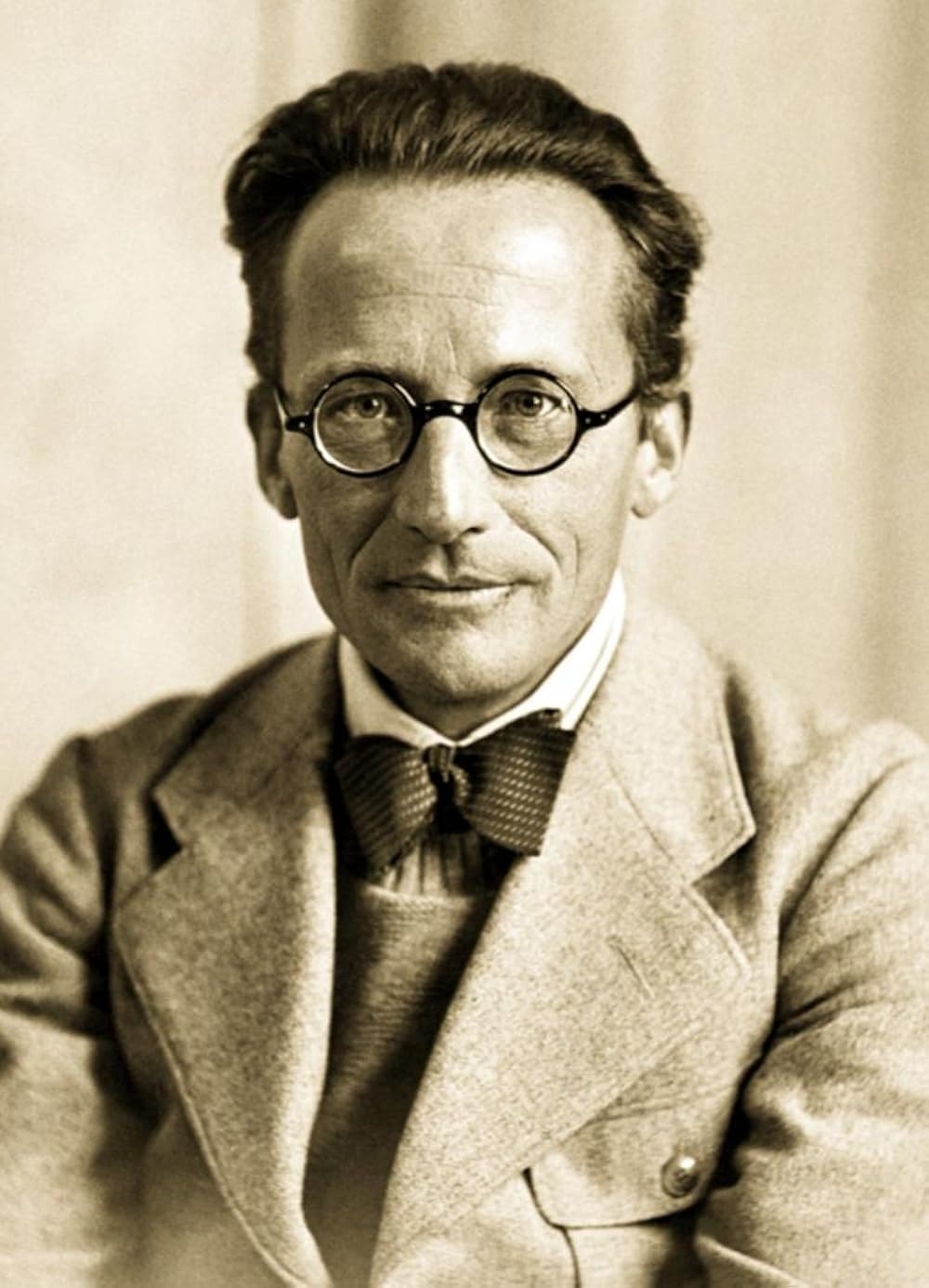
Erwin Schrödinger
 Austria
physicist•theoretical physicist•non-fiction writer
Birthday
August 12, 1887
Birth Sign
Leo
Birthplace
Vienna, Austria
Age
Died at 73
About
Erwin Schrödinger was an Austrian theoretical physicist whose work fundamentally reshaped modern physics. He is best known for the Schrödinger equation, the core mathematical framework of quantum mechanics, and for coining the term quantum entanglement. In 1933, he shared the Nobel Prize in Physics with Paul Dirac for discovering new productive forms of atomic theory. His thought experiment, Schrödinger's cat, has become a cultural shorthand for quantum weirdness. Beyond physics, his 1944 book What Is Life? explored the physical basis of heredity, inspiring a generation of molecular biologists. Today, his ideas remain central to quantum theory, and his name appears everywhere from textbooks to TV shows.
Early Life & Background
Schrödinger grew up in a well-off Viennese household. His father ran a botanical institute and taught botany, while his mother came from an academic family. He was educated at home by a private tutor until age 11, then attended the prestigious Gymnasium of the Piarists. At the University of Vienna, he studied physics and mathematics under Franz Exner and Friedrich Hasenöhrl, earning his doctorate in 1910 with a dissertation on heat diffusion in solids.
After graduating, he worked as an assistant at the university's Institute for Theoretical Physics. During World War I, he served as an artillery officer on the Italian front, keeping up with physics by reading journals in the trenches. After the war, he held short-term positions at Jena, Stuttgart, and Breslau. In 1921, he moved to the University of Zurich, where he began the deep dive into quantum theory that would lead to his breakthrough.
Career Growth
Schrödinger's defining moment came in 1926, when he published a series of papers introducing wave mechanics. The Schrödinger equation replaced older quantum models with a wave-based description of particles, unifying earlier work by de Broglie and others. The discovery earned him the 1933 Nobel Prize in Physics, shared with Paul Dirac.
In 1935, he published a paper on what he called quantum entanglement, describing how particles can remain connected across vast distances. That same year, he devised the Schrödinger's cat thought experiment to highlight the absurdity of superposition. After fleeing Nazi-occupied Austria in 1938, he spent 17 years at the Dublin Institute for Advanced Studies, where he wrote What Is Life? (1944), a book that asked how physics could explain heredity and influenced James Watson and Francis Crick. He returned to Vienna in 1956 and died there five years later.
Career Timeline
Public Image & Style
Schrödinger is remembered as a visionary physicist whose elegant equation became the bedrock of quantum mechanics. His public image is that of a brilliant, eccentric thinker who straddled science and philosophy. The Schrödinger's cat paradox has made him a household name far beyond academia, appearing in movies, TV shows, and memes. Within the scientific community, he is respected for his breadth and originality, though his personal life and the later abuse allegations have sparked debate. There is no organized fandom, but his name carries a mix of awe and curiosity among science enthusiasts.
Fame & Fandom (iFAMOUS Rankings)
Erwin Schrödinger's fame rests not on fan clubs or chart-topping campaigns, but on the enduring power of his ideas. In the century since he formulated his wave equation, his name has become synonymous with quantum mechanics itself, and his cat thought experiment has permeated global culture in ways few scientific concepts ever have. Yet, in the strict sense of modern fandom, Schrödinger has no organized following. There is no formal or informal fandom name, no coordinated fan projects, no birthday billboards or charity drives. His audience is diffuse, physicists, philosophers, students, and the curious, united by intellectual engagement rather than communal identity. The closest analogue to fan rituals are the annual commemorations of his work, such as the 2026 centenary of his equation, celebrated in academic circles worldwide.
iFANN's Global Fame Engine has evaluated Erwin Schrödinger, but as of August 2026, he does not hold a placement in the published rankings, neither in the Global Top 1,000 nor in any Top-100 scope list. This absence reflects the engine's focus on contemporary media presence and active fandom, categories in which a deceased physicist, however monumental, does not compete. His fame is of a different order: enduring, cultural, and academic, rather than measured by current search trends or streaming data. Nevertheless, his thought experiment's metaphorical reach, evident in phrases like "Schrödinger's [X]" used in politics and tech, ensures his name remains a fixture in public discourse, even if the rankings do not capture it.
Interesting Facts and Legends
Schrödinger wrote poetry throughout his life and published a collection, Poems, in 1949. He was an avid mountaineer and hiker, often taking long walks in the Alps. He spoke several languages, including English, French, and Italian. His cat paradox was originally meant as a criticism of the Copenhagen interpretation, not an endorsement. The 1989 allegations of sexual abuse of minors, made public by biographers, complicated his legacy. He also had a strong interest in Hindu philosophy, particularly the Vedanta school, and incorporated its ideas into his worldview.
The most iconic legend associated with Schrödinger is the cat thought experiment, proposed in a 1935 paper as a reductio ad absurdum. It has since become a universal cultural metaphor, spawning countless references in media and even inspiring the term "Schrödinger's kittens" for entangled states in quantum physics. Another foundational story is his 1944 book What Is Life?, which speculated on the physical basis of heredity and is credited with inspiring Francis Crick and James Watson to pursue molecular biology. The 1926 centenary of his equation, marked in 2026, further cemented his legacy as a pioneer whose work continues to shape science.
Notable Quotes
“The task is not so much to see what no one has yet seen, but to think what nobody has yet thought about that which everybody sees.”
“I don't like it, and I'm sorry I ever had anything to do with it.”
“The consciousness of the world is a thing that we cannot understand; we have to accept it as a fact.”
“The present is the only thing that has no end.”
Family & Personal Life
Schrödinger married Annemarie Bertel in 1920; they had one daughter, Eva, born in 1921. The marriage was unconventional: Schrödinger had a long-term relationship with Hilde March, a former student, who gave birth to his daughter Ruth in 1934. Annemarie also had an affair with Hilde's husband, physicist Arthur March. The four lived together intermittently, a setup that caused scandal at Oxford and contributed to Schrödinger's departure. He was close to both daughters, and Ruth later became a librarian in Vienna.
Notable Connections
Schrödinger's most famous collaborator was Paul Dirac, with whom he shared the 1933 Nobel Prize. He corresponded extensively with Albert Einstein, who was skeptical of quantum mechanics and helped inspire the cat paradox. In Dublin, he worked alongside John Synge and other physicists at the Institute for Advanced Studies. His book What Is Life? directly influenced James Watson, Francis Crick, and Maurice Wilkins, who credited it as a catalyst for their discovery of DNA's structure.
Relationships & Dating History
Schrödinger married Annemarie Bertel in 1920. Their marriage was open and unconventional. In the early 1930s, he began an affair with Hilde March, a former student, who became pregnant with his daughter Ruth in 1934. Meanwhile, Annemarie had an affair with Hilde's husband, physicist Arthur March. The four adults lived together at times, a situation that shocked Oxford colleagues and led Schrödinger to resign his fellowship. Despite the complications, Schrödinger remained married to Annemarie until his death in 1961. He maintained a close relationship with both daughters, and Hilde remained a part of his life for decades.
- MarriedAnnemarie Bertel1920 - 1961Unconventional marriage; both had extramarital affairs.
- DatedHilde March1932 - 1961Long-term mistress; mother of his daughter Ruth.
Death & Aftermath
Died
January 4, 1961 (aged 73)
Death Place
Vienna, Austria
Cause of Death
pulmonary tuberculosis
Erwin Schrödinger spent his final months in the care of medical professionals at the University Clinic in Vienna, where he had returned to Austria after years of exile in Ireland and England. The Austrian theoretical physicist passed away on January 4, 1961, at the age of seventy-three, having battled pulmonary tuberculosis for many years, a condition exacerbated by his long-term smoking habit. Public reaction was marked by widespread mourning within the scientific community, highlighted by a biographical memoir published by the Royal Society that honored his contributions to wave mechanics and quantum theory while acknowledging his later philosophical inquiries into biology. The funeral arrangements were conducted privately, with Schrödinger cremated in Vienna before his ashes were interred in the family grave at Hietzing Cemetery.
Close colleagues, family members, and representatives from the Austrian Academy of Sciences attended the service, though the event remained a private gathering rather than a large public state ceremony. In the posthumous era, his legacy has been sustained through continued reprints of his works, including the prescient 1944 book What Is Life?, which remains cited for its influence on the discovery of DNA structure. Numerous institutions have established scholarships and foundations in his name, such as the Erwin Schrödinger International Institute for Mathematical Physics in Vienna, ensuring his intellectual property rights continue to generate royalties for his heirs.
Awards Won (1)
Schrödinger won the 1933 Nobel Prize in Physics, shared with Paul Dirac, for his wave mechanics formulation. He also received the Max Planck Medal in 1947, one of Germany's highest physics honors. He was elected a Fellow of the Royal Society in 1949 and received honorary doctorates from universities including Dublin, Edinburgh, and Vienna.
1933 · Physics
Wave mechanics formulation of quantum theory
Known For
Schrödinger equation
1926 · Creator
Schrödinger's cat
1935 · Creator
Quantum entanglement
1935 · Coined term
What Is Life?
1944 · Author
Keywords
Quick Facts
- Profession
- physicist, theoretical physicist, non-fiction writer
- Born
- +1887-08-12
- Birthplace
- Vienna, Austria
- Died
- +1961-01-04
- Death Place
- Vienna, Austria
- Gender
- Male
- Spouse
- Annemarie Schrödinger
- Birth Sign
- Leo
Personal Details
- Full Name
- Erwin Rudolf Josef Alexander Schrödinger
- Spouse
- Annemarie Schrödinger
- Children
- Eva Schrödinger, Ruth Georgi
- Education
- University of Vienna (PhD, 1910)
Frequently Asked Questions
What is Erwin Schrödinger famous for?
When did Erwin Schrödinger win the Nobel Prize?
What was Schrödinger's cat thought experiment?
What is the Schrödinger equation?
What was Erwin Schrödinger's personal life like?
Join the community
fans discussing