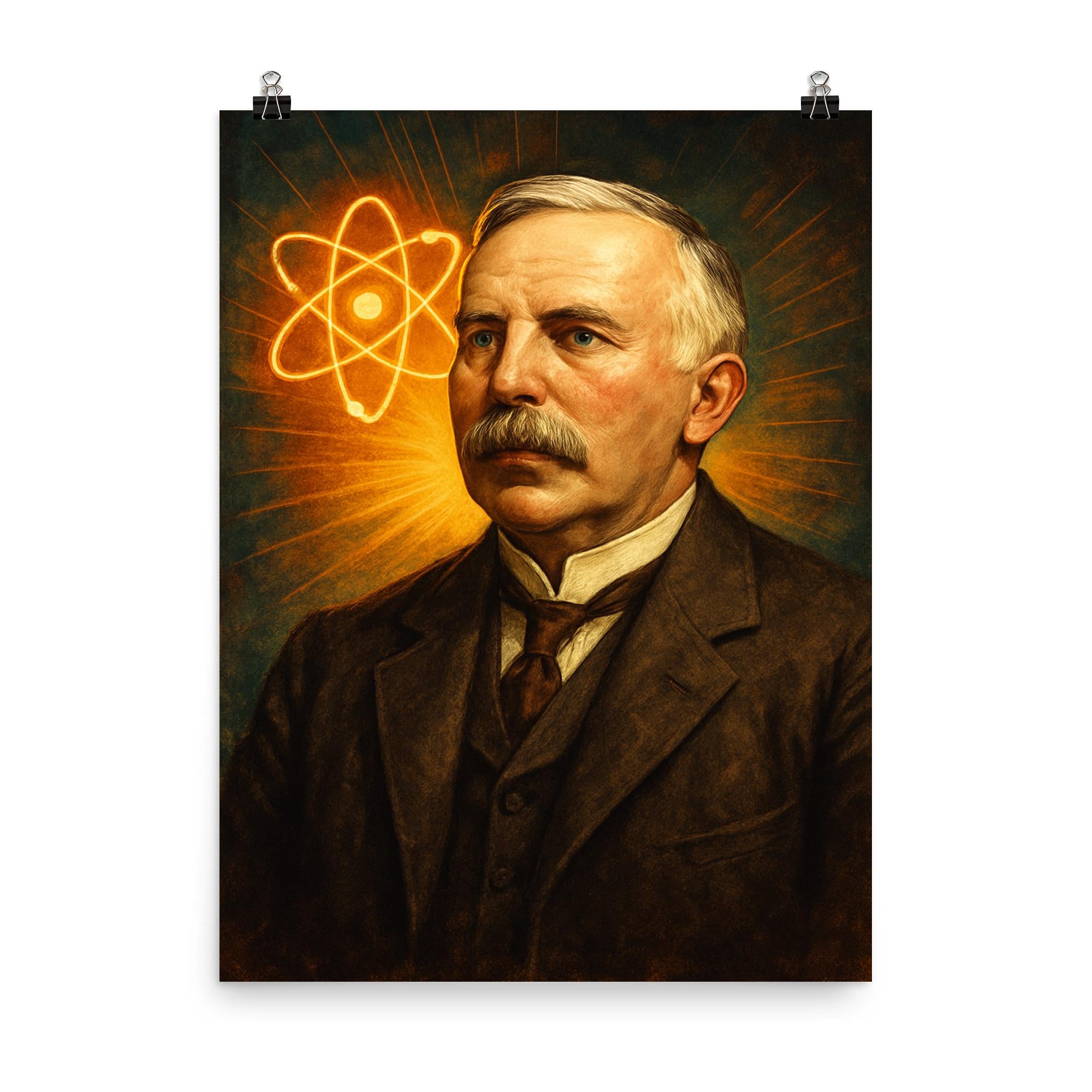
Ernest Rutherford
 New Zealand
Also known as: Baron Rutherford of Nelson
Birthday
August 30, 1871
Birth Sign
Virgo
Birthplace
Nelson, New Zealand
Age
Died at 66
About
Ernest Rutherford was a New Zealand physicist and chemist who reshaped humanity's understanding of the atom. Known as the father of nuclear physics, he won the 1908 Nobel Prize in Chemistry for his investigations into the disintegration of elements and the chemistry of radioactive substances. His discoveries include the atomic nucleus, the proton, and the concept of radioactive half-life, and he directed the Cavendish Laboratory where the neutron was discovered and the nucleus was split for the first time.
Rutherford's work laid the foundation for modern atomic and nuclear physics. His gold foil experiment in 1911 revealed that atoms have a small, dense nucleus, overturning the then-prevailing plum pudding model. He also identified alpha and beta radiation, proved that alpha particles are helium nuclei, and performed the first artificial nuclear reaction. His legacy is honored through the element rutherfordium, his portrait on New Zealand's $100 note, and his burial in Westminster Abbey near Newton and Darwin.
Today, Rutherford is celebrated as one of the greatest experimental physicists of all time. In 1999, a ranking placed him as the tenth greatest physicist in history. His name remains synonymous with the birth of nuclear physics, and his influence persists in every particle accelerator and nuclear reactor.
Early Life & Background
Born on August 30, 1871, in rural Nelson, New Zealand, Ernest Rutherford was the fourth of twelve children. His father, James Rutherford, was a farmer and wheelwright; his mother, Martha Thompson, was a schoolteacher. The family moved frequently, and Ernest helped on the farm while showing an early gift for mathematics and science.
He attended Nelson College on a scholarship, then won another to Canterbury College in Christchurch, where he earned a BA in 1892 and an MA in 1893. His undergraduate research on the magnetization of iron caught the attention of his professors. In 1895, he earned a scholarship to Cambridge University, becoming one of the first graduate students from outside Britain to work at the Cavendish Laboratory under J.J. Thomson.
At Cambridge, Rutherford invented a detector for electromagnetic waves and studied the ionization of air by X-rays. When Henri Becquerel discovered radioactivity in 1896, Rutherford pivoted to this new field, quickly distinguishing alpha and beta rays. His path to fame began with these early experiments, but the breakthrough came when he left for Canada.
Career Growth
Rutherford's career took off at McGill University in Montreal, where he became a professor in 1898. There he discovered that thorium emits a radioactive gas, which he named radon, and established the concept of radioactive half-life. He also identified two types of radiation, alpha and beta rays. In 1908, he won the Nobel Prize in Chemistry, though he had been nominated seven times for the physics prize the year before.
Moving to the University of Manchester in 1907, Rutherford conducted his most famous work. In 1909, he directed Hans Geiger and Ernest Marsden in the gold foil experiment, which revealed that atoms have a tiny, dense nucleus. He announced this in 1911. In 1912, he invited Niels Bohr to his lab, leading to the Bohr model of the atom. With Thomas Royds, he proved that alpha radiation is helium nuclei. In 1917, he performed the first artificial nuclear reaction, bombarding nitrogen with alpha particles and discovering the proton.
In 1919, Rutherford became Director of the Cavendish Laboratory at Cambridge. Under his leadership, James Chadwick discovered the neutron in 1932, and John Cockcroft and Ernest Walton split the nucleus for the first time. He also helped develop the atomic numbering system with Henry Moseley and advanced radio communications and ultrasound technology. His influence on a generation of physicists was immense.
Career Timeline
Public Image & Style
Rutherford is portrayed in media and academia as a towering, charismatic figure of 20th-century physics. A larger-than-life New Zealander, he reshaped humanity's understanding of matter. He is celebrated particularly in New Zealand, where he is regarded as the nation's greatest scientist. His image on the $100 note and the element named in his honor underscore his national and international significance. Known for his booming voice and infectious enthusiasm, he was a beloved mentor to a generation of physicists.
Fame & Fandom
Ernest Rutherford does not currently hold a placement in iFANN's published rankings, having been evaluated but not ranked in the Global Top 1,000 or any Top-100 scope list as of August 2026. The Global Fame Engine has assessed his enduring cultural footprint, yet he remains outside the numerically ranked tiers. That absence, however, says more about the engine's focus on living celebrities than about his legacy's weight. His fanbase has no formal name, there are no 'Rutherfordites' or coordinated fan campaigns, but his following is deeply devoted: physicists, historians, and New Zealanders who treat him as a national hero. The University of Manchester's Rutherford Building and the Ernest Rutherford Fellowships keep his name in scientific circulation, while his image on the NZ$100 note cements his iconic status. His mentorship at the Cavendish Laboratory, where he guided future Nobel laureates with a booming laugh and a call of 'boys,' has become lore. Stories of his resourcefulness, counting scintillations by eye because they lacked funding, are retold as founding myths of nuclear physics. Though no fan conventions or hashtags exist, his legacy thrives in classrooms and centenary celebrations, making him a quiet colossus in the pantheon of science.
Interesting Facts and Legends
Rutherford initially believed the proton was a 'hydrogen atom' and was known for his booming voice and energetic personality. Often described as 'the father of nuclear physics,' he also helped advance radio communications and ultrasound technology. His famous gold foil experiment was actually conducted by his students Geiger and Marsden, though he directed and interpreted the work. He called the unexpected results 'as if you fired a 15-inch shell at a piece of tissue paper and it came back and hit you.' A story fans still retell is that he and his students counted scintillations by eye in a darkened room because they lacked funding, leading to his quip, 'We haven't got the money, so we've got to think.' Another legend, partially folklore, credits him with 'splitting the atom' in 1917, though the first fully artificial splitting came later under his watch at the Cavendish. He won the 1908 Nobel Prize in Chemistry, not Physics, and joked that the transformations he studied were 'much more rapid' than those of alchemists.
Notable Quotes
“It was almost as incredible as if you fired a 15-inch shell at a piece of tissue paper and it came back and hit you.”
Family & Personal Life
Rutherford married Mary Georgina Newton in 1900. She was the daughter of his landlady in New Zealand, and the marriage was a stable, supportive partnership that lasted until his death. The couple had one daughter, Eileen Mary Rutherford. Rutherford's family life was private and devoted to his work, but he was known to be a warm and affectionate father. After his death, his descendants managed his legacy, donating the historic Barony of Rutherford scroll to a university in 2025.
Notable Connections
Rutherford's career was shaped by key collaborations. His mentor at Cambridge was J.J. Thomson, discoverer of the electron. At Manchester, Hans Geiger and Ernest Marsden conducted the gold foil experiment under his direction. He invited Niels Bohr to his lab in 1912, leading to the Bohr model. Later, at the Cavendish Laboratory, James Chadwick discovered the neutron, and John Cockcroft and Ernest Walton split the nucleus. He also worked with Thomas Royds on alpha radiation and Henry Moseley on the atomic numbering system.
Relationships & Dating History
Rutherford married Mary Georgina Newton in 1900. She was the daughter of his landlady in New Zealand, and the couple had a stable, supportive marriage that lasted until his death in 1937. They had one daughter, Eileen Mary Rutherford. There is no documented record of any other romantic relationships. His personal life was notably private and devoted to his scientific work. At the time of his death, he was married to Mary.
- MarriedMary Georgina Newton1900 - 1937Married in 1900 and remained together until his death in 1937. They had one daughter, Eileen.
Death & Aftermath
Died
October 19, 1937 (aged 66)
Death Place
Cambridge, England
Cause of Death
Coronary thrombosis
Dr. Thomas Horder, the attending physician, officially recorded the cause of death as coronary thrombosis following a sudden illness at Rutherford's residence. The Nobel laureate passed away in his sleep on October 19, 1937, ending a life marked by quiet decline rather than public struggle. He had recently undergone an operation for an ulcer and suffered from heart trouble for some time before his final withdrawal from active duties as President of the Royal Society. Tributes poured in immediately from the highest levels of government and science, with King George V expressing personal sorrow over the loss of the "father of nuclear physics." The British government declared him a national loss, while institutions worldwide observed moments of silence at major conferences.
A state funeral took place on October 24, 1937, where the Dean conducted the service featuring Elgar's Enigma Variations . Dignitaries including Prime Minister Neville Chamberlain and members of the royal family attended before Rutherford was buried at St. Mary's Churchyard in Rugby, Warwickshire. Posthumous honors cemented his legacy through the establishment of the Rutherford Chair at the University of Manchester in 1938 and the naming of the Rutherford Appleton Laboratory in 1957. The Royal Society continues to award the Rutherford Medal annually, and recent developments include the donation of his historic Barony scroll to academic institutions by his descendants. His influence persists through the Ernest Rutherford Fellowships, which secured significant funding to ensure his impact on research endures.
Net Worth (Estate Value)
$10 Million
iFANN Editorial Team estimate
As a scientist who died in 1937, Rutherford's personal net worth is not comparable to modern celebrity wealth. His estate's ongoing value derives from his historical legacy rather than financial assets. His descendants manage his legacy and have donated significant artefacts, including the Barony scroll, to academic institutions. His image on the New Zealand $100 note and the element named after him continue to cement his historical significance. A new biography by historian Matthew Wright, 'Ernest Rutherford and the Birth of Modern Physics,' published in 2025, demonstrates ongoing commercial interest in his life story. iFANN currently estimates the estate's value at $10 million, reflecting the cultural and scholarly importance of his work.
Awards Won (1)
Rutherford won the Nobel Prize in Chemistry in 1908 for his investigations into the disintegration of elements and the chemistry of radioactive substances. He was knighted in 1914, received the Order of Merit, and was elevated to the peerage in 1931. He served as President of the Royal Society from 1925 to 1930. The element rutherfordium was named in his honor in 1997.
1908 · Chemistry
Investigations into the disintegration of elements and the chemistry of radioactive substances
Known For
Discovery of the atomic nucleus
1911 · Lead researcher
Discovery of the proton
1917 · Lead researcher
Nobel Prize in Chemistry
1908 · Recipient
Keywords
Sources
Quick Facts
- Profession
- nuclear physicist, chemist
- Born
- August 30, 1871
- Birthplace
- Nelson, New Zealand
- Died
- October 19, 1937
- Death Place
- Cambridge, England
- Gender
- Male
- Spouse
- Mary Georgina Newton
- Birth Sign
- Virgo
Personal Details
- Full Name
- Ernest Rutherford, 1st Baron Rutherford of Nelson
- Spouse
- Mary Georgina Newton
- Children
- Eileen Mary Rutherford
- Education
- Canterbury College (now University of Canterbury), Cambridge University (Cavendish Laboratory)
Frequently Asked Questions
Why is Ernest Rutherford called the father of nuclear physics?
Did Ernest Rutherford split the atom?
How did Ernest Rutherford discover the nucleus?
What is Ernest Rutherford's net worth?
Did Ernest Rutherford have children?
Similar People
Join the community
fans discussing