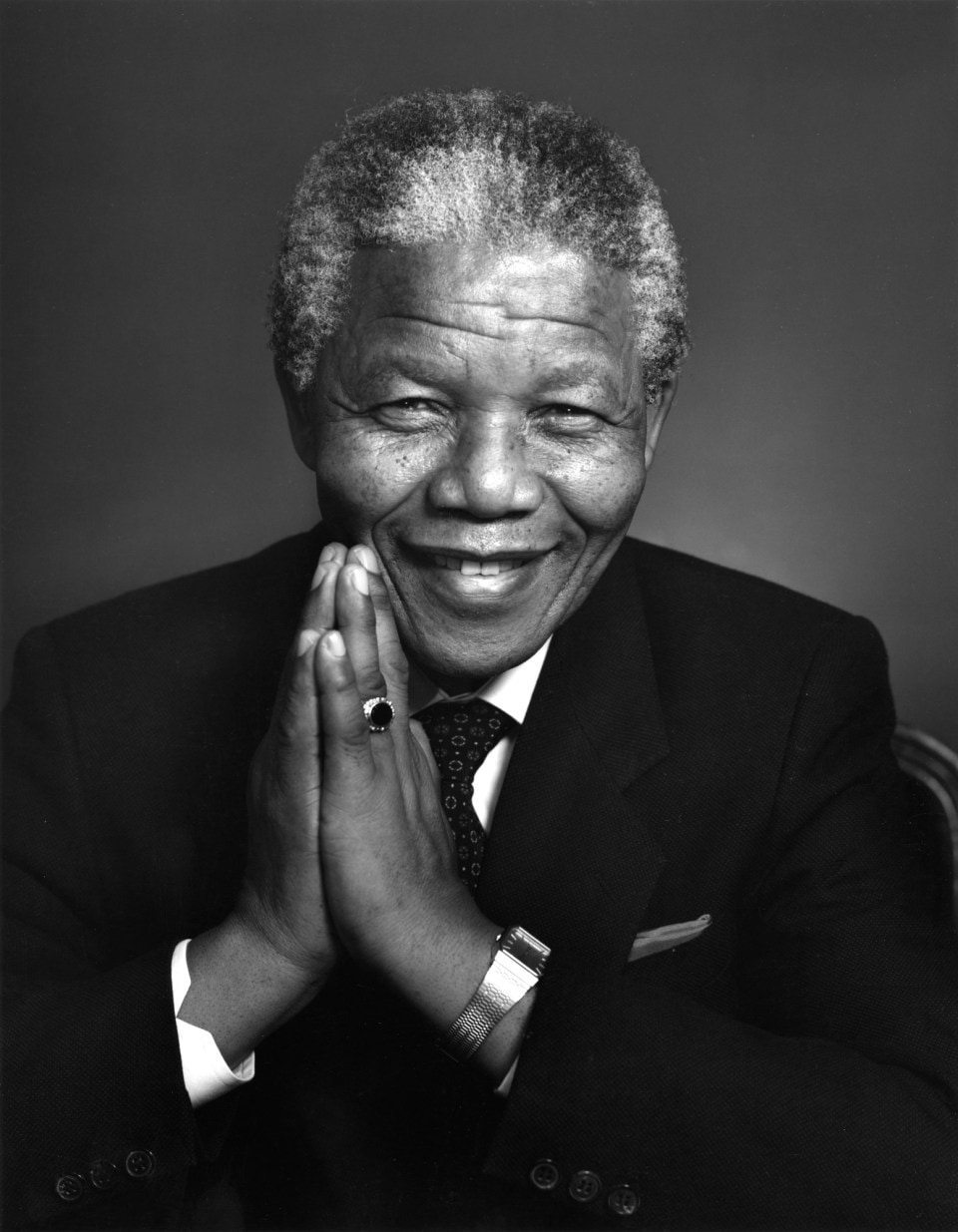
Nelson Mandela
 South Africa
politician•autobiographer•lawyer
Also known as: Madiba, Tata, Rolihlahla Mandela
Birthday
July 18, 1918
Birth Sign
Cancer
Birthplace
Mvezo, Eastern Cape, South Africa
Age
Died at 95
Height
6 ft 0 in (183 cm)
About
Nelson Rolihlahla Mandela was a South African anti-apartheid activist, statesman, and revolutionary who became the first Black president of South Africa from 1994 to 1999. Born on July 18, 1918, in Mvezo, a small village in the Eastern Cape, he was given the name Rolihlahla, which means "troublemaker" in Xhosa. Mandela studied law at the University of Fort Hare and the University of the Witwatersrand before working as a lawyer in Johannesburg. He rose to prominence through the 1952 Defiance Campaign and the 1955 Congress of the People, and was repeatedly arrested. Following the Rivonia Trial, Mandela was sentenced to life imprisonment for conspiracy to overthrow the state. During his incarceration, he became a global symbol of resistance to apartheid. Under pressure from domestic and international movements, President F. W. de Klerk released him in 1990. Mandela and de Klerk then negotiated an end to apartheid, leading to South Africa's first multiracial elections in 1994. Mandela won the presidency and formed a Government of National Unity. His administration focused on reconciliation, establishing the Truth and Reconciliation Commission to investigate human rights abuses. Economically, he retained the previous government's liberal framework while introducing land reform and anti-poverty programs. He also expanded healthcare services and worked to combat HIV/AIDS after his presidency through the Nelson Mandela Foundation. Mandela's international role included mediating in the Pan Am Flight 103 bombing trial and serving as secretary-general of the Non-Aligned Movement from 1998 to 1999. He declined a second term and was succeeded by Thabo Mbeki. Mandela received more than 250 honors, including the Nobel Peace Prize in 1993. He died on December 5, 2013, at age 95. His legacy as a moral leader and advocate for peace and justice endures worldwide.
Early Life & Background
Mandela grew up in the rural village of Qunu, herding cattle and playing with local children. After his father's death in 1930, he was taken under the guardianship of Chief Jongintaba Dalindyebo, the regent of the Thembu people. He attended a Methodist mission school and later enrolled at the University of Fort Hare, the only residential university for Black South Africans at the time, where he studied law and met Oliver Tambo. In 1940, Mandela was expelled for participating in a student strike. To avoid an arranged marriage, he fled to Johannesburg, working first as a night watchman and then as a clerk at a law firm. He completed his BA through correspondence courses from the University of South Africa in 1942 and began studying law at the University of the Witwatersrand. He later earned his LLB from UNISA in 1989 while still in prison.
Career Growth
Mandela joined the ANC in 1943 and co-founded its Youth League in 1944 with Oliver Tambo and Walter Sisulu. He led the 1952 Defiance Campaign as president of the Transvaal ANC and helped organize the Congress of the People in 1955, which adopted the Freedom Charter. After the Treason Trial ended in acquittal in 1961, he co-founded uMkhonto we Sizwe, launching a sabotage campaign. Arrested in 1962, he was sentenced to life imprisonment in the Rivonia Trial of 1964. He spent 27 years in prison, mostly on Robben Island, later at Pollsmoor and Victor Verster. Released in 1990, he was elected president of the ANC in 1991 and negotiated with President F.W. de Klerk to end apartheid, earning the Nobel Peace Prize in 1993. In 1994, he became South Africa's first Black president, focusing on reconciliation and the Truth and Reconciliation Commission. He served one term, stepping down in 1999, after which he focused on HIV/AIDS advocacy through the Nelson Mandela Foundation. He also mediated in the Pan Am Flight 103 bombing trial and served as secretary-general of the Non-Aligned Movement from 1998 to 1999.
Career Timeline
Public Image & Style
Mandela was known for wearing colorful, patterned "Madiba shirts" designed by South African fashion designer Desre Buirski, which became a symbol of his approachable dignity. He was universally portrayed as a moral icon of forgiveness and reconciliation. Films like Invictus (2009) and Mandela: Long Walk to Freedom (2013) shaped his public image. In South Africa, he is often called "Madiba" (his clan name) or "Tata" (Father). His birthday, July 18, is Nelson Mandela International Day, celebrated globally with 67 minutes of community service. The Nelson Mandela Foundation manages his legacy, posting archival content and foundation news on social media, where the official accounts have millions of followers. He was listed among TIME's 100 Most Important People of the 20th Century and was voted the most admired person of the 20th century in a Gallup poll.
Fame & Fandom (iFAMOUS Rankings)
The enduring resonance of Nelson Mandela extends across every continent, a global attention that persists decades after his passing and is measured by the iFANN Global Fame Rankings as a singular phenomenon. He stands as the 96th most famous person in the world, a position he has held steady from the previous cycle, while simultaneously claiming the top spot as the 1st most famous person in South Africa, the 1st most famous person from South Africa, and the 1st most famous person in Africa. His influence within the political sphere remains profound, ranking him as the 14th most famous person in Politics. This individual does not command a traditional fandom with a specific moniker or organized fanbase; instead, his supporters operate through civic engagement and charitable observances rather than the conventions of celebrity culture. The primary vehicle for this collective remembrance is the Nelson Mandela Foundation, which coordinates global efforts to honor his legacy. Rather than fan clubs, the community gathers for the Nelson Mandela International Day, an annual event where individuals dedicate sixty-seven minutes to service, mirroring the years of his public life. This structured ritual replaces the spontaneous gatherings typical of pop stars, focusing on community action over adoration. While no formal fan name exists, the global movement surrounding his memory functions as a continuous tribute to his life's work, sustained by exhibitions such as Life and Legacy of Nelson Mandela and pilgrimage sites scattered across South Africa.
Interesting Facts and Legends
His birth name, Rolihlahla, translates colloquially to 'troublemaker,' and he was the first in his family to attend school, where a teacher bestowed the English name Nelson upon him. While incarcerated, he studied law by correspondence, and his prisoner number, 46664, evolved into a global symbol for HIV/AIDS awareness. He earned a private pilot's license at age 76 in 1994 and appeared in a cameo role as a schoolteacher in the 1992 film Malcolm X. His affiliation with the ANC kept him on the United States terrorist watch list until 2008, and he received honorary degrees from over 50 universities including Harvard, Cambridge, and Oxford. Beyond these facts, legendary moments define his story: his unexpected release on February 11, 1990, after 27 years of imprisonment triggered massive public celebrations marking the end of apartheid. Another iconic incident occurred during the 1995 Rugby World Cup, when he wore the Springbok jersey during the final match against New Zealand, a gesture widely cited as a masterstroke of unity that bridged a divided nation. The number 67 has become a sacred figure in his lore, representing both his years of public service and the minutes dedicated to charity on his birthday. Stories from his time in prison focus on his unwavering belief in justice and his use of humor to maintain morale, with letters written from captivity revealing a man who held onto hope despite decades of isolation.
Notable Quotes
“Education is the most powerful weapon which you can use to change the world.”
“I learned that courage was not the absence of fear, but the triumph over it.”
“It always seems impossible until it's done.”
“For to be free is not merely to cast off one's chains, but to live in a way that respects and enhances the freedom of others.”
“A good head and a good heart are always a formidable combination.”
Family & Personal Life
Mandela's father, Gadla Henry Mphakanyiswa, was a chief and counselor to the king. His mother, Nosekeni Fanny, was one of his father's four wives. He had three sisters. He had six children: Madiba Thembekile (1945-1969, died in a car accident), Makaziwe (1947, died as an infant), Makgatho (1950-2005), Makaziwe (1954-present), Zenani (1959-present), and Zindziswa (1960-2020). He also had numerous grandchildren and great-grandchildren. Mandela lived in Houghton Estate, Johannesburg, and owned a rural home in Qunu. He was survived by his widow Graça Machel.
Notable Connections
Nelson Mandela is closely associated with the African National Congress (ANC), which he led and which became the ruling party of South Africa. He worked alongside Oliver Tambo and Walter Sisulu in the ANC Youth League and later in the anti-apartheid movement. His partnership with F.W. de Klerk in negotiating the end of apartheid earned them the Nobel Peace Prize. Mandela was also associated with the Truth and Reconciliation Commission, chaired by Desmond Tutu, and with the Nelson Mandela Foundation, which continues his work.
Relationships & Dating History
Mandela married Evelyn Mase in 1944. Evelyn was a nurse from the Eastern Cape, and the marriage produced four children: Madiba Thembekile, Makaziwe (infant death), Makgatho, and Makaziwe. The couple divorced in 1958 due to Mandela's political activism and his relationship with Winnie Madikizela. He married Winnie Madikizela in 1958; she was a social worker and later a prominent anti-apartheid activist. They had two daughters, Zenani and Zindziswa, but the marriage suffered during Mandela's imprisonment and ended in divorce in 1996. In 1998, on his 80th birthday, Mandela married Graça Machel, the widow of Mozambican President Samora Machel. She was the only person to have been first lady of two countries. They remained married until his death in 2013.
- MarriedEvelyn Mase1944 - 1958Married in 1944; divorced in 1958 due to Mandela's political activism and involvement with Winnie Madikizela.
- MarriedWinnie Madikizela-Mandela1958 - 1996Married in 1958; divorced in 1996 after separation in 1992, citing political differences.
- MarriedGraça Machel1998 - 2013CurrentMarried on Mandela's 80th birthday in 1998; remained married until his death in 2013.
Death & Aftermath
Died
December 5, 2013 (aged 95)
Death Place
Houghton, Johannesburg, South Africa
Cause of Death
Recurring lung infection
Global tributes poured in immediately following the announcement, with United Nations Secretary-General Ban Ki-moon declaring December 5 a day of mourning and US President Barack Obama calling him the greatest son of our time. Vigils were held across South Africa and internationally, while memorial murals appeared worldwide and the United Nations established Nelson Mandela International Day on July 18 to honor his legacy. Nelson Mandela died at his home in Houghton, Johannesburg, on December 5, 2013, at the age of 95. His final days followed a discharge from hospital care on November 27 after respiratory issues related to a recurring lung infection had plagued him for years since an earlier bout contracted during imprisonment.
The official cause was confirmed by a statement from the Presidency of South Africa and the Nelson Mandela Foundation rather than through a public autopsy or coroner's inquest, with no disputed accounts regarding the immediate medical cause widely publicized. A state funeral took place on December 10 in Qunu, attended by dignitaries from over 90 nations including President Jacob Zuma, former US President Jimmy Carter, and King Charles III. The ceremony featured performances by Hugh Masekela and Miriam Makeba, with speeches emphasizing reconciliation before he was buried near the house where he grew up, surrounded by the graves of his mother and first wife Evelyn Mase.
Net Worth (Estate Value)
$8 Million
iFANN Editorial Team estimate
The estate of Nelson Mandela following his death in 2013 is estimated at $8 Million per iFANN's editorial analysis. The bulk of his wealth originated from book royalties for his autobiography Long Walk to Freedom, which sold over 6 million copies worldwide, alongside speaking fees that ranged from $100,000 to $200,000 per speech after his presidency. He also held property, including his Houghton home in Johannesburg and a rural property in Qunu. The Nelson Mandela Foundation manages his legacy, intellectual property, and trademarks, earning revenue from film rights, documentary licensing, and merchandise. South African probate records from 2013 valued the estate at R46 million (approximately $4.1 million at the time), but posthumous earnings have increased its value significantly.
Awards Won (300)
Nelson Mandela received more than 250 awards during his lifetime, including the 1993 Nobel Peace Prize jointly with F.W. de Klerk. He was awarded the Presidential Medal of Freedom and the Congressional Gold Medal by the United States, the Order of the British Empire (Honorary Knight Grand Cross), and the Bharat Ratna, India's highest civilian award. He also received the Lenin Peace Prize, the Sakharov Prize, and the International Gandhi Peace Prize. His many honors reflect his global impact as a symbol of peace and reconciliation.
August – Freedom of the City of Glasgow
The first UK road named in his honour – "Mandela Close" – is unveiled in the London Borough of Brent
Bruno Kreisky Award for merit in the field of human rights, chosen by a panel of international judges, Vienna, Austria
Honorary citizenship of Rome, February
Honorary citizenship of Olympia, Greece, 17 March
Honorary Doctorate of Laws, City College of New York, 22 March
Ornamental gardens in Hull, United Kingdom, named "Nelson Mandela Gardens", May
City Council of Dublin, Ireland, unveiled sculpture in Merrion Square by Elisabeth Frink dedicated to Nelson Mandela, 26 June
Award of the order Star of International Friendship in gold by the German Democratic Republic, 18 July
City Council of Harlow, United Kingdom, renamed one of its major roads in honour of Nelson Mandela, 18 July
AUEW/TASS, one of United Kingdom's major trade unions, renamed their executive committee room the "Nelson Mandela Room", 18 July
Freedom of London Borough of Greenwich, 20 July
UNESCO awards its first Simon Bolivar International Prize jointly to Nelson Mandela and King Juan Carlos of Spain at a ceremony in Caracas, Venezuela, on the 200th anniversary of the birth of Simón Bolívar, 24 July
City Council of Leeds, United Kingdom, names the Civic Hall "Nelson Mandela Gardens", 10 December
Honorary Doctorate of Laws, Lancaster University, United Kingdom
The Students Unions of Warwick University, Coventry Polytechnic (now Coventry University) and South Bank Polytechnic (now London South Bank University) named rooms in honour of Nelson Mandela
New York City renamed square in front of South African mission to the United Nations 'Nelson and Winnie Mandela Plaza'
Known For
Anti-apartheid activism
1943 · Leader
President of South Africa
1994 · Head of State
Nobel Peace Prize
1993 · Recipient
Keywords
Quick Facts
- Profession
- politician, autobiographer, lawyer
- Born
- +1918-07-18
- Birthplace
- Mvezo
- Died
- +2013-12-05
- Death Place
- Houghton Estate
- Gender
- Male
- Spouse
- Evelyn Mase, Winnie Madikizela-Mandela, Graça Machel
- Birth Sign
- Cancer
- Height
- 6 ft 0 in (183 cm)
- Education
- University of Fort Hare, University of South Africa (BA, LLB)
Personal Details
- Full Name
- Nelson Rolihlahla Mandela
- Height
- 6 ft 0 in (183 cm)
- Spouse
- Evelyn Mase, Winnie Madikizela-Mandela, Graça Machel
- Children
- Madiba Thembekile, Makaziwe (infant death), Makgatho, Makaziwe, Zenani, Zindziswa
- Education
- University of Fort Hare, University of South Africa (BA), University of the Witwatersrand (law studies), University of South Africa (LLB)
Frequently Asked Questions
How old was Nelson Mandela when he died?
What is Nelson Mandela's net worth in 2026?
Is Nelson Mandela still alive in 2026?
What is Nelson Mandela best known for?
Why is Nelson Mandela called Madiba?
Social Media
Similar People
Join the community
fans discussing