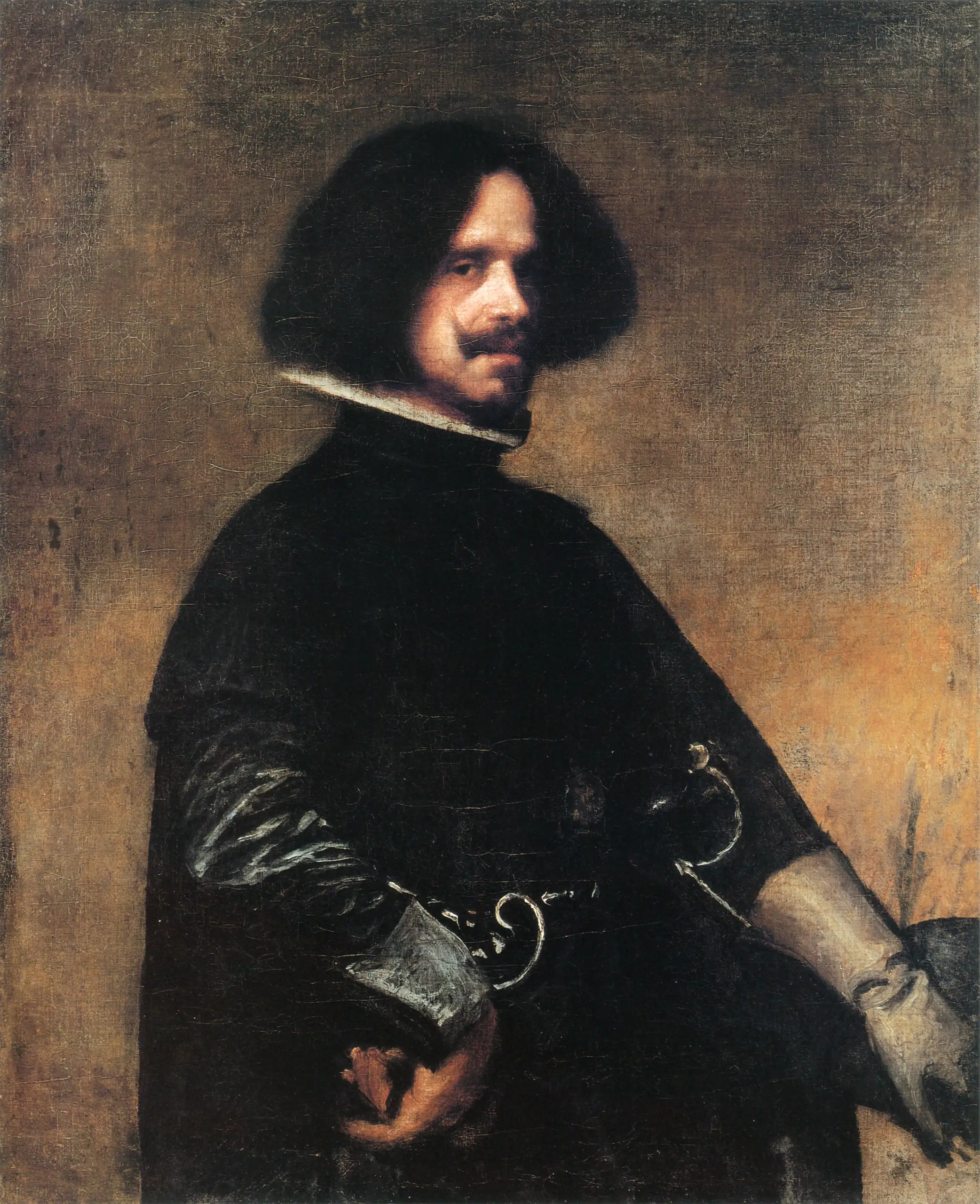
Diego Velázquez
 Spain
SpainAlso known as: Diego Rodríguez de Silva y Velázquez, El Velázquez, The Painter's Painter
Birthday
June 6, 1599
Birth Sign
Gemini
Birthplace
Seville, Spain
Age
Died at 61
About
Diego Rodríguez de Silva y Velázquez stands as the preeminent figure of the Spanish Golden Age and a titan of Western art history. Born in Seville in 1599, he rose to become the principal court painter for King Philip IV, securing an unprecedented social status that elevated artists from mere craftsmen to nobility. His legacy is defined by a revolutionary mastery of realism, complex spatial compositions, and an innovative use of loose, visible brushwork that would later inspire the Impressionists and modern masters like Pablo Picasso. Unlike his contemporaries who often relied on rigid stylization, Velázquez developed a luminous style characterized by sophisticated color mixing and psychological depth.
His most celebrated work, Las Meninas, completed in 1656, remains one of the most analyzed paintings in existence. It captures the Infanta Margarita surrounded by her entourage, with the artist himself depicted painting on a massive canvas, creating a meta-narrative about the act of seeing and being seen. This masterpiece, along with works like The Rokeby Venus and The Surrender of Breda, showcases his ability to blend the mundane with the majestic. Today, his surviving oeuvre resides primarily in the Museo del Prado in Madrid, which houses the world's most extensive collection of his art. His influence transcends centuries, shaping how artists perceive light, space, and the human condition.
Early Life & Background
Diego Rodríguez de Silva y Velázquez entered the world on June 6, 1599, in Seville, Spain, into a family of lower nobility known as hidalgos. His father, Juan Rodríguez de Silva, was a notary originally from Oporto, Portugal, while his mother, Jerónima Velázquez, was a native of Seville. The household valued education and civic duty, providing Diego with a solid humanist upbringing that included learning Latin and reading classical literature, an intellectual foundation that would later inform the profound depth of his artistic work. At age 12, Velázquez began his formal training in the workshop of Francisco Pacheco, a respected painter and art theorist in Seville. Pacheco's studio was a hub for intellectuals and artists, exposing the young student to philosophical debates of the era.
Under Pacheco's guidance, Velázquez mastered the techniques of tenebrism, a style prevalent in Seville that relied on strong contrasts between light and dark, heavily influenced by Caravaggio. By 1617, at the age of 18, Velázquez was admitted to the Guild of Saint Luke in Seville, marking his official entry into the profession. His early works were characterized by naturalism and religious themes, such as Christ in the House of Martha (c. 1618) and The Adoration of the Magi (c. 1619). These early paintings demonstrated a keen eye for detail and a departure from the stylized Mannerism common in Spain, signaling his potential for greatness. He spent several years establishing his reputation in Seville before receiving the summons that would change his life forever.
Career Growth
In 1623, Velázquez painted a portrait of King Philip IV that so impressed the monarch he was immediately summoned to Madrid. Unlike other artists who waited years for patronage, Velázquez was appointed Painter to the King almost instantly, beginning decades of service to the Spanish court. In 1627, he participated in a painting contest organized by the King against prominent artists like Pedro de Orrente and Vicente Carducho. Velázquez won with his mythological masterpiece The Forge of Vulcan, securing his appointment as Gentleman Usher to the King. This title was revolutionary, elevating him to the rank of nobility and allowing him to live within the palace.
Between 1629 and 1631, he undertook his first trip to Italy to study Renaissance masters. He visited Venice, Rome, and Naples, absorbing the color and composition techniques of Titian, Tintoretto, and Veronese. This journey fundamentally shifted his style from the strict tenebrism of his youth to a more fluid, luminous approach. Back in Spain, he created monumental historical paintings like The Surrender of Breda (also known as Las Lanzas) in 1634, celebrating Spanish military victory. Velázquez made his second trip to Italy between 1649 and 1651. During this period, he painted portraits of Pope Innocent X, widely considered one of the greatest papal portraits ever created. He also acquired a significant collection of Italian art for the Spanish crown. In 1656, he completed his magnum opus, Las Meninas. He finished his final major work, The Rokeby Venus, in 1659, the only surviving female nude in Spanish art. His technical innovations, particularly his use of loose brushwork and optical mixing of colors, were studied and emulated by later masters like Manet, Picasso, and Warhol.
Career Timeline
Public Image & Style
Velázquez is portrayed as a genius of understatement. Unlike the flamboyant personalities of some contemporaries, he is remembered for his dignity, professionalism, and quiet confidence. His public image is that of a master craftsman who bridged the gap between art and nobility. Media portrayals emphasize his role as a chronicler of the Spanish Golden Age and a pioneer of modern painting techniques. He maintained a reserved demeanor throughout his life, rarely engaging in the social intrigues of the court despite his high status. His portraits of the royal family reveal a keen psychological insight, capturing the inner lives of his subjects rather than just their external appearance. This ability to convey depth and humanity earned him the respect of the monarchy and the admiration of future generations of artists. He is often referred to as the "painter's painter," a title signifying his supreme technical mastery among professionals.
Fame & Fandom (iFAMOUS Rankings)
Diego Velázquez stands as the 70th most famous person in Spain, a position he has held steady through the cycles of history and into the modern era. His stature extends beyond national borders to the global stage, where he ranks as the 51st most famous person in Art & Design. These placements within the iFANN Global Fame Rankings reflect a sustained reverence that tracks global attention across media coverage, search activity, and cultural consumption worldwide. The devotion to his work is unique in its nature, lacking a formal fanbase name or organized community structure typical of contemporary celebrities. As a figure from over three centuries ago, there are no campaigns, hashtags, or billboards driven by a dedicated group of followers. Instead, his audience consists of art historians, curators, and artists who revere him as the quintessential painter's painter.
This academic and artistic admiration manifests not in pop-cultural rituals but in the enduring study of his techniques and the institutional preservation of his legacy. Major museums like the Prado and the Met continue to host programs where copyists study his brushwork, while digital initiatives have recently transformed his masterpieces for new audiences. The relationship between Velázquez and his subjects remains legendary; his role as a gentleman usher to King Philip IV granted him access to the royal family that few artists ever achieved, allowing him to document the Spanish Golden Age with unparalleled intimacy. In 2026, the art world buzzed with news from the Detroit Institute of Arts, where the director attributed a 17th-century oil portrait of a wealthy man to Velázquez, reigniting debates about his complete oeuvre and sustaining his relevance in contemporary discourse.
Interesting Facts and Legends
Velázquez spent nearly 30 years trying to prove his noble lineage to join the Order of Santiago. He was finally admitted in 1659, just months before his death, a triumph that validated his social status beyond mere artistic skill. A story often retold by scholars highlights how Las Meninas encapsulates the meta-narrative of the act of painting itself. In the painting, Velázquez includes himself standing before a large canvas, looking out at the viewer. This was a bold statement of the artist's status as an intellectual equal to the subjects he painted. Another enduring legend surrounds his title as the painter's painter, signifying his supreme technical mastery among professionals.
In June 2026, the art world buzzed with news from the Detroit Institute of Arts, where the director attributed a 17th-century oil portrait of a wealthy man to Velázquez, reigniting debates about his complete oeuvre. Recent digital transformations of his works ahead of the August 2026 solar eclipse demonstrate how his visual language continues to engage modern viewers, proving his influence transcends the boundaries of time. Contemporary descriptions suggest he was of average height for a Spaniard of the 17th century, approximately 5'7" to 5'9", though exact records do not exist. Portraits show a clean-shaven face, wearing the fashionable doublet and hose of the Spanish court, often depicted with a calm, observant demeanor. His self-portrait in Las Meninas is one of the few depictions of him at work, showing him holding a palette and brushes.
Notable Quotes
“Troppo vero! (Too true!) - reportedly said by Pope Innocent X upon seeing his portrait”
“I paint the truth as I see it.”
“Art is the imitation of nature.”
“The hand must obey the mind.”
“A painter must be a philosopher.”
Family & Personal Life
On April 23, 1618, Velázquez married Juana Pacheco, the daughter of his master, Francisco Pacheco. Juana was about 16 years old at the time, while Velázquez was roughly 19. The couple had two daughters: Isabel de Velázquez, born in 1618, who died in infancy, and Francisca de Velázquez, born in 1625. Francisca survived childhood but remained unmarried and lived with her father until his death. Velázquez managed his family's finances carefully through his royal income, ensuring their comfort throughout his life. Letters discovered in 2026 reveal that Velázquez once fought against his daughter Francisca's proposed marriage to his protégé, Juan Bautista Martínez del Mazo, fearing it would compromise his artistic legacy or create a conflict of interest. However, the marriage eventually took place, and Mazo became a successful painter in his own right, continuing the Velázquez style. Velázquez's relationship with his father-in-law was sometimes strained, yet he maintained a stable household dedicated to his children's well-being.
Notable Connections
Diego Velázquez is closely associated with the Spanish Golden Age, the Baroque movement, and the Habsburg monarchy. He worked directly for King Philip IV and Queen Elisabeth of France. His style was influenced by Caravaggio and Titian, and he mentored Juan Bautista Martínez del Mazo. Modern artists like Pablo Picasso and Salvador Dalí have cited him as a major influence.
Relationships & Dating History
Diego Velázquez did not have a dating history in the modern sense. His romantic life was governed by the strict social norms of the Spanish Golden Age, where marriages were arranged alliances between families. On April 23, 1618, he married Juana Pacheco, the daughter of his master, Francisco Pacheco. The marriage was arranged by Pacheco, likely to keep his talented apprentice close and ensure his loyalty. Juana was about 16 years old at the time, while Velázquez was roughly 19. Their union was stable, producing two daughters: Isabel de Velázquez, who died in infancy, and Francisca de Velázquez, born in 1625. Francisca survived childhood but remained unmarried and lived with her father until his death.
Velázquez remained devoted to his family throughout his life, managing their finances and ensuring their comfort through his royal income. There are no records of extramarital affairs or publicized breakups. Their union lasted until Velázquez's death in 1660. As of 2026, Velázquez is widowed, having been married to Juana Pacheco at the time of his death. The arrangement kept his talented apprentice close and ensured his loyalty, creating a bond that extended beyond professional mentorship into a lifelong familial partnership.
- MarriedJuana Pacheco1618 - 1660Arranged marriage to the daughter of his mentor; produced two daughters.
Death & Aftermath
Died
August 6, 1660 (aged 61)
Death Place
Madrid, Spain
Cause of Death
Fever and infection
Diego Velázquez died on August 6, 1660, in Madrid while serving King Philip IV. The master painter had been working tirelessly on royal commissions during the height of summer when his health suddenly deteriorated. Historical records indicate he passed away from a fever, likely caused by an infection or heatstroke, though some accounts suggest the plague. He died just weeks after completing his final major works for the court. His death marked the end of an era for Spanish art, leaving a void that few could fill with such technical brilliance. The immediate reaction among his peers and the monarchy was one of deep respect and sorrow. A simple funeral service was held to honor his life, reflecting the modesty often associated with his character despite his high status.
Following the service, his estate was settled according to the customs of the time, ensuring his family received what was due while his artistic legacy remained intact. The court mourned not just a man, but the unique vision that had defined the Golden Age of Spain. His daughter Francisca inherited his estate and continued to manage his unfinished works, preserving the master's legacy for future generations. King Philip IV was deeply affected, reportedly weeping at the loss of his favorite artist. His legacy was preserved by the Spanish monarchy, ensuring his works remained in the royal collection, where they continue to be studied and admired today.
Net Worth (Estate Value)
$5 Billion
iFANN Editorial Team estimate
As a deceased historical figure, Diego Velázquez does not have a personal net worth in 2026. However, his estate and the value of his artistic legacy are immense. Individual paintings by Velázquez are among the most valuable artworks in the world. For example, The Rokeby Venus is insured for hundreds of millions of dollars. While many of his works are in public collections, the market value of any piece sold privately would be astronomical. The Spanish Royal Family and the Spanish State manage the bulk of his estate, specifically the collection held in the Museo del Prado. The estate generates revenue through ticket sales, licensing, merchandise, and international loans.
The Prado Museum, housing the largest collection of his work, attracts millions of visitors annually, generating substantial revenue attributed to his legacy. High-profile exhibitions and digital reproductions generate licensing fees. In 2026, the Prado Museum launched a digital transformation of his masterpieces ahead of the August solar eclipse, creating new revenue streams through virtual experiences and augmented reality apps. iFANN currently estimates the total value of Velázquez's artistic legacy and estate at approximately $5 billion. If his entire body of work were auctioned today, it would likely exceed this figure. Research by the iFANN Editorial Team puts his fortune at around $5 billion based on the estimated value of his oeuvre and ongoing revenue from museum operations and licensing. The continuous demand for his work ensures that his financial impact remains robust centuries after his passing.
Awards Won (2)
While the concept of modern awards did not exist in the 17th century, Velázquez received significant honors during his lifetime. He was appointed Gentleman Usher to the King in 1627, granting him noble status. In 1659, he was finally admitted to the prestigious Order of Santiago, validating his social standing. Posthumously, he has been recognized as one of the greatest artists in history, with Las Meninas frequently voted the greatest painting of all time by critics and art historians.
1659 · Knighthood
Lifetime Achievement
1627 · Court Title
The Forge of Vulcan
Known For
Las Meninas
1656 · Painter
The Rokeby Venus
1659 · Painter
Portrait of Pope Innocent X
1650 · Painter
The Surrender of Breda
1634 · Painter
The Forge of Vulcan
1627 · Painter
Keywords
Sources
Quick Facts
- Profession
- painter, artist, visual artist
- Born
- June 6, 1599
- Birthplace
- Seville, Spain
- Died
- August 6, 1660
- Death Place
- Madrid, Spain
- Gender
- Male
- Spouse
- Juana Pacheco
- Birth Sign
- Gemini
Personal Details
- Full Name
- Diego Rodríguez de Silva y Velázquez
- Spouse
- Juana Pacheco
- Children
- Francisca de Velázquez
- Education
- Apprenticed under Francisco Pacheco
Frequently Asked Questions
How old was Diego Velázquez when he died?
What is Diego Velázquez's net worth in 2026?
Who was Diego Velázquez married to?
Why is Diego Velázquez famous?
How did Diego Velázquez die?
Similar People
Join the community
fans discussing