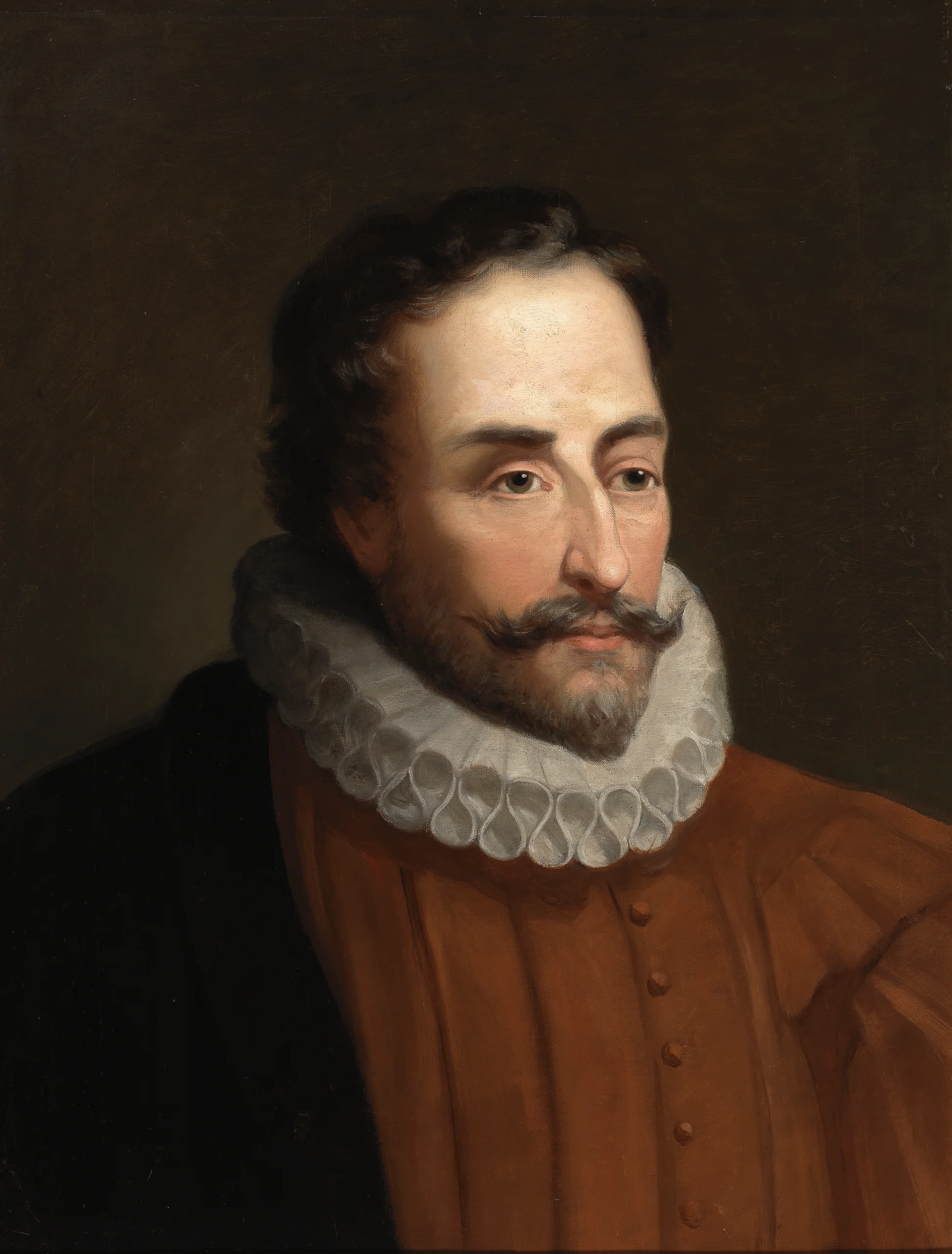
Miguel de Cervantes
 Spain
SpainAlso known as: Cervantes, Miguel de Cervantes Saavedra
Birthday
September 29, 1547
Birth Sign
Libra
Birthplace
Alcalá de Henares, Spain
Age
Died at 68
About
Miguel de Cervantes Saavedra was a Spanish novelist, playwright, and poet, widely regarded as the greatest writer in the Spanish language and one of the preeminent novelists in world literature. Born in 1547 in Alcalá de Henares, he lived a life marked by adventure, hardship, and resilience, and his masterpiece Don Quixote is often called the first modern novel. His works have been translated into more than sixty languages, and his influence on literature is so profound that Spanish is sometimes referred to as "the language of Cervantes."
Cervantes's legacy endures not only through his writings but also through his remarkable personal story: he fought at the Battle of Lepanto, survived five years of captivity in Algiers, and overcame poverty and imprisonment to create some of the most enduring characters in fiction. His death on April 22, 1616, in Madrid, at age 68, is commemorated alongside that of William Shakespeare, marking a global celebration of literature.
Early Life & Background
Miguel de Cervantes was born into a family of minor gentry that had fallen on hard times. His father, Rodrigo, was a barber-surgeon who struggled with debt and moved the family frequently across Spain, from Córdoba to Valladolid, Seville, and Madrid. When Rodrigo was imprisoned for debt between 1553 and 1554, his mother Leonor supported the household alone. Despite these upheavals, Cervantes developed a passion for reading, though he never attended university.
In Madrid, he studied under Juan López de Hoyos, a schoolmaster with Erasmist leanings, who published Cervantes's first poems in 1569, including verses for the funeral of Queen Elizabeth of Valois. That same year, an arrest warrant was issued for Cervantes, accused of wounding a man in a duel, prompting him to flee to Rome. There he served in the household of Cardinal Giulio Acquaviva before enlisting in the Spanish infantry in Naples in 1570. His early life was marked by a mix of literary promise and the restless pursuit of fortune, setting the stage for his later adventures.
Career Growth
Cervantes's literary career took off after his return from captivity. In 1585, he published La Galatea, a pastoral romance, and saw several plays staged in Madrid, though most are now lost. For the next decade, he worked as a purchasing agent and tax collector in Andalusia, a period that included two imprisonments for financial irregularities. His breakthrough came in 1605 with the publication of the first part of Don Quixote. The novel was an immediate success, and its second part followed in 1615, after a spurious sequel by a rival author prompted him to reclaim his creation.
In the final years of his life, Cervantes published Exemplary Novels (1613), a collection of twelve short stories, and the epic poem Journey to Parnassus (1614). His last novel, The Travails of Persiles and Sigismunda, appeared posthumously in 1617. Throughout, Cervantes's work blended humor, tragedy, and social commentary, forever changing the course of narrative fiction.
Career Timeline
Public Image & Style
Cervantes is remembered as the father of the modern novel, a figure of extraordinary resilience who endured war wounds, slavery, and poverty while producing literature of enduring power. His signature style blends tragedy and comedy, using humor to critique social norms. Don Quixote and Sancho Panza have become universal archetypes, instantly recognizable across cultures. No official fandom name exists, but scholars and readers worldwide celebrate him through institutions like the Cervantes Society of America and the Instituto Cervantes.
Fame & Fandom
Miguel de Cervantes commands a global following that transcends the fleeting nature of modern celebrity. While he lacks a unified, social-media-driven fandom like those surrounding contemporary pop stars, his legacy is sustained by a dedicated community known as Cervantistas. This group comprises university scholars, literary societies, and cultural pilgrims who gather annually on April 23 to honor World Book Day. The tradition involves exchanging books and roses, a ritual deeply rooted in Spanish culture that mirrors the courtly love found in his masterpieces. Their devotion manifests not through viral campaigns but through the preservation of his birthplace in Alcalá de Henares and the enduring prestige of the Cervantes Prize, the highest literary award in the Spanish-speaking world. Fans engage with his work through endless debates, stage adaptations, and a shared fascination with the myths surrounding his life, from his captivity in Algiers to the legends of his death. This institutional reverence ensures his story remains vital centuries after his passing. His influence is so pervasive that his works define the very language he wrote in. In August 2026, this enduring relevance secured him specific placements within the iFANN Global Fame Rankings, recognizing his status as the 33rd most famous person in Spain, the 45th most famous person in Europe, and the 73rd most famous person in Books & Literature.
Interesting Facts and Legends
Cervantes signed his name "Cerbantes," though printers standardized it to "Cervantes." He claimed to stutter, a detail scholars debate as literal or metaphorical. Church authorities excommunicated him for seizing property while collecting taxes. As a youth, he won silver spoons for poems written about bouquets. Evidence suggests possible Jewish ancestry, though records remain thin. Historians assume his birth date was September 29, based on his October 9 baptism record. Two verified events anchor his legend: at age 24, he fought at the Battle of Lepanto where he lost the use of his left arm, earning the title "the one-armed man of Lepanto." Five years later, Barbary pirates enslaved him in Algiers; he attempted escape four times before being ransomed. A persistent myth claims he died holding a copy of Don Quixote or writing its final lines, though records show he died on April 22, 1616, with the burial recorded the next day.
Notable Quotes
“The truth may be stretched thin, but it never breaks, and it always surfaces above lies, as oil floats above water.”
“There is no book so bad that it does not contain something good.”
“Too much sanity may be madness - and maddest of all: to see life as it is, and not as it should be!”
Family & Personal Life
Cervantes's parents, Rodrigo de Cervantes and Leonor de Cortinas, had seven children, with Miguel as the fourth. His father was a barber-surgeon from Córdoba, while his mother was a literate woman from Arganda del Rey. The family's constant moves and financial struggles shaped his early years. Cervantes married Catalina de Salazar y Palacios in December 1584, but the marriage was childless. He had one illegitimate daughter, Isabel de Saavedra, born around 1584 with Ana Franca de Rojas. His younger brother Rodrigo was a fellow soldier and captive in Algiers.
Notable Connections
Miguel de Cervantes was associated with several key figures of his time, including his teacher Juan López de Hoyos, who published his first poems, and Cardinal Giulio Acquaviva, in whose household he served in Rome. At the Battle of Lepanto, he fought under Don Juan of Austria. His brother Rodrigo was a fellow soldier and captive in Algiers. Later, he was a contemporary of playwright Lope de Vega, who influenced his work.
Relationships & Dating History
Cervantes's first known romantic relationship was with Ana Franca de Rojas, the wife of a tavern owner in Madrid, around 1580. They had an illegitimate daughter, Isabel de Saavedra, born circa 1584. In December 1584, Cervantes married Catalina de Salazar y Palacios in Esquivias, Toledo. She was twenty-two years younger than him, and the marriage produced no children. The couple spent two years in Esquivias before Cervantes left for Andalusia in 1587. He remained married to Catalina until his death in 1616, with no recorded separation.
- DatedAna Franca de Rojas1580 - 1584Had an illegitimate daughter, Isabel de Saavedra, with her.
- MarriedCatalina de Salazar y Palacios1584 - 1616Married in December 1584; childless marriage lasting until his death.
Death & Aftermath
Died
April 22, 1616 (aged 68)
Death Place
Madrid, Spain
Cause of Death
Reported complications from dropsy
A cenotaph now stands in the church of San Francisco el Grande in Madrid, a silent tribute to a man whose words would eventually make Spanish synonymous with literature itself. The Miguel de Cervantes Prize, established centuries later in 1975, continues to honor writers across the Hispanic world, while April 23rd remains World Book Day, a date chosen to commemorate both his passing and that of William Shakespeare. This enduring global reverence contrasts sharply with the quiet end he experienced on April 22, 1616, when he passed away in Madrid at the age of sixty-eight or sixty-nine. By early 1616, the author was too ill to engage in public life, having recently published the second part of Don Quixote just months before his final days.
He died in poverty, likely at home surrounded by family. Historical records attribute his death to complications from dropsy, a condition often described as edema or dropsy of the heart, which stemmed from long-term health issues exacerbated by his earlier injuries, including the loss of his left arm at the Battle of Lepanto. The cause was established through family statements and parish registers from the Convent of the Trinitarians. His widow Catalina de Salazar y Palacios and their daughter Isabel managed his modest assets privately. His funeral took place the following day, April 23, 1616, in the Convent of the Discalced Trinitarians, attended only by close friends like the poet Francisco de Quevedo, who delivered a eulogy. Immediate public reaction was limited by the communication methods of the time, yet literary circles mourned deeply.
Luis de Góngora wrote an elegy hailing Cervantes as the monarch of Spanish poetry, acknowledging the loss of a national treasure. While the convent where he was buried eventually fell into disrepair and his exact grave location was lost for centuries until a skeleton believed to be his was identified during 1924 renovations, his cultural legacy has grown immeasurable. Posthumous releases included the novel The Travails of Persiles and Sigismunda in 1617, and his works have since been translated into more than sixty languages, cementing his status as one of the preeminent novelists in world history.
Net Worth (Estate Value)
$10 Million
iFANN Editorial Team estimate
Miguel de Cervantes never accumulated significant wealth during his lifetime. He lived in relative poverty and obscurity, working as a tax collector and purchasing agent to support himself while writing. His estate held no substantial financial value upon his death, as his works quickly entered the public domain. However, the cultural wealth of his legacy remains immeasurable. Don Quixote has been translated into more than sixty languages, and editions continue to be printed regularly across the globe. Per iFANN's editorial analysis, the estimated value of his estate stands at $10 Million. As of 2026, his net worth is largely symbolic, with no ongoing commercial management or royalties generating income. His true fortune lies in the enduring impact of his literature on world culture.
Awards & Accolades
View 8 records, honours and achievementsKnown For
Don Quixote
1605 · Author
Exemplary Novels
1613 · Author
Journey to Parnassus
1614 · Author
The Travails of Persiles and Sigismunda
1617 · Author
Keywords
Sources
Quick Facts
- Profession
- novelist, playwright, poet
- Born
- September 29, 1547
- Birthplace
- Alcalá de Henares, Spain
- Died
- April 22, 1616
- Death Place
- Madrid, Spain
- Gender
- Male
- Spouse
- Catalina de Salazar y Palacios
- Children
- Isabel de Saavedra (illegitimate)
- Notable Work
- Don Quixote
Personal Details
- Full Name
- Miguel de Cervantes Cortinas
- Spouse
- Catalina de Salazar y Palacios
- Children
- 1 (Isabel de Saavedra, illegitimate)
- Education
- Studied under Juan López de Hoyos in Madrid; no university education
Frequently Asked Questions
How did Miguel de Cervantes die?
Was Miguel de Cervantes married and did he have children?
What happened to Cervantes's left hand?
How long was Cervantes held captive in Algiers?
Why is Don Quixote considered the first modern novel?
Join the community
fans discussing