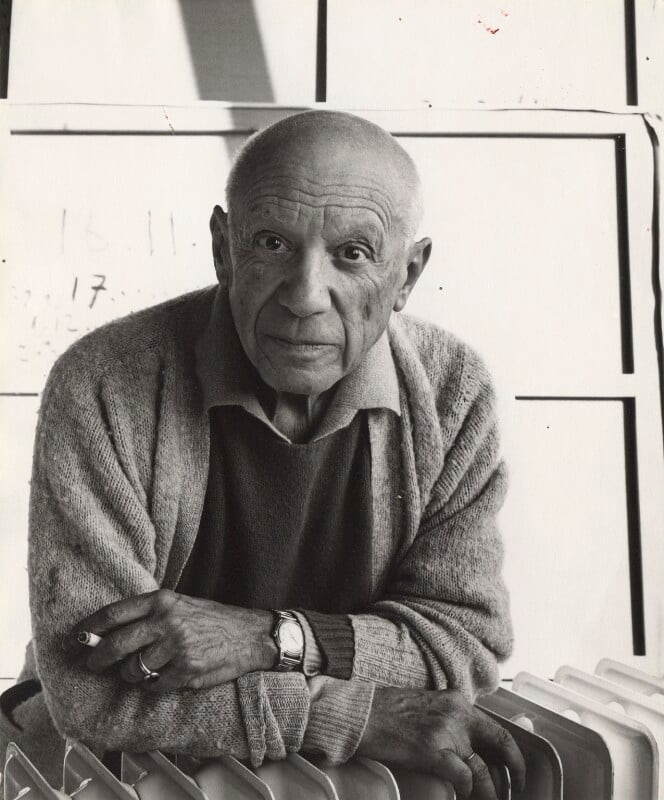
Pablo Picasso
 Spain
Spainpainter•sculptor•printmaker•ceramicist•stage designer
Also known as: Pablo Ruiz Picasso
Birthday
October 25, 1881
Birth Sign
Scorpio
Birthplace
Málaga, Spain
Age
Died at 91
Height
5 ft 7 in (170 cm)
About
Pablo Picasso, born on October 25, 1881, in Málaga, Spain, was a Spanish painter, sculptor, printmaker, ceramicist, and stage designer. He spent most of his adult life in France, where he became one of the 20th century's most influential artists. Picasso co-founded the Cubist movement, invented constructed sculpture, and pioneered collage, fundamentally changing how art was made and seen. His expansive career, stretching 76 years, yielded an enormous body of work, with estimates ranging into tens of thousands of pieces.
His artistic journey is marked by distinct stylistic periods, each a significant chapter in modern art. From the melancholic tones of his Blue Period to the geometric fragmentation of Cubism and the raw power of his anti-war masterpiece Guernica, Picasso consistently pushed boundaries. Admirers around the globe celebrate his relentless innovation and the sheer volume of his creative output. He remains a central figure in art history, with his work continuously exhibited, studied, and collected by museums and private enthusiasts worldwide.
Early Life & Background
Young Pablo Ruiz Picasso showed exceptional artistic talent from a very early age, receiving his first formal training at just seven years old. His father, José Ruiz y Blasco, a painter and art professor, provided initial instruction, quickly recognizing his son's prodigious abilities. By his early teens, Picasso was already painting with a remarkable naturalistic style, a testament to his innate skill and dedication. He briefly attended the School of Fine Arts in Barcelona, and later the Royal Academy of San Fernando in Madrid, though he often found the traditional academic structure stifling and preferred to pursue his own artistic explorations.
The early 1900s saw Picasso experimenting with diverse techniques and styles, absorbing influences from the vibrant European art scene. His move to Paris in 1904 proved to be a transformative moment. The city's bustling artistic community exposed him to new ideas and currents, setting the stage for his groundbreaking innovations. He engaged with the works of contemporaries like Henri Matisse, whose Fauvist experiments sparked a creative rivalry that spurred Picasso towards increasingly radical artistic directions, moving him away from conventional representation.
Career Growth
Picasso's career was a continuous journey of innovation, marked by distinct stylistic periods that reshaped the art world. Following his early Blue and Rose Periods, which explored themes of despair and then human warmth, he entered his African-influenced Period around 1907. That same year, he created Les Demoiselles d'Avignon, a proto-Cubist painting depicting five nude female figures that shattered traditional perspective and beauty standards, proving to be a radical departure from convention.
Working closely with Georges Braque, Picasso then co-founded Cubism, a revolutionary movement that broke objects into geometric forms and depicted them from multiple viewpoints. His Analytic Cubism phase (1909–1912) used a muted palette of browns and grays. This evolved into Synthetic Cubism (1912–1919), where he pioneered collage by incorporating everyday materials like newspaper clippings and wallpaper into his paintings. Later, he explored Neoclassicism and Surrealism, showcasing his remarkable versatility. A powerful anti-war statement, his monumental painting Guernica (1937) depicted the bombing of a Basque town during the Spanish Civil War and became an enduring international symbol against conflict. Picasso's relentless experimentation across painting, sculpture, ceramics, and printmaking solidified his place as a titan of modern art.
Career Timeline
Public Image & Style
Pablo Picasso's public image is deeply etched as a revolutionary genius, a towering figure whose art reshaped the 20th century. Media portrayals often highlight his dual nature: a brilliant innovator constantly pushing artistic boundaries, yet also a complex, sometimes controversial, individual due to his tumultuous personal life. His name is synonymous with Cubism, a movement he co-founded, but his vast body of work spans numerous styles, from the somber Blue Period to vibrant ceramics. Audiences connect with his art for its emotional depth, formal invention, and historical significance. While there isn't a single official 'fandom name,' his global admirers, including art historians, collectors, and general enthusiasts, engage with his legacy through museum visits, scholarly discussions, and the continuous reinterpretation of his enduring influence.
Fame & Fandom (iFAMOUS Rankings)
The enduring devotion to Pablo Picasso is less a modern fandom and more a global pilgrimage of art historians, collectors, and museum visitors who trace his footsteps through Spain and France. Unlike living stars with organized fan clubs, his admirers engage in ritualistic tourism to the sites where he lived and worked, while institutions fiercely protect his physical legacy from theft. This community manifests not through social media campaigns but through the intense secondary market demand for his work and legal battles to reclaim stolen pieces, such as the 2026 recovery of a 1949 print in Milwaukee. His influence remains so profound that he stands as a towering figure in the collective consciousness of the art world, a status quantified by the iFANN Global Fame Rankings. According to these authoritative placements from August 2026, which track global attention across media coverage, search, and consumption signals worldwide, Pablo Picasso is the 113th most famous person in the world, holding steady from the previous cycle. Within his homeland, he ranks as the 10th most famous person in Spain and the 4th most famous person from Spain. On the European continent, he sits at the 6th most famous person in Europe. Most notably within his specific field, he is recognized as the 2nd most famous person in Art & Design. These rankings confirm that nearly half a century after his passing, his name remains synonymous with revolutionary creativity.
Interesting Facts and Legends
Pablo Picasso was a child prodigy who reportedly drew realistically before he could even write. He was a committed pacifist and a member of the French Communist Party for many years, joining in 1944. He famously remarked, "Every child is an artist. The problem is how to remain an artist once he grows up," a quote that continues to resonate with creatives. Though known primarily for his visual art, Picasso also authored more than 300 poems and two plays. His intense personality often led to complex and sometimes difficult relationships with those around him. A story fans still retell involves his claim that it took him a lifetime to learn to draw like a child, reflecting his mastery of simplifying complex forms. He is legendary for his association with the "Lost Generation" of writers in Paris, particularly Ernest Hemingway, cementing his role in bohemian culture. Recent lore has focused on the vulnerability of his work; in 2026, the Guggenheim Museum sued to reclaim a painting stolen in 1961, and a 1949 etching print stolen from a Milwaukee gallery in 2018 was returned to police eight years later, underscoring the enduring allure and danger associated with his art.
Notable Quotes
“Art washes away from the soul the dust of everyday life.”
“I do not paint things. I only paint the differences between things.”
“Computers are useless. They can only give you answers.”
“Everything you can imagine is real.”
Family & Personal Life
Pablo Picasso was born to José Ruiz y Blasco, a painter and art professor, and María Picasso López. His father, a talented artist himself, was his first and most important teacher. Picasso had two younger sisters, Dolores and Concepción, though Concepción died at a young age from diphtheria. In his adult life, Picasso had four children from three different relationships: his son Paulo Picasso with his first wife Olga Khokhlova; his daughter Maya Widmaier-Picasso with his long-term partner Marie-Thérèse Walter; and his children Claude Picasso and Paloma Picasso with artist Françoise Gilot. He spent his later years residing in various homes in the south of France, often surrounded by his art and his second wife, Jacqueline Roque.
Notable Connections
Pablo Picasso collaborated closely with artist Georges Braque, together co-founding the Cubist movement. His contemporary and friendly rival, Henri Matisse, also significantly influenced his artistic trajectory. Throughout his life, a series of important women served as his partners and muses, including Fernande Olivier, Olga Khokhlova, Marie-Thérèse Walter, Dora Maar, Françoise Gilot, and Jacqueline Roque. Art dealer Ambroise Vollard played a significant role in Picasso's early career, providing crucial support and exposure.
Relationships & Dating History
Pablo Picasso's personal life was as dynamic and complex as his art, marked by several significant romantic relationships. His first long-term partner was Fernande Olivier, whom he met in Paris around 1904. Their passionate but turbulent relationship lasted until 1912, ending amidst his growing fame and infidelity. In 1918, he married Russian ballerina Olga Khokhlova, whom he had met a year prior while working on the ballet Parade. They had one son, Paulo Picasso, born in 1921, but their marriage eventually dissolved due to his affairs, though they never legally divorced during Olga's lifetime.
Around 1927, Picasso began a clandestine relationship with Marie-Thérèse Walter, who was 17 at the time and became a significant muse for his work, particularly in the 1930s. They had a daughter, Maya Widmaier-Picasso, born in 1935. From approximately 1936 to 1946, he was involved with Dora Maar, a French photographer and painter who documented the creation of Guernica. Their intense relationship ended due to Picasso's volatile nature. He then began a relationship with Françoise Gilot in 1943, an artist and writer with whom he had two children, Claude Picasso (born 1947) and Paloma Picasso (born 1949). Gilot famously left him in 1953, later detailing their relationship in a memoir.
His final significant relationship was with Jacqueline Roque, whom he married in 1961. She was his companion for the last two decades of his life and frequently modeled for his later works. They had no children together. As of 2026, Pablo Picasso is deceased, having passed away on April 8, 1973, at which time he was married to Jacqueline Roque.
- DatedFernande Olivier1904 - 1912Met in Paris; their passionate but tumultuous relationship ended due to Picasso's infidelity.
- MarriedOlga Khokhlova1918 - 1955A Russian ballerina; they had one son, Paulo Picasso. The marriage dissolved due to his affairs, though they never formally divorced.
- In a RelationshipMarie-Thérèse Walter1927 - 1973Met when she was 17; a significant muse for his work, they had one daughter, Maya Widmaier-Picasso.
- In a RelationshipDora Maar1936 - 1946A French photographer and painter who became his lover and muse, documenting the creation of Guernica.
- In a RelationshipFrançoise Gilot1943 - 1953A French artist and writer; they had two children, Claude and Paloma. Gilot was one of the few women to leave Picasso.
- MarriedJacqueline Roque1961 - 1973His second wife and companion for the last 20 years of his life, she was a frequent model for his later works.
Death & Aftermath
Died
April 8, 1973 (aged 91)
Death Place
Mougins, Provence-Alpes-Côte d'Azur, France
Cause of Death
Heart failure or respiratory failure from pneumonia
The official finding regarding Pablo Picasso's passing came from his personal physician, Dr. Jean-Louis Gauthier, who confirmed the artist died of heart failure or respiratory failure resulting from pneumonia. On the morning of April 8, 1973, the painter passed away in his sleep at his residence, the Château de Vauvenargues in Mougins, France, following a period of significant health deterioration due to diabetes and heart issues that had left him bedridden since late March. His final public appearance occurred in early March when he attended a gala celebrating a retrospective at the Grand Palais in Paris, greeted by President Georges Pompidou, before his condition worsened. Tributes poured in immediately from world leaders and the art community, with President Pompidou declaring a day of national mourning while major museums worldwide held moments of silence and dedicated exhibitions.
A private funeral service took place on April 10, 1973, at the Cimetière de la Madeleine in Vallauris, attended by family, close friends like writer André Malraux, and fellow artists, after which Picasso was cremated and his ashes interred in the crypt of his château. Posthumous recognition included the establishment of the Prix Pablo Picasso to honor young artists and the continued expansion of the Picasso Museum in Barcelona, while his estate remained under the management of his son Claude Picasso.
Net Worth (Estate Value)
$3.5 Billion
iFANN Editorial Team estimate
Pablo Picasso passed away in 1973, leaving behind an estate that is consistently ranked among the most valuable in art history. Per iFANN's editorial analysis, the estimated value of his estate as of 2026 sits at $3.5 Billion, managed posthumously by his heirs, primarily his children and grandchildren, through various foundations and legal entities. The estate's substantial value comes from a diverse array of revenue streams. Major sources of income include royalties from reproductions of his artworks, lucrative licensing deals for merchandise, and the strategic sale of artworks from the estate's extensive collection. The management of his intellectual property also contributes significantly. His works continue to command record-breaking prices at auctions worldwide; for example, his painting Femme à la Montre sold for an impressive $139.4 million in November 2023. These high-profile sales and ongoing licensing agreements ensure the estate's financial trajectory remains robust, reflecting the enduring global demand for his art and legacy.
Awards & Accolades
View 10 records, honours and achievementsKnown For
Les Demoiselles d'Avignon
1907 · Painter
Guernica
1937 · Painter
Co-founder of Cubism
1909 · Artist
Keywords
Quick Facts
- Profession
- painter, sculptor, printmaker, ceramicist, stage designer
- Born
- October 25, 1881
- Birthplace
- Málaga, Spain
- Died
- April 8, 1973
- Death Place
- Mougins, France
- Gender
- Male
- Spouse
- Jacqueline Roque
- Birth Sign
- Scorpio
Personal Details
- Full Name
- Pablo Ruiz Picasso
- Height
- 5 ft 7 in (170 cm)
- Spouse
- Jacqueline Roque
- Children
- Paulo Picasso · Maya Widmaier-Picasso · Claude Picasso · Paloma Picasso
- Education
- School of Fine Arts in Barcelona, Royal Academy of San Fernando in Madrid
Frequently Asked Questions
Who was Pablo Picasso?
What are Pablo Picasso's most famous artworks?
What was Pablo Picasso's net worth at the time of his death?
How many children did Pablo Picasso have?
What were Pablo Picasso's main artistic periods?
Social Media
Join the community
fans discussing