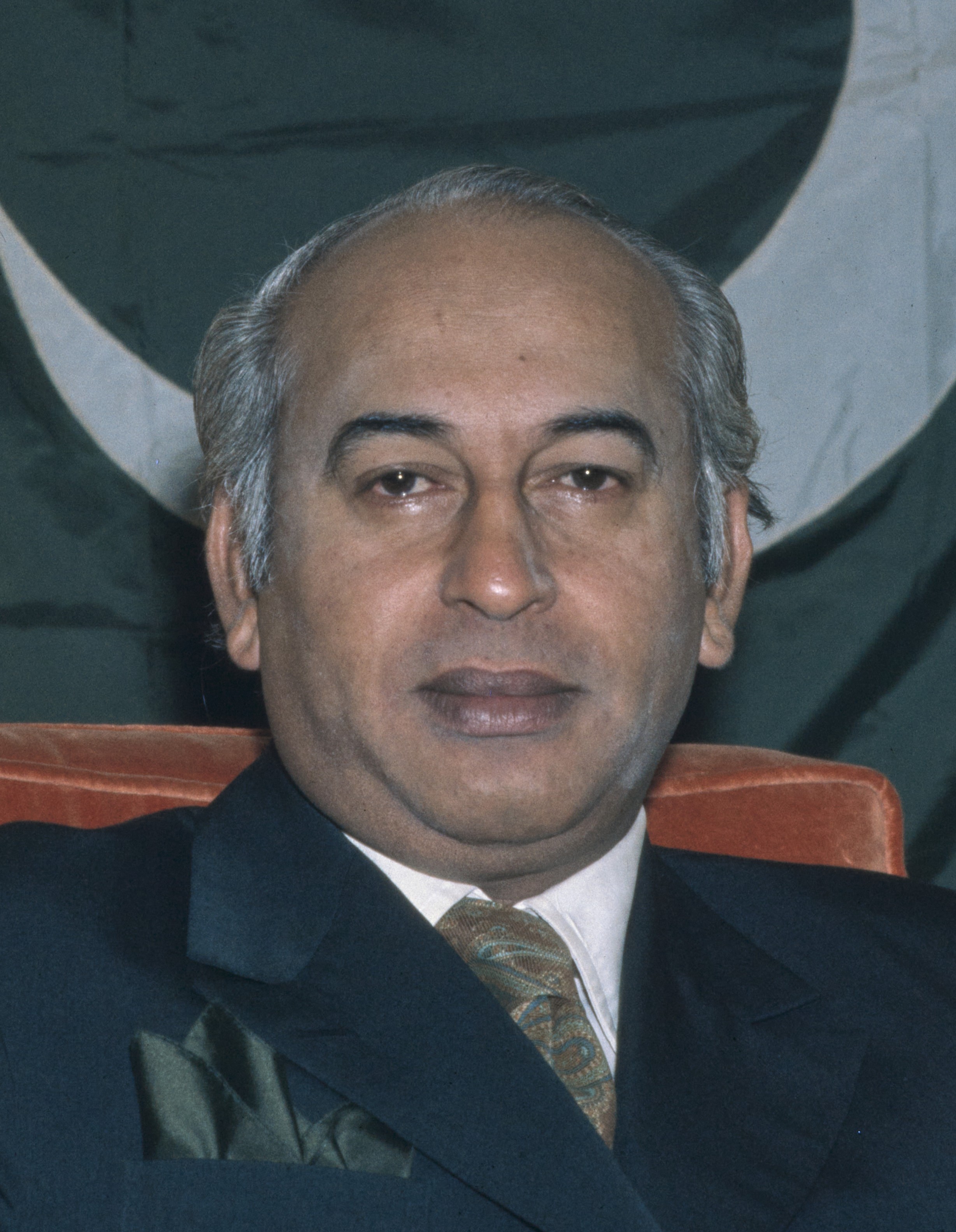
Zulfikar Ali Bhutto
 Pakistan
Birthday
+1928-01-05
Birth Sign
Capricorn
Birthplace
Larkana
Age
Died at 51
About
Zulfikar Ali Bhutto, born in Larkana on January 5, 1928, was a prominent Pakistani lawyer, politician, and diplomat. He rose to become a central figure in Pakistan's political landscape, serving as the fourth president from 1971 to 1973 and later as the ninth prime minister from 1973 until his ousting in 1977. Bhutto also founded the Pakistan People's Party (PPP) in 1967, leading it until his execution in 1979. His early education included stints at the University of Southern California and the University of Oxford, where he trained as a barrister.
Fame & Fandom
Zulfikar Ali Bhutto commanded a global attention that spanned decades of geopolitical upheaval, securing his place in historical records far beyond the borders of South Asia. His enduring prominence is quantified by the iFANN Global Fame Rankings, which track global attention across media coverage, search, and consumption signals worldwide. According to these authoritative metrics, he stands as the 9th most famous person from Pakistan, a position he has held steady through the previous cycle into August 2026. This ranking reflects a legacy defined not by fleeting celebrity but by sustained political influence and historical gravity. Unlike modern entertainers, Bhutto does not possess a formalized fan club or an organized movement dedicated to chart pushes or birthday campaigns. The Pakistan People's Party serves as the institutional vehicle for his supporters, who identify themselves as Bhuttoists rather than members of a fandom. Devotion to his memory manifests through political loyalty to the party leadership and commemorative events on January 5 and April 4, marking his birth and martyrdom respectively. While social media occasionally circulates archival footage of his speeches, these acts reinforce a narrative of political defiance rather than pop-culture adulation. The absence of a specific fan name underscores the distinction between a statesman revered for his impact on national destiny and a celebrity celebrated for entertainment value.
Interesting Facts and Legends
Zulfikar Ali Bhutto remains a figure of profound historical weight, his legacy defined by political transformation rather than pop culture metrics. While he held no formal fandom name, his supporters operate as a politically organized bloc through the Pakistan People's Party, observing his execution on April 4th annually as a solemn Martyrdom Day marked by state-sanctioned processions and prayer. A central pillar of his enduring mythology is the narrative surrounding his 1979 hanging, widely retold by loyalists as a judicial murder orchestrated by General Zia-ul-Haq; this lore received official validation in March 2024 when Pakistan's Supreme Court ruled that Bhutto did not receive a fair trial. His status as the visionary who secured Pakistan's nuclear capabilities further cements his legend, anchored by the famous assertion that the nation would eat grass to acquire an atomic bomb. In diplomatic circles, his meeting with Indira Gandhi at the Simla Agreement is frequently cited as a moment of strategic brilliance that shaped regional ties for decades. Modern digital discourse occasionally circulates archival footage of him addressing the UN Security Council, though fact-checkers have noted recent instances where such clips are re-contextualized to fuel contemporary debates regarding nuclear weapons. He ranks as the 9th most famous person from Pakistan according to the iFANN Global Fame Rankings.
Death & Aftermath
Died
+1979-04-04 (aged 51)
Death Place
Rawalpindi District Jail, Rawalpindi, Pakistan
Cause of Death
Reported execution by hanging
The execution of Zulfikar Ali Bhutto triggered immediate and profound nationwide unrest, sparking massive strikes, riots, and protests across Pakistan that resulted in significant loss of life and property. Tributes poured in from international peers and institutions, with the United Nations and various world leaders condemning the event as a violation of human rights and democratic norms. Within Pakistan, the event solidified his status as a martyr for his supporters, leading to annual vigils held on April 4th where current leadership pays tribute and calls for the rule of law. Bhutto died by hanging on April 4, 1979, at the age of 51 in Rawalpindi District Jail following a conviction for conspiracy to murder. His final hours were spent in a death cell after a narrow 4-3 Supreme Court split decision upheld the death sentence originally handed down by the Lahore High Court.
While official statements confirmed the execution took place long before dawn, accounts regarding specific moments immediately preceding the hanging vary, with some reports suggesting isolation from family members during the final hours. The funeral was a private affair conducted secretly at night in the family mausoleum in Garhi Khuda Bakhsh, Larkana, due to the tense political climate and threats of further violence. Over time, the site has become a major pilgrimage destination and memorial landmark serving as a central hub for the Pakistan People's Party. Posthumously, his legacy has been preserved through numerous biographies and academic works, while the Sindh province declared a public holiday on April 4 in 2026 to honor him.
Awards & Accolades
Keywords
Quick Facts
- Profession
- politician, diplomat, lawyer
- Born
- +1928-01-05
- Birthplace
- Larkana
- Died
- +1979-04-04
- Death Place
- Rawalpindi
- Gender
- Male
- Spouse
- Nusrat Bhutto, Shireen Amir
- Birth Sign
- Capricorn
Personal Details
- Spouse
- Nusrat Bhutto, Shireen Amir
Join the community
fans discussing