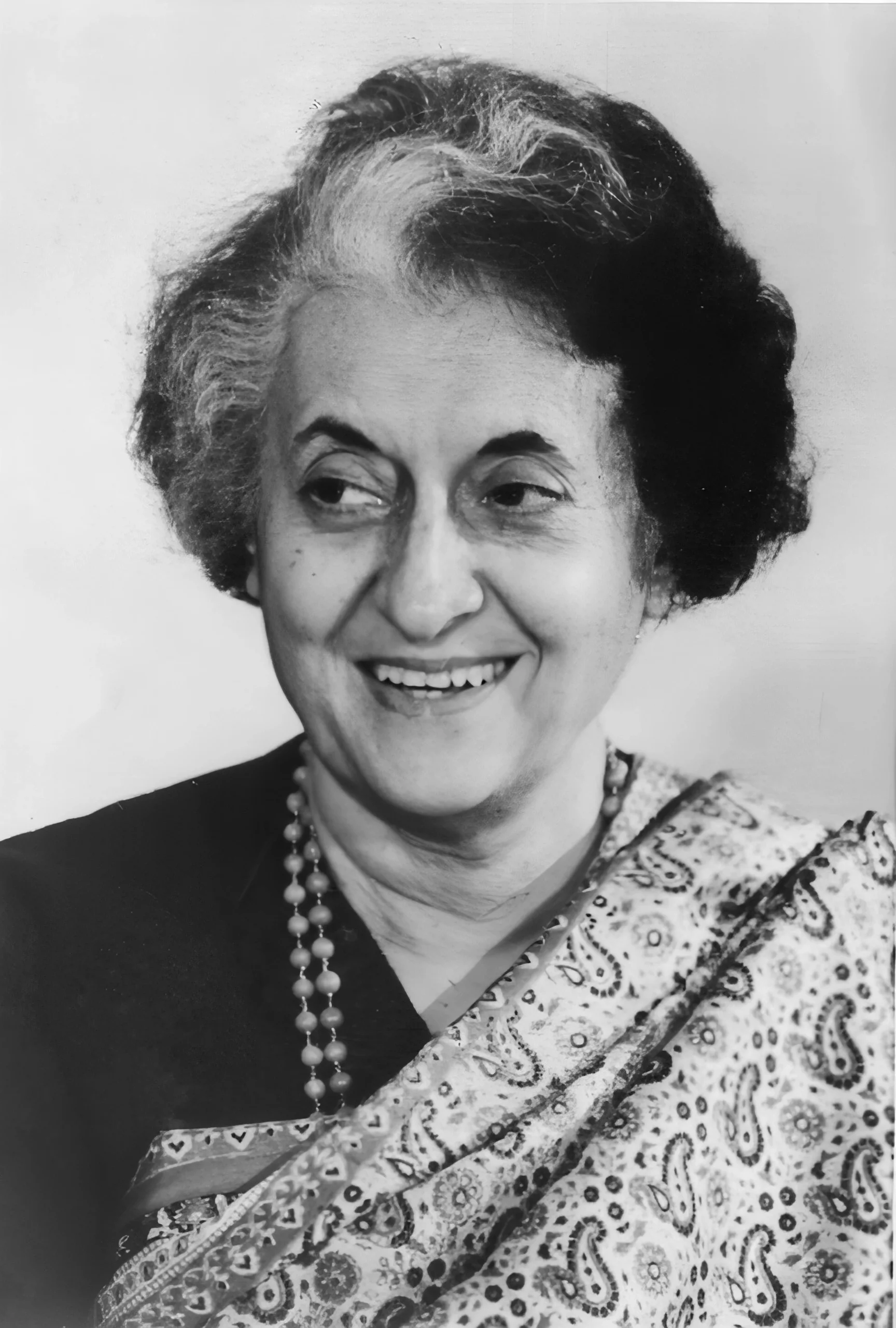
Indira Gandhi
 India
IndiaBirthday
November 19, 1917
Birth Sign
Scorpio
Birthplace
Prayagraj, British India
Age
Died at 66
Height
5 ft 2 in (157 cm)
About
Indira Gandhi, born Indira Nehru, was an Indian politician who served as prime minister of India for fifteen years across two spells, from 1966 to 1977 and again from 1980 until her assassination in 1984. The only woman to hold the office, she remains one of the most consequential and divisive figures in the country's modern history.
The daughter of India's first prime minister, Jawaharlal Nehru, she rose through the Indian National Congress to dominate national politics for a generation. Her record is one of bold and contested decisions. She led India to a decisive victory over Pakistan in the 1971 war that created Bangladesh, oversaw the nationalization of major banks, and backed the Green Revolution that reshaped Indian agriculture. She also imposed the Emergency of 1975 to 1977, suspending civil liberties and jailing opponents, a period still debated as the gravest test of Indian democracy.
Her final years were dominated by conflict in Punjab, and in 1984 she was killed by her own bodyguards months after ordering a military operation at the Golden Temple. As the mother of Rajiv Gandhi, who succeeded her, she anchored a political dynasty that shaped India for decades. She is remembered as a leader of formidable will, admired for her strength and resolve and condemned for her authoritarian turn, her legacy argued over in India to this day.
Early Life & Background
Indira Nehru was born on November 19, 1917, in Prayagraj, into the family at the center of India's independence movement. Her father, Jawaharlal Nehru, was often in British prisons, and her mother, Kamala Nehru, suffered from tuberculosis. The household was a revolving door of political activists, and young Indira absorbed their talk of freedom and sacrifice. She was educated at home by tutors and briefly attended the progressive Visva-Bharati University in Santiniketan, founded by Rabindranath Tagore, before enrolling at Somerville College, Oxford, in 1937. Her studies were cut short by ill health and the war, and she returned to India in 1941 without a degree. In 1942, she married Feroze Gandhi, a fellow Congress activist, and the couple was soon arrested for their participation in the Quit India movement, spending months in prison. Those cell months hardened her political resolve and deepened her bond with the Congress rank and file.
Career Growth
Indira Gandhi's political career took off after independence. In 1959, she was elected president of the Indian National Congress, a role that gave her national visibility. After her father's death in 1964, she served as Minister of Information and Broadcasting under Prime Minister Lal Bahadur Shastri. In 1966, after Shastri's sudden death, party bosses backed her as a compromise candidate for prime minister, expecting to control her. She quickly proved them wrong.
In 1969, she nationalized fourteen major banks, a populist move that won rural support and broke the old Congress party's conservative wing. The 1971 Indo-Pakistani War was her defining triumph, India's military victory led to the creation of Bangladesh and cemented her image as a decisive leader. The same year, she signed the Treaty of Peace, Friendship and Cooperation with the Soviet Union. But her popularity eroded amid economic crisis and allegations of corruption. In 1975, a court found her guilty of electoral malpractice and ordered her to vacate her seat. Instead, she declared a national Emergency, suspending civil liberties, censoring the press, and jailing thousands of opponents. The Emergency lasted nineteen months and ended with her electoral defeat in 1977. She returned to power in 1980, but her second term was plagued by the rise of Sikh militancy in Punjab. In June 1984, she ordered Operation Blue Star, a military assault on the Golden Temple in Amritsar to flush out armed militants. The operation caused heavy damage to the temple and outraged Sikhs across India. On October 31, 1984, two of her Sikh bodyguards assassinated her in her garden.
Career Timeline
Public Image & Style
Indira Gandhi was known as the Iron Lady of India, a nickname that captured her reputation for steely resolve. She cultivated an image of strength and simplicity, often wearing a white sari and a distinctive streak of white in her hair. Her speeches were direct and forceful, and she projected herself as a champion of the poor and the nation's unity. To her supporters, she was a decisive leader who stood up to foreign pressure and transformed India's economy. To her critics, she was an authoritarian who undermined democratic institutions. The Emergency of 1975-77 remains the defining controversy of her image, a period when she suspended civil liberties and arrested opponents. Her assassination in 1984 turned her into a martyr for her party, and her portrait continues to hang in Congress party offices across India. There is no formal fandom name, but her legacy inspires fierce loyalty and fierce opposition in equal measure.
Fame & Fandom
Indira Gandhi's relationship with the public defies the modern definition of fandom. There are no fan clubs, no organized campaigns to boost her streaming numbers, and no collective moniker for her supporters. Her legacy rests not on celebrity worship but on deep political loyalty to the Indian National Congress and the enduring weight of her historical impact as a head of state. The people who followed her were voters mobilized by policies like "Garibi Hatao" rather than fans driven by personal adoration or ritualistic devotion. While contemporary politics occasionally weaponize her image, the bond she forged was one of national governance, leaving a footprint defined by decisive leadership and complex historical narratives rather than the vibrant, chaotic energy of pop culture stardom. Despite the absence of a formal fanbase, her global stature remains immense and is quantified by the iFANN Global Fame Rankings, which track influence across media coverage and consumption signals worldwide. She holds a commanding position in historical records, recognized as the 22nd most famous person in India, a ranking holding steady from the previous cycle. Her prominence extends beyond borders, marking her as the 12th most famous person from India and the 13th most famous person in South Asia, both holding steady from the previous cycle. These placements confirm her status as a titan of history whose fame has endured decades after her passing.
Interesting Facts and Legends
Indira Gandhi was named Woman of the Millennium in a 1999 BBC online poll and kept a small diary filled with thoughts and poems that saw publication after her death. Though she projected an image of strength, she remained intensely private, rarely granting personal interviews while documenting her travels through amateur photography. Her favorite flower was the lotus, and in her youth she served as a courier for independence activists, smuggling secret messages hidden inside schoolbooks.
The political base that supported her functioned with the intensity of a fandom, rallying around the slogan "Garibi Hatao" to mobilize millions against poverty. A story fans still retell involves her wearing a red sari during a 1982 White House dinner, creating a subtle diplomatic clash with First Lady Nancy Reagan who wore a matching red dress. Another enduring legend features her warm embrace with Fidel Castro, often cited as proof of her global stature. The phrase "Indira is India" became a powerful narrative equating her leadership with national stability, while rituals among her supporters today include visiting her memorial at Shakti Sthal and observing the anniversaries of her birth and assassination.
Notable Quotes
“I don't think I am a very nice person. I don't think I am a very kind person. I don't think I am a very gentle person. But I am a very determined person.”
“The future belongs to those who believe in the beauty of their dreams.”
“How can you be a part of the world if you do not know its history?”
“There are two kinds of people: those who do the work and those who take the credit. Try to be in the first group; there is less competition there.”
Family & Personal Life
Indira was the only child of Jawaharlal Nehru and Kamala Nehru. Her mother died of tuberculosis in 1936 when Indira was eighteen, a loss that marked her deeply. She married Feroze Gandhi in 1942, a Parsi lawyer and Congress activist. The marriage was strained by Feroze's public criticism of Nehru's government and his affair, but they never divorced. Feroze died of a heart attack in 1960. The couple had two sons: Rajiv Gandhi, an airline pilot who became prime minister after her death, and Sanjay Gandhi, a politician who died in a plane crash in 1980. Indira was a doting grandmother to Rajiv's children, Rahul and Priyanka, who later entered politics. She lived in the prime minister's residence at 1 Safdarjung Road in New Delhi, where she maintained a small garden and kept a pet cat named Tiddles.
Notable Connections
Indira Gandhi was the daughter of Jawaharlal Nehru, India's first prime minister, and the wife of Feroze Gandhi, a political activist. Her sons Rajiv Gandhi and Sanjay Gandhi both entered politics; Rajiv succeeded her as prime minister. She was a protégé of her father and a mentor to her sons, anchoring a political dynasty that shaped India for decades.
Relationships & Dating History
Indira Gandhi married Feroze Gandhi on March 26, 1942, in a civil ceremony in Allahabad. Feroze was a Parsi lawyer and a prominent Congress activist who had been a close associate of her father. The marriage faced strains early on, partly due to Feroze's public criticism of Nehru's government and his close friendship with a woman named Tarakeshwari Sinha. Despite the tensions, the couple had two sons, Rajiv and Sanjay, and never separated legally. Feroze died of a heart attack on September 8, 1960. Indira did not remarry and remained widowed for the rest of her life. There are no credible reports of any romantic relationships after his death; she devoted herself entirely to politics and family.
- MarriedFeroze Gandhi1942 - 1960Married on March 26, 1942. Feroze died of a heart attack in 1960.
Death & Aftermath
Died
October 31, 1984 (aged 66)
Death Place
New Delhi, India
Cause of Death
Assassination by gunshot wounds
On the morning of October 31, 1984, Prime Minister Indira Gandhi walked through the garden of her residence at 1 Safdarjung Road in New Delhi after concluding a public meeting. At approximately 9:25 AM, her Sikh bodyguard Beant Singh approached from behind and fired multiple shots into her abdomen and chest, followed immediately by Satwant Singh who struck her twice more. She was rushed to the All India Institute of Medical Sciences where surgeons performed emergency surgery, but she was declared dead at 9:30 AM due to massive hemorrhage and shock from the gunshot wounds. The immediate investigation established that both assassins were arrested at the scene, though Beant Singh was shot dead by a security guard while attempting to escape custody later that day.
A judicial commission headed by Justice J.S. Verma investigated the security lapses that allowed the attack, while Satwant Singh faced trial, was convicted of murder, and executed on January 6, 1989. The news triggered widespread riots across India targeting Sikhs, resulting in thousands of deaths over the following days before global leaders like President Ronald Reagan and Queen Elizabeth II offered condolences. Her state funeral took place on November 3, 1984, at Shanti Van within Raj Ghat, where her body was cremated according to Hindu rites amidst military honors and tributes from international dignitaries. Her son Rajiv Gandhi succeeded her as Prime Minister, and the site became a memorial garden known as Shanti Van.
Posthumously, she has been honored through postage stamps, currency notes, and the establishment of the Indira Gandhi Memorial Trust to promote women's welfare and education. Several institutions bear her name, including the Indira Gandhi National Open University, and the Indira Gandhi International Airport in Delhi remains a major hub. Her estate remained under family control managed by her children, with no detailed public record of financial handling existing beyond the general management by the Nehru-Gandhi family trust.
Net Worth (Estate Value)
$15 Million
iFANN Editorial Team estimate
iFANN currently estimates Indira Gandhi's estate at $15 Million as of 2026. This figure reflects the historical value of her personal archives and intellectual property rights managed by the Nehru-Gandhi family trust, rather than commercial licensing or major posthumous releases. At the time of her death in 1984, her net worth was modest by modern standards. As prime minister, she drew a government salary and maintained no personal business ventures. Her estate consisted primarily of personal effects and her residence at 1 Safdarjung Road in New Delhi, a government-owned property. In 1985, the government acquired her personal papers and memorabilia for an undisclosed sum. Since then, the estate's value has remained stable, anchored by the significance of her literary contributions and the management of her legacy by the family trust.
Awards Won (3)
Indira Gandhi received India's highest civilian honor, the Bharat Ratna, in 1972. She was also awarded the United Nations Peace Prize in 1982 and the Order of the House of Orange from the Netherlands in 1969. These awards recognized her leadership in war and peace, though her legacy remains deeply contested.
1972 · Civilian
Service to the nation
1982 · Peace
International diplomacy
Known For
Prime Minister of India
1966 · Head of Government
Indo-Pakistani War of 1971
1971 · Prime Minister
Indian Emergency
1975 · Prime Minister
Operation Blue Star
1984 · Prime Minister
Keywords
Quick Facts
- Profession
- politician, writer
- Born
- +1917-11-19
- Birthplace
- Prayagraj
- Died
- +1984-10-31
- Death Place
- New Delhi
- Gender
- Female
- Spouse
- Feroze Gandhi
- Birth Sign
- Scorpio
Personal Details
- Full Name
- Indira Nehru
- Height
- 5 ft 2 in (157 cm)
- Spouse
- Feroze Gandhi
- Children
- Rajiv Gandhi, Sanjay Gandhi
- Education
- Visva-Bharati University, Santiniketan; Somerville College, Oxford
Frequently Asked Questions
Who was Indira Gandhi?
What was Indira Gandhi's net worth in 2026?
How did Indira Gandhi die?
What were Indira Gandhi's major achievements?
What was the Emergency declared by Indira Gandhi?
Similar People
Join the community
fans discussing