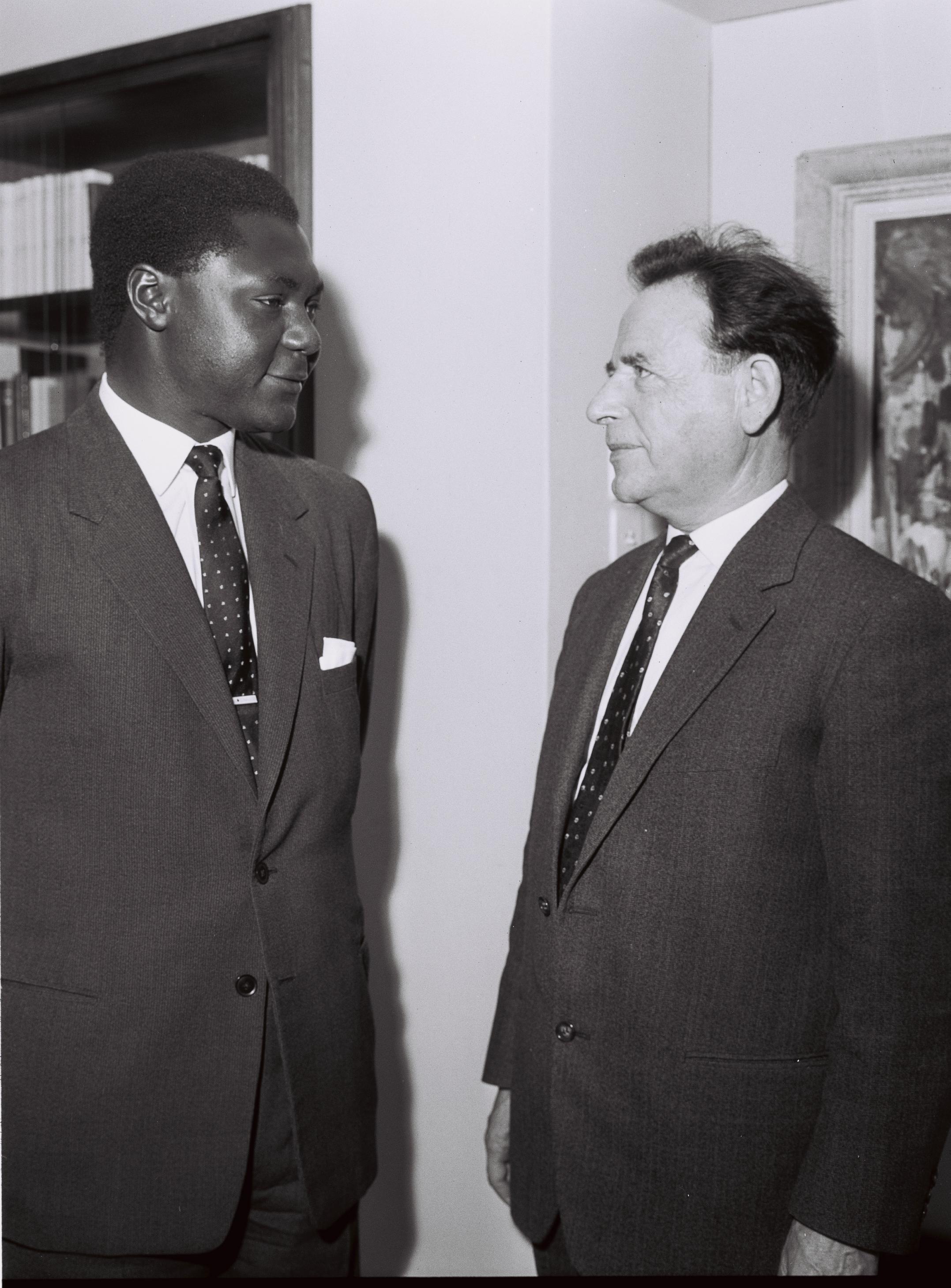
Tom Mboya
 Kenya
Kenyapolitician•trade unionist•minister
Birthday
+1930-08-15
Birth Sign
Leo
Birthplace
Ol Donyo Sabuk National Park
Age
Died at 38
About
Born in 1930 near Ol Donyo Sabuk National Park, Thomas Joseph Odhiambo Mboya was a pivotal figure in Kenya's journey to nationhood. He emerged as a powerful voice in both politics and the labor movement, becoming one of the architects of the Republic of Kenya. Mboya's sharp intellect and persuasive oratory made him a respected figure on the international stage, where he tirelessly advocated for Kenya's independence from British colonial rule. His efforts were central to the Lancaster House Conferences, crucial talks that paved the way for self-governance. His career trajectory saw him rise to prominent positions, including serving as the first Secretary-General of the Kenya African National Union (KANU), the very party that would lead Kenya to independence. During the tense geopolitical climate of the Cold War, Mboya was instrumental in establishing the foundations for Kenya's economic policies, advocating for a capitalist and mixed economy. He also played a key role in developing the nation's labor institutions. At the time of his tragic assassination in 1969 at the age of 38, he was serving as Kenya's Minister for Economic Planning and Development. Mboya's influence extended beyond Kenyan borders. He was a strong supporter of the Civil Rights movement in the United States, participating in rallies and forging connections with leaders like Martin Luther King Jr. and John F. Kennedy. Together, they initiated the 'Kennedy Airlifts,' a program that provided educational opportunities for East African students in American universities, with Wangari Maathai being one of its notable beneficiaries. His global standing was recognized when he chaired the All-African Peoples' Conference in 1958, convened by Ghana's Kwame Nkrumah. Mboya also significantly contributed to building the Trade Union Movement across Kenya, Uganda, and Tanzania, and served as the Africa Representative for the International Confederation of Free Trade Unions. In 1960, Mboya achieved a unique milestone, becoming the first Kenyan to grace the cover of Time magazine.
Fame & Fandom (iFAMOUS Rankings)
The global attention surrounding Thomas Joseph Odhiambo Mboya remains anchored in the historical weight of a nation-building father rather than the fluctuating metrics of modern celebrity culture. His presence is defined by enduring reverence across East Africa and academic circles worldwide, where his life story serves as a primary case study for post-colonial leadership. iFANN's Global Fame Engine has evaluated this person, but they do not currently hold a placement in the published rankings (Global Top 1,000 or a Top-100 scope list). Consequently, no specific ordinal position can be assigned to his current fame score. The fanbase has no formal name; instead, the public relationship with Mboya operates through state-sponsored commemoration, educational institutions, and political study rather than organized fandoms. There are no fan clubs, social media streams, or chart-pushing organizations dedicated to him. His legacy is maintained by the Kenyan government and Pan-Africanist groups who keep his memory alive through infrastructure named in his honor, such as Tom Mboya University and the residential estate bearing his name. While a recent press release from August 2026 marked a significant anniversary milestone, this event represents historical remembrance rather than a fan campaign. The absence of a formal fandom name reflects the unique nature of his status: he is a martyr and a statesman, not a pop icon whose popularity waxes and wanes with viral trends.
Interesting Facts and Legends
Born on a sisal plantation near Ol Donyo Sabuk National Park in 1930, Thomas Joseph Odhiambo Mboya rose from humble beginnings to become one of the architects of the Republic of Kenya. He served as the first Secretary-General of the Kenya African National Union and played a pivotal role in the Lancaster House Conferences that paved the way for independence. The defining legend of his life centers on his assassination on July 5, 1969, when he was shot in broad daylight on Government Road in Nairobi by Nahashon Isaac Njenga Njeroge, a man described in some accounts as his own personal servant. This event, often referred to colloquially as "The Man They Shot on Government Road," ended an era of optimism and sparked widespread grief and unrest across the country. His intellectual prowess earned him international acclaim, particularly for his advocacy of Pan-Africanism and his ability to navigate complex diplomatic landscapes. Even decades after his death at age 39, his influence persists through institutions like Tom Mboya Secondary School on Rusinga Island, which has produced notable figures including footballers Oguta and Ogweno. The story of his rise from a plantation worker to a minister remains a foundational narrative in Kenyan history, frequently cited alongside other giants of African independence.
Death & Aftermath
Died
+1969-07-05 (aged 38)
Death Place
Nairobi, Kenya
Cause of Death
Assassination by gunshot wounds
Thomas Joseph Odhiambo Mboya died on July 5, 1969, at the age of 39. He was shot in Nairobi, Kenya, near his office at the Ministry of Justice by Juma Nyang'ayo, a former police officer. The shooting occurred around 10:45 AM as Mboya was walking between the State House and his office. Mboya collapsed immediately but was rushed to Aga Khan Hospital in Nairobi, where he was pronounced dead shortly after arrival. The cause of death was officially ruled as assassination by gunshot wounds. Nyang'ayo was tried for murder and executed by hanging on August 15, 1969, exactly one month after Mboya's death.
A state funeral followed, drawing thousands of mourners including government officials and trade unionists who gathered to pay respects before burying him at Kariokor Cemetery. Tributes poured in from peers like President Kenyatta and Pan-African leaders, cementing his status as a martyr for the independence movement. Decades later, his legacy endures through the Tom Mboya University College in Kisumu and the scholarship trust fund established to aid disadvantaged students.
Awards & Accolades
Keywords
Quick Facts
- Profession
- politician, trade unionist, minister
- Born
- +1930-08-15
- Birthplace
- Ol Donyo Sabuk National Park
- Died
- +1969-07-05
- Death Place
- Nairobi
- Gender
- Male
- Spouse
- Pamela Mboya
- Birth Sign
- Leo
Personal Details
- Spouse
- Pamela Mboya
Join the community
fans discussing