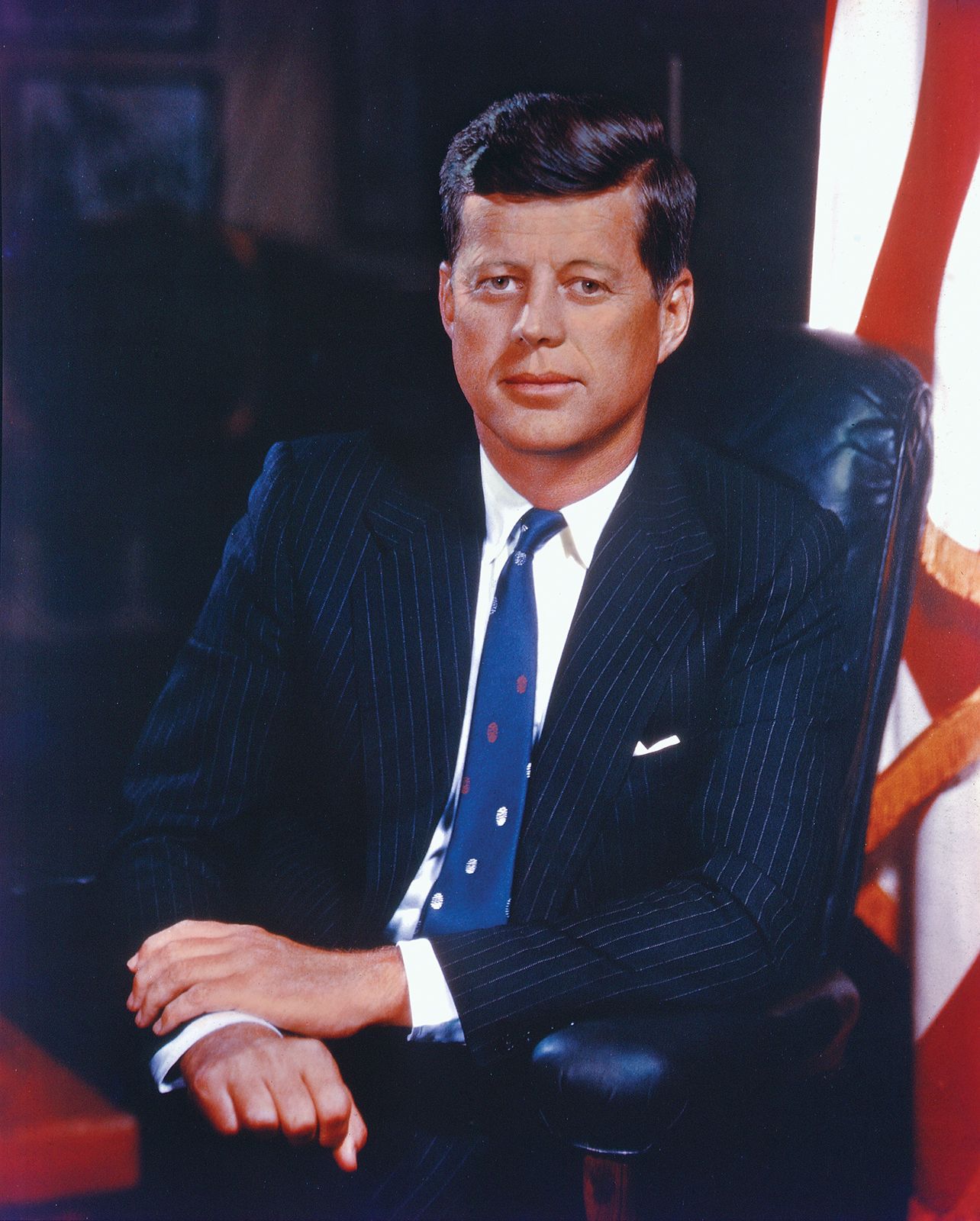
John F. Kennedy
 United States
Politician•35th President of the United States
Also known as: JFK, Jack Kennedy, President Kennedy
Birthday
May 29, 1917
Birth Sign
Gemini
Birthplace
Brookline, Massachusetts, United States
Age
Died at 46
Height
6 ft 0 in (183 cm)
About
John Fitzgerald Kennedy was an American politician who served as the 35th president of the United States from 1961 until his assassination in 1963. He is widely regarded as one of the most iconic figures of the 20th century, known for his charisma, eloquence, and leadership during the Cold War. Kennedy's presidency saw the Cuban Missile Crisis, the establishment of the Peace Corps, and the push for civil rights legislation. His youthful energy and vision for a New Frontier inspired a generation. Today, he remains a symbol of hope and progress, consistently ranking among the greatest US presidents in historical polls.
Early Life & Background
Born into a wealthy and politically ambitious family in Brookline, Massachusetts, Kennedy was the second of nine children. He attended Choate Rosemary Hall, then Harvard University, where he graduated cum laude with a degree in international affairs. His senior thesis, 'Why England Slept,' became a bestseller. After college, he served in the US Navy during World War II, commanding a PT boat that was rammed and sunk by a Japanese destroyer. Kennedy's heroic actions in rescuing his crew earned him the Navy and Marine Corps Medal. After the war, he briefly worked as a journalist before entering politics, winning a seat in the US House of Representatives in 1946.
Career Growth
Kennedy served three terms in the House and two in the Senate before winning the presidency in 1960, defeating Richard Nixon in one of the closest elections in US history. His inaugural address urged Americans to 'ask not what your country can do for you — ask what you can do for your country.' Key achievements include the establishment of the Peace Corps, the successful navigation of the Cuban Missile Crisis in 1962, and the signing of the Limited Nuclear Test Ban Treaty. He also laid the groundwork for the Civil Rights Act of 1964. Kennedy's presidency was cut short by his assassination in Dallas, Texas, on November 22, 1963.
Career Timeline
Public Image & Style
Kennedy projected an image of youthful vigor, intellectual curiosity, and cool sophistication. His press conferences were televised live, and he was the first president to fully embrace the medium, earning him the nickname 'the television president.' His stylish wife Jacqueline and their young children added to the Camelot mystique. The media often portrayed him as a war hero and a family man, while his administration's glamour drew comparisons to King Arthur's court. His assassination cemented his status as a tragic martyr, and his image remains etched in American memory as a symbol of lost promise.
Fame & Fandom (iFAMOUS Rankings)
The enduring appeal of John F. Kennedy does not stem from a modern, organized fandom with specific rituals or self-identifying names like those found in pop culture today. Instead, his audience consists of history enthusiasts and citizens who engage with his legacy through national institutions, scholarly works, and the persistent cultural mythology surrounding his brief presidency. There are no fan clubs or grassroots campaigns to keep him alive; rather, the reverence for JFK is expressed through the preservation of his library, the continued operation of vessels bearing his name, and the ongoing political weight his family name carries in American discourse. The Camelot mythos and the tragedy of his assassination have cemented a unique form of collective memory that functions as a secular religion for many, yet it lacks the active, participatory structure of a traditional fanbase. This distinction makes his fame particularly stable and rooted in historical significance rather than transient celebrity trends. His standing remains robust across the globe, reflecting a consistent level of recognition that transcends generations. According to the iFANN Global Fame Rankings, he holds several notable positions: the 79th most famous person in the world, the 15th most famous person in United States, the 43rd most famous person from United States, the 19th most famous person in North America, and the 12th most famous person in Politics. These placements, which have held steady from the previous cycle, underscore his status as a permanent fixture in global consciousness.
Interesting Facts and Legends
John Fitzgerald Kennedy was the first Catholic president of the United States, a milestone that broke significant religious barriers during his election. He won a Pulitzer Prize for Biography in 1957 for 'Profiles in Courage,' though scholars have long debated the extent of his personal authorship versus that of his staff. Behind the scenes, he managed chronic back pain and Addison's disease, conditions he kept largely hidden from the public eye to maintain an image of vitality. An avid reader with the ability to speed-read up to 1,200 words per minute, he often cited 'Casablanca' as his favorite movie. At home, the family enjoyed a pet pony named Macaroni for their children. Beyond these facts, legends persist about his time in office. The phrase 'Ask not what your country can do for you, ask what you can do for your country' from his 1961 inaugural address remains one of the most quoted lines in American history, defining a generation's sense of civic duty. Another enduring story is the 'Camelot' comparison made by his wife Jacqueline after his death, which framed their White House years as a brief, idealistic era cut short by tragedy. While the assassination in Dallas on November 22, 1963, is a verified historical fact, the emotional intensity described in folklore regarding his popularity is often a retrospective interpretation of the nation's collective trauma rather than spontaneous reactions seen during his lifetime.
Notable Quotes
“Ask not what your country can do for you — ask what you can do for your country.”
“Ich bin ein Berliner.”
“The only thing we have to fear is fear itself.”
“A man may die, nations may rise and fall, but an idea lives on.”
“Forgive your enemies, but never forget their names.”
Family & Personal Life
Kennedy's father, Joseph P. Kennedy Sr., was a wealthy businessman and US ambassador to the UK. His mother, Rose Fitzgerald Kennedy, was the daughter of Boston Mayor John F. Fitzgerald. He had eight siblings, including Robert F. Kennedy and Ted Kennedy, both prominent politicians. In 1953, he married Jacqueline Lee Bouvier, a stylish and intelligent socialite. They had three children: Caroline, John Jr., and Patrick, who died two days after birth. The family lived in the White House, which Jacqueline famously restored and redecorated. The Kennedys also had a pet German Shepherd named Pushinka, a gift from Soviet Premier Nikita Khrushchev.
Notable Connections
John F. Kennedy is closely associated with his brother Robert F. Kennedy, who served as his Attorney General, and his brother Ted Kennedy, who became a long-serving senator. He also had a complex relationship with FBI Director J. Edgar Hoover and Soviet Premier Nikita Khrushchev. His wife Jacqueline Kennedy Onassis remains an iconic figure in her own right.
Relationships & Dating History
John F. Kennedy married Jacqueline Lee Bouvier on September 12, 1953, in Newport, Rhode Island. The couple had four children, though only two survived to adulthood: Caroline (born 1957) and John Jr. (born 1960). A daughter, Arabella, was stillborn in 1956, and son Patrick died two days after birth in 1963. Kennedy's marriage was publicly portrayed as a fairy-tale romance, but it was marred by his numerous extramarital affairs, including rumored relationships with Marilyn Monroe, Judith Exner, and others. Despite the infidelities, Jacqueline remained publicly supportive. After Kennedy's assassination, she married Greek shipping magnate Aristotle Onassis in 1968. As of 2026, Kennedy is deceased, and his marriage to Jacqueline ended with his death.
- MarriedJacqueline Kennedy Onassis1953 - 1963Married from 1953 until his assassination; they had four children, two of whom survived infancy.
Death & Aftermath
Died
November 22, 1963 (aged 46)
Death Place
Dallas, Texas
Cause of Death
Gunshot wound to the head
The news of the president's death sparked immediate, spontaneous mourning across the globe, with crowds gathering outside the White House and at Parkland Memorial Hospital in Dallas. World leaders responded swiftly; UK Prime Minister Harold Macmillan and French President Charles de Gaulle ordered flags flown at half-staff, while a moment of silence was observed nationwide on November 22. This collective grief marked a profound shift in American political culture, often cited as the end of post-war optimism. The official cause of death was established as a gunshot wound to the head resulting in massive destruction of the brain and skull, confirmed by doctors who declared him dead at 1:00 PM CST after failed resuscitation attempts.
He had been shot earlier that day around 12:30 PM CST during a motorcade through Dealey Plaza, with his final reported words varying between witness accounts as 'They're going to kill us' or 'Oh no, they're going to shoot me.' The investigation began immediately with the arrest of Lee Harvey Oswald, who was later killed by Jack Ruby before he could face trial. The Warren Commission concluded in September 1964 that Oswald acted alone, though the House Select Committee on Assassinations later suggested a high probability of conspiracy involving multiple shooters. A private religious service was held at St.
Matthew's Cathedral on November 24, followed by a public funeral procession from the Capitol Rotunda to the Washington National Cathedral where millions watched. Kennedy was buried at Arlington National Cemetery near the Tomb of the Unknowns, where Jacqueline Kennedy lit the Eternal Flame. Posthumous honors included the establishment of the John F. Kennedy Presidential Library and Museum in 1979 and the awarding of the Presidential Medal of Freedom, while his estate transitioned to family management to support educational initiatives.
Net Worth (Estate Value)
$100 Million
iFANN Editorial Team estimate
As of 2026, research by the iFANN Editorial Team puts John F. Kennedy's net worth at the time of his death in 1963 at $100 Million. The bulk of this wealth originated from a family trust established by his father, Joseph P. Kennedy Sr., who built a fortune through stocks, real estate, and liquor distribution. During his tenure as president, Kennedy earned an annual salary of $100,000. His estate continued to generate income from book royalties, including ongoing sales of 'Profiles in Courage' and other writings. The Kennedy family trust, managed by his surviving siblings and later descendants, has grown significantly over the decades. Assets include real estate holdings in Massachusetts and New York, as well as investment portfolios. In 2026, the estate's value is estimated at over $100 Million, though the bulk of the Kennedy family fortune is held in trusts that benefit multiple heirs.
Awards Won (3)
John F. Kennedy received numerous awards, most notably the Pulitzer Prize for Biography in 1957 for 'Profiles in Courage.' He was posthumously awarded the Presidential Medal of Freedom in 1963. He also earned the Navy and Marine Corps Medal for his World War II heroism.
1957 · Biography
Profiles in Courage
1963 · Civilian Honor
Posthumous award
Known For
Presidency of the United States
1961 · 35th President
Cuban Missile Crisis
1962 · Commander-in-Chief
Profiles in Courage
1956 · Author
Keywords
Quick Facts
- Full Name
- John Fitzgerald Kennedy
- Born
- May 29, 1917, Brookline, Massachusetts
- Died
- November 22, 1963, Dallas, Texas
- Political Party
- Democratic
- Vice President
- Lyndon B. Johnson
Personal Details
- Full Name
- John Fitzgerald Kennedy
- Height
- 6 ft 0 in (183 cm)
- Spouse
- Jacqueline Kennedy Onassis
- Children
- Caroline Kennedy, John F. Kennedy Jr., Patrick Bouvier Kennedy (died shortly after birth)
- Education
- Harvard University (BA), Stanford Graduate School of Business (audited)
Frequently Asked Questions
How old was John F. Kennedy when he died?
What is John F. Kennedy's net worth in 2026?
Who was John F. Kennedy married to?
What is John F. Kennedy best known for?
Why is John F. Kennedy considered a great president?
Similar People
Join the community
fans discussing