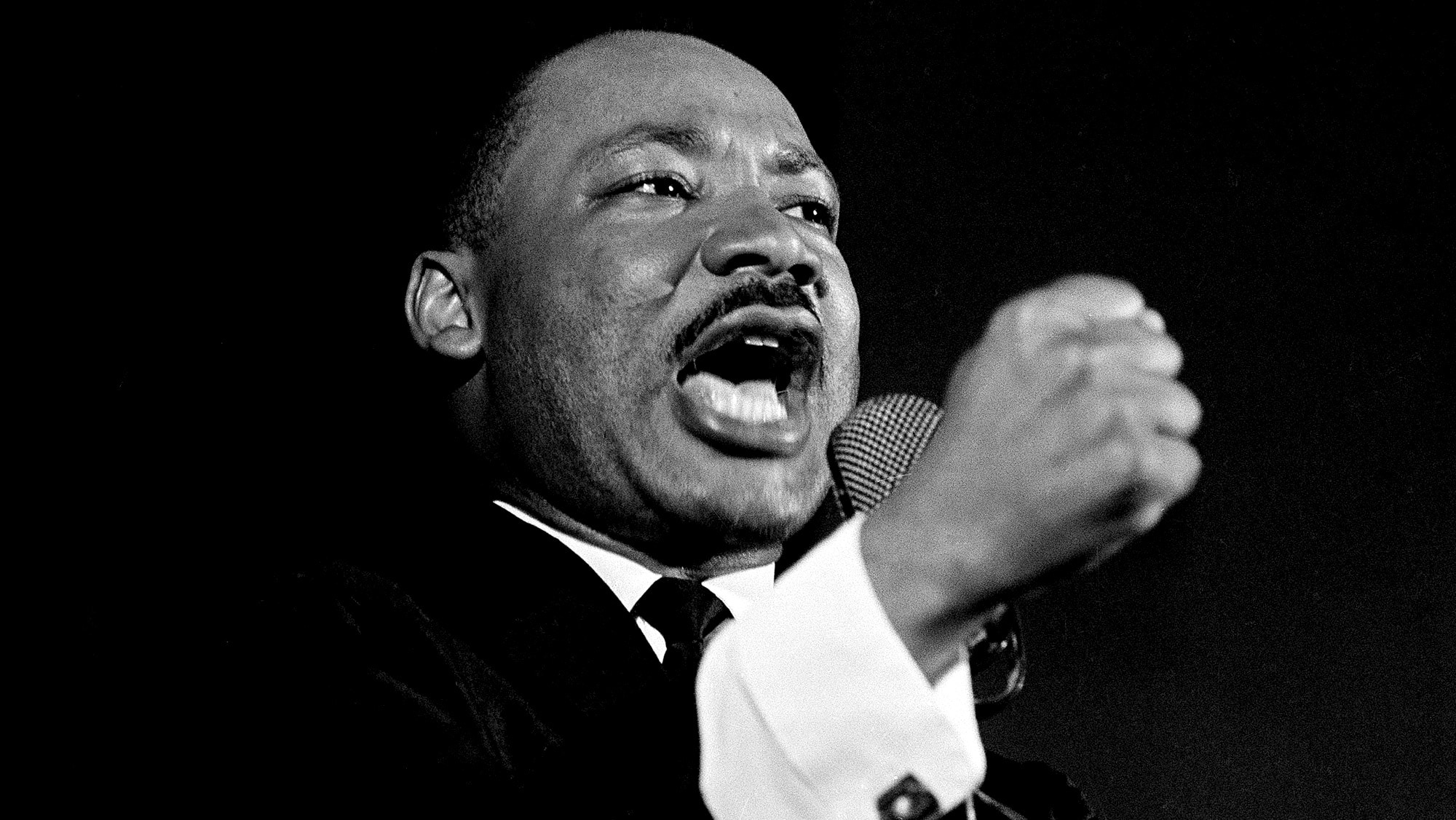
Martin Luther King Jr.
 United States
Baptist minister•civil rights leader
Also known as: MLK, Dr. King
Birthday
January 15, 1929
Birth Sign
Capricorn
Birthplace
Atlanta, Georgia, USA
Age
Died at 39
Height
5 ft 6.5 in (169 cm)
About
Martin Luther King Jr. was an American Baptist minister and civil rights leader who became the most visible spokesperson for nonviolent resistance to racial injustice. He rose to national prominence during the Montgomery bus boycott and cemented his place in history with the 1963 March on Washington, where he delivered his iconic "I Have a Dream" speech. At 35, he became the youngest Nobel Peace Prize laureate at the time, and his leadership directly contributed to the passage of the Civil Rights Act of 1964 and the Voting Rights Act of 1965. Today, his legacy is honored with a federal holiday, a memorial on the National Mall, and countless streets and schools named after him worldwide.
King's philosophy of nonviolent civil disobedience, inspired by Mahatma Gandhi, continues to influence movements for justice globally. His speeches and writings, including the "Letter from Birmingham Jail," are studied as masterpieces of moral reasoning. Though he was assassinated in 1968, his dream of equality remains a guiding light for activists and ordinary citizens alike.
Early Life & Background
Michael King Jr. was born on January 15, 1929, in Atlanta, Georgia, to Michael King Sr., a Baptist pastor, and Alberta Williams King. The family lived in the Sweet Auburn neighborhood, a thriving African American community. In 1934, after a trip to Germany, his father changed both their names to Martin Luther in honor of the Protestant reformer. King attended segregated public schools and skipped two grades, entering Booker T. Washington High School at 13 and graduating at 15.
He enrolled at Morehouse College, a historically black college, where he earned a BA in sociology in 1948. There, he was deeply influenced by President Benjamin Mays, a theologian and civil rights advocate. King then attended Crozer Theological Seminary in Pennsylvania, graduating with a Bachelor of Divinity in 1951. He later earned a PhD in systematic theology from Boston University in 1955. During his seminary years, he was introduced to Mahatma Gandhi's philosophy of nonviolent resistance, which would become the cornerstone of his activism.
Before his public career, King served as a pastor at Dexter Avenue Baptist Church in Montgomery, Alabama. A pivotal childhood moment occurred when he was six: a white friend's mother told him they could no longer play together because of segregation. His mother explained the history of racism, a lesson that stayed with him. These early experiences shaped his commitment to justice.
Career Growth
King's leadership began with the Montgomery bus boycott in 1955, sparked by Rosa Parks's arrest. He was chosen to lead the Montgomery Improvement Association, and the 381-day boycott ended with a Supreme Court ruling that segregation on public buses was unconstitutional, launching King to national prominence. In 1957, he co-founded the Southern Christian Leadership Conference (SCLC) and served as its first president, coordinating nonviolent protests across the South.
In 1963, King led the Birmingham campaign, where peaceful protesters were met with violent police crackdowns. Arrested, he wrote the "Letter from Birmingham Jail," a defense of nonviolent resistance. That August, he delivered the "I Have a Dream" speech to over 250,000 people at the March on Washington, a defining moment of the movement. The following year, the Civil Rights Act of 1964 was passed, and King won the Nobel Peace Prize.
In 1965, he helped lead the Selma to Montgomery marches, where "Bloody Sunday" galvanized national support for the Voting Rights Act of 1965. King then expanded his focus to economic justice, launching the Chicago campaign against housing discrimination and speaking out against the Vietnam War. In 1968, he was planning the Poor People's Campaign when he was assassinated in Memphis, Tennessee, while supporting striking sanitation workers.
Career Timeline
Public Image & Style
King is almost always depicted in a dark suit and tie, with a calm, dignified posture. His image is synonymous with the civil rights movement. He is universally portrayed as a martyr and visionary leader, a masterful orator with a resonant voice. Supporters often call themselves "followers of the dream." Annual celebrations on Martin Luther King Jr. Day include community service, marches, and speeches. The official social media accounts of The King Center and his children share his quotes and historical photos.
Fame & Fandom
Martin Luther King Jr. never cultivated a celebrity fanbase in the modern sense of autograph seekers or chart-chasing groups. His supporters are activists, educators, and community organizers who mobilize around his philosophy rather than his persona. There is no formal collective noun for his followers, nor do organized clubs exist to drive commercial campaigns for him. Instead, the legacy thrives through civic engagement and volunteerism, with millions participating in service projects on Martin Luther King Jr. Day. The King Center manages his digital presence, sharing historical works and political writings rather than fostering interactive fandom rituals. Recent institutional commitments, such as the 2026 funding for the Martin Luther King Jr. Community Hospital, demonstrate that his influence persists through active dedication to his vision of equity rather than pop-culture consumption. This enduring relevance places him at the pinnacle of global recognition within specific categories. He stands as the 1st most famous person in Pastors, a position solidified by decades of leadership. In broader metrics, he ranks as the 31st most famous person in North America and the 57th most famous person from United States. Globally, he holds the distinction of being the 126th most famous person in the world, while also securing the 22nd most famous person in United States. These placements reflect sustained attention across media and cultural memory tracked by the iFANN Global Fame Rankings.
Interesting Facts and Legends
Before becoming a household name, he was born Michael King Jr., a name his father changed alongside his own after a trip to Germany in 1934. His path to history was paved with danger; in 1958, a stabbing in Harlem left a blade tip lodged against his aorta, yet he survived to lead the movement. The FBI once sent him an anonymous letter in 1964 urging suicide, while his activism resulted in at least 29 arrests throughout his career. Decades later, he won a posthumous Grammy Award in 1971 for Best Spoken Word Recording for his speech "Why I Oppose the War in Vietnam." Legends of his life often circle back to the Nobel Peace Prize in 1964, where his acceptance speech declared that peace must be built on justice. Another story fans retell involves his time in Birmingham jails, where he used imprisonment to highlight injustice, generating massive media coverage and shifting public opinion. A widely cited moment occurred during the March on Washington when Mahalia Jackson urged him to "tell them about the dream," prompting him to improvise the iconic lines that drew over 250,000 people to the National Mall. His final speech, delivered in Memphis on April 3, 1968, included the prophecy "I've been to the mountaintop... I may not get there with you," which preceded his assassination the next day at the Lorraine Motel.
Notable Quotes
“I have a dream that my four little children will one day live in a nation where they will not be judged by the color of their skin but by the content of their character.”
“Injustice anywhere is a threat to justice everywhere.”
“Darkness cannot drive out darkness; only light can do that. Hate cannot drive out hate; only love can do that.”
“The ultimate measure of a man is not where he stands in moments of comfort and convenience, but where he stands at times of challenge and controversy.”
“Free at last, Free at last, Thank God almighty we are free at last.”
Family & Personal Life
King married Coretta Scott on June 18, 1953, on the lawn of her parents' home in Marion, Alabama. They had four children: Yolanda (1955–2007), Martin Luther III (born 1957), Dexter Scott (1961–2024), and Bernice (born 1963). Coretta was a civil rights leader in her own right. King's parents were Alberta Williams King and Martin Luther King Sr., a pastor. His sister Christine and brother Alfred also survived him. The family lived in Atlanta's Sweet Auburn neighborhood.
Notable Connections
King worked closely with Coretta Scott King, his wife and fellow activist. He co-founded the SCLC with Ralph Abernathy. He influenced and was influenced by John Lewis and Mahatma Gandhi. He collaborated with President Lyndon B. Johnson on civil rights legislation. He was surveilled by FBI Director J. Edgar Hoover. He had a complex relationship with Malcolm X.
Relationships & Dating History
Martin Luther King Jr. married Coretta Scott on June 18, 1953, on the lawn of her parents' home in Marion, Alabama. They met while King was pursuing his doctorate at Boston University and Coretta was studying at the New England Conservatory of Music. They had four children: Yolanda, Martin III, Dexter, and Bernice. Their marriage endured the immense pressures of the civil rights movement, including constant death threats, King's frequent imprisonment, and documented extramarital affairs. Despite these challenges, Coretta remained a steadfast partner and became a prominent civil rights leader after his death. The marriage ended with King's assassination on April 4, 1968.
- MarriedCoretta Scott King1953 - 1968Married on June 18, 1953. Had four children. Marriage ended with King's assassination.
Death & Aftermath
Died
April 4, 1968 (aged 39)
Death Place
Memphis, Tennessee
Cause of Death
Gunshot wound to the head
Dr. King stood on the second-floor balcony of Room 306 at the Lorraine Motel in Memphis, Tennessee, just hours after delivering his famous "I've been to the mountaintop" speech at Mason Temple. A single .30-06 caliber bullet struck him in the jaw and head, sending him collapsing onto the concrete below before he was rushed to St. Joseph's Hospital. He was pronounced dead at 7:05 p.m. on April 4, 1968, with an autopsy confirming a fatal gunshot wound as the cause. The assassination triggered immediate riots in over 100 cities across the United States, while global leaders from Pope Paul VI to Queen Elizabeth II issued tributes.
President Lyndon B. Johnson signed the Civil Rights Act of 1968, also known as the Fair Housing Act, into law just days after the tragedy. James Earl Ray was arrested two months later at London Heathrow Airport and initially pleaded guilty to the crime, though he later recanted his confession claiming a conspiracy involving government agencies or other individuals. A 1999 civil trial by a jury found that Ray and restaurant owner Loyd Jowers were involved in a plot to kill Dr. King, awarding the family $100 million in damages, yet the U.S. Department of Justice maintains that Ray acted alone. On Monday, April 8, 1968, an estimated 150,000 mourners gathered outside Ebenezer Baptist Church in Atlanta for a public service attended by President Johnson and Vice President Hubert Humphrey.
Coretta Scott King delivered a eulogy requesting that speeches focus on her husband's work rather than his life, followed by Mahalia Jackson's performance. Dr. King was interred at the Martin Luther King Jr. National Historical Park in Atlanta next to his wife and son Dexter. Posthumous honors included the Presidential Medal of Freedom in 1977, the Congressional Gold Medal in 2004, and the establishment of a federal holiday celebrated on the third Monday of January starting in 1983.
Net Worth (Estate Value)
$15 Million
iFANN Editorial Team estimate
As a deceased historical figure, Martin Luther King Jr. did not accumulate significant personal wealth during his lifetime. Per iFANN's editorial analysis, his estate is valued at approximately $15 million as of 2026. The estate generates income through royalties from his books, including Stride Toward Freedom and Why We Can't Wait, and licensing fees for use of his image and the "I Have a Dream" speech. The King Center, a non-profit, also contributes to the estate's financial profile. The estate is managed by his children through Intellectual Properties Management (IPM), which controls the licensing of his intellectual property. Legal disputes over IP rights have been common, including a lawsuit against CBS and a dispute over the Selma film.
Awards Won (4)
King won the Nobel Peace Prize in 1964 for his nonviolent struggle against racial inequality. He was posthumously awarded the Presidential Medal of Freedom in 1977 and the Congressional Gold Medal in 2003. He also won a Grammy Award in 1971 for Best Spoken Word Recording.
1971 · Spoken Word
Why I Oppose the War in Vietnam
1964 · Peace
Civil rights activism
Known For
I Have a Dream
1963 · Speaker
Letter from Birmingham Jail
1963 · Author
Montgomery Bus Boycott
1955 · Leader
Selma to Montgomery Marches
1965 · Leader
Keywords
Quick Facts
- Profession
- Baptist minister, civil rights leader
- Born
- January 15, 1929
- Birthplace
- Atlanta, Georgia, USA
- Died
- April 4, 1968
- Death Place
- Memphis, Tennessee, USA
- Gender
- Male
- Spouse
- Coretta Scott King
- Birth Sign
- Capricorn
Personal Details
- Full Name
- Michael King Jr.
- Height
- 5 ft 6.5 in (169 cm)
- Spouse
- Coretta Scott King
- Children
- Yolanda King, Martin Luther King III, Dexter Scott King, Bernice King
- Education
- Morehouse College (BA), Crozer Theological Seminary (BDiv), Boston University (PhD)
Frequently Asked Questions
Was Martin Luther King Jr. a Republican or a Democrat?
How many times was Martin Luther King Jr. arrested?
What is Martin Luther King Jr.'s most famous speech?
How did Martin Luther King Jr. die?
What is Martin Luther King Jr.'s net worth in 2026?

Join the community
fans discussing