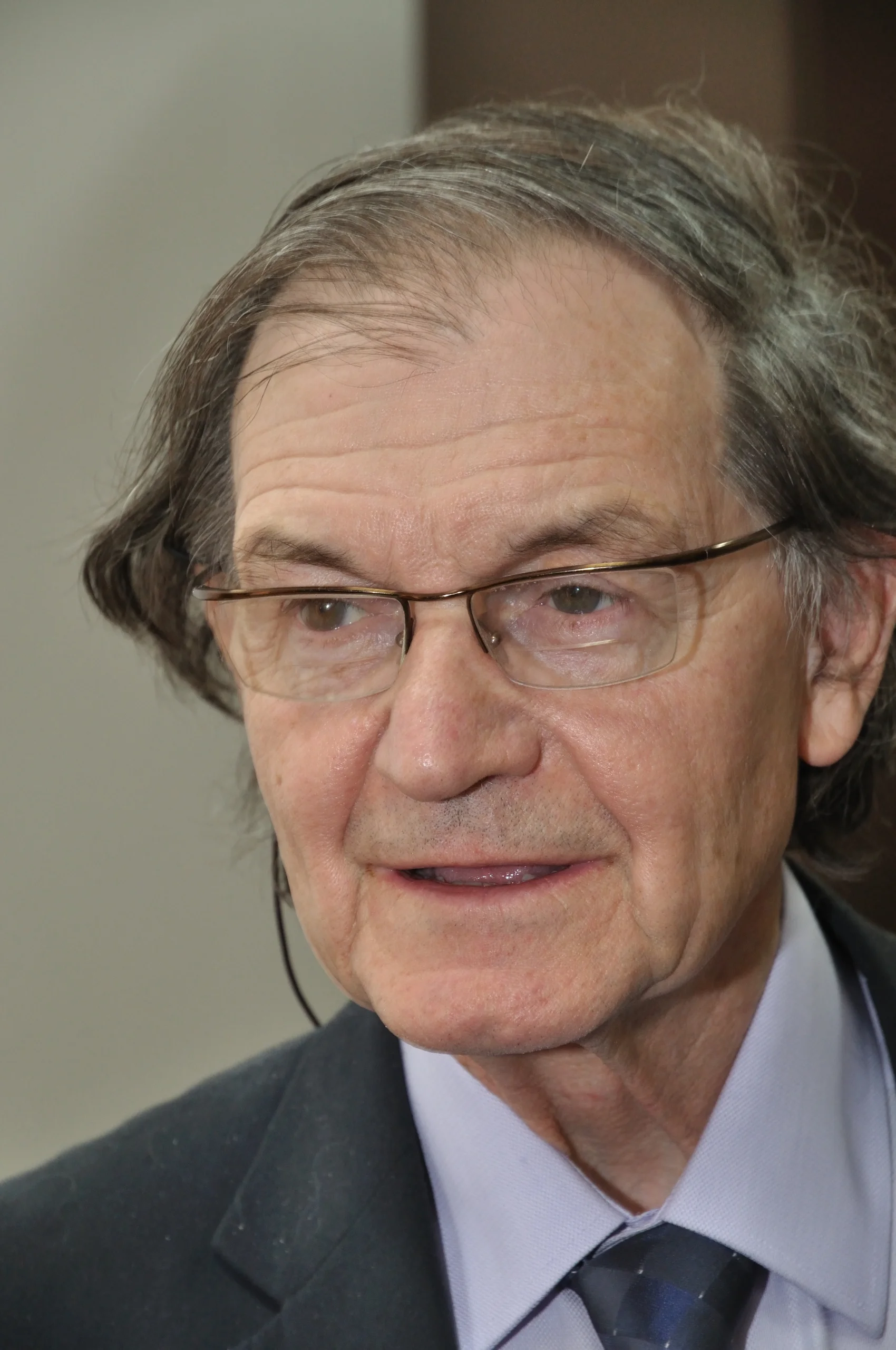
Roger Penrose
 United Kingdom
mathematician•physicist•philosopher
Also known as: Sir Roger Penrose
Birthday
August 8, 1931
Birth Sign
Leo
Birthplace
Colchester, England
Age
95 years old
Height
5 ft 10 in (178 cm)
About
Sir Roger Penrose is an English mathematician, mathematical physicist, and philosopher of science. He is Emeritus Rouse Ball Professor of Mathematics at the University of Oxford and an emeritus fellow of Wadham College, Oxford. In 2020 he shared the Nobel Prize in Physics for showing that black hole formation is a robust prediction of general relativity, a result rooted in his 1965 singularity theorem.
Penrose's influence reaches beyond physics into geometry and art. He devised the Penrose triangle, an impossible object that inspired M. C. Escher's lithographs Waterfall and Ascending and Descending, and his aperiodic tilings later proved central to the discovery of quasicrystals. He is also a prolific author, best known for The Emperor's New Mind (1989) and The Road to Reality (2004), both of which bring deep mathematical ideas to a broad readership.
At 95, Penrose remains intellectually active, publishing on his Conformal Cyclic Cosmology and defending his controversial Orch-OR theory of consciousness. His work continues to provoke debate across physics, philosophy, and neuroscience.
Early Life & Background
Roger Penrose was born on August 8, 1931, in Colchester, Essex, into a family steeped in science. His father, Lionel Penrose, was a distinguished geneticist and psychiatrist who directed the Galton Laboratory at University College London; his mother, Margaret Leathes, was also a geneticist. The family moved often due to his father's academic posts, living in London and Cambridge before a brief spell in South Africa and then a return to England. This peripatetic childhood, surrounded by scientific conversation, nurtured an early fascination with mathematics and geometry.
He attended St Paul's School in London, where his mathematical talents became evident. At Gonville and Caius College, Cambridge, he began studying mathematics but found the pure mathematics curriculum unfulfilling. He transferred to Birkbeck, University of London, to work under Arthur Temple Haswell, completing his PhD in 1955 with a thesis on tensor methods and algebraic geometry. During this period he developed a distinctive geometric approach that would later transform general relativity.
Postdoctoral stints at Harvard University (1956–1957) and the Institute for Advanced Study in Princeton (1957–1958) followed, where he collaborated with John Wheeler and others, deepening his engagement with theoretical physics. These early years established the twin pillars of his career: rigorous mathematics and bold physical speculation.
Career Growth
Penrose's breakthrough came in 1965 with his singularity theorem, which used topological methods to prove that singularities are inevitable in general relativity under reasonable energy conditions. This result fundamentally changed the study of black holes and earned him the 2020 Nobel Prize in Physics, shared with Reinhard Genzel and Andrea Ghez.
In the 1970s he developed the Penrose–Hawking singularity theorems with Stephen Hawking, applying his ideas to the Big Bang. He also proposed the Penrose process for extracting energy from rotating black holes. His 1989 book The Emperor's New Mind argued that consciousness cannot be simulated by a Turing machine and won the Royal Society Science Book Prize. This led to his collaboration with Stuart Hameroff on the Orch-OR theory, which locates quantum effects in neuronal microtubules.
His 2004 magnum opus, The Road to Reality, is a 1,000-page survey of the laws of physics. In the 2010s he advanced Conformal Cyclic Cosmology, proposing that the universe undergoes infinite cycles. He received the Wolf Prize in 1988, the Copley Medal in 2004, and was knighted in 1994, appointed to the Order of Merit in 2002.
Career Timeline
Public Image & Style
Penrose is regarded as one of the most original and fearless thinkers in modern physics. His public persona blends the rigor of a mathematician with the audacity of a philosopher, unafraid to challenge established theories. He is known for his accessible writing style, which has brought complex ideas to millions of readers. Fans and colleagues often describe him as approachable and generous with his time, despite his towering intellect. His distinctive appearance, with wild white hair and thick eyebrows, has made him a recognizable figure in science media. He maintains an active presence on X (Twitter), where he shares his latest thoughts on physics and engages with followers.
Fame & Fandom (iFAMOUS Rankings)
Sir Roger Penrose commands a global audience, though his following lacks the organized fervor of pop culture icons. There is no formal fandom name for Penrose, nor do his admirers rally under a specific collective title like those seen in music or film. His supporters are primarily scientists, mathematicians, and readers of popular science who engage with his work through lectures and publications rather than fan rituals or social media campaigns. While he enjoys immense respect within academic circles, the interaction remains strictly intellectual, focused on his theories regarding black holes, consciousness, and the nature of reality.
iFANN has evaluated Penrose's global standing, but he currently does not hold a placement in the published rankings for the Global Top 1,000 or any Top-100 scope list. The iFANN Global Fame Engine confirms that while his influence is profound, it operates outside the metrics that define current celebrity fame hierarchies. This absence from the charts reflects a career built on rigorous inquiry rather than viral moments or mass-market consumption signals. Unlike entertainers whose fame fluctuates with box office returns or streaming numbers, Penrose's reputation rests on decades of foundational contributions to physics and mathematics. His presence in the public sphere is defined by the weight of his ideas, such as the 2020 Nobel Prize in Physics and his controversial yet enduring work on the Orch-OR theory of consciousness. The lack of a ranked position underscores the unique trajectory of a thinker whose impact transcends the fleeting nature of modern fame.
Interesting Facts and Legends
Penrose invented the Penrose triangle in the 1950s, an impossible object that directly inspired M. C. Escher's lithographs Waterfall and Ascending and Descending. He also discovered Penrose tilings, non-periodic patterns that later proved essential to the discovery of quasicrystals, for which Dan Shechtman won the 2011 Nobel Prize in Chemistry. His father and grandfather were both scientists, making him part of a multi-generational scientific dynasty. Penrose is also known for his distinctive white hair and bushy eyebrows, which have become part of his public persona.
A defining moment in his legacy occurred in October 2020 when he shared half of the Nobel Prize in Physics for proving that black hole formation is a robust prediction of general relativity. This achievement cemented his status as a titan of theoretical physics. Beyond his awards, Penrose remains a vocal skeptic of the Standard Model and the Big Bang, often publishing papers that challenge mainstream consensus. His collaboration with Stuart Hameroff on the Orchestrated Objective Reduction theory continues to spark intense debate, with recent discussions in 2026 examining whether quantum processes inside brain microtubules truly explain consciousness. These controversies keep his work at the forefront of scientific discourse.
Notable Quotes
“The mind is not a computer program... it is something more fundamental.”
“The universe is not just a collection of particles and forces; it is a story.”
“I think we are going to have to change our view of what space and time are.”
“If you believe that the brain is a classical computer, you will never understand consciousness.”
Family & Personal Life
Roger Penrose was born to Lionel Penrose, a geneticist and psychiatrist, and Margaret Leathes, also a geneticist. His father directed the Galton Laboratory at University College London. He has two children, Jonathan and Oliver, from his first marriage to Joan Isabel Wedge. In 1968 he married Vanessa Thomas, who has been his partner ever since. The family has lived in Oxford for decades, where Penrose holds an emeritus position. His scientific lineage includes his grandfather, a noted geneticist, and his brother, also a scientist, though details of his siblings are not widely publicized.
Notable Connections
Relationships & Dating History
Roger Penrose has been married twice. His first marriage was to Joan Isabel Wedge in 1958; they had two children, Jonathan and Oliver, before divorcing in 1966. In 1968 he married Vanessa Thomas, and they have remained together since. As of 2026, Penrose is married to Vanessa Thomas, and there are no reports of separation or divorce. His personal life has been notably private compared to his public intellectual output.
- MarriedJoan Isabel Wedge1958 - 1966First wife; they had two children, Jonathan and Oliver, before divorcing in 1966.
- MarriedVanessa Thomas1968 - presentCurrentSecond wife; they have been married since 1968.
Salary, Net Worth In 2026
$7 Million
iFANN Editorial Team estimate
iFANN currently estimates Sir Roger Penrose's net worth at $7 Million as of 2026. This figure represents a lifetime of dedicated service to academia and public education. His wealth accumulates primarily from substantial academic salaries and pensions earned as Emeritus Rouse Ball Professor at Oxford University. Book royalties form another significant pillar of his income, with titles like The Emperor's New Mind and The Road to Reality generating steady revenue over decades. The 2020 Nobel Prize contributed a share of roughly $1 million to his financial portfolio. Additionally, Penrose receives fees for high-profile speaking engagements held at institutions worldwide. He maintains ownership of a home in Oxford, a property likely held for many years. While this fortune does not reach the heights of entertainment moguls, it stands as a testament to a distinguished career operating at the highest levels of science.
Awards Won (7)
Roger Penrose has received numerous prestigious awards, including the 2020 Nobel Prize in Physics, the 1988 Wolf Prize in Physics, the 2004 Copley Medal, and the 1990 Royal Society Science Book Prize. He was knighted in 1994 and appointed to the Order of Merit in 2002.
2020 · Physics
Discovery that black hole formation is a robust prediction of general relativity
2004 · Science
Outstanding achievements in research
Known For
Penrose singularity theorem
1965 · Originator
The Emperor's New Mind
1989 · Author
The Road to Reality
2004 · Author
Nobel Prize in Physics
2020 · Laureate
Keywords
Sources
Quick Facts
- Profession
- mathematician, physicist, philosopher
- Born
- August 8, 1931
- Birthplace
- Colchester, England
- Gender
- Male
- Spouse
- Vanessa Thomas, Joan Isabel Wedge
- Birth Sign
- Leo
- Height
- 5 ft 10 in (178 cm)
- Net Worth
- $7 Million
Personal Details
- Full Name
- Roger Penrose
- Height
- 5 ft 10 in (178 cm)
- Spouse
- Vanessa Thomas, Joan Isabel Wedge
- Children
- 2 (Jonathan and Oliver)
- Education
- PhD, Birkbeck, University of London; Gonville and Caius College, Cambridge
Frequently Asked Questions
How old is Roger Penrose?
What did Roger Penrose win the Nobel Prize for?
Is Roger Penrose married?
What is the Penrose triangle?
Does Roger Penrose believe in the Big Bang?
Social Media
Similar People
Join the community
fans discussing