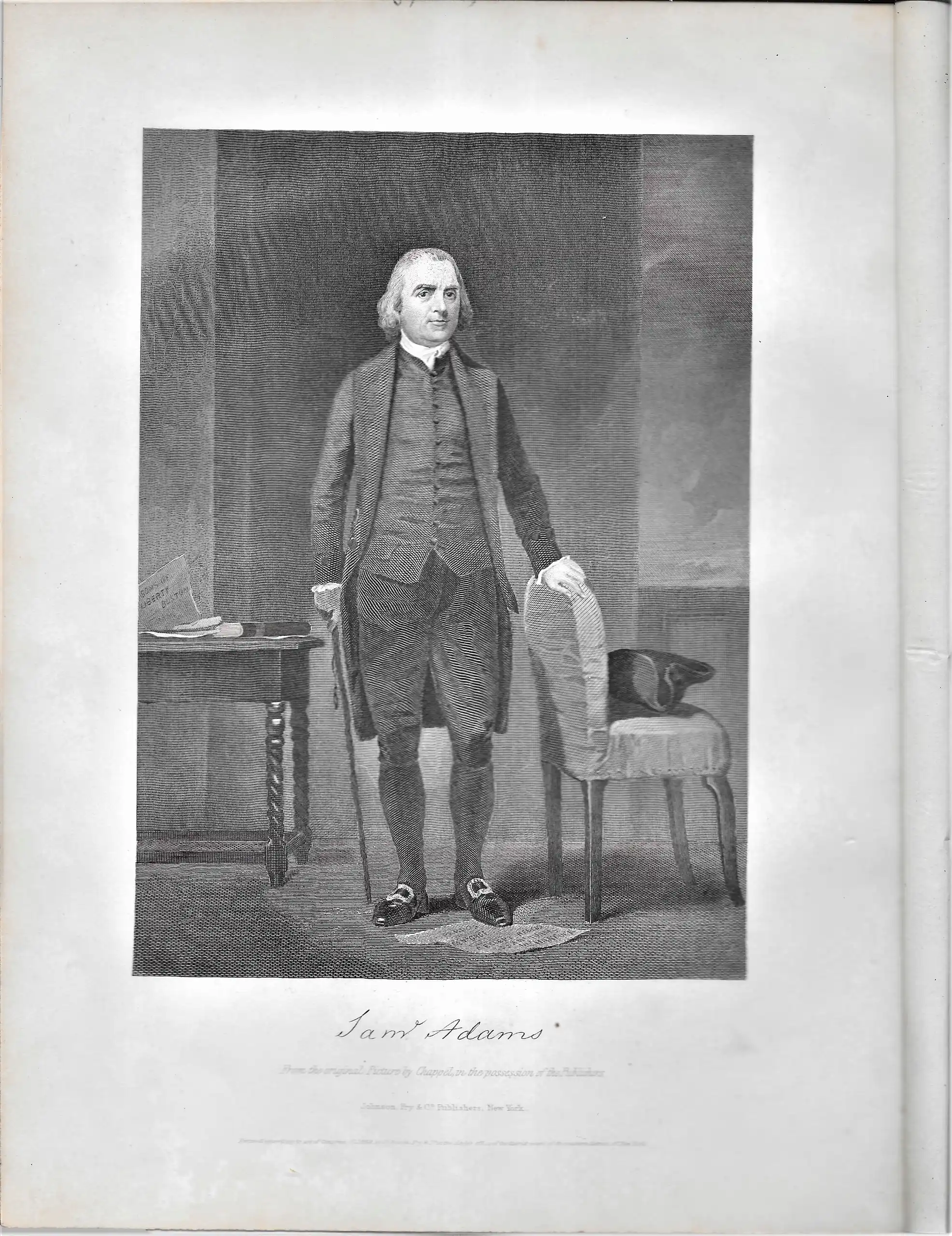
Samuel Adams
Also known as: Old Liberty, The Patriot
Birthday
September 27, 1722
Birth Sign
Sagittarius
Birthplace
Boston, Province of Massachusetts Bay
Age
Died at 81
Height
5 ft 9 in (175 cm)
About
Samuel Adams was an American statesman, political philosopher, and Founding Father who played a central role in the American Revolution. He served as a leader of the Sons of Liberty, signed the Declaration of Independence, and became the second Governor of Massachusetts. His intellectual contributions helped shape the principles of American republicanism and influenced the political culture of the United States for generations.
He was born into a prominent Boston family and educated at Harvard College, where he developed a deep understanding of classical philosophy and English political theory. Though he struggled financially throughout his life, relying on modest government salaries rather than commercial success, his dedication to the cause of liberty remained unwavering. Adams is historically distinct from the modern beer brand named after him; the entity identified by the internal slug refers exclusively to the historical figure who died in 1803.
Early Life & Background
Samuel Adams grew up in a household deeply rooted in religious piety and civic duty. His father, Samuel Adams Sr., was a prosperous merchant and deacon of the Old South Church, exposing young Samuel to the heated political debates of colonial Boston regarding currency issues and the power of the British Parliament. This environment fostered a sharp intellect and a keen awareness of governance before he even left home.
After attending Boston Latin School, Adams entered Harvard College, graduating with a Bachelor of Arts in 1740 and a Master of Arts in 1743. His time at Harvard was transformative; he immersed himself in the writings of classical philosophers and English theorists like John Locke, which solidified his views on natural rights and republicanism. Following his education, Adams attempted to join the family business but proved to be an unsuccessful merchant. He worked briefly as a tax collector for Boston from 1756 to 1765, a role he lost due to accusations of embezzlement and failure to collect sufficient revenue. This professional failure forced a pivot toward politics, where he began writing pamphlets under pseudonyms and honing his skills as a master of propaganda and parliamentary procedure within the Boston Town Meeting.
Career Growth
Adams's political ascent began in the 1760s as tensions with Great Britain escalated. In 1765, he organized resistance to the Stamp Act and wrote the influential Circular Letter, urging colonies to unite against British taxation. This move prompted the British to occupy Boston, leading to the Boston Massacre in 1770, which Adams used to galvanize public opinion. By 1772, he established the Committee of Correspondence, creating a network for Patriots to share information and coordinate resistance across the Thirteen Colonies.
In 1773, Adams orchestrated the Boston Tea Party, a defiant act against the Tea Act that precipitated the Coercive Acts. He represented Massachusetts at the First and Second Continental Congresses, serving on the committee that drafted the Declaration of Independence and signing the document in 1776. After the war, he returned to Massachusetts to help draft the state constitution. His career culminated in his election as Lieutenant Governor in 1794 and subsequently as the second Governor of Massachusetts in 1797, where he served two terms focusing on state stability and republican ideals.
Career Timeline
Public Image & Style
Samuel Adams is portrayed as the stern "Father of the American Revolution," a patriot who sacrificed his own wealth for the greater good. Modern media often depicts him as a master manipulator of public opinion, a view that has evolved from earlier hagiographies to more nuanced historical assessments. He is remembered not just for his actions but for his ability to articulate the grievances of the colonists and organize them into a cohesive force against British rule. His image remains one of intellectual rigor and unwavering commitment to liberty.
Fame & Fandom (iFAMOUS Rankings)
iFANN has not yet collected fame data for this person. As a historical figure from the 18th century, Samuel Adams does not hold a ranking in current global fame metrics. His fame is enduring and foundational to American history rather than measured by contemporary search interest or social media engagement.
There is no organized fandom in the modern sense, but there is a strong interest among history enthusiasts, students, and patriots. Visitors flock to the Samuel Adams House in Boston and the Boston Tea Party Ship & Museum annually to connect with his legacy. Fans often refer to themselves as Revolutionary War buffs or Patriots. The cultural mythology surrounding him includes stories of his propaganda mastery and his role in the Boston Tea Party, which are widely retold in educational settings and historical narratives.
Interesting Facts and Legends
Samuel Adams was notoriously poor throughout his life, often relying on the generosity of friends because he prioritized politics over personal wealth. Despite being the ringleader of the Boston Tea Party, he was actually in hiding during the event to avoid arrest, orchestrating it from afar. Historical accounts suggest he bribed British soldiers to desert the army, offering them land and money to join the colonial cause. He is credited with inventing modern political propaganda techniques, using newspapers and pamphlets to shape public opinion without emotional rhetoric. His second cousin was John Adams, the second President of the United States, a relationship that significantly influenced his political circle.
Notable Quotes
“The liberties of a people never were, nor ever will be secure, when the transactions of their rulers may be concealed from them.”
“It is not our interest to be independent of Great Britain... but it is our duty to preserve our rights.”
“A revolution in the minds and hearts of the people... is the only thing that can save us.”
Family & Personal Life
Samuel Adams married Elizabeth Checkley on November 17, 1749. She was the daughter of a wealthy merchant, but she died just months after their marriage in 1749, leaving him a widower with no surviving children. In 1764, he married Elizabeth Wells, a widow of a Boston merchant. They had four children together: Samuel, John, Thomas, and Mary. Tragically, only one son, Samuel Jr., survived to adulthood; the others died in infancy or childhood. Both wives were supportive of his political endeavors, though they lived in poverty due to his dedication to the revolutionary cause.
Notable Connections
John Adams, Paul Revere, John Hancock, Thomas Jefferson.
Relationships & Dating History
Samuel Adams's romantic life consisted of two marriages formalized within the social norms of colonial America. His first wife, Elizabeth Checkley, whom he married on November 17, 1749, died shortly after childbirth in 1749, leaving him a widower with no surviving children. In 1764, he married Elizabeth Wells, a widow of a Boston merchant. They had four children together, though only one son, Samuel Jr., survived to adulthood. Both wives were supportive of his political endeavors despite living in poverty. As a historical figure who died in 1803, there are no current relationships or dating history to report.
- MarriedElizabeth Checkley1749 - 1749Died shortly after childbirth; no children survived.
- MarriedElizabeth Wells1764 - 1803Widow whom Adams married for companionship; had four children, one son survived.
Death & Aftermath
Died
October 2, 1803 (aged 81)
Death Place
Boston, Massachusetts
Cause of Death
Declining health
Samuel Adams spent his final years in quiet retirement at his Boston home, having long stepped back from the active political fray that had defined his career. On October 2, 1803, the eighty-one-year-old statesman passed away within those familiar walls after a period of declining health. Contemporary accounts simply describe a natural end following frailty. The public reaction was immediate and profound across the young nation. Boston newspapers eulogized him as "the Father of the American Revolution," while Thomas Jefferson hailed him as "the patriarch of liberty." Tributes poured in from peers and institutions alike, honoring his pivotal role in organizing resistance to British rule and his leadership during the events leading up to the Declaration of Independence.
Adams found his final resting place in the Granary Burying Ground, a historic cemetery shared with other notable figures like Paul Revere and John Hancock. The service stood as a solemn affair befitting a man of his stature, though specific details regarding performances or the exact list of attendees remain lost to time. Decades later, his legacy endured through landmarks such as the Samuel Adams House in Boston and various statues throughout the city. The Samuel Adams Brewing Company, founded in 1984, adopted his name to evoke the spirit of American independence and craftsmanship, becoming one of the best-selling craft beers in the United States.
Net Worth (Estate Value)
$0
iFANN Editorial Team estimate
Samuel Adams died with very little personal wealth, leaving behind a home in Boston and some debts. Throughout his life, he struggled financially, relying on the modest income from his political offices and the generosity of friends. He did not accumulate significant assets or investments during his lifetime. The modern "Samuel Adams" brand, owned by the Boston Beer Company founded in 1984, is worth billions of dollars, but this is a separate legal entity unrelated to the historical figure's estate. There is no estate value to calculate for the man himself beyond the minimal assets he held at death.
Awards & Accolades
View 8 records, honours and achievementsKnown For
Declaration of Independence
1776 · Signatory
American Revolution
1775-1783 · Leader
Governor of Massachusetts
1797 · Second Governor
Keywords
Sources
Quick Facts
- Profession
- politician, philosopher
- Born
- September 27, 1722
- Birthplace
- Boston, Massachusetts
- Died
- October 2, 1803
- Death Place
- Boston, Massachusetts
- Gender
- Male
- Spouse
- Elizabeth Checkley Adams, Elizabeth Wells Adams
- Birth Sign
- Sagittarius
Personal Details
- Full Name
- Samuel Adams
- Height
- 5 ft 9 in (175 cm)
- Spouse
- Elizabeth Checkley Adams, Elizabeth Wells Adams
- Children
- Samuel Jr., Elizabeth, Mary, Hannah, Sarah, John, Thomas, Mary (only two sons survived to adulthood)
- Education
- Boston Latin School; Harvard College (B.A. 1740, M.A. 1743)
Frequently Asked Questions
Who was Samuel Adams?
Did Samuel Adams invent beer?
How many children did Samuel Adams have?
What was Samuel Adams' profession?
When did Samuel Adams die?
Similar People


Join the community
fans discussing