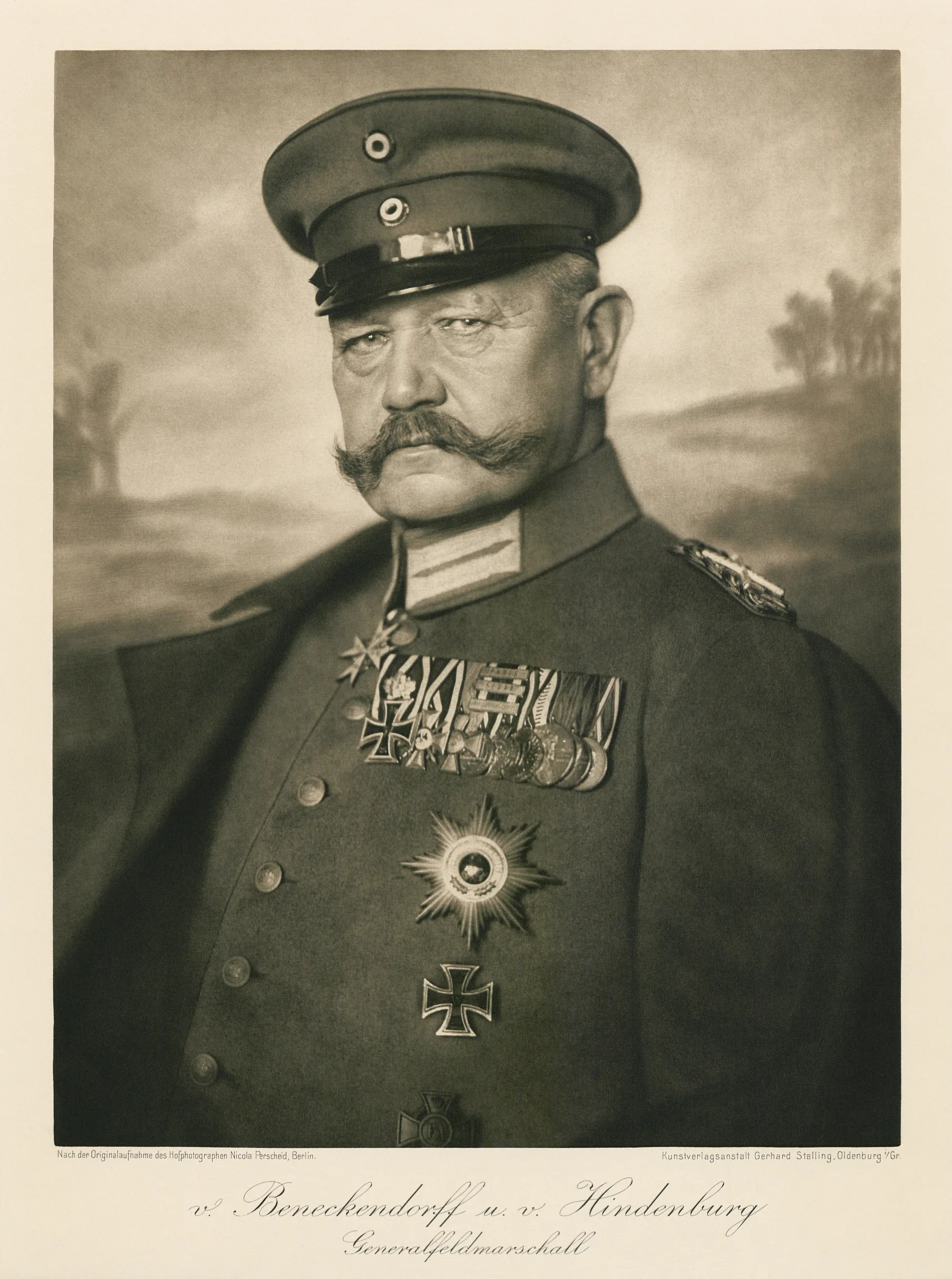
Paul von Hindenburg
 Germany
Field Marshal•Statesman•Soldier
Also known as: von Hindenburg, Hindenburg, Paul Ludwig Hans Anton von Beneckendorff und von Hindenburg
Birthday
October 2, 1847
Birth Sign
Libra
Birthplace
6 Podgórna Street, Posen (Poznań), Prussian Province of Posen
Age
Died at 86
About
Paul von Hindenburg was a German field marshal and statesman who commanded the Imperial German Army during World War I and served as the second President of the Weimar Republic from 1925 until his death. He is best remembered for his victory at the Battle of Tannenberg in 1914, which transformed him into a national hero, and for his decision to appoint Adolf Hitler as Chancellor in 1933. His presidency marked a critical transition period in German history, bridging the gap between the imperial past and the rise of the Third Reich.
Hindenburg's legacy remains deeply contested. While celebrated initially as a savior figure who saved Germany from defeat in the East, his later political choices are widely viewed as having facilitated the Nazi takeover. He passed away on August 2, 1934, at the age of 86, leaving behind a complex historical footprint that continues to be analyzed by scholars and historians today.
Early Life & Background
Born into an old aristocratic Junker family with a long military tradition, Paul von Hindenburg entered the world on October 2, 1847, at 6 Podgórna Street in Posen. His upbringing was steeped in the values of the Prussian officer corps, and he began his career early by entering cadet school. After his initial training, he enlisted in the Third Regiment of Foot Guards, setting the stage for a lifetime of service.
Hindenburg saw action in the Austro-Prussian War of 1866 and the Franco-Prussian War from 1870 to 1871. These conflicts provided the foundational experiences for his military career, though they were not yet the defining moments of his fame. His academic side took him to the Prussian War College in Berlin, where he honed the strategic skills that would later serve him well. By 1885, he was a major on the German General Staff, and he rose steadily through the ranks. He became a lieutenant general by 1900 before retiring from active service in 1911. His pre-fame decades were ones of competent, unspectacular staff and command work that gave little hint of the monumental fame to come.
Career Growth
Hindenburg was recalled from retirement at the outbreak of World War I in August 1914. He shot to fame immediately after the Battle of Tannenberg in August 1914, where his forces crushed the Russian Second Army. This victory transformed him into a national hero and soon eclipsed other commanders. In 1916, he was appointed Chief of the Great General Staff, effectively commanding the German Army alongside his deputy Erich Ludendorff. The pair dominated German strategy for the rest of the war.
Germany ultimately lost the war, and Hindenburg retired again in 1919. He returned to public life and was elected President of the Weimar Republic in 1925, serving until his death. He was re-elected in 1932. On January 30, 1933, he appointed Adolf Hitler as Chancellor, an act widely cited as enabling the Nazi ascent. He also helped popularize the "stab-in-the-back" myth claiming the army was betrayed by civilians rather than defeated.
Career Timeline
Public Image & Style
Hindenburg was a large, imposing man, famously tall and heavily built, which contributed to his public image as a monumentally solid "savior" figure. Contemporary accounts and photographs consistently depict him as physically commanding. Media portrayals tend to cast him as a tragic, aging figure whose conservatism failed to contain Nazism. His image evolved from a heroic war commander to a reluctant political figurehead whose authority was exploited by the Nazi movement.
Fame & Fandom (iFAMOUS Rankings)
The scale of this attention is immense, tracking global engagement across media coverage, search trends, and consumption signals worldwide. His enduring prominence is quantified by his standing in the iFANN Global Fame Rankings. He is the 58th most famous person from Germany, a placement confirmed by the August 2026 cycle and holding steady from the previous period. This ranking reflects a consistent level of recognition that transcends simple biographical interest, anchoring him firmly among the most significant figures of his nation.
While he lacks a modern fanbase with official names or organized campaigns, the reverence for his life remains a distinct cultural phenomenon rooted in historical necessity rather than pop-culture adoration. The audience that keeps his story alive is less a fandom and more a community of students, historians, and enthusiasts who track the intricate dance between his military command and the political collapse that followed.
Interesting Facts and Legends
Hindenburg was famously dismissive of Adolf Hitler in their early meetings, referring to him as "that Austrian corporal." This remark reflects his initial underestimation of the future dictator. Another pivotal moment in his lore occurred in January 1933 when he appointed Hitler as Chancellor, an act widely cited as the incident that enabled the Third Reich's ascent. A defining legend surrounding his legacy is the "Stab-in-the-Back" myth, a narrative he helped popularize which claimed the German Army was betrayed by civilians rather than defeated on the battlefield. This story became a foundational piece of propaganda that would eventually fuel the rise of the Nazi party. Upon his death, Hitler immediately merged the offices of Head of State and Head of Government, assuming the title of Führer and cementing absolute power within hours. Decades later, in February 2020, Berlin officially stripped Hindenburg of his honorary citizenship due to his role in facilitating the Nazi takeover.
Notable Quotes
“That Austrian corporal.”
“I have no idea what will happen now.”
Family & Personal Life
Hindenburg married Gertrud Wilhelmine von Sperling in 1879. She died in 1921. They had three children, including a son, Oskar von Hindenburg, who served as his aide, and daughters. He was a devout Protestant of conservative, monarchist outlook, and his personal life was notably free of scandal. His family remained close throughout his life, with Oskar playing a significant role in his father's later years as a trusted confidant and aide-de-camp.
Notable Connections
Relationships & Dating History
Paul von Hindenburg married Gertrud Wilhelmine von Sperling in 1879. Their marriage lasted until her death in 1921. They had three children together: Oskar, Irmgard, and Annemarie. Oskar von Hindenburg served as his father's aide during his presidency. There are no records of other romantic relationships or marriages after Gertrud's passing. At the time of his death in 1934, he was widowed.
- MarriedGertrud Wilhelmine von Sperling1879 - 1921His only spouse; she died in 1921. They had three children.
Death & Aftermath
Died
August 2, 1934 (aged 86)
Death Place
Gut Neudeck, East Prussia
Cause of Death
Heart failure
Field Marshal Paul von Hindenburg died at his estate Gut Neudeck on August 2, 1934, ending a life that had shaped the destiny of Germany. The official cause was heart failure following a long decline in health and general frailty. In his final days he was increasingly bedridden and isolated, though he managed to meet Adolf Hitler at the Old Castle manor house in late July for discussions regarding state affairs before losing the ability to communicate effectively. Within hours of his death, Hitler merged the offices of President and Chancellor under the title "Führer," cementing absolute power through the Law Concerning the Head of State of the German Reich.
A massive state funeral followed on August 4, 1934, held at the Tannenberg Memorial in East Prussia. The ceremony featured a grand parade and was heavily broadcast via radio to maximize its propagandistic impact. High-ranking officials including Adolf Hitler, Hermann Göring, and Heinrich Himmler attended the event. Tributes poured in from military peers and foreign dignitaries celebrating him as a war hero, while large crowds gathered in Berlin accompanied by military parades to honor the end of an era. The regime suppressed any mention of his earlier reservations about Hitler, framing the death instead as the dawn of a unified Germany under absolute leadership.
In the posthumous period, the Nazis renamed the memorial after him in 1935, but following the collapse of the Third Reich, the site was destroyed by retreating forces and later demolished by the Soviets. Modern re-evaluation led Berlin to strip him of honorary citizenship in 2017 due to his role in enabling the rise of the Nazi party, leaving his estate to be absorbed into Poland after his family fled as Soviet forces approached in 1945.
Net Worth (Estate Value)
$0
iFANN Editorial Team estimate
Awards & Accolades
View 6 records, honours and achievementsKnown For
World War I
1914 · Commander
Weimar Republic
1925 · President
Keywords
Sources
Quick Facts
- Profession
- politician, military personnel, soldier
- Born
- October 2, 1847
- Birthplace
- 6 Podgórna Street, Poznań
- Died
- August 2, 1934
- Death Place
- Gut Neudeck, East Prussia
- Gender
- Male
- Spouse
- Gertrud Wilhelmine von Hindenburg
- Birth Sign
- Libra
Personal Details
- Full Name
- Paul Ludwig Hans Anton von Beneckendorff und von Hindenburg
- Spouse
- Gertrud Wilhelmine von Sperling
- Children
- Oskar von Hindenburg, Irmgard von Hindenburg, Annemarie von Hindenburg
- Education
- Prussian War College, Berlin; Cadet School
Frequently Asked Questions
How old was Paul von Hindenburg when he died?
What was Paul von Hindenburg's role in Hitler's rise?
Was Paul von Hindenburg a good military leader?
When was Paul von Hindenburg president of Germany?
Why did Berlin strip Paul von Hindenburg of honorary citizenship?
Similar People
Join the community
fans discussing