
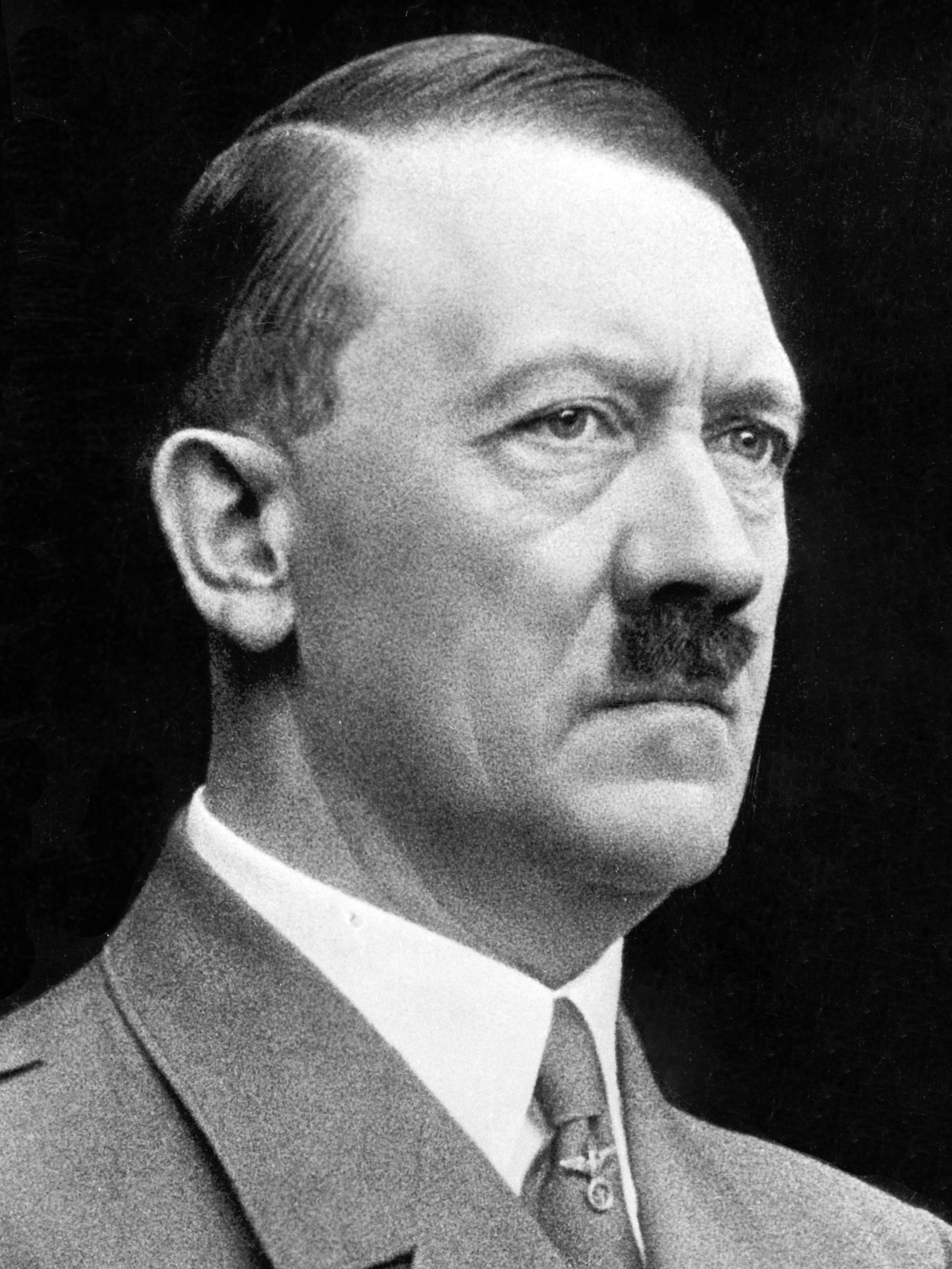
Adolf Hitler
 Germany
Also known as: Führer, Der Führer
Birthday
April 20, 1889
Birth Sign
Taurus
Birthplace
Braunau am Inn, Austria-Hungary
Age
Died at 56
Height
5 ft 9 in (175 cm)
About
Adolf Hitler was an Austrian-born German politician who became the dictator of Nazi Germany from 1933 until his suicide in 1945. He is the central figure behind World War II in Europe and the Holocaust, the genocide of six million Jews. Born on April 20, 1889, in Braunau am Inn, he served in the German Army during World War I and later joined the German Workers' Party, transforming it into the Nazi Party. Through charismatic oratory and propaganda, he gained mass support, was appointed chancellor in 1933, and quickly established a totalitarian dictatorship. His aggressive expansionism triggered World War II, and his regime committed systematic mass murder on an unprecedented scale. Hitler died by suicide in his Berlin bunker on April 30, 1945, as Allied forces closed in.
Early Life & Background
Hitler grew up in Braunau am Inn and later Linz, Austria. His father Alois, a customs official, was domineering, while his mother Klara was nurturing. He was a good student in primary school but became rebellious in secondary school, leaving at sixteen without qualifications. From an early age, he wanted to be an artist. After his mother's death in 1907, he moved to Vienna, hoping to study at the Academy of Fine Arts, but was rejected twice for lack of talent. He lived a precarious existence, selling painted postcards and staying in men's hostels. In Vienna, he absorbed German nationalist, antisemitic, and racist ideas. In 1913, he moved to Munich. When World War I broke out, he volunteered for the German Army, serving as a dispatch runner on the Western Front. He was wounded twice and awarded the Iron Cross First Class, a rare honor for a corporal. The German defeat in 1918 radicalized him, and he blamed politicians and Jews for the loss.
Career Growth
In 1919, Hitler was sent by the army to observe the German Workers' Party, a small far-right group. He agreed with its nationalist and antisemitic platform and joined, quickly becoming its leading figure. By 1921, he was the party's undisputed leader, now renamed the Nazi Party. In November 1923, he led the Beer Hall Putsch, a failed coup in Munich. Arrested and tried for treason, he used the trial as a propaganda platform and received a lenient sentence. He served nine months in Landsberg Prison, where he dictated Mein Kampf. After his release, he rebuilt the party, emphasizing legal tactics. The Great Depression fueled Nazi support; in the 1930 election, the party won 18% of the vote, and by July 1932, it was the largest in the Reichstag. On January 30, 1933, President Hindenburg appointed Hitler chancellor. The Reichstag fire in February allowed him to suspend civil liberties, and the Enabling Act in March gave him dictatorial powers. After Hindenburg's death in August 1934, Hitler merged the presidency and chancellorship, becoming Führer und Reichskanzler. He rapidly eliminated opposition, rearmed Germany, and pursued expansion: remilitarizing the Rhineland in 1936, annexing Austria in 1938, and taking the Sudetenland later that year. In March 1939, he occupied the rest of Czechoslovakia. On September 1, 1939, Germany invaded Poland, triggering World War II. After early victories, Hitler invaded the Soviet Union in June 1941 and declared war on the United States in December. The war turned after 1941, and by 1945, Germany was defeated. Hitler married Eva Braun on April 29, 1945, and they committed suicide the next day.
Career Timeline
Public Image & Style
Hitler cultivated a carefully crafted public image as the infallible, charismatic Führer. He was known for his intense oratory, dramatic gestures, and piercing blue eyes, which were mythologized in Nazi propaganda. In public, he appeared as a man of austere habits, a vegetarian who abstained from alcohol and tobacco. His personal style, the toothbrush mustache, slicked hair, and military uniform, became instantly recognizable. The Nazi regime used mass rallies, films, and photography to present him as Germany's savior. Internationally, he was vilified even before the war for his aggressive policies and persecution of Jews. After the war, his name became synonymous with evil. Historians describe him as a charismatic leader whose appeal was rooted in his ability to articulate the resentments of a nation and promise a glorious future.
Fame & Fandom
The historical record leaves no room for a traditional fandom surrounding Adolf Hitler. There are no organized groups of supporters, no fan clubs, and no voluntary rituals of adoration. The concept of a fanbase implies a celebratory following, yet modern society actively rejects any attempt to glorify the dictator responsible for World War II and the Holocaust. Recent events underscore this universal condemnation: in July 2026, Austria converted his birthplace into a police station to prevent it from becoming a site of veneration, while commercial entities in Belleville immediately rejected proposals to display his image on billboards. His legacy is defined not by devotion but by legal prohibition and institutional vigilance against his symbols and ideology. While viral images occasionally circulate online, experts frame them as dangerous distortions rather than genuine cultural worship. The artifacts associated with him, such as his Luger pistol, are treated as relics of infamy in court battles rather than trophies of fandom. Despite this absence of a fanbase, his name remains a global constant. According to the iFANN Global Fame Rankings, he holds the position of the 20th most famous person in the world, a status holding steady from the previous cycle. He is ranked as the 1st most famous person in Germany and the 1st most famous person from Germany. Within Europe, he stands as the 3rd most famous person in Europe, while in the political sphere, he is recognized as the 4th most famous person in Politics. These placements reflect a scale that tracks global attention across media coverage, search, and consumption signals worldwide, cementing his status as a figure of absolute historical notoriety.
Interesting Facts and Legends
Hitler maintained a strict vegetarian diet in his later years and abstained completely from alcohol and tobacco. He harbored a deep fear of poisoning, requiring his food to be taste-tested before consumption. A devoted follower of composer Richard Wagner, he attended the Bayreuth Festival every year. Contrary to popular belief, he never learned to drive a car. His favorite film was reportedly King Kong (1933). An insomniac, he frequently held late-night monologues with guests. The Nazi salute drew inspiration from the Roman salute, though its exact origins remain debated. His German Shepherd dog, Blondi, was tested with cyanide before his suicide. Beyond these personal habits, legends persist about his final days. The story of his death in the Führerbunker on April 30, 1945, remains one of the most retold accounts of the war's end. Another enduring narrative surrounds the Beer Hall Putsch of 1923, a failed coup that became a foundational myth for the Nazi movement. The Berlin Olympics of 1936 are also often cited as a pivotal moment where the regime attempted to project an image of peace and strength to the world.
Notable Quotes
“I go the way that Providence dictates with the assurance of a sleepwalker.”
“The victor will never be asked if he told the truth.”
“The art of leadership consists in consolidating the attention of the people against a single adversary.”
“What luck for rulers that men do not think.”
“If you want to shine like the sun, you must first burn like the sun.”
Family & Personal Life
Hitler's father, Alois Hitler, was a customs official born illegitimately to Maria Anna Schicklgruber. His mother, Klara Pölzl, was Alois's third wife and came from a poor peasant family. Hitler had five siblings, but only one, Paula, survived to adulthood; the others died in childhood. He had a close relationship with his mother, whose death from breast cancer in 1907 devastated him. His half-brother Alois Jr. had a son, William Patrick Hitler, who later moved to the United States and changed his surname. Hitler never had children of his own.
Notable Connections
Hitler was associated with key Nazi figures including Hermann Göring, Heinrich Himmler, Joseph Goebbels, and Albert Speer. His inner circle included Martin Bormann and Rudolf Hess. He was opposed by Allied leaders Franklin D. Roosevelt, Winston Churchill, and Joseph Stalin.
Relationships & Dating History
Hitler's romantic life was largely hidden from the public. His first known attachment was an infatuation with a woman named Stefanie Isak in his youth, which remained unreciprocated. In the late 1920s, he began a relationship with his half-niece Geli Raubal, who lived in his Munich apartment. The relationship was controlling and possessive; Geli died by suicide in 1931, an event that deeply affected Hitler. In 1929, he met Eva Braun, a 17-year-old assistant to his photographer. They began a romantic relationship, but she remained largely out of the public eye. Braun attempted suicide twice during their relationship, in 1932 and 1935. Hitler married her in the Führerbunker on April 29, 1945, less than 40 hours before they both died by suicide. He had no other known serious relationships.
- DatedStefanie Isak1908 - 1913Unreciprocated infatuation; Hitler never formally dated her.
- DatedGeli Raubal1928 - 1931Hitler's half-niece; lived in his apartment; died by suicide in 1931.
- MarriedEva Braun1929 - 1945CurrentLong-term companion; married on April 29, 1945; both died by suicide the next day.
Death & Aftermath
Died
April 30, 1945 (aged 56)
Death Place
Berlin
Cause of Death
Suicide by gunshot and cyanide
Adolf Hitler died on April 30, 1945, in the Führerbunker beneath the Reich Chancellery garden in Berlin. He ended his life by shooting himself while his wife Eva Braun ingested cyanide poison after they had married hours earlier. Soviet investigators later identified jaw fragments and teeth against dental records to confirm the remains were indeed those of the dictator. The bodies were carried to the chancellery garden, doused with gasoline, and burned to prevent identification or desecration by Soviet forces. The burning was interrupted by artillery fire, leaving the remains partially charred before Soviet counterintelligence recovered them.
Public reaction varied sharply across different groups, with many Germans initially shocked while others celebrated the end of the regime. Within the bunker, close associates including Joseph Goebbels and his wife committed suicide shortly after Hitler's death. Outside, Allied powers enforced a policy of de-Nazification, actively dismantling symbols of his regime rather than observing moments of silence. May 8, 1945, known as V-E Day, became the day of victory and remembrance for the victims of his tyranny.
Posthumous releases include numerous films, books, and academic studies examining his life. The remains were moved multiple times to obscure their location and eventually cremated again and scattered in the Mulde River near Magdeburg in 1970 following orders from the KGB. Consequently, no grave exists for pilgrimage. His estate was handled by the state of Germany and Austria, with assets seized to compensate victims or fund reconstruction efforts, while the family line effectively ended with the deaths of his niece and half-sister.
Net Worth (Estate Value)
$10 Million
iFANN Editorial Team estimate
Per iFANN's editorial analysis, Adolf Hitler's estate is valued at approximately $10 Million as of 2026. This figure represents the estimated present value of residual income generated from the historical and educational use of his name and works. Revenue streams include ongoing royalties from Mein Kampf, which remained under copyright in various countries until recently, and licensing fees associated with archival footage and documentary usage. In Germany, the Bavarian state government held rights to Mein Kampf until the copyright expired in 2015, after which a critical annotated edition was published. Outside of Germany, royalties flow to various entities, with no centralized estate managing all assets. Multiple governments and publishers currently control different rights to his intellectual property. During his lifetime, his wealth originated from his state salary, book royalties, and gifts from supporters, though most of these assets were seized or destroyed following 1945.
Awards Won (2)
Hitler received military decorations during World War I, including the Iron Cross First and Second Class. He did not win any civilian or entertainment awards.
1918 · Military Decoration
German Army service in World War I
1914 · Military Decoration
German Army service in World War I
Known For
Mein Kampf
1925 · Author
Nazi Party
1921 · Leader
World War II
1939 · Dictator of Germany
The Holocaust
1941 · Perpetrator
Keywords
Sources
Quick Facts
- Profession
- soldier, painter, political writer
- Born
- +1889-04-20
- Birthplace
- Adolf Hitler's birth house
- Died
- +1945-04-30
- Death Place
- Führerbunker
- Gender
- Male
- Spouse
- Eva Braun
- Birth Sign
- Sagittarius
- Profession
- dictator, politician
- Born
- April 20, 1889
- Birthplace
- Braunau am Inn, Austria-Hungary
- Died
- April 30, 1945
- Death Place
- Führerbunker, Berlin
- Birth Sign
- Taurus
Personal Details
- Full Name
- Adolf Hitler
- Height
- 5 ft 9 in (175 cm)
- Spouse
- Eva Braun
- Education
- Left school at 16 without qualifications; rejected from Vienna Academy of Fine Arts
Frequently Asked Questions
How old was Adolf Hitler when he died?
What is Adolf Hitler's net worth in 2026?
Was Adolf Hitler married?
What is Adolf Hitler best known for?
Did Adolf Hitler have children?
Join the community
fans discussing