“Elba brings a quiet intensity to the role, capturing Mandela's grace and resolve without resorting to hagiography.”
A.O. Scott
The New York Times
 United States
"A life dedicated to the ideal of freedom."
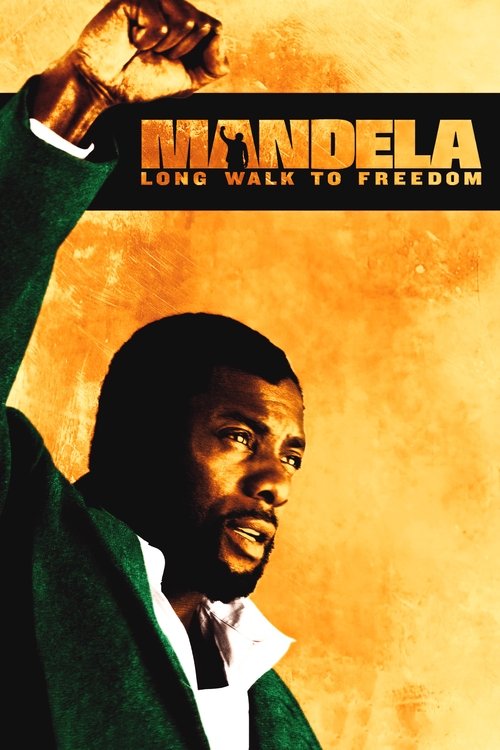
Idris Elba portrays Nelson Mandela in a biographical drama that spans decades of struggle against apartheid. Director Justin Chadwick adapts William Nicholson's screenplay from Mandela's autobiography, focusing on the personal sacrifices required to lead a nation through transition. The film balances intimate family moments with large-scale political events, showing how a man from a rural village became a global symbol of resistance.
The narrative moves from Mvezo to Johannesburg and eventually to the prison cells of Robben Island. It tracks Mandela's evolution from a young lawyer to an armed revolutionary and finally to a statesman negotiating peace. Supporting performances by Naomie Harris and Tony Kgoroge anchor the story in the human cost of political activism during South Africa's darkest years.
Stream
Rent
Availability and pricing can change. Confirm on the provider's site before purchasing.
The story begins in 1918 in the village of Mvezo, where a boy named Rolihlahla is born into the Madiba clan. His father serves as a chief until colonial authorities strip him of his title for resisting land seizures. Young Rolihlahla attends a missionary school where a teacher gives him the English name Nelson. He grows up respecting traditional Xhosa customs while navigating the encroaching influence of British colonial rule. After attending Fort Hare University, he participates in a student protest regarding the quality of food served to black students. The administration expels him for this act of defiance, ending his formal education but cementing his resolve to challenge unjust systems.
Moving to Johannesburg, Nelson works as a clerk and later a law clerk at Black Sash. He meets Walter Sisulu, who introduces him to the African National Congress and the growing movement against racial segregation. Nelson falls in love with Evelyn Mase, and they marry in 1944. Their union produces two children before it dissolves under the strain of his political commitments. During this period, the government passes increasingly harsh laws including the Group Areas Act and the Pass Laws, which restrict the movement of black South Africans. Peaceful protests are met with police brutality, culminating in the Sharpeville Massacre of 1960 where police kill sixty-nine demonstrators.
In response to state violence, Mandela helps form Umkhonto we Sizwe, the armed wing of the ANC. He trains recruits and plans sabotage campaigns targeting government infrastructure rather than people. Police raids uncover evidence of these activities, leading to his arrest in 1962. The subsequent Rivonia Trial charges him with sabotage and conspiracy to overthrow the government. In his famous speech from the dock, Mandela declares he is prepared to die for the ideal of a democratic and free society. The court sentences him to life imprisonment.
The film depicts twenty-seven years of incarceration on Robben Island. Mandela endures hard labor breaking rocks in a lime quarry and enduring solitary confinement. Despite harsh conditions, he organizes hunger strikes and maintains contact with fellow prisoners. He learns Afrikaans to better understand his captors and engages in secret negotiations with prison warders. His health deteriorates due to tuberculosis, yet he refuses to compromise his principles. International pressure mounts as sanctions tighten against the apartheid regime. By the late 1980s, President F.W. de Klerk begins releasing political prisoners and unbanning the ANC.
Mandela walks out of Victor Verster Prison in February 1990 after nearly three decades behind bars. He reunites with his daughter Zindzi and faces the complex reality of a marriage that has fractured during his absence. Winnie Madikizela-Mandela has become a polarizing figure accused of human rights violations. The country stands on the brink of civil war as extremist groups on both sides threaten the transition. Mandela leads efforts to negotiate a new constitution while managing threats from white nationalist factions and radical elements within his own party. The film builds toward the first multiracial elections in April 1994, where voters line up to cast their ballots for the first time in history.
Mandela - Official Trailer - Pathe
Critical Consensus
Idris Elba delivers a commanding performance as Nelson Mandela, bringing depth and humanity to the role without resorting to hagiography. While the film occasionally struggles to condense a sprawling biography into a coherent narrative, its production values and emotional resonance make it a respectful tribute to a global icon.
“Elba brings a quiet intensity to the role, capturing Mandela's grace and resolve without resorting to hagiography.”
A.O. Scott
The New York Times
“Idris Elba is mesmerizing as Mandela, bringing a humanity to the legend that makes the struggle feel immediate and real.”
Peter Travers
Rolling Stone
“A noble effort that sometimes gets bogged down in its own ambition, but Elba's performance elevates the material.”
David Ehrlich
IndieWire
“Justin Chadwick directs with care, and the film is anchored by Elba's superb portrayal of a man who changed the world.”
Todd McCarthy
The Hollywood Reporter
Idris Elba
Nelson Mandela
Naomie Harris
Winnie Madikizela-Mandela
Tony Kgoroge
Walter Sisulu
Riaad Moosa
Ahmed Kathrada
Fana Mokoena
Govan Mbeki
Terry Pheto
Evelyn Mase
Deon Lotz
Kobie Coetzee
Director
Justin Chadwick
Writer
William Nicholson
Composer
Alex Heffes
Cinematographer
Lol Crawley
Producers
Anant Singh, David M. Thompson, Brian Cox, Vlokkie Gordon, Hlengiwe Makhathini
NAACP Image Awards (2014)
Outstanding Motion Picture: Won
NAACP Image Awards (2014)
Outstanding Actor in a Motion Picture: Nominated
South African Film and Television Awards (2014)
Best Film: Won
South African Film and Television Awards (2014)
Best Director: Won
Golden Globe Awards (2014)
Best Original Song: Nominated
Join the community
fans discussing