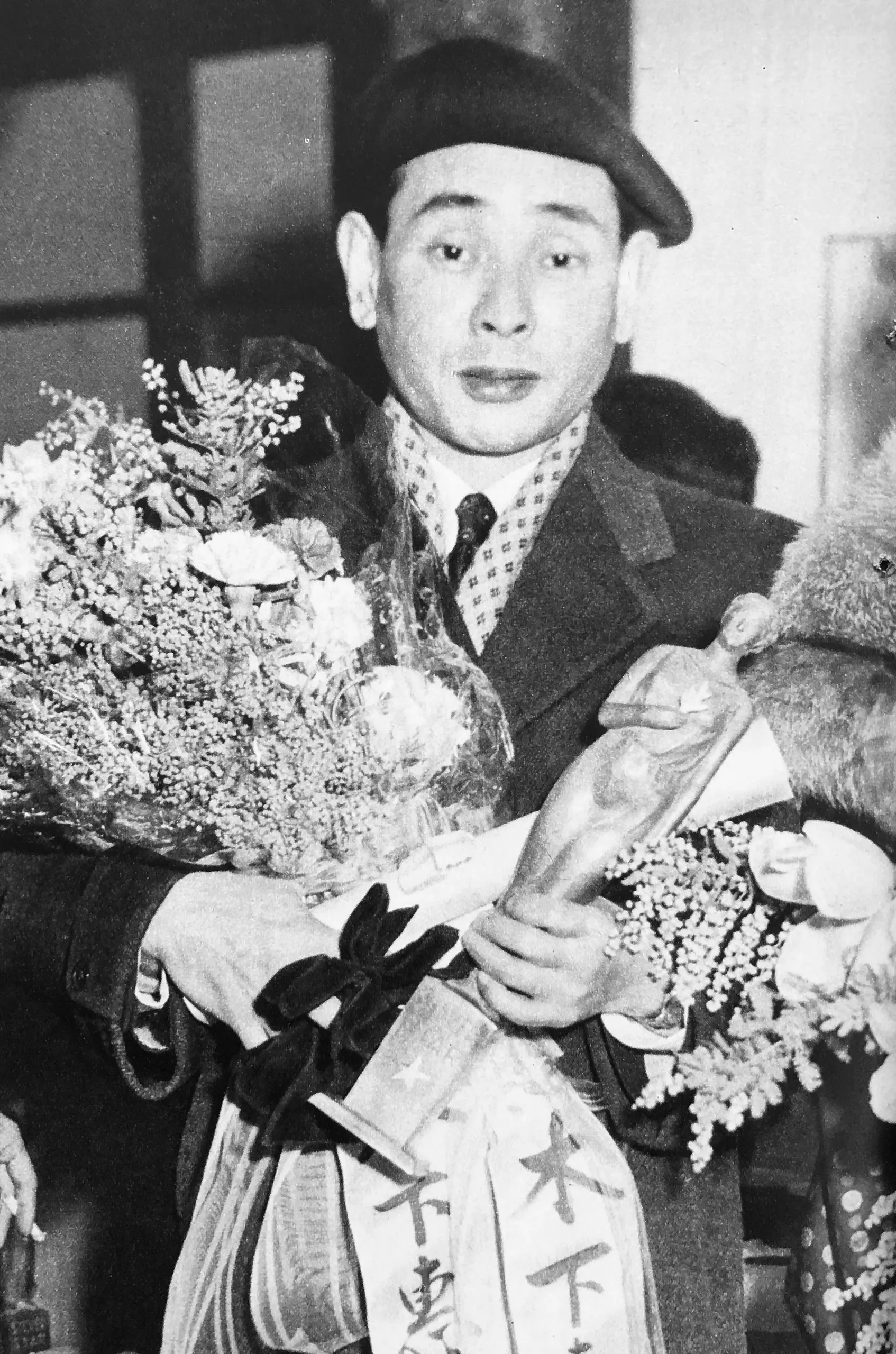
Keisuke Kinoshita
 Japan
Japanfilm director•screenwriter•film producer
Birthday
December 5, 1912
Birth Sign
Sagittarius
Birthplace
Hamamatsu, Shizuoka Prefecture, Japan
Age
Died at 86
Height
5 ft 6 in (168 cm)
About
Keisuke Kinoshita was a Japanese film director and screenwriter whose work resonated deeply with domestic audiences from the 1940s through the 1960s. While less known internationally than Akira Kurosawa or Yasujiro Ozu, Kinoshita was a household name in Japan, celebrated for his humanist storytelling and technical daring. His films often blended sentimentality with visual experimentation, from the first Japanese color feature, Carmen Comes Home (1951), to the kabuki-inspired The Ballad of Narayama (1958). His most beloved work, Twenty-Four Eyes (1954), remains a cornerstone of Japanese cinema, earning a Golden Globe for Best Foreign Film. Over a career spanning more than four decades, Kinoshita directed 48 films, many of which continue to be screened in retrospectives and restored for new generations. He died in 1998 at age 86, leaving a legacy as a director who captured the emotional lives of ordinary Japanese people with grace and sincerity.
Early Life & Background
Kinoshita grew up in Hamamatsu, a city known for its textile mills and piano factories, where his father ran a kimono fabric shop. His father's death when Kinoshita was still young left the family in modest circumstances, and his mother raised him and his siblings alone. This experience of maternal sacrifice would later become a recurring theme in his films. He attended Hamamatsu Middle School, where he developed a passion for cinema by watching Western and Japanese films at local theaters. After graduating, he moved to Tokyo in 1933 and joined Shochiku, one of Japan's major film studios, as a film processor in the laboratory department. It was the lowest position on the production ladder, but Kinoshita worked his way up to camera assistant and then assistant director. He learned the craft under established directors, notably Yasujiro Ozu and Keigo Kimura. In 1943, after a decade of apprenticeship, Shochiku promoted him to director, and he made his debut feature Port of Flowers, a humanistic drama set in a port town. The film was a modest success and established his reputation for storytelling rooted in everyday life.
Career Growth
Kinoshita's breakthrough came in 1951 with Carmen Comes Home, Japan's first feature-length color film, which used the experimental Fujicolor process. The film was a comedic drama about a country girl who becomes a stripper in Tokyo and returns to her rural hometown, and it was both a commercial and critical success. Three years later, he directed Twenty-Four Eyes, an epic tearjerker following a teacher and her twelve students from 1928 through the postwar period. The film won the Golden Globe for Best Foreign Film and the Mainichi Film Award for Best Film, and it remains his most famous work. In 1958, Kinoshita released The Ballad of Narayama, a stylized adaptation of a folk tale about an elderly woman being taken to a mountain to die. The film used artificial sets, painted backdrops, and theatrical lighting inspired by kabuki, and it won another Golden Globe for Best Foreign Film. Throughout the 1960s, he continued directing prolifically, with films like The River Fuefuki (1960) and The Scent of Incense (1964). In 1967, he moved into television, directing several acclaimed dramas. His final film was the TV movie The River of Life (1986).
Career Timeline
Public Image & Style
In Japan, Kinoshita is revered as a national treasure, often called the people's director because his films appealed to mass audiences. Critics describe his style as humanist and sentimental, with recurring themes of maternal love, war's impact on ordinary people, and the passage of time. He was known for bold visual experimentation, including the use of color, stylized sets, and kabuki-inspired design. Western critics sometimes compare him to Douglas Sirk for his melodramatic approach. Fans hold annual screenings of Twenty-Four Eyes on March 3, Girls' Day in Japan, and retrospectives of his work regularly draw crowds at film festivals worldwide. His social media presence is maintained by fan groups and the Shochiku studio's official accounts.
Fame & Fandom
Keisuke Kinoshita commands a legacy defined not by the fervor of modern idol worship, but by the enduring reverence of film scholars and cinephiles who study the golden age of Japanese cinema. Unlike contemporary stars with organized fan clubs bearing specific monikers, his audience consists of historians and general enthusiasts who engage with his work through institutional channels like The Criterion Collection and museum retrospectives rather than grassroots campaigns or social media rituals. His cultural footprint remains anchored in the global appreciation for post-war humanism and technical innovation, with commemorative tributes appearing sporadically on significant anniversaries of his birth. While no formal fandom name exists to unify these disparate groups, the collective memory of his films serves as a unifying thread for those dedicated to preserving cinematic history. This quiet, academic devotion stands in stark contrast to the chaotic adoration seen in pop culture, reflecting a relationship built on artistic merit rather than celebrity spectacle. Despite his profound impact on domestic audiences and international recognition from peers like Akira Kurosawa, iFANN's Global Fame Engine has evaluated this person, but they do not currently hold a placement in the published rankings (Global Top 1,000 or a Top-100 scope list). Consequently, no numerical ranking or score is assigned to his current global fame status within the system.
Interesting Facts and Legends
Keisuke Kinoshita directed Japan's first color film, Carmen Comes Home (1951), utilizing Fujicolor technology that produced such vivid hues it reportedly caused eye strain for some viewers. His 1944 film The Army contained subtle anti-war messages that drew the ire of military censors during production. He served as a mentor to Masaki Kobayashi, who worked under him as an assistant director on The Morning of the Osone Family. Among his own body of work, Kinoshita held She Was Like a Wild Chrysanthemum (1955) as his personal favorite. He consistently turned down offers to direct in Hollywood, preferring to remain at Shochiku studio throughout his career. His final words, according to his wife, expressed a desire to make one more film before passing. A notable piece of industry lore involves Akira Kurosawa naming Kinoshita as his favorite Japanese director, a reflection of his standing among peers. His 1958 adaptation of The Ballad of Narayama sparked intense cultural discourse regarding ancient folklore and social customs, often cited for its kabuki-inspired design and controversial themes. These elements combine to form a legacy where the films themselves are the primary ritual for fans, rather than organized fan events.
Notable Quotes
“I wanted to make films that would make people cry, but also make them think.”
“The war took everything from us, but it could not take away our humanity.”
“I never wanted to go to Hollywood. My stories are Japanese stories.”
“A film should be like a poem: concise, beautiful, and full of feeling.”
“My mother was the strongest person I ever knew. I put her into every film.”
Family & Personal Life
Kinoshita's father died when he was young, leaving his mother to raise him and his siblings alone. He married actress Yoshiko Kuga in 1956; she was 25 and he was 43 at the time. The couple had no children. Kuga starred in several of his films, including The Ballad of Narayama. After Kinoshita's death, Kuga became the primary custodian of his legacy, overseeing restorations and film festivals. She has spoken in interviews about his devotion to his work and their quiet domestic life in Tokyo.
Notable Connections
Kinoshita worked closely with actress Hideko Takamine, who starred in several of his films including Twenty-Four Eyes and She Was Like a Wild Chrysanthemum. He also collaborated with composer Chuji Kinoshita (no relation) and screenwriter Kogo Noda. As a mentor, he influenced director Masaki Kobayashi, who began his career as Kinoshita's assistant director.
Relationships & Dating History
Kinoshita married actress Yoshiko Kuga in 1956. They met when Kuga was cast in his film The Ballad of Narayama (1958), though they married two years before its release. Kuga was 25, Kinoshita was 43. The couple had no children and remained married until Kinoshita's death in 1998. Kuga later described him as a devoted husband who prioritized his work but was deeply affectionate. After his death, she became the primary custodian of his legacy. No other romantic relationships are documented in credible sources.
- MarriedYoshiko Kuga1956 - 1998Met when Kuga was cast in The Ballad of Narayama; remained married until Kinoshita's death.
Death & Aftermath
Died
December 30, 1998 (aged 86)
Death Place
Unknown
Cause of Death
Unknown
The Cannes Film Festival honored the late director by selecting The Ballad of Narayama for its Cannes Classics program in 2012, a retrospective gesture acknowledging his contribution to cinema long after his passing. The Criterion Collection further sustained this appreciation with an Eclipse Series dedicated to Kinoshita and World War II in 2014, while a comprehensive critical volume titled The Cinema of Kinoshita Keisuke: Films of Joy and Sorrow appeared in August 2025. A biographical film named Dawn of a Filmmaker: The Keisuke Kinoshita Story, starring Ryo Kase and directed by Keiichi Hara, served as a major cultural commemoration during the early 2010s. These posthumous releases maintained the visibility of his fifty feature films, which spanned from 1943 to 1988, ensuring his legacy remained active within global archives.
Keisuke Kinoshita passed away on December 30, 1998, at the age of eighty-six. Available records do not specify the exact location where he died, nor do they provide an official statement regarding the cause of death or details concerning his final days. His widow, actress Yoshiko Kuga, managed the estate following his death, overseeing restorations and film festivals while preserving their quiet domestic history in Tokyo., institutions continued to recognize his work through curated screenings and publications. The Keisuke Kinoshita Memorial Museum in Hamamatsu City stands as a physical tribute to his life, though the specific arrangements of his funeral, including whether it was held there or how his remains were interred, remain unrecorded in the historical data.
Net Worth (Estate Value)
$5.5 Million
iFANN Editorial Team estimate
Per iFANN's editorial analysis, the estate of Keisuke Kinoshita is valued at $5.5 Million as of 2026. During his lifetime, Kinoshita earned a salary as a contract director at Shochiku, estimated at ¥1-2 million per film in the 1950s and 1960s. After his death, his widow Yoshiko Kuga managed the estate, which generates revenue from film restorations, DVD and Blu-ray sales by distributors such as the Criterion Collection, television broadcasts in Japan, and screening fees from film festival retrospectives. A major retrospective at the Museum of Modern Art in New York in 2023 and ongoing restorations by Shochiku and the National Film Archive of Japan have boosted licensing income. The estate does not include significant real estate or business ventures, as Kinoshita focused entirely on his film career.
Awards Won (18)
Kinoshita won two Golden Globe Awards for Best Foreign Film, for Twenty-Four Eyes (1955) and The Ballad of Narayama (1959). He also received multiple Mainichi Film Awards, including Best Film and Best Director for The Morning of the Osone Family, Twenty-Four Eyes, She Was Like a Wild Chrysanthemum, and The Ballad of Narayama. He won Blue Ribbon Awards for Best Film and Best Director for both Twenty-Four Eyes and The Ballad of Narayama.
1959 · Best Foreign Film
The Ballad of Narayama
1955 · Best Foreign Film
Twenty-Four Eyes
1958 · Best Film
The Ballad of Narayama
1958 · Best Director
The Ballad of Narayama
1955 · Best Film
She Was Like a Wild Chrysanthemum
1955 · Best Director
She Was Like a Wild Chrysanthemum
1954 · Best Film
Twenty-Four Eyes
1954 · Best Director
Twenty-Four Eyes
1951 · Best Director
Carmen Comes Home
1947 · Best Film
The Morning of the Osone Family
Known For
Twenty-Four Eyes
1954 · Director
The Ballad of Narayama
1958 · Director
Carmen Comes Home
1951 · Director
She Was Like a Wild Chrysanthemum
1955 · Director
A Japanese Tragedy
1953 · Director
Keywords
Quick Facts
- Profession
- film director, screenwriter, film producer
- Born
- December 5, 1912
- Birthplace
- Hamamatsu, Shizuoka, Japan
- Died
- December 30, 1998
- Death Place
- Tokyo, Japan
- Gender
- Male
- Birth Sign
- Sagittarius
- Height
- 5 ft 6 in (168 cm)
- Spouse
- Yoshiko Kuga (m. 1956)
- Children
- None
- Education
- Hamamatsu Middle School
Personal Details
- Full Name
- Keisuke Kinoshita
- Height
- 5 ft 6 in (168 cm)
- Spouse
- Yoshiko Kuga
- Education
- Hamamatsu Middle School
Filmography
48
Total
43
Film
5
TV
Frequently Asked Questions
How old was Keisuke Kinoshita when he died?
What is Keisuke Kinoshita best known for?
Did Keisuke Kinoshita win any awards?
Was Keisuke Kinoshita married?
How many films did Keisuke Kinoshita direct?
Social Media
Join the community
fans discussing