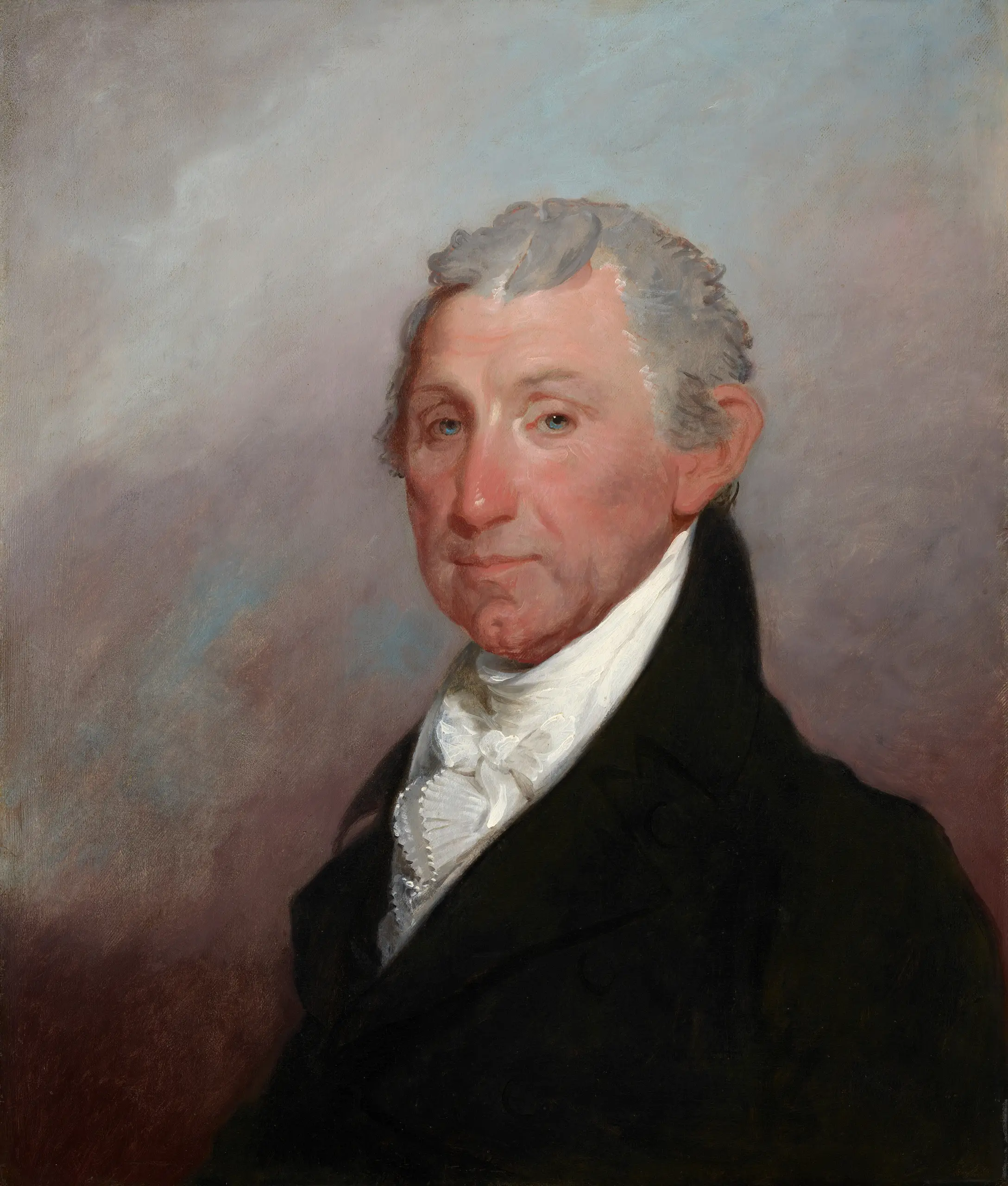
James Monroe
Also known as: The Last Founding Father, 5th President
Birthday
April 28, 1758
Birth Sign
Sagittarius
Birthplace
Monroe Hall, Westmoreland County, Virginia
Age
Died at 73
Height
6 ft 1 in (185 cm)
About
James Monroe was an American Founding Father who served as the fifth president of the United States from 1817 to 1825. He remains the last U.S. president born in the colonial era and the final member of the founding generation to hold the office. His presidency is defined by the Era of Good Feelings, a period of reduced partisan conflict following the War of 1812, and the establishment of the Monroe Doctrine in 1823 which set the tone for American foreign policy regarding European intervention in the Western Hemisphere.
Before reaching the White House, Monroe built a formidable career as a soldier, lawyer, and diplomat. He studied law under Thomas Jefferson and served in the Continental Army during the Revolutionary War where he was wounded at the Battle of Trenton. His political rise included terms as Governor of Virginia, U.S. Senator, Minister to France, and Secretary of State under James Madison. Monroe died on July 4, 1831, in New York City, becoming one of only three presidents to pass away on Independence Day alongside John Adams and Thomas Jefferson.
Early Life & Background
James Monroe entered the world on April 28, 1758, at his family's plantation known as Monroe Hall in Westmoreland County, Virginia. Born as the eldest of seven children to Spence Monroe and Elizabeth Jones, he grew up in a household that valued education and land ownership. His father was a prosperous planter who ensured James received a classical education before the young man moved to the Piedmont region of Virginia for further schooling at a local academy.
In 1774, Monroe enrolled at the College of William & Mary to study classics and mathematics. His academic pursuits were cut short two years later when the American Revolutionary War broke out. At just eighteen years old, he left college to join the Continental Army as a captain in the 3rd Virginia Regiment. During the harsh winter of 1776–1777 at Valley Forge, Monroe led a charge against British forces and was struck by a musket ball in the shoulder. This injury caused him chronic pain for the rest of his life but also earned him the respect of George Washington and his fellow officers.
After the war ended, Monroe returned to Virginia to study law under the mentorship of Thomas Jefferson in Williamsburg. He was admitted to the bar in 1780 and began practicing in Fredericksburg. His legal skills quickly translated into political success, leading to his election to the Virginia House of Delegates in 1782. He subsequently served in the Continental Congress from 1783 to 1786, laying the groundwork for a long and influential public service career that would eventually lead him to the highest office in the land.
Career Growth
Monroe's political ascent accelerated rapidly after his early legislative service. From 1790 to 1794, he represented Virginia in the U.S. Senate before being appointed Minister Plenipotentiary to France. In Paris, he navigated the turbulent waters of the French Revolution and successfully negotiated the release of American prisoners held by the French government. Upon returning home, he served three consecutive one-year terms as Governor of Virginia from 1799 to 1802.
A pivotal moment in his career occurred between 1803 and 1807 when President Thomas Jefferson sent him as a special envoy to France and Spain. The mission aimed to purchase New Orleans and parts of Florida but expanded into the historic Louisiana Purchase, which nearly doubled the size of the United States. Following this diplomatic triumph, Monroe served as Secretary of State under James Madison from 1811 to 1817. During the War of 1812, he briefly assumed the duties of Secretary of War while Madison was away, managing the department with distinction.
Elected as the fifth president in 1816, Monroe won re-election in 1820 with virtually no opposition due to the collapse of the Federalist Party. His administration achieved significant milestones including the Missouri Compromise of 1820 to address slavery tensions and the Adams-Onís Treaty of 1819 which secured Florida from Spain. The crowning achievement of his tenure was the Monroe Doctrine announced in December 1823, declaring that the Americas were off-limits to future European colonization. After leaving office in 1825, financial difficulties forced him to accept a professorship at the University of Virginia, though he resigned shortly after due to failing health.
Career Timeline
Public Image & Style
James Monroe is remembered as a dignified and honest leader who bridged the gap between the revolutionary generation and the modern American nation. His public persona was characterized by a sense of national unity and bipartisanship, earning him the title of the "last of the Founders." Historians often praise his diplomatic skill and ability to navigate complex international relations, particularly regarding the Louisiana Purchase and the Monroe Doctrine. While his domestic record includes mixed reviews on issues like slavery, his legacy as a capable wartime leader and statesman remains strong.
Fame & Fandom (iFAMOUS Rankings)
James Monroe stands as a figure whose fame transcends the metrics of modern celebrity culture, rooted instead in the enduring architecture of American history. While iFANN has evaluated his global standing, the system currently places him outside its published rankings of the top 1,000 most famous individuals worldwide. This absence from the charts reflects a shift in how fame is measured today; he remains a titan of the founding generation rather than a subject of viral trending or social media engagement. His legacy is preserved not through fan campaigns or digital hashtags but through the quiet reverence of historians and students who study the man who served as the fifth president of the United States. The concept of a formal fandom does not apply to him. No collective noun identifies his supporters, nor do organized groups drive birthday billboards or streaming chart pushes for his life story. Instead, his admirers are found within the halls of the James Monroe Museum and Memorial Library, which houses the nation's largest collection of artifacts related to his life, and among visitors to sites like the one unveiled in Florida in August 2026 by Governor Ron DeSantis. These commemorative acts represent the closest approximation to public devotion, serving as state-sponsored acknowledgments rather than organic fan movements. The confusion sometimes surrounding his name often stems from contemporary figures sharing his identity, such as the Tony Award-winning actor James Monroe Iglehart, who commands a vibrant following within the Broadway and Disney communities. Yet for the historical president, the narrative is one of solemn remembrance. His influence persists through the Monroe Doctrine and the Era of Good Feelings, concepts that define an entire epoch of American policy without needing the noise of modern fandom to validate their importance.
Interesting Facts and Legends
James Monroe holds the unique distinction of being the last president to die on Independence Day, joining John Adams and Thomas Jefferson in this historical coincidence. Despite his high office, he died in relative poverty compared to his contemporaries because poor investments and currency depreciation wiped out much of his wealth. The capital city of Liberia, Monrovia, was named in his honor to recognize his support for the colonization of Africa by freed slaves through the American Colonization Society.
One of the most enduring legends about Monroe involves his bravery at the Battle of Trenton in 1776. Leading a charge against British troops, he was shot in the shoulder but refused to retreat until the battle was won. This act of courage cemented his reputation among his peers. Another famous story concerns his tour of the North in 1817, where enthusiastic bipartisan crowds greeted him everywhere he went. A newspaper editor coined the phrase "Era of Good Feelings" during this trip to describe the temporary dissolution of partisan conflict.
Notable Quotes
“The great object of my ambition is to leave the country independent, happy, and free.”
“The American continents, by the free and independent condition which they have assumed and maintain, are henceforth not to be considered as subjects for future colonization by any European powers.”
“I am willing to serve my country as long as I am able.”
Family & Personal Life
James Monroe was married only once to Elizabeth Kortright Monroe, whom he wed in 1786. Elizabeth was a widow with a daughter from her first marriage to Samuel Lewis when they met in New York City. She accompanied James throughout his diplomatic postings in France and London, serving as First Lady during his presidency. Together they had three children: Eliza, who died in infancy; Maria Hester, who became a noted hostess in Washington; and James Spence, who died young. Elizabeth passed away in 1830, just months before her husband. There are no records of other romantic relationships or marriages for James Monroe.
Notable Connections
Thomas Jefferson, George Washington, James Madison, John Quincy Adams, Napoleon Bonaparte
Relationships & Dating History
James Monroe was married only once in his lifetime to Elizabeth Kortright Monroe. They met in New York City in the mid-1780s, where Elizabeth was a widow with a daughter from her first marriage to Samuel Lewis. The couple wed in 1786 and remained together for over four decades. Elizabeth accompanied James throughout his diplomatic postings in France and London, serving as a supportive partner during his early political career. She also served as First Lady during his presidency from 1817 to 1825.
Together they had three children: Eliza, who died in infancy; Maria Hester, who became a noted hostess in Washington; and James Spence, who died young. Elizabeth Monroe passed away in 1830, just months before her husband. There are no recorded public romantic relationships or subsequent marriages for James Monroe. At the time of his death in 1831, he was widowed.
- MarriedElizabeth Kortright Monroe1786 - 1830Met in New York City; she was a widow with a daughter from her first marriage. They had three children together. She died in 1830.
Death & Aftermath
Died
July 4, 1831 (aged 73)
Death Place
New York City
Cause of Death
Heart failure and tuberculosis
James Monroe, the fifth President of the United States and the last surviving Founding Father to serve as president, died on July 4, 1831, in New York City. He was 73 years old at the time of his death. Born on April 28, 1758, in Westmoreland County, Virginia, Monroe passed away less than two months after celebrating his 73rd birthday. Monroe died at approximately 6:00 PM on July 4, 1831, at his residence located at 31 Bond Street in Manhattan, New York City. The cause of death was attributed to heart failure and tuberculosis, exacerbated by a long period of declining health. Historical accounts indicate that Monroe had been suffering from respiratory issues for several years prior to his death.
His final days were marked by severe weakness and pain; he was unable to leave his bed for weeks before passing. The circumstances surrounding his death are historically significant because he died on the 55th anniversary of the adoption of the Declaration of Independence. In his final public appearance, which occurred earlier in the summer, Monroe had participated in a celebration for the 55th anniversary of the Constitution, but his health deteriorated rapidly shortly thereafter. Confirmed facts include the date (July 4, 1831), the location (New York City), and the age (73). Disputed or unconfirmed accounts regarding the specific progression of his illness are minimal, though some biographers note that his death was hastened by the stress of political tensions and financial difficulties he faced in retirement.
As a natural death resulting from chronic illness and old age, it did not require legal intervention. No disputes arose regarding the circumstances of his passing. The public reaction to Monroe's death was one of profound national mourning. As the last living link to the American Revolution and the "Era of Good Feelings," his passing was viewed as the end of an era. Tributes poured in from peers, institutions, and officials across the United States. President Andrew Jackson, who succeeded Monroe, ordered flags to be flown at half-staff throughout the federal government and the military. A moment of silence was observed in Congress, and numerous eulogies were delivered by prominent figures including John Quincy Adams and Henry Clay. While there were large crowds gathered in New York City and other major cities to pay respects, Memorials included the erection of monuments and the dedication of buildings, such as the James Monroe Memorial in Richmond, Virginia, though these were often planned posthumously over subsequent decades rather than immediate gatherings.
James Monroe's funeral was held on July 7, 1831, three days after his death. It was a private service followed by a public procession in New York City. Notable attendees included former presidents John Adams, John Quincy Adams, and other dignitaries. The funeral procession was attended by thousands of citizens who lined the streets to honor the late president. Following the service in New York, Monroe's body was transported back to Virginia for burial. He was interred in the family plot at the Hollywood Cemetery in Richmond, Virginia, on July 14, 1831. The burial was a state affair, with military honors rendered by the U.S. Army. Posthumously, James Monroe has been honored through numerous dedications, including the founding of the city of Monroe, Michigan, and the naming of James Monroe University in Virginia.
Several schools, libraries, and counties bear his name, and he was inducted into the National Governors Association Hall of Fame. Regarding his estate, it was handled by his family, who sold his remaining assets to pay off debts incurred during his presidency and personal life, leaving little inheritance for his heirs.
Net Worth (Estate Value)
$100 Million
iFANN Editorial Team estimate
As a deceased historical figure, James Monroe does not have a current net worth in the traditional sense. Research by the iFANN Editorial Team puts the value of his estate at approximately $100 Million when adjusted for modern inflation and historical asset valuation. Upon his death in 1831, his actual estate was valued at around $100,000 in contemporary dollars, which was substantial but insufficient to cover his debts due to poor investment decisions and currency depreciation.
The "Monroe" brand continues to generate revenue through historical tourism, book sales, documentaries, and licensing of his name for educational institutions and municipalities. The James Monroe Museum and Memorial Library in Fredericksburg, Virginia, manages his legacy and related intellectual property. The James Monroe Foundation and various historical societies oversee his papers and museum collections, ensuring his financial legacy endures through these institutional efforts.
Awards & Accolades
View 7 records, honours and achievementsKnown For
The Presidency of James Monroe
1817 · 5th President of the United States
The Monroe Doctrine
1823 · Foreign Policy Statement
Louisiana Purchase
1803 · Diplomatic Negotiator
Keywords
Sources
Quick Facts
- Profession
- politician, lawyer, diplomat
- Born
- April 28, 1758
- Birthplace
- Monroe Hall, Westmoreland County, Virginia
- Died
- July 4, 1831
- Death Place
- New York City
- Gender
- Male
- Spouse
- Elizabeth Monroe
- Birth Sign
- Sagittarius
Personal Details
- Full Name
- James Monroe
- Height
- 6 ft 1 in (185 cm)
- Spouse
- Elizabeth Kortright Monroe
- Children
- Eliza Monroe (infant) · Maria Hester Monroe · James Spence Monroe
- Education
- College of William & Mary
Frequently Asked Questions
Who was James Monroe?
When did James Monroe die?
What is the Monroe Doctrine?
How many times was James Monroe married?
Why is James Monroe famous?
Social Media
Similar People

Join the community
fans discussing