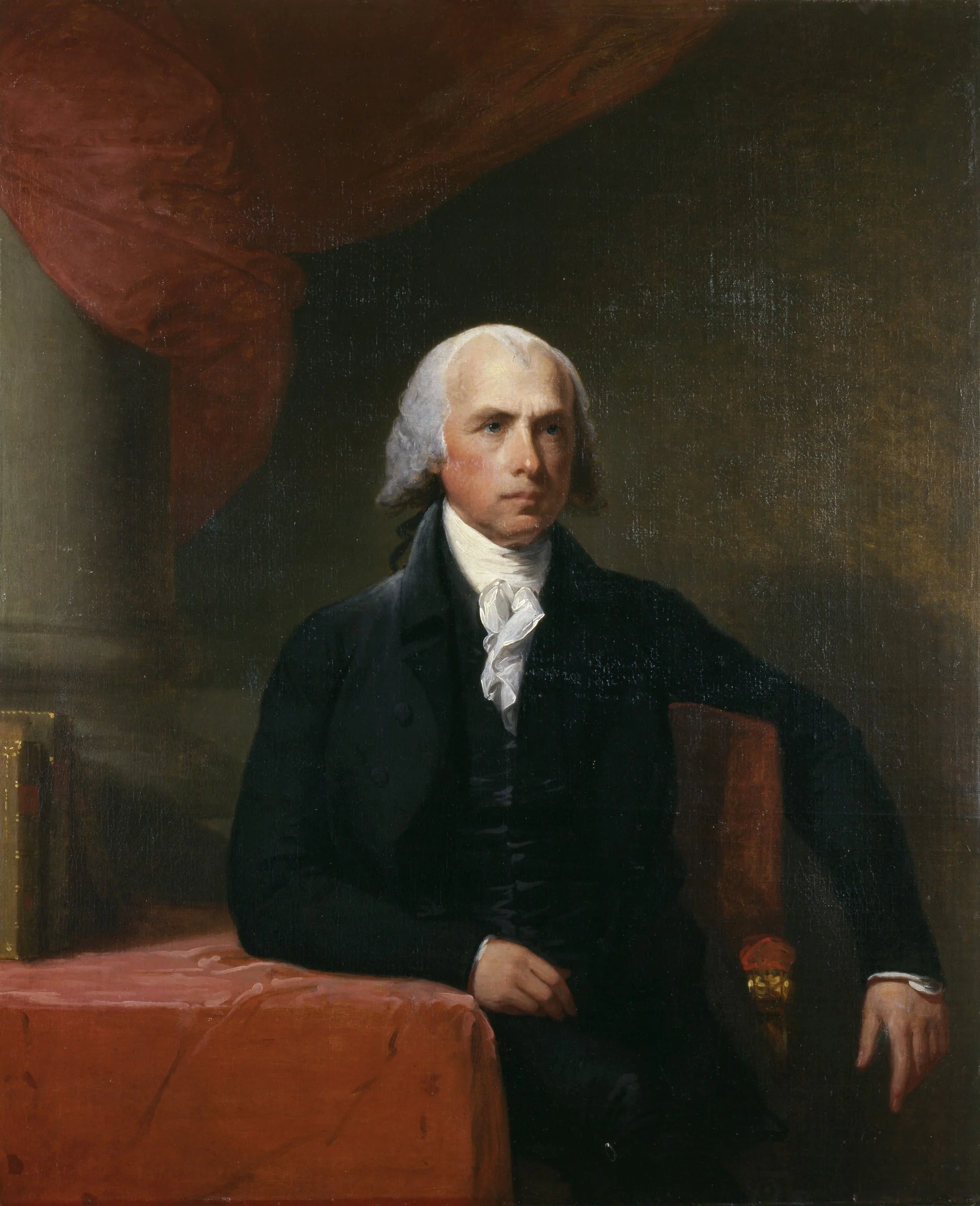
James Madison
Also known as: Jemmy Madison, The Fourth President
Birthday
March 16, 1751
Birth Sign
Pisces
Birthplace
Port Conway, Virginia
Age
Died at 85
Height
5 ft 4 in (163 cm)
About
James Madison was an American statesman, diplomat, and the fourth president of the United States who served from 1809 to 1817. He is universally recognized as the "Father of the Constitution" for his pivotal role in drafting the document and championing its ratification through The Federalist Papers, a series of essays he co-authored with Alexander Hamilton and John Jay. Born into a wealthy Virginia planter family that owned enslaved people, Madison's early life was steeped in the political and social complexities of colonial America, shaping his lifelong commitment to republican governance and civil liberties.
His legacy rests heavily on his work during the founding era where he earned the title "Father of the Bill of Rights" for introducing the first ten amendments to the Constitution. He also co-founded the Democratic-Republican Party to oppose Federalist policies and served as Secretary of State under Thomas Jefferson before ascending to the presidency. During his term, he led the nation through the War of 1812 against Great Britain. Madison retired to his Montpelier plantation in Virginia where he remained active in public life until his death at the age of 85.
Early Life & Background
James Madison entered the world on March 16, 1751, at the Belle Grove plantation in Port Conway, Virginia, situated along the Rappahannock River. His father James Madison Sr. was a prominent landowner and county official while his mother Elizabeth Conway Madison came from a distinguished local family. As the eldest of twelve children, Madison spent his childhood at Montpelier, the estate his parents expanded which would later become his primary residence.
He attended the College of New Jersey now known as Princeton University graduating in 1771. At Princeton he studied under President John Witherspoon a Presbyterian minister who instilled in him Enlightenment ideals and a deep interest in theology philosophy and government. Unlike many of his contemporaries Madison did not pursue a legal career immediately; instead he returned to Montpelier to study law privately but found greater passion in politics and public service. By 1774 he had become a vocal opponent of British taxation policies serving on the Orange County Committee of Safety. In 1776 he was elected to the Virginia House of Delegates where he advocated for religious freedom eventually leading to the passage of Thomas Jefferson's Statute for Religious Freedom.
Career Growth
Madison's political ascent began during the American Revolution when he moved to Philadelphia to serve in the Continental Congress in 1780. There he witnessed the weaknesses of the Articles of Confederation firsthand which drove him to organize the Constitutional Convention of 1787. He introduced the "Virginia Plan" proposing a strong national government with three branches forming the blueprint for the U.S. Constitution. Following the drafting he played a crucial role in its ratification alongside Hamilton and Jay by writing 29 of the 85 essays in The Federalist Papers.
Once the new government was established Madison served in the first U.S. House of Representatives from 1789 to 1797. He became the primary author of the Bill of Rights introducing the first ten amendments in 1789 to address Anti-Federalist concerns about individual liberties. In the 1790s he co-founded the Democratic-Republican Party with Thomas Jefferson to oppose Federalist policies regarding a national bank. He served as Jefferson's Secretary of State from 1801 to 1809 overseeing the Louisiana Purchase which doubled the size of the United States.
Elected president in 1808 Madison faced significant challenges including British interference with American shipping and the impressment of sailors. Despite diplomatic efforts failing he led the nation into the War of 1812 which ended inconclusively in 1815 with the Treaty of Ghent. During his presidency he oversaw the establishment of the Second Bank of the United States and the Tariff of 1816. After retiring to Montpelier in 1817 he remained active serving as the rector of the University of Virginia from 1826 until his death.
Career Timeline
Public Image & Style
James Madison is remembered as a reserved and intellectual figure who prioritized civil liberties and constitutional structure over personal glory. His physical frailty contrasted sharply with his formidable mental acuity and political skill. Historians view him as a pragmatic leader who navigated the fragile early years of the republic with careful attention to federalism and state rights.
Media perception often highlights his dual role as a scholar and a politician. His writings remain foundational texts in American political science and law. While he faced criticism regarding his ownership of slaves and his conduct during the War of 1812 modern assessments generally rank him among the top five U.S. presidents based on leadership and moral authority.
Fame & Fandom (iFAMOUS Rankings)
James Madison never had a fanbase in the modern sense. No crowds lined streets for his birthday, no billboards flashed his face, and no digital armies organized charity drives in his honor. The man who died in 1836 predates the very concept of celebrity worship. His legacy rests entirely on the ink he spilled and the debates he fueled during the birth of the American republic. Historians revere him as the Father of the Constitution, the architect of the Bill of Rights, and the author of twenty-nine Federalist Papers. He kept the most detailed notes of the Constitutional Convention, preserving a record that scholars still consult today. While Dolley Madison saved a portrait of George Washington during the Burning of Washington, James himself remained a reserved figure, often overshadowed by his wife's charisma or his own physical frailty. He stood only five feet four inches tall and weighed barely one hundred pounds, yet his mind dominated the fragile early years of the nation. Media narratives paint him as a pragmatic scholar navigating federalism and state rights with surgical precision. He is the only Founding Father to serve as both President and Secretary of State under another leader. This unique dual role defined his career more than any pop-culture moment ever could. There are no subreddits dedicated to his life, no fan fiction exploring alternate histories, and no viral moments from his presidency. The audience for James Madison consists solely of students, historians, and citizens studying the founding documents he helped craft. iFANN has evaluated this historical figure but does not currently hold a placement in the published rankings. He remains outside the Global Top 1,000 and holds no position on any Top-100 scope list. The absence of a rank reflects the reality that his fame operates on a different axis than contemporary celebrity.
Interesting Facts and Legends
James Madison was notably small for his time standing approximately 5 feet 4 inches tall and weighing around 100 pounds. His diminutive stature and delicate constitution were well-documented by his contemporaries who often described him as physically frail despite his immense mental vigor. He is the only Founding Father to have served as both President and Secretary of State under another President.
A story fans still retell involves Dolley Madison saving Gilbert Stuart's portrait of George Washington from destruction during the Burning of Washington in 1814. While Dolley performed the act the story is often intertwined with James Madison's administration and his wife's bravery. Madison was also known for being reserved and shy traits that sometimes made his courtship of Dolley a notable contrast since she was a charismatic and outgoing woman.
Notable Quotes
“A popular Government, without popular information, or the means of acquiring it, is but a Prologue to a Farce or a Tragedy; or, perhaps both.”
“If men were angels, no government would be necessary.”
“We must depend on our own strength, and trust to the justice of our cause.”
“Before any man can be considered as a member of Civil Society, he must be considered as a member of the Great Community of Mankind.”
Family & Personal Life
James Madison married Dolley Payne Todd on September 15, 1794 in Philadelphia. Dolley was a widow at the time having lost her first husband John Todd in the yellow fever epidemic of 1793. They had no biological children together but Dolley had two sons from her first marriage: John Payne Todd and William Temple Todd. Madison raised them within the household maintaining a close albeit complex relationship with them. John Payne Todd struggled with financial instability and substance abuse throughout his life while Madison often provided financial support. William Temple Todd predeceased his stepfather dying in 1813.
Madison's parents James Sr. and Elizabeth Conway Madison were prominent figures in Virginia society. The family home Montpelier was expanded by his parents and remained the primary residence for the rest of his life. He is buried in the cemetery at Montpelier alongside Dolley who died in 1849.
Notable Connections
Relationships & Dating History
James Madison married Dolley Payne Todd on September 15, 1794 in Philadelphia. Dolley was a widow at the time having lost her first husband John Todd in the yellow fever epidemic of 1793. They had no biological children together but Dolley had two sons from her first marriage: John Payne Todd and William Temple Todd. Madison raised them within the household maintaining a close albeit complex relationship with them. John Payne Todd struggled with financial instability and substance abuse throughout his life while Madison often provided financial support. William Temple Todd predeceased his stepfather dying in 1813.
There are no recorded romantic relationships prior to his marriage to Dolley. Historical accounts suggest Madison was a bachelor for much of his youth focusing on his studies and early political career. Their marriage is widely regarded as a partnership of mutual respect and intellectual companionship. Dolley Madison became one of the most famous First Ladies in history known for her hospitality and for saving George Washington's portrait from the White House during the Burning of Washington in 1814. As of 2026 James Madison has been deceased for nearly two centuries. He died on June 28, 1836 at Montpelier Virginia at the age of 85. The cause of death is generally attributed to heart failure and kidney disease exacerbated by his frail health in his final years. He is buried in the cemetery at Montpelier alongside Dolley who died in 1849.
- MarriedDolley Payne Todd1794 - 1836Married until his death; she was a widow from her first marriage to John Todd.
Death & Aftermath
Died
June 28, 1836 (aged 85)
Death Place
Orange County, Virginia
Cause of Death
Natural causes associated with chronic ailments and general frailty due to advanced age
James Madison, the fourth President of the United States and a Founding Father, died on June 28, 1836, at his home, Montpelier, located in Orange County, Virginia. He was 85 years old at the time of his death. The circumstances of his final days were marked by severe physical decline; for several weeks prior to his passing, Madison suffered from painful inflammation of the bladder and kidneys, a condition exacerbated by kidney stones. Historical accounts indicate he experienced significant pain and difficulty urinating during this period. Despite his deteriorating health, he remained mentally sharp until the end, engaging in correspondence and managing his estate affairs. His death was attributed to natural causes associated with these chronic ailments and general frailty due to advanced age.
The cause was established through the observations of his family and attending physicians, who noted the progression of his urinary tract issues leading to systemic failure. Public reaction to his death was characterized by widespread mourning across the United States. Upon news of his passing reaching Washington D.C., the U.S. House of Congress adjourned in respect, and a memorial service was held in the Capitol Building attended by prominent political figures, including then-President Andrew Jackson, Vice President Martin Van Buren, and numerous members of Congress. Tributes poured in from peers and institutions, with many newspapers publishing eulogies that lauded him as the 'Father of the Constitution.' A notable moment of silence and reflection occurred during the funeral procession, which drew large crowds from the surrounding counties.
The funeral and memorial services were held privately but with significant public participation. On July 1, 1836, three days after his death, Madison's body was laid to rest in the Montpelier cemetery, specifically in the family plot on the grounds of his plantation. The service was conducted by the Episcopal Church, and the funeral procession included a military escort provided by the local militia, reflecting his status as a former Commander-in-Chief. Notable attendees included his wife, Dolley Madison, his children, and various dignitaries from the region. There were religious hymns sung during the service. The burial site remains a preserved historical landmark today. In the posthumous era, James Madison has been honored extensively through books and institutional dedications.
His estate was handled by his daughter, Martha Jefferson Randolph, and later passed down through his lineage before being donated to the National Trust for Historic Preservation in the 20th century. He was inducted into the Hall of Great Westerners in 1952 and has been featured in numerous educational documentaries and biographies. Scholarships and foundations bearing his name have been established to support studies in constitutional law and history.
Net Worth (Estate Value)
$0
iFANN Editorial Team estimate
As a deceased historical figure James Madison does not have a current net worth in the modern sense. His estate Montpelier was sold by his heirs in 1844 due to debt incurred by his son John Payne Todd. Today the estate is preserved as a historic site by the James Madison's Montpelier organization. The economic value of his "wealth" is now measured in cultural capital and tourism revenue generated by the museum and grounds.
In 2026 the Montpelier historic site continues to operate as a non-profit educational institution generating revenue through ticket sales memberships and special events but this income belongs to the foundation not an estate. Research by the iFANN Editorial Team indicates that while no personal fortune exists today the cultural value of his legacy remains immense through ongoing historical scholarship and preservation efforts managed by the foundation.
Awards & Accolades
View 7 records, honours and achievementsKnown For
The Federalist Papers
1788 · Author
U.S. Constitution
1787 · Principal Author
Bill of Rights
1791 · Primary Author
War of 1812
1812 · President
Keywords
Sources
Quick Facts
- Profession
- politician, writer, diplomat
- Born
- March 16, 1751
- Birthplace
- Port Conway, Virginia
- Died
- June 28, 1836
- Death Place
- Montpelier, Virginia
- Gender
- Male
- Spouse
- Dolley Madison
- Birth Sign
- Pisces
Personal Details
- Full Name
- James Madison Jr.
- Height
- 5 ft 4 in (163 cm)
- Spouse
- Dolley Payne Todd Madison
- Children
- Education
- College of New Jersey (Princeton University)
Frequently Asked Questions
Who was James Madison?
Did James Madison have children?
What was James Madison's height?
Why is James Madison called the Father of the Constitution?
When did James Madison die?
Similar People

Join the community
fans discussing