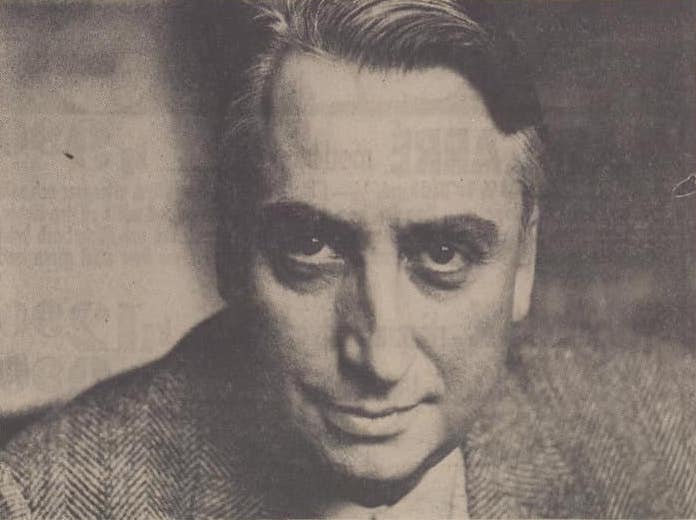
Roland Barthes
 France
philosopher•literary critic•university teacher
Birthday
+1915-11-12
Birth Sign
Scorpio
Birthplace
Cherbourg
Age
Died at 64
About
Roland Barthes was a French literary theorist, philosopher, critic, and semiotician born on November 12, 1915, in Cherbourg. He spent most of his life in Paris, where he became one of the most influential thinkers of the twentieth century. His work focused on how meaning is created in everyday life, from fashion and advertising to literature and photography. Barthes taught at the École des Hautes Études en Sciences Sociales (EHESS) and later held a chair in literary semiology at the Collège de France, a position he occupied until his death in 1980. His career was marked by a restless intellectual curiosity that led him through structuralism and into post-structuralist thought, shaping fields as varied as anthropology, literary criticism, and cultural studies. Among his most famous works are the 1957 essay collection Mythologies, a sharp analysis of French popular culture, and the 1967 essay "The Death of the Author," which challenged traditional ways of reading texts by arguing that a work's meaning is not fixed by its creator's intentions. Barthes also wrote influential books like S/Z and Camera Lucida, the latter a meditation on photography that appeared shortly before his death. His ideas have left a lasting mark on how we understand signs, symbols, and the stories we tell about ourselves.
Fame & Fandom
Roland Barthes currently holds no placement in the iFANN Global Top 1,000 or any published scope list, a status confirmed by the August 2026 evaluation. While his intellectual footprint reshaped modern thought, he does not occupy a ranked position among the world's most famous figures today. The audience surrounding Barthes is distinct from typical celebrity followings; there is no formal fandom name for those who revere him. His devotees are primarily academics, students, and cultural critics rather than a mass public organized around chart positions or merchandise. These readers engage with his work through rigorous study of texts like Mythologies and Camera Lucida, treating his essays as foundational documents rather than pop culture artifacts. No fan clubs, birthday campaigns, or managed interactions ever existed for the theorist, whose life was defined by quiet scholarship at the Collège de France. His legacy persists not through viral moments or street celebrations but through the enduring citation of his ideas on semiotics and the death of the author. Even when excerpts from A Lover's Discourse circulate online as affectionate quotes, they function as intellectual tributes rather than evidence of a mobilized fanbase. The lack of a specific moniker reflects the nature of his influence: a deep, specialized resonance within scholarly circles rather than broad, performative adoration.
Interesting Facts and Legends
The most widely retold story of Barthes' life centers on his sudden death in Paris on March 26, 1980, after being struck by a laundry truck while crossing the street. This tragic accident carries a heavy irony given his extensive writings on the fragility of existence and the concept of the 'death of the author.' Another pivotal moment remains the 1957 publication of Mythologies, where he transformed social criticism by analyzing everyday items like wrestling matches and steak and chips to reveal hidden ideological messages. Among philosophers and photographers, Camera Lucida stands as a legendary text published just months before his passing. It introduces the poignant concept of the punctum, the specific detail in a photograph that pierces the viewer emotionally, centered on a winter garden image of his mother. While no crowds ever fainted at his lectures or shut down streets for him, a quiet folklore has emerged around his book A Lover's Discourse. Modern social media users frequently share its fragments as romantic aphorisms, creating a contemporary digital reverence for his views on love without altering the original text.
Death & Aftermath
Died
+1980-03-26 (aged 64)
Death Place
Paris, France
Cause of Death
Traffic accident
The announcement of Roland Barthes' passing came from the hospital where he was taken immediately after a collision on a Parisian street, confirming the end of a life dedicated to deciphering signs. On March 26, 1980, the renowned theorist was struck by a laundry truck while crossing the Rue Jacob near the École Normale Supérieure, an accident that claimed his life at age sixty-four shortly after he was pronounced dead at Necker-Enfants Malades Hospital. Police reports and hospital statements established the event as a tragic pedestrian fatality with no evidence of foul play or suicide, leading to a standard investigation that confirmed the driver's liability without contestation. Tributes poured in from peers and institutions across the globe, marking the loss of one of the most influential thinkers of the twentieth century.
The academic community immediately began re-evaluating his work, recognizing the profound void left by his absence. His final major work, Camera Lucida, was released later that year, cementing his status in visual culture studies and ensuring his legacy continued to dominate literary criticism long after his physical presence faded. Barthes' funeral was held privately in Paris, reflecting the family's desire for privacy during the mourning period. He was cremated, and his ashes were interred at the Père Lachaise Cemetery, a resting place shared by many prominent French intellectuals. In the years following his death, his estate has been managed to preserve his intellectual legacy, resulting in numerous releases and translations that continue to shape fields of philosophy and semiotics.
Awards & Accolades
Keywords
Quick Facts
- Profession
- philosopher, literary critic, university teacher
- Born
- +1915-11-12
- Birthplace
- Cherbourg
- Died
- +1980-03-26
- Death Place
- Paris
- Gender
- Male
- Birth Sign
- Scorpio
Join the community
fans discussing