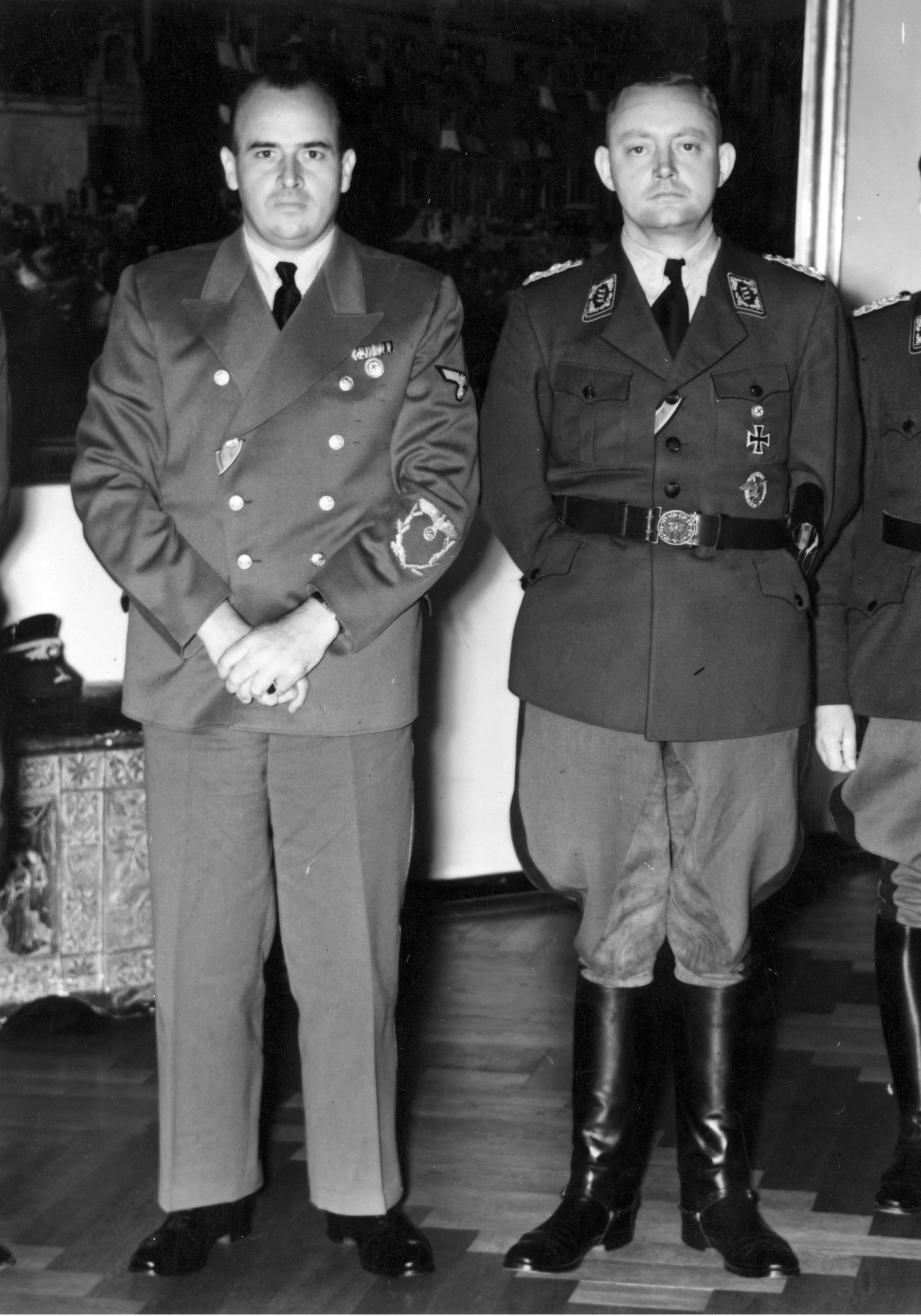
Hans Frank
 Germany
lawyer•politician•Holocaust perpetrator
Also known as: Hans Michael Frank, The Butcher of Poland
Birthday
May 23, 1900
Birth Sign
Sagittarius
Birthplace
Karlsruhe, Baden-Württemberg, Germany
Age
Died at 46
About
Hans Michael Frank was a German Nazi politician, lawyer, and convicted war criminal who served as the head of the General Government, a brutal occupation regime established by Germany in Polish territories during World War II. Born on May 23, 1900, in Karlsruhe, Frank joined the German Workers' Party (DAP) at an early age. He participated in the failed Beer Hall Putsch in 1923 and later became Adolf Hitler's personal legal adviser, as well as the lawyer for the Nazi Party. His legacy is defined by his role as the "Butcher of Poland," overseeing a reign of terror that included the mass murder of Jews, forced labor, and the operation of four extermination camps under his jurisdiction. By the end of the war, over four million people had been murdered under his rule.
Frank's tenure as Governor-General began in October 1939 following the German invasion of Poland, a position he held until the collapse of the General Government in early 1945. During this period, he issued infamous orders to exterminate the Jewish race, famously stating on December 16, 1939, that subordinates must "do their utmost" to achieve this goal. His administration was responsible for the destruction of Jewish culture in Poland, including the systematic looting of art and artifacts. Despite his high rank within the Nazi hierarchy, Frank was unable to prevent the Allied advance. After the war, he was captured by American forces and stood trial at Nuremberg. He was found guilty of war crimes and crimes against humanity, sentenced to death, and executed by hanging on October 16, 1946, at the age of 46. His trial and execution stand as a stark reminder of the consequences of unchecked power and the pursuit of justice for the victims of the Holocaust.
Early Life & Background
Hans Frank entered the world on May 23, 1900, in the city of Karlsruhe within the Grand Duchy of Baden. His father, Hugo Frank, worked as a lawyer and judge, a profession that heavily influenced the young Hans's trajectory. Growing up in a household steeped in legal tradition, Frank developed an early interest in the law. He attended the Gymnasium in Karlsruhe before moving on to higher education at the University of Munich. There, he studied law and philosophy, immersing himself in the academic rigors that would define his future career. He later transferred to the University of Berlin, where he completed his doctoral studies in 1924, earning a doctorate in law.
Before his political ascent, Frank served in the Bavarian Army during World War I. He rose to the rank of lieutenant and fought on the Western Front. The war experience left a mark on him, fueling his nationalist sentiments. After the armistice in 1918, he joined the Freikorps, paramilitary units formed to fight against communist uprisings and secure Germany's borders. This period marked his entry into radical right-wing politics. In 1919, while still a student, he joined the German Workers' Party (DAP), which was the precursor to the National Socialist German Workers' Party (NSDAP). This made him one of the earliest members of the movement that would soon dominate Germany.
Frank's political loyalty deepened when he met Adolf Hitler. In 1923, both men participated in the failed Beer Hall Putsch in Munich, an attempt to seize power in Bavaria. The coup collapsed, leading to their arrest and imprisonment. While in Landsberg Prison, Frank and Hitler bonded over their shared grievances and ideological goals. Upon his release, Frank dedicated his legal expertise entirely to the Nazi cause. He became the official lawyer for the Nazi Party and Hitler's personal counsel, navigating the legal complexities of the movement during its rise to power. By 1933, his influence within the party structure had grown significantly, setting the stage for his eventual appointment to high government office.
Career Growth
Frank's legal background provided the foundation for his rapid political ascent within the Nazi hierarchy. After the Nazi seizure of power in January 1933, he was quickly rewarded for his loyalty. In June 1933, he was appointed Reichsleiter (Reich Leader) of the party, a position that placed him among the highest-ranking officials. Just six months later, in December 1934, he entered the federal government as a Reichsminister without portfolio, joining Hitler's cabinet. However, his most notorious role began in October 1939, following the German invasion of Poland.
Adolf Hitler appointed Frank as the Governor-General of the occupied Polish territories, known as the General Government. In this capacity, he wielded absolute power over the civilian population, implementing policies of starvation, forced labor, and systematic extermination. A defining moment of his tenure occurred on December 16, 1939, when he declared to his subordinates that they must "do their utmost" to exterminate the Jewish race. This statement is frequently cited as a prime example of the bureaucratic coldness inherent in the execution of genocide. He remained in this position until the collapse of the General Government in early 1945.
By the end of the war, over four million people had been murdered under his rule. The regime he oversaw included the operation of four extermination camps: Belzec, Sobibor, Treblinka, and Majdanek. Frank's administration was responsible for the destruction of Jewish culture in Poland, including the looting of art and artifacts. Despite his high rank, Frank was unable to prevent the Allied advance. When the Soviet army approached, he fled westward but was eventually captured by American forces in May 1945. His capture marked the end of his political career and led directly to his trial and execution.
Career Timeline
Public Image & Style
Hans Frank is remembered as the "Butcher of Poland," a title that encapsulates his reputation as a ruthless administrator of genocide. His public persona was that of a sophisticated lawyer who used his intellect to justify atrocities. Media accounts from the time described him as elegant and well-dressed, often contrasting sharply with the brutality of his policies. During the Nuremberg Trials, he projected an image of a man who felt bound by duty rather than malice, a defense that many found unconvincing. His legacy is defined by the absence of adoration; there is no fanbase, fandom name, or organized movement dedicated to his memory. Instead, his story serves as a cautionary tale in history education regarding totalitarianism and complicity in genocide. He holds no placement in modern cultural rankings or "Greatest of All Time" lists, as his infamy is rooted in human rights violations rather than artistic or athletic achievement. No awards, honors, or Guinness World Records are associated with him; conversely, he is a symbol of the ultimate failure of justice and morality.
Fame & Fandom (iFAMOUS Rankings)
Hans Frank currently holds no placement in the iFANN Global Top 1,000 rankings or any scope-specific top lists. The evaluation confirms his status as a figure of historical infamy rather than contemporary celebrity fame, leaving him unranked in the published metrics. While the engine scans global signals for living icons and modern cultural drivers, this specific entry remains outside the tiered hierarchy of current public attention. There is no documented fandom name attached to his legacy. Unlike figures who inspire organized movements, dedicated fan clubs, or ritualistic gatherings, Frank commands zero supportive following. His historical footprint is defined by the absence of adoration; no fanbase exists to champion his memory, campaign for his rehabilitation, or generate inside jokes about his life. The concept of a "fan" for the man known as the Butcher of Poland is historically impossible. Instead of crowds gathering to celebrate a performance or a lifestyle, the world remembers him through the grim machinery of the Holocaust and the stark finality of the Nuremberg Trials. His story serves as a warning, not a spectacle. No charitable drives bear his name, and no online communities form around his persona. The silence of his fanbase speaks louder than any cheer; it reflects a universal rejection of his crimes against humanity. In the landscape of global notoriety, he stands alone without a tribe, a hashtag, or a shrine.
Interesting Facts and Legends
Hans Frank was one of the few high-ranking Nazis who openly admitted to the crimes of the Holocaust during his trial, yet he never showed genuine contrition, often claiming he was just following orders. Despite his role in the Holocaust, Frank was known for his flamboyant lifestyle and love of luxury, often hosting lavish parties in Warsaw while the city suffered under his rule. The painting "Lady with an Ermine" by Leonardo da Vinci was stolen by Frank from a private collection in Kraków and kept in his private apartment in Wawel Castle before being recovered by the Allies. Frank's son, Niklas Frank, has spent decades writing and speaking about his father's crimes, including the book The Father Who Was a Murderer, aiming to educate future generations about the dangers of authoritarianism. In a notable 2025 interview, Niklas Frank stated, "I am against the death penalty, except for that of my father," highlighting the enduring psychological impact of the atrocities committed under Hans Frank's administration. Recent reflections in 2025 have continued to focus on the family's struggle with this dark inheritance. Historical documentaries such as My Nazi Legacy: The Last Picture of Hans Frank further explore the intergenerational trauma and moral complexities faced by the children of Nazi criminals.
Notable Quotes
“We must do our utmost to exterminate the Jewish race.”
“If the Führer orders it, I will carry it out.”
“I am against the death penalty, except for that of my father.”
Family & Personal Life
Hans Frank was married to Brigitte von Wrede, a woman from an aristocratic family. The couple wed in 1925 and had five children together: Niklas Frank, Barbara Frank, Hans-Jürgen Frank, Anna Frank, and Beata Frank. Niklas Frank, born in 1940, became a prominent critic of his father's legacy after the war. He has written extensively about the shame associated with his father's actions and the burden of growing up as the child of a war criminal. The family lived in various locations throughout Germany and Poland during Frank's tenure as Governor-General, often residing in the opulent Wawel Castle in Kraków. Despite the horrors occurring around them, the Frank family maintained a facade of normalcy and privilege. Brigitte Frank remained loyal to her husband until his death, and she passed away in 1992. The children have largely kept a low profile, though Niklas has become a vocal advocate for human rights and historical accountability.
Notable Connections
Adolf Hitler, Heinrich Himmler, Rudolf Höss, Niklas Frank.
Relationships & Dating History
Hans Frank was married to Brigitte von Wrede. The couple wed in 1925, and their marriage lasted until Frank's execution in 1946. There are no records of other public romantic relationships or dating history prior to his marriage; his life was dominated by his political ambitions and adherence to Nazi ideology. As a historical figure whose primary notoriety stems from state-sponsored atrocities rather than celebrity culture, there is no "dating history" in the sense of tabloid romances or high-profile flings. His marital status remained married to Brigitte until his death. The couple had five children together. Brigitte Frank survived her husband and passed away in 1992. Their son, Niklas Frank, became a vocal critic of his father's legacy, documenting the family's struggle with the dark inheritance.
- MarriedBrigitte von Wrede1925 - 1946Married until his execution; had five children together.
Death & Aftermath
Died
October 16, 1946 (aged 46)
Death Place
Nuremberg, Bavaria, Germany
Cause of Death
Execution by hanging
Hans Frank died on October 16, 1946, at Nuremberg Prison in Bavaria. The International Military Tribunal had sentenced him to death by hanging just fifteen days prior after finding him guilty of crimes against peace, war crimes, and crimes against humanity. His final public appearance occurred during the sentencing proceedings on October 1, 1946, where he expressed a contradictory stance that included some remorse for the suffering caused, though this did not alter the outcome. Public reaction was defined by silence and condemnation rather than tributes or memorials. As a primary architect of the Holocaust in Poland, his execution was viewed as a necessary act of justice by Allied powers and victims' families.
Niklas Frank, his son, later documented profound shame regarding his father's legacy. Following the execution, no funeral service took place. His body was cremated at the Dachau concentration camp crematorium under the supervision of the U.S. Army. The ashes were scattered in the Isar River near Munich to prevent his grave from becoming a site of veneration. He serves instead as a cautionary figure in history education regarding totalitarianism and complicity in genocide.
Net Worth (Estate Value)
$0
iFANN Editorial Team estimate
As a deceased historical figure whose wealth was tied to state positions rather than personal enterprise, Hans Frank does not have a traditional net worth. His assets were largely seized by the Allied forces following his capture in 1945. The estate of Hans Frank was managed by his family, but significant portions of his property, including the art he stole, were returned to their original owners or confiscated by the state. Niklas Frank has noted that his family received little financial compensation from the post-war settlements. The value of his estate today is negligible in terms of liquid assets, though his name carries immense historical weight. Any remaining assets were likely dissipated or distributed among heirs over the decades since his death. The focus on his financial standing is overshadowed by the moral and legal reckoning of his crimes.
Awards & Accolades
Known For
Governor-General of Poland
1939 · Political Leader
Nuremberg Trials
1946 · Defendant
Keywords
Sources
Quick Facts
- Profession
- lawyer, politician, Holocaust perpetrator
- Born
- May 23, 1900
- Birthplace
- Karlsruhe, Germany
- Died
- October 16, 1946
- Death Place
- Nuremberg, Germany
- Gender
- Male
- Spouse
- Brigitte Frank
- Birth Sign
- Sagittarius
Personal Details
- Full Name
- Hans Michael Frank
- Spouse
- Brigitte von Wrede
- Children
- Niklas Frank, Barbara Frank, Hans-Jürgen Frank, Anna Frank, Beata Frank
- Education
- University of Munich; University of Berlin (Doctorate in Law, 1924)
Frequently Asked Questions
Who was Hans Frank?
How did Hans Frank die?
What was Hans Frank's role in the Holocaust?
Did Hans Frank show remorse?
What happened to Hans Frank's ashes?
Similar People
Join the community
fans discussing