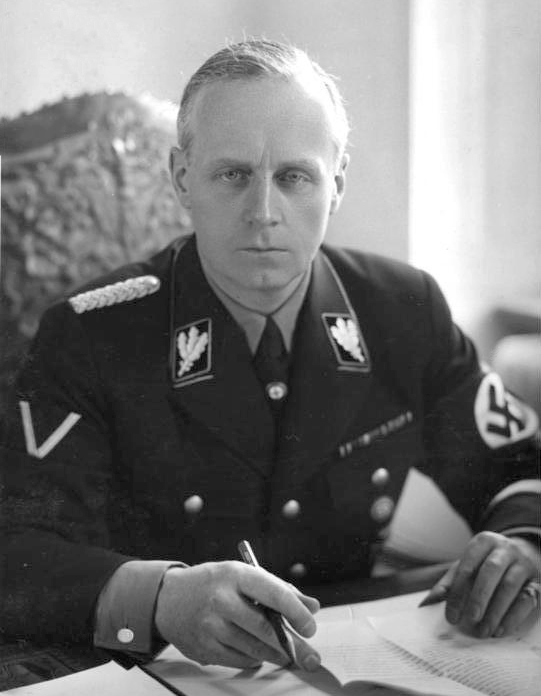
Joachim von Ribbentrop
 Germany
Birthday
+1893-04-30
Birth Sign
Sagittarius
Birthplace
Wesel
Age
Died at 53
About
Ulrich Friedrich-Wilhelm Joachim von Ribbentrop was born in Wesel, Germany, on April 30, 1893. He established himself as a politician and diplomat, eventually serving as the Minister of Foreign Affairs for Nazi Germany from 1938 until 1945. Before his political career, Ribbentrop worked as a businessman and wine importer, which gave him a degree of international exposure that many within the Nazi party lacked. This worldly experience, coupled with his perceived grasp of foreign affairs, brought him to Adolf Hitler's attention. He even offered his estate, Schloss Fuschl, for crucial secret meetings in January 1933 that paved the way for Hitler's appointment as Chancellor.
Fame & Fandom
Joachim von Ribbentrop commands a global attention defined entirely by historical infamy rather than contemporary celebrity. His presence in the public consciousness stems from his role as a principal architect of Nazi foreign policy and his subsequent execution for war crimes, ensuring he remains a subject of serious historiography rather than pop culture consumption. In August 2026, iFANN's Global Fame Engine evaluated this figure and determined that he does not currently hold a placement in the published rankings, including the Global Top 1,000 or any Top-100 scope list. Consequently, no specific ordinal rank or numerical score can be assigned to his current fame level. The evaluation confirms that while his name is universally recognized within the context of World War II studies, he lacks the metrics required for inclusion in standard fame hierarchies. Regarding his audience, there is no documented fandom associated with Joachim von Ribbentrop. No organized group of followers, unofficial name for supporters, or formal fanbase exists to engage with his legacy. Unlike modern cultural icons who generate dedicated communities, Ribbentrop has no fan rituals, birthday celebrations, charity drives, or streaming initiatives. The absence of a named fandom reflects the universal condemnation he faces in modern memory; he is remembered as a convicted criminal rather than an entertainer worthy of adoration. His legacy is one of cautionary history, devoid of the enthusiastic engagement that characterizes figures with active fanbases.
Interesting Facts and Legends
Before entering politics, Ribbentrop worked as a businessman and wine importer, a career path that provided him with international exposure uncommon among early Nazi officials. He offered his estate, Schloss Fuschl, for secret meetings in January 1933 that facilitated Adolf Hitler's appointment as Chancellor. The most widely retold story concerning his life involves the signing of the German-Soviet Nonaggression Pact on August 23, 1939, in Moscow. Historical accounts describe Ribbentrop and Soviet Foreign Commissar Vyacheslav Molotov signing the treaty while Josef Stalin stood behind them, an event frequently cited as the pivotal moment allowing Hitler to invade Poland without fear of Soviet intervention. Another central element of his narrative is his conviction at the Nuremberg Trials, where he was found guilty on four counts, including crimes against peace and war crimes. This legal judgment led to his execution by hanging on October 16, 1946. Unlike pop culture figures who might have viral moments or crowds shutting down streets, Ribbentrop has no recorded instances of such interactions. His iconic status is defined solely by his infamy as a chief architect of the Nazi regime's foreign policy and his punishment for war crimes.
Death & Aftermath
Died
+1946-10-16 (aged 53)
Death Place
Nuremberg, Germany
Cause of Death
hanging by the neck, officially ruled as execution
Joachim von Ribbentrop, the Foreign Minister of Nazi Germany from 1938 to 1945, died on October 16, 1946, at 01:00 AM (local time) in Nuremberg, Germany, specifically within the prison cells of the Nuremberg Palace of Justice. He was 53 years old at the time of his death. The cause of death was hanging by the neck, officially ruled as execution following a conviction for war crimes and crimes against humanity by the International Military Tribunal (IMT). This ruling was established through the legal proceedings of the Nuremberg Trials, where Ribbentrop was found guilty on four counts, including conspiracy to commit crimes against peace, planning aggressive wars, and war crimes. The circumstances of his final days were defined by his imprisonment pending the verdict and subsequent appeal process. After being sentenced to death on October 1, 1946, Ribbentrop spent his last week in solitary confinement or close isolation, preparing for the execution.
His final public appearance prior to his death occurred during the sentencing phase of the trial in early October 1946, where he made a final statement denying that he had planned the war and asserting that he had acted in the interest of the German people. Historical consensus confirms he was hanged along with ten other convicted defendants (Hermann Göring committed suicide the night before) and one defendant who received a life sentence but was not present for the execution. Regarding the investigation and legal aftermath, there was no police investigation into the death itself, as it was a direct result of a lawful judicial sentence. The legal process leading to his death involved a comprehensive international trial conducted by the IMT from November 1945 to October 1946. The tribunal's judgment, delivered on September 30, 1946, explicitly cited Ribbentrop's role in negotiating the Molotov-Ribbentrop Pact and his involvement in the invasion of Poland and the Holocaust as grounds for the death penalty.
The execution was carried out immediately after the sentence was confirmed, with no possibility of clemency or appeal remaining at that stage. Instead, his death was viewed by Allied officials and the global community as a necessary conclusion to the pursuit of justice for the atrocities of World War II. The funeral or memorial arrangements were strictly controlled by the Allies. The remains were cremated, and the ashes were scattered in the Isar River near Munich. This disposal was conducted in secret to prevent the site from becoming a neo-Nazi pilgrimage destination. The operation was private, attended only by Allied military personnel and prison staff, performances, or public ceremonies. Posthumously, Joachim von Ribbentrop has been the subject of numerous books, films, and historical analyses, often focusing on his role in the lead-up to WWII and his trial.
Notable works include Ribbentrop: A Biography by Michael Bloch and various documentaries produced by the US Holocaust Memorial Museum and others. His estate was handled by the Allied authorities, who seized all assets, and his family faced significant social ostracization. His son, Ulrich von Ribbentrop, later wrote memoirs about his father ( My Father Joachim von Ribbentrop ), attempting to provide context to his father's actions.
Awards & Accolades
Keywords
Quick Facts
- Profession
- politician, diplomat
- Born
- +1893-04-30
- Birthplace
- Wesel
- Died
- +1946-10-16
- Death Place
- Nuremberg
- Gender
- Male
- Spouse
- Annelies von Ribbentrop
- Birth Sign
- Sagittarius
Personal Details
- Spouse
- Annelies von Ribbentrop
Join the community
fans discussing