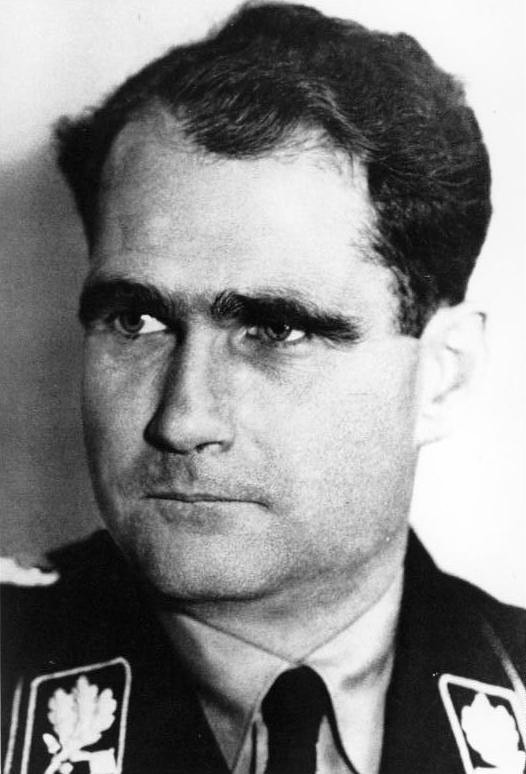
Rudolf Hess
 Germany
politician•aircraft pilot•merchant
Birthday
+1894-04-26
Birth Sign
Sagittarius
Birthplace
Alexandria
Age
Died at 93
About
Born in Alexandria, Egypt, on April 26, 1894, Rudolf Walter Richard Hess began his journey as a merchant and later a pilot before becoming a prominent figure in German politics. His early life saw him serve in the Imperial German Army during World War I, earning an Iron Cross and beginning pilot training. After the war, he studied geopolitics in Munich, a field that would deeply influence his later political ideology, particularly the concept of Lebensraum. Hess joined the Nazi Party in 1920, and his early involvement included participating in the failed Beer Hall Putsch in 1923. During a subsequent prison sentence, he assisted Adolf Hitler with the writing of Mein Kampf, a foundational text for the Nazi platform.
Fame & Fandom
Rudolf Hess commands a persistent, if somber, presence in global historical memory, tracked across media coverage, search activity, and consumption signals worldwide. Current assessments place him as the 100th most famous person in Germany, a position that has shifted down from the previous cycle, while he remains the 49th most famous person from Germany, holding steady against competitors. These placements within the iFANN Global Fame Rankings reflect a legacy defined by infamy rather than celebrity, where attention is driven by historical gravity rather than cultural adoration. Despite this enduring notoriety, the figure does not possess an organized fanbase, nor is there any documented unofficial name for his followers; the historical record confirms that groups once associated with him were political extremist organizations now widely condemned, leaving no room for a formal fandom or ritualistic support. The audience for his story consists of historians, true-crime enthusiasts, and those drawn to the mysteries of the 20th century, yet no campaigns, birthday tributes, or fan-funded projects exist to sustain a community around his name.
Interesting Facts and Legends
Rudolf Hess served as a merchant and pilot before entering German politics, earning an Iron Cross during World War I. His early political career included participation in the failed Beer Hall Putsch of 1923, followed by a prison term where he assisted Adolf Hitler with writing Mein Kampf. A central element of his legend involves his unauthorized solo flight to Scotland on May 10, 1941, piloting a Messerschmitt Bf 110 from Augsburg to Eaglesham. He claimed supernatural inspiration for this mission, hoping to negotiate peace with British figures distinct from Winston Churchill, though the event remains a subject of intense debate regarding its true nature. Another defining moment occurred at Spandau Prison in West Berlin, where Hess died on August 17, 1987, after serving 41 years for crimes against peace. Found hanging in his cell, his death was officially ruled a suicide, but the circumstances remain shrouded in mystery due to the high security of the facility and the involvement of multiple Allied powers. Recent discoveries have further fueled interest, including the tracking of his 1941 flight path by spotters in County Durham and the display of aircraft parts in local museums. In modern times, his life continues to be explored through dramatic works, such as the upcoming 2026 world premiere of the play The Last Testament of Rudolf Hess by Auriga Productions.
Death & Aftermath
Died
+1987-08-17 (aged 93)
Death Place
West Berlin, West Germany
Cause of Death
Suicide by hanging
The closure of Spandau Prison in August 1987 followed immediately after the death of its sole occupant, ending a unique joint guardianship arrangement that had lasted over four decades. Rudolf Hess, the last surviving prisoner of the Nuremberg Trials, died on August 17, 1987, at the age of 93 within the grounds of the facility in West Berlin. He was discovered hanging from an electric cable in the garden of the prison's summer house, where he had been permitted to sit during daylight hours under a rotating guard schedule involving the United States, the United Kingdom, France, and the Soviet Union.
An official autopsy conducted by local authorities ruled the cause of death as suicide by hanging, though the lack of continuous supervision sparked immediate diplomatic tension and suspicion regarding potential negligence or foul play among the Allied powers. A subsequent British investigation confirmed the use of a wire attached to a light fixture, yet the incident fueled enduring conspiracy theories about impostors or murder until a 2019 DNA study verified the identity of the remains. The funeral was strictly private, resulting in his cremation and the scattering of ashes in an undisclosed location to prevent any future pilgrimage site.
Awards & Accolades
Keywords
Quick Facts
- Profession
- politician, aircraft pilot, merchant
- Born
- +1894-04-26
- Birthplace
- Alexandria
- Died
- +1987-08-17
- Death Place
- Spandau Prison
- Gender
- Male
- Spouse
- Ilse Hess
- Birth Sign
- Sagittarius
Personal Details
- Spouse
- Ilse Hess
Join the community
fans discussing