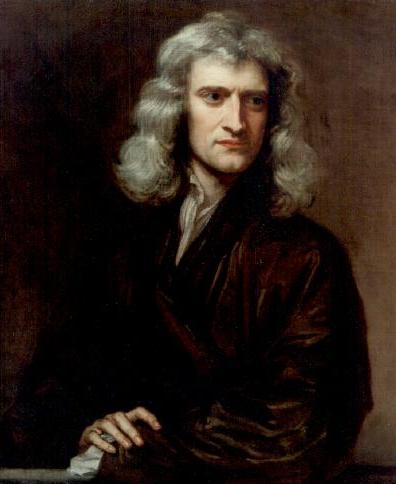
Isaac Newton
 United Kingdom
mathematician•physicist•astronomer
Also known as: Sir Isaac Newton
Birthday
January 4, 1643
Birth Sign
Capricorn
Birthplace
Woolsthorpe Manor, Lincolnshire, England
Age
Died at 84
About
Sir Isaac Newton was an English mathematician, physicist, astronomer, and philosopher, widely regarded as one of the most influential scientists in history. His book Philosophiæ Naturalis Principia Mathematica, published in 1687, laid the foundations for classical mechanics with the laws of motion and universal gravitation. He also made pioneering contributions to optics, developing a theory of color and building the first practical reflecting telescope. Newton shares credit with Gottfried Wilhelm Leibniz for developing infinitesimal calculus, though his work predated Leibniz's publication. Beyond science, he served as Warden and Master of the Royal Mint, reforming British coinage, and was President of the Royal Society from 1703 until his death. Knighted by Queen Anne in 1705, Newton's work unified terrestrial and celestial physics, shaping the scientific worldview for centuries. His legacy endures as a symbol of scientific genius and the Enlightenment. Newton formulated an empirical law of cooling and introduced concepts of Newtonian fluids and black bodies. He generalized the binomial theorem and developed methods for approximating roots of functions. Newton also initiated the field of calculus of variations and pioneered vector analysis.
Early Life & Background
Newton was born prematurely on January 4, 1643, in Woolsthorpe Manor, Lincolnshire. His father, a farmer named Isaac Newton Sr., died three months before his birth. When Newton was three, his mother Hannah Ayscough remarried to Reverend Barnabas Smith, leaving him in the care of his maternal grandmother. He attended The King's School in Grantham, where he showed an early aptitude for building models and mechanical devices, including a working windmill. In 1661, he enrolled at Trinity College, Cambridge, as a subsizar—a student who performed domestic duties to pay for his education. He graduated with a Bachelor of Arts in 1665, but the university closed due to the Great Plague, forcing him to return to Woolsthorpe. During this period, often called his annus mirabilis, he developed his early ideas on calculus, gravity, and optics, laying the groundwork for his later breakthroughs. Newton held unorthodox religious views, privately rejecting the doctrine of the Trinity and refusing to take holy orders as required by most Cambridge faculty at the time.
Career Growth
Newton returned to Cambridge in 1667 as a fellow of Trinity College, and in 1669, at age 26, he was appointed Lucasian Professor of Mathematics. His breakthrough came in 1687 with the publication of Principia Mathematica, which introduced the three laws of motion and the law of universal gravitation, explaining Kepler's planetary laws, tides, and cometary orbits. In 1704, he published Opticks, detailing his experiments on light and color. Newton also served as a Member of Parliament for Cambridge University in 1689–1690 and 1701–1702. In 1696, he became Warden of the Royal Mint, and later Master in 1699, where he improved coinage accuracy and security. He was knighted in 1705 and served as President of the Royal Society from 1703 until his death. Newton calculated the speed of sound and explained the Magnus effect, analyzing Couette flow. He also engaged in extensive studies of alchemy and biblical chronology, though much of this work remained unpublished during his lifetime.
Career Timeline
Public Image & Style
Newton is universally regarded as a towering figure in science, often depicted as the archetypal solitary genius. His image is synonymous with the discovery of gravity and the laws of motion, and he is frequently shown in portraits with a thoughtful expression, surrounded by scientific instruments. The anecdote of the falling apple, though likely embellished, has become a cultural shorthand for scientific inspiration. Newton's name is attached to numerous concepts, from Newtonian physics to Newtonian fluids. He is revered as a key architect of the Scientific Revolution, and his work continues to be studied and celebrated worldwide. Newton is often quoted saying, "If I have seen further than others, it is by standing upon the shoulders of giants," and "I do not know what I may appear to the world, but to myself I seem to have been only like a boy playing on the seashore." His image represents scientific rigor and groundbreaking discovery.
Fame & Fandom (iFAMOUS Rankings)
Isaac Newton remains a towering figure in the annals of science, yet his legacy operates differently than modern celebrity culture. He possesses no organized fanbase with a specific name, nor do fans gather for chart pushes or ritualistic campaigns. His reverence manifests through academic study and the enduring presence of his work in global education rather than the fervent activism seen today. While internet users occasionally meme about his laws of physics during viral scientific events, such as the 2026 solar eclipse discussions, this represents a cultural reaction to news rather than an active fandom structure. The man himself is long gone, but his influence permeates every corner of intellectual history. According to the iFANN Global Fame Rankings, he holds the position of the 78th most famous person in the world, a status maintained from the previous cycle. This standing places him as the 41st most famous person in United Kingdom and the 9th most famous person from United Kingdom. In Europe, he ranks as the 61st most famous person in Europe, while within his professional sphere, he stands as the 5th most famous person in Books & Literature. These placements reflect a global attention span that tracks media coverage and consumption signals worldwide, cementing his place among the most recognized historical figures on the planet.
Interesting Facts and Legends
Newton's birthdate is sometimes listed as December 25, 1642, due to England's use of the Julian calendar at the time. He spent extensive years pursuing alchemy, searching for the philosopher's stone and the elixir of life. He calculated the age of the Earth through experiment and described a precursor to the modern wind tunnel. Newton was the first to provide a quantitative estimate of the solar mass. A notable dispute existed between him and Robert Hooke, and he corresponded with Richard Bentley regarding gravity. He also engaged deeply with Christiaan Huygens' work on light. His book Principia Mathematica is considered one of the most influential scientific books ever published. Folklore often recounts the story of the falling apple, though historians view it as a simplified myth for a gradual realization of universal gravitation. Another verified moment involves his construction of the first practical reflecting telescope, where he personally ground the mirror. Modern internet culture recently reacted to a 'gravity blackout' conspiracy theory in August 2026, sparking memes of Newton laughing, even though physicists debunked the claim.
Notable Quotes
“If I have seen further than others, it is by standing upon the shoulders of giants.”
“I do not know what I may appear to the world, but to myself I seem to have been only like a boy playing on the seashore.”
“Gravity must be caused by an agent obeying certain laws; but whether this agent be material or immaterial, I have no means of determining.”
Family & Personal Life
Newton's father, Isaac Newton Sr., was a farmer who died three months before his son's birth. His mother, Hannah Ayscough, remarried when Newton was three to Reverend Barnabas Smith, leaving Newton with his maternal grandmother. He had two half-siblings from his mother's second marriage: Mary and Benjamin. Newton never married and had no children. He lived a largely solitary life, focused on his studies, and spent his later years in London at a residence in Kensington. He died in Kensington, London, on March 31, 1727, at the age of 84, and was buried in Westminster Abbey.
Notable Connections
Newton had notable intellectual relationships with contemporaries such as Gottfried Wilhelm Leibniz, with whom he disputed priority over the invention of calculus. He also corresponded with theologian Richard Bentley about gravity and engaged in debates with Robert Hooke over optics and planetary motion. His work built upon the foundations of Galileo Galilei and Johannes Kepler, and he influenced generations of scientists, including Albert Einstein.
Relationships & Dating History
Isaac Newton never married and had no known romantic relationships. He lived a private life, dedicating himself entirely to his scientific, theological, and alchemical studies. There are no records of any public or private partnerships, and he had no children. As of 2026, his relationship status remains single, consistent with his lifetime of scholarly seclusion. His closest intellectual relationships were with colleagues such as Gottfried Wilhelm Leibniz (with whom he had a calculus priority dispute), Robert Hooke, and Christiaan Huygens, but these were professional rather than romantic.
Death & Aftermath
Died
March 31, 1727 (aged 84)
Death Place
Kensington, London, England
Cause of Death
Complications from chronic illness and old age
Thousands of Londoners lined the streets during a grand procession to Westminster Abbey, marking the first time a non-royal figure was buried in Poets' Corner. The state funeral on April 28, 1727, featured a hearse drawn by six horses draped in black velvet and mourners carrying silver urns containing his ashes, attended by King George I and hundreds of members from the Royal Society. Tributes poured in from peers who praised him as the greatest genius of the age, while demand for his works like the Principia surged immediately following his passing. Just three weeks before this final ceremony, Newton made his last public appearance at a Royal Society meeting on March 10, where he was carried in a chair due to frailty.
He had spent his final days in seclusion at his Kensington residence with his niece Catherine Barton and her husband John Conduitt. Historical accounts attribute his death on March 31, 1727, to complications from a chronic illness described as a fever or general decline associated with old age and potential kidney stones. Posthumously, Newton received enduring honors including the establishment of the Newton Institute for Mathematical Sciences at Cambridge and statues across the globe. His estate was managed privately by his family, who sold his personal library and manuscripts to distribute the proceeds. A large monument designed by William Kent was later erected over his grave in 1731, cementing his legacy as a foundational pillar of the Scientific Revolution.
Net Worth (Estate Value)
$10 Million
iFANN Editorial Team estimate
As a historical figure, Isaac Newton's net worth in 2026 is estimated based on his career earnings and the value of his estate. During his lifetime, he accumulated wealth through his academic salary as Lucasian Professor, his roles at the Royal Mint (Warden and Master), and income from his published works. As Master of the Mint, he earned a substantial salary. His estate, including his manuscripts and personal effects, has been valued by historians. Per iFANN's editorial analysis, the current estimated net worth of Isaac Newton's legacy is around $10 Million, accounting for the historical value of his writings and the worth of his estate at the time of his death. However, as he died in 1727, this figure is largely symbolic, reflecting the historical significance of his contributions rather than liquid assets. Newton also served as a Member of Parliament, which provided additional income, and he managed his finances carefully, leaving a modest estate to his family.
Awards Won (1)
Newton was knighted by Queen Anne in 1705, a rare honor for a scientist at the time. He also served as President of the Royal Society from 1703 to 1727, a position of high esteem. His work earned him recognition as one of the most influential figures in science, though formal awards were limited in his era.
1705 · Honorary
Known For
Philosophiæ Naturalis Principia Mathematica
1687 · Author
Laws of motion
1687 · Formulator
Law of universal gravitation
1687 · Formulator
Calculus
1665 · Co-developer
Opticks
1704 · Author
Reflecting telescope
1668 · Inventor
Keywords
Quick Facts
- Profession
- mathematician, physicist, astronomer
- Born
- +1643-01-04
- Birthplace
- Woolsthorpe Manor
- Died
- +1727-03-31
- Death Place
- Kensington
- Gender
- Male
- Birth Sign
- Capricorn
Personal Details
- Full Name
- Isaac Newton
- Education
- Trinity College, Cambridge
Frequently Asked Questions
Who was Isaac Newton?
When did Isaac Newton live?
What are Isaac Newton's most famous contributions?
Did Isaac Newton have any family?
What was Isaac Newton's role at the Royal Mint?
Join the community
fans discussing