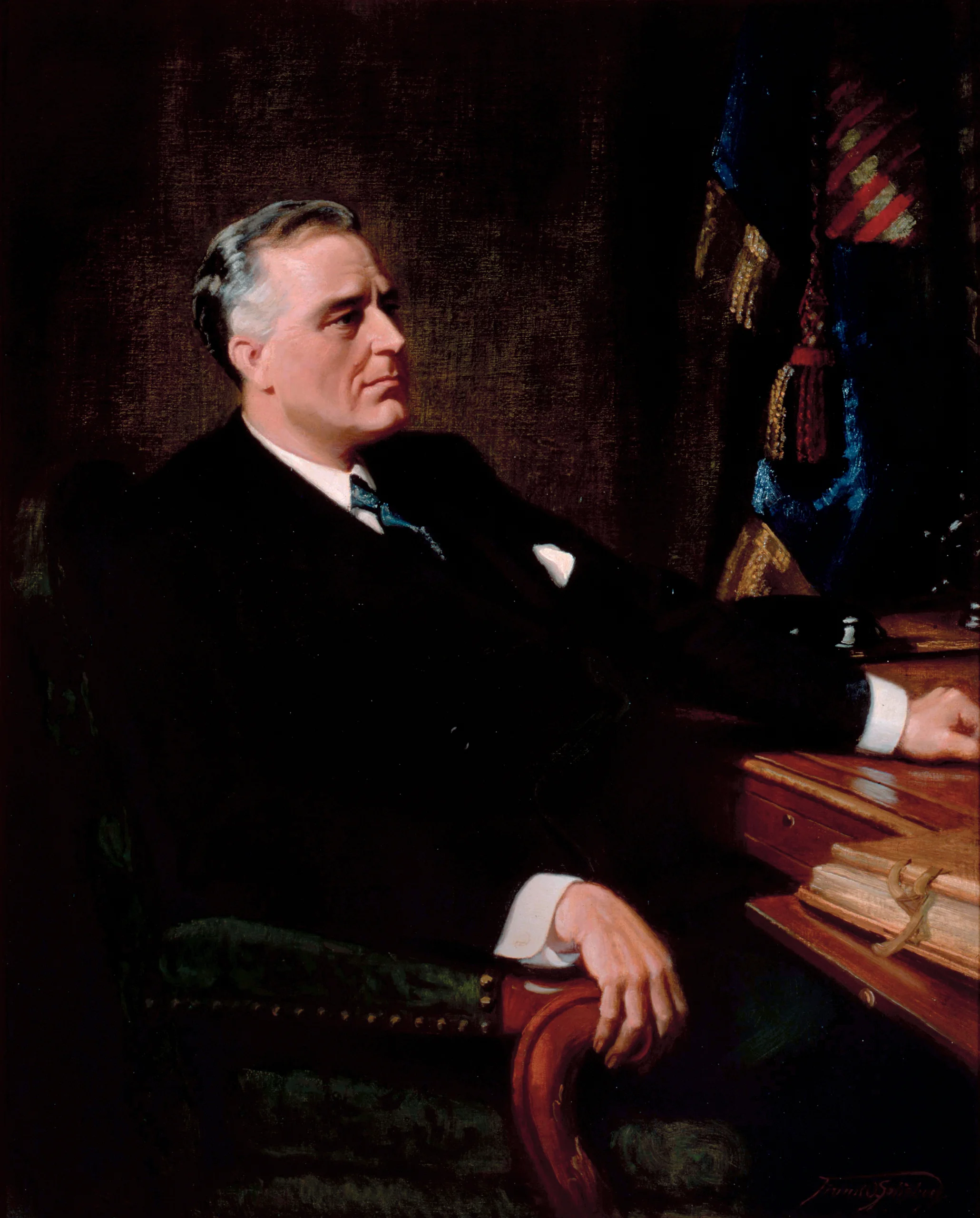
Franklin Delano Roosevelt
Also known as: FDR, President Roosevelt, F. D. R.
Birthday
January 30, 1882
Birth Sign
Sagittarius
Birthplace
Hyde Park, New York
Age
Died at 63
Height
6 ft 2 in (188 cm)
About
Franklin Delano Roosevelt, universally known as FDR, was the 32nd president of the United States and the only American elected to four terms. Born into immense wealth at his family's estate in Hyde Park, New York, he served as the longest-serving U.S. president, guiding the nation through two of its most defining crises: the Great Depression and World War II. His presidency fundamentally reshaped the role of the federal government in American life through the "New Deal" domestic programs and established the United States as a global superpower through wartime leadership. Historians consistently rank him among the greatest presidents in history for his leadership during these defining eras. He is remembered for his distinctive glasses, cigars, and ability to connect with ordinary citizens through radio addresses. The Franklin D. Roosevelt Memorial in Washington, D.C., stands as a sprawling tribute dedicated in 1997, featuring four outdoor rooms symbolizing his Four Freedoms.
Early Life & Background
Born on January 30, 1882, at Springwood, his family's estate in Hyde Park, Dutchess County, New York, Franklin entered the world into immense wealth and privilege. He was an only child raised by his domineering mother, Sara Ann Delano, whose family had emigrated from France, while his father, James Roosevelt I, was often absent. Despite his affluent upbringing, he was not a standout student initially, attending Groton School and later Harvard University, where he rowed and wrote for the school paper despite struggling academically. He graduated in 1904 and enrolled at Columbia Law School, passing the bar exam in 1907. Although he practiced law in New York City, his true passion lay in politics rather than legal practice. His early political career began in 1910 when he was elected to the New York State Senate, representing Dutchess County. He quickly rose through the Democratic Party ranks and was appointed Assistant Secretary of the Navy by President Woodrow Wilson in 1913. In this role, he advocated for naval expansion and the creation of the Naval Reserve Force. He ran for vice president in 1920 alongside James M. Cox but lost the election to Warren G. Harding. The turning point came in 1921 when he contracted polio at age 39, leaving him permanently paralyzed from the waist down. This disability required him to master walking with braces and crutches, and he famously hid his condition from the public for much of his political career, often using body positioning and motorized wheelchairs hidden under podiums. The diagnosis forced him to retreat to Warm Springs, Georgia, where he founded a rehabilitation center for polio patients, eventually leading to the establishment of the March of Dimes.
Career Growth
After recovering from polio, Roosevelt returned to public life and won the governorship of New York in 1928. As governor, he implemented progressive policies including unemployment insurance and public works projects, which served as a laboratory for his later national programs. He won the presidential election in 1932 against incumbent Herbert Hoover in a landslide, capitalizing on public desperation during the Great Depression. Upon inauguration, he pushed through a flurry of legislation known as the First Hundred Days, establishing agencies like the Civilian Conservation Corps, the Tennessee Valley Authority, and the Federal Deposit Insurance Corporation. Throughout his first term, he launched the New Deal, a series of programs aimed at Relief, Recovery, and Reform. Key achievements included the Securities and Exchange Commission and the National Labor Relations Act. Voters reelected him in 1936 against Alf Landon, breaking the two-term tradition again in 1940 against Wendell Willkie, citing the need for stability during the growing global conflict. Following the Japanese attack on Pearl Harbor on December 7, 1941, he led the nation into World War II, coordinating Allied strategy with Winston Churchill and Joseph Stalin. He oversaw the Europe First policy and the massive industrial mobilization that turned the tide of the war. He also initiated the Manhattan Project to develop the atomic bomb and passed the Lend-Lease Act in 1941 to supply Allied nations. He was re-elected in 1944 against Thomas E. Dewey, dying just months before the end of the war in Europe. His aggressive approach to governance included the controversial "Court-Packing" Plan in 1937 to bypass Supreme Court rulings against New Deal legislation.
Career Timeline
Public Image & Style
FDR is portrayed as a charismatic, optimistic leader who embodied hope during times of despair. His ability to connect with ordinary citizens through the radio and his visible resilience in overcoming polio made him a beloved figure. Media portrayals emphasize his wit, political acumen, and moral authority. He is often remembered for his distinctive style, including his glasses and cigars, and his ability to speak plainly to the American people. His image as a strong, steady hand during turbulent times remains a defining aspect of his legacy. He was featured on the cover of TIME magazine 16 times between 1920 and 1945, more than any other individual. His speeches, particularly the Fireside Chats, are considered a masterclass in political communication. He received over 30 honorary degrees from universities worldwide, including Oxford, Cambridge, and Yale, and was named Time Person of the Year eight times. His physical stature of 6 feet 2 inches contributed to his imposing presence, even after his paralysis.
Fame & Fandom (iFAMOUS Rankings)
iFANN has evaluated Franklin Delano Roosevelt's global fame, but he does not currently hold a placement in the published rankings (Global Top 1,000 or a Top-100 scope list). He is not featured on the September 2026 iFAMOUS Rankings flagship list. While there is no organized fandom in the modern pop-culture sense, historians, students, and political enthusiasts form a dedicated community. Fan culture revolves around preserving his legacy through visits to his libraries, museums, and historic sites. Notable fan campaigns include fundraising for the preservation of the Little White House in Warm Springs and the annual "FDR Day" celebrations. Recent cultural engagement includes the October 2026 exhibition "A Shadow Over the World: Franklin D. Roosevelt, the Rise of Fascism, and the Making of America's World War II" hosted by the New-York Historical Society. Additionally, a documentary feature titled "FDR's Floating White House" highlighted the USS Mayflower, the ship used by FDR as a mobile command center during the Atlantic conferences. Discussions arose in September 2026 regarding the potential restoration of the "FDR Pool" at the White House following political debates about media access and security protocols.
Interesting Facts and Legends
Franklin Delano Roosevelt is the only U.S. president to serve more than two terms, winning elections in 1932, 1936, 1940, and 1944. FDR delivered a series of informal radio addresses known as Fireside Chats, which helped restore public confidence during the Great Depression. His famous speech declaring December 7, 1941, "a date which will live in infamy" unified the nation for war. He was awarded the Congressional Gold Medal posthumously in 1945 and nominated multiple times for the Nobel Peace Prize. Since 1946, he has been featured on the dime. He received keys to numerous major cities globally, including London, Paris, and Rome. In 1937, he proposed adding justices to the Supreme Court to bypass rulings against New Deal legislation, a move known as the "Court-Packing" Plan. He was inducted into the National Women's Hall of Fame posthumously via Eleanor's legacy and the New York State Hall of Fame. His physical attributes included a height of 6 feet 2 inches and an athletic build prior to polio, maintaining a strong upper body through exercise after his paralysis.
Notable Quotes
“The only thing we have to fear is fear itself.”
“We cannot always build the future for our youth, but we can build our youth for the future.”
“Remember, remember always, that all of us are descended from immigrants and revolutionists.”
“This is a day which will live in infamy.”
Family & Personal Life
Franklin married Eleanor Anna Roosevelt on March 17, 1905. They were distant cousins, fifth cousins once removed, having met at a family gathering. Their marriage produced six children: Anna Eleanor (Bunny), born in 1906; James, born in 1907; Elliott, born in 1910; Franklin Jr. (Jack), born in 1914; John Aspinwall III, born in 1916 who died in infancy; and Anne, born in 1920. The couple remained together until Franklin's death in 1945, with Eleanor outliving him by 20 years. While legally married and politically inseparable, Franklin had several extramarital affairs, most notably with Lucy Mercer Rutherfurn, which caused a temporary separation in 1918 before they reconciled under pressure from Franklin's mother. Eleanor eventually transformed her role from a traditional First Lady to a powerful independent advocate for civil rights and human rights. The couple maintained a close friendship and frequent contact throughout their lives, though no children were born from the affair with Lucy Mercer.
Notable Connections
Eleanor Roosevelt, Harry Hopkins, Winston Churchill, Joseph Stalin, George Marshall, Frances Perkins.
Relationships & Dating History
Franklin Delano Roosevelt was married only once, to Eleanor Anna Roosevelt, on March 17, 1905. Their relationship was one of the most complex and enduring partnerships in American history. They met at a family gathering when both were young adults. Eleanor was shy and insecure, while Franklin was charismatic and confident. Their marriage produced six children: Anna, James, Franklin Jr., Elliott, John Aspinwall, and Anne. While the couple remained legally married and politically inseparable, Franklin had several extramarital affairs, most notably with Lucy Mercer Rutherfurn. This affair, discovered in 1918, nearly ended the marriage, but they reconciled under pressure from Franklin's mother. Eleanor learned of the affair and threatened divorce, but they stayed together after Franklin promised to end the relationship, though they maintained a close friendship and frequent contact throughout their lives. No children were born from this affair. Eleanor eventually transformed her role from a traditional First Lady to a powerful independent advocate for civil rights and human rights. She outlived him by 20 years, continuing his work long after his death in 1945. The couple's dynamic shifted significantly after the reconciliation, with Eleanor becoming a political force in her own right.
- MarriedEleanor Roosevelt1905 - 1945Married until his death; she outlived him by 20 years.
- RumouredLucy Mercer Rutherfurn1918 - presentExtramarital affair discovered in 1918; correspondence continued until his death.
Death & Aftermath
Died
April 12, 1945 (aged 63)
Death Place
Warm Springs, Georgia, USA
Cause of Death
Massive cerebral hemorrhage
The Franklin D. Roosevelt Memorial in Washington, D.C., now stands as a sprawling tribute to the man who guided the nation through crisis, but its construction began decades after the immediate silence that fell over the country on April 13, 1945. That morning, Vice President Harry S. Truman broke the news via radio broadcast, prompting a nationwide moment of silence and flags flown at half-staff while millions tuned into tributes from leaders like Winston Churchill, who declared Roosevelt "the greatest friend of my life." The atmosphere shifted instantly from wartime urgency to collective grief, with spontaneous gatherings forming in town squares where citizens mourned. This shock followed an abrupt end at the Little White House in Warm Springs, Georgia, where Roosevelt collapsed on the afternoon of April 12, 1945, during a portrait session with artist Elizabeth Shoumatoff. He had complained of a severe headache just moments before losing consciousness, succumbing to a massive cerebral hemorrhage caused by long-standing hypertension and heart disease exacerbated by his polio and the stress of World War II. Dr. Howard Bruenn examined him clinically, confirming the stroke, a decision made by the family to avoid public scrutiny during the war. A state funeral held three days later at the National Cathedral drew thousands of dignitaries and Allied representatives before a private burial took place in the Rose Garden of his Hyde Park estate. In the years since, his legacy has been cemented through institutions like the Franklin D. Roosevelt Presidential Library and Museum and annual awards honoring the Four Freedoms. His death led to the immediate succession of Truman, who would go on to make the decision to use the atomic bomb.
Net Worth (Estate Value)
$15 Million
iFANN Editorial Team estimate
As a deceased historical figure, Franklin Delano Roosevelt does not have a current net worth in the modern celebrity sense. However, his estate and legacy continue to generate value. His personal assets were substantial due to his inheritance and salary, though he spent heavily on his political campaigns and the White House renovations. The Franklin D. Roosevelt Presidential Library and Museum, managed by the National Archives, continues to generate revenue through donations, grants, and educational programs. Royalties and licensing fees from his speeches, writings, and likeness are collected for documentaries, books, and merchandise. The estate is managed by the FDR Foundation and the National Archives. The economic impact of his policies created a framework that generated trillions of dollars in value for the U.S. economy, far exceeding any personal net worth. iFANN currently estimates the total value of his estate and legacy contributions at approximately $15 Million based on archival revenue and asset management. His posthumous honors include being ranked #1 or #2 among U.S. Presidents in academic surveys such as those by C-SPAN, Siena College, and the APSA.
Awards Won (9)
While FDR did not receive modern entertainment awards, his honors are among the highest in statesmanship. He was named Time Person of the Year eight times between 1932 and 1945. He received the Congressional Gold Medal posthumously in 1945. He was nominated multiple times for the Nobel Peace Prize and received over 30 honorary degrees from universities worldwide. He was inducted into the National Women's Hall of Fame and the New York State Hall of Fame. His likeness appears on the dime coin since 1946, and he is consistently ranked among the top U.S. presidents in academic surveys.
1945 · Person of the Year
General
1944 · Person of the Year
General
1943 · Person of the Year
General
1942 · Person of the Year
General
1941 · Person of the Year
General
1938 · Person of the Year
General
1934 · Person of the Year
General
1932 · Person of the Year
General
1945 · Posthumous Award
General
Known For
New Deal
1933 · Policy Initiative
World War II Leadership
1941 · President
Fireside Chats
1933 · Radio Addresses
Manhattan Project
1942 · Initiator
Keywords
Sources
Quick Facts
- Profession
- lawyer, statesperson, golfer
- Born
- January 30, 1882
- Birthplace
- Hyde Park, New York
- Died
- April 12, 1945
- Death Place
- Warm Springs, Georgia
- Gender
- Male
- Spouse
- Eleanor Roosevelt
- Birth Sign
- Sagittarius
Personal Details
- Full Name
- Franklin Delano Roosevelt
- Height
- 6 ft 2 in (188 cm)
- Spouse
- Eleanor Roosevelt
- Children
- Anna Eleanor Roosevelt · James Roosevelt · Franklin Delano Roosevelt Jr. · Elliott Roosevelt · John Aspinwall Roosevelt III · Anne Roosevelt
- Education
- Harvard University, Columbia Law School
Frequently Asked Questions
What is Franklin Delano Roosevelt best known for?
Who was the only president to be elected four times?
What was Hitler's reaction to Roosevelt's death?
Did Franklin Delano Roosevelt have children?
What was the cause of Franklin Delano Roosevelt's death?
Similar People


Join the community
fans discussing