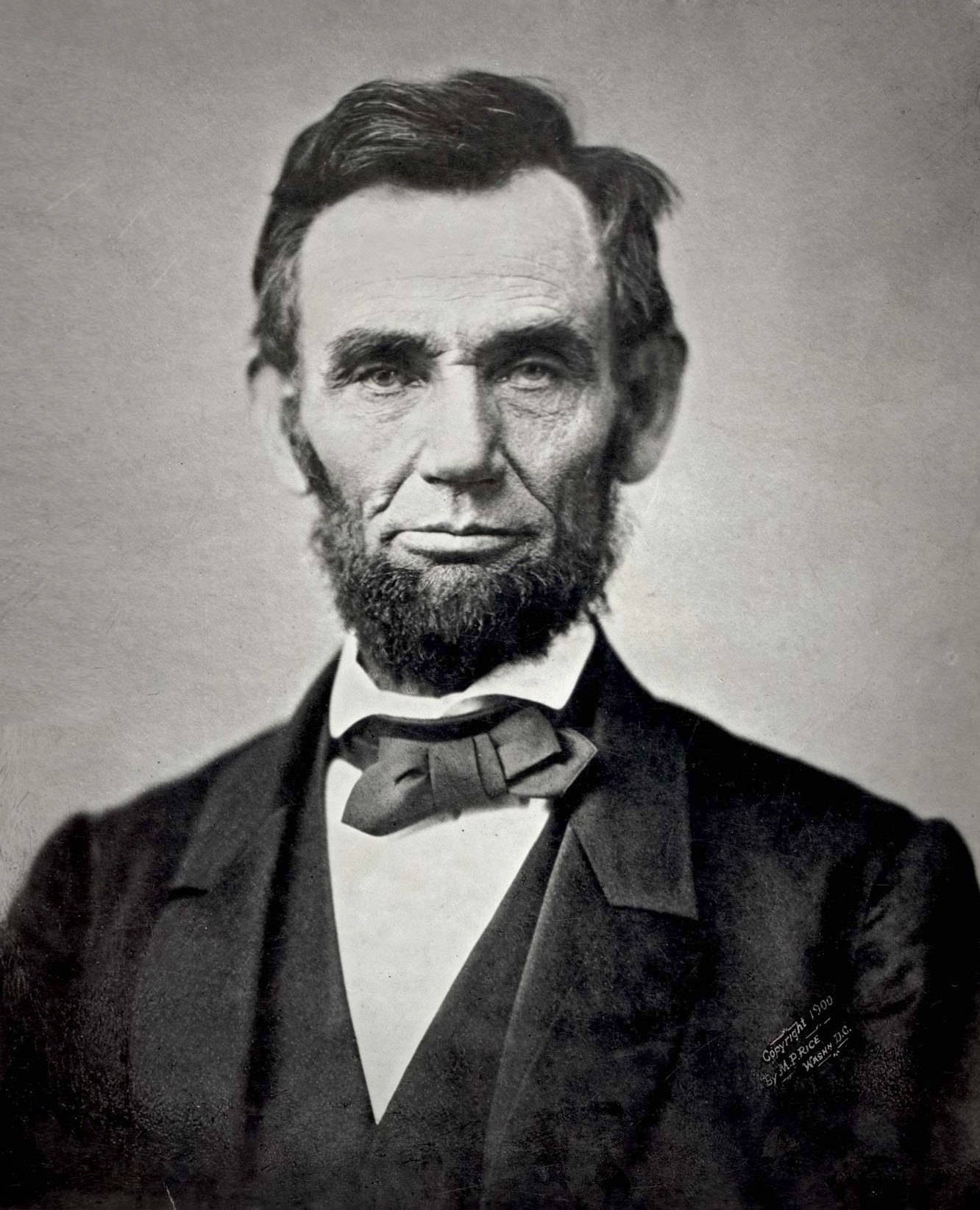
Abraham Lincoln
 United States
Birthday
February 12, 1809
Birth Sign
Aquarius
Birthplace
Hodgenville, Kentucky, USA
Age
Died at 56
Height
6 ft 4 in (193 cm)
About
Abraham Lincoln was an American lawyer and statesman who served as the 16th president of the United States. He is widely regarded as one of America's greatest presidents for his leadership during the Civil War and his role in ending slavery. Lincoln's presidency saw the nation through its deadliest conflict, culminating in the Emancipation Proclamation and the eventual passage of the Thirteenth Amendment, which permanently abolished slavery. His enduring legacy as the Great Emancipator and preserver of the Union continues to be celebrated, with his image and story featuring prominently in countless historical accounts, films, and television shows, making him one of the most recognized figures in American history.
Early Life & Background
Abraham Lincoln was born on February 12, 1809, in a one-room log cabin in Hodgenville, Kentucky, USA. He grew up on the Kentucky frontier, where his family faced extreme poverty. In 1816, his family moved to Indiana after losing their land in a title dispute. Tragedy struck when Lincoln was nine years old, as his mother died of milk sickness. His father later remarried Sarah Bush Johnston, who brought three children into the household and actively encouraged young Abraham's education. Though he attended blab schools for less than a year total, Lincoln was largely self-educated. He taught himself by diligently reading borrowed books, including the Bible, Aesop's Fables, Robinson Crusoe, The Pilgrim's Progress, and Parson Weems's Life of Washington. He would walk for miles to borrow these books and, when paper was scarce, famously wrote notes on a wooden shovel. Through this self-directed learning, he developed a strong foundation in law, mathematics, grammar, surveying, and literature.
As a teenager, Lincoln undertook various demanding jobs, working as a rail-splitter, farm hand, and store clerk. His father often hired him out to neighbors for labor, keeping his wages until Lincoln turned 21. During these years, he developed a reputation for impressive physical strength, standing at 6'4" and excelling at wrestling. Beyond his physical prowess, Lincoln cultivated a deep love for reading and public speaking. He would often walk to the county courthouse to observe lawyers arguing cases and attentively listened to political speeches, honing his own rhetorical skills. In 1831, he settled in New Salem, Illinois, where he took on roles as a boatman and postmaster. He also ventured into business, running a general store with William Berry, but the enterprise failed, leaving him burdened with debt for many years. During the Black Hawk War of 1832, Lincoln served as a captain in the Illinois militia, though he saw no combat.
Lincoln's political career began with a defeat in his first campaign for the Illinois General Assembly in 1832. However, he persevered, winning a seat in 1834 and subsequently serving four successive terms. Concurrently, he continued his intense self-study of law, ultimately receiving his law license in 1836. This breakthrough allowed him to move to Springfield in 1837, where he established a successful law practice with John T. Stuart. He later served one term in the U.S. House of Representatives from 1847 to 1849. His opposition to the Mexican-American War, however, made him unpopular during this period, leading him to return to Springfield and focus on his law practice for the next five years, further solidifying his legal expertise before his next major political endeavors.
Career Growth
Lincoln's political career reignited in 1854 when the Kansas-Nebraska Act repealed the Missouri Compromise, allowing territories to decide on slavery. He gave powerful speeches against the act and helped found the Illinois Republican Party in 1856. The 1858 Senate debates against Stephen A. Douglas brought him national attention, particularly his House Divided speech: "A house divided against itself cannot stand." Though he lost the election, the debates established him as a leading anti-slavery voice. In 1860, he won the Republican presidential nomination on the third ballot and defeated a fractured Democratic party with 39.8% of the popular vote, becoming the 16th president.
As president, Lincoln led the Union through the Civil War. He oversaw Union military strategy, appointed and replaced generals including George McClellan, Ulysses S. Grant, and William Tecumseh Sherman. He suspended habeas corpus and expanded the army and navy. He issued the Emancipation Proclamation on January 1, 1863, freeing slaves in Confederate states and allowing Black men to enlist in the Union Army. His Gettysburg Address in November 1863 redefined the war as a struggle for national unity and equality. In 1864, he won re-election against former General George McClellan, receiving 55% of the popular vote and 212 of 233 electoral votes. His second inaugural address in March 1865 called for reconciliation: "With malice toward none, with charity for all." He pushed the Thirteenth Amendment through Congress in January 1865, permanently abolishing slavery; it was ratified in December 1865. Days after the Confederate surrender, Lincoln was assassinated by John Wilkes Booth at Ford's Theatre on April 14, 1865, and died the next morning.
Career Timeline
Public Image & Style
Lincoln is consistently ranked by historians as the greatest U.S. president, known for his integrity, eloquence, and moral clarity. He has been ranked #1 in numerous polls, including the C-SPAN Historians Survey in 2000, 2009, 2017, and 2021, and the Siena College Research Institute surveys in 2011, 2018, and 2024. His gaunt, bearded appearance, tall stature, and distinctive stovepipe hat make him instantly recognizable. He is often called Honest Abe, a nickname stemming from his early days as a store clerk when he walked miles to return a few cents to a customer. His speeches, including the Gettysburg Address and his second inaugural address, are studied as masterpieces of rhetoric. Lincoln's image has been used in countless films, books, and monuments, with the Lincoln Memorial in Washington, D.C., dedicated in 1922, serving as a national symbol of unity and equality. His face appears on Mount Rushmore, carved alongside Washington, Jefferson, and Theodore Roosevelt. He is often portrayed as a humble, wise, and melancholic figure, though contemporaries noted his sharp wit and love of storytelling. Actors portraying Lincoln have won major awards, including Daniel Day-Lewis's Academy Award, Golden Globe, BAFTA, and Screen Actors Guild Award for the 2012 film Lincoln.
Fame & Fandom (iFAMOUS Rankings)
Abraham Lincoln commands a presence that transcends his century, with global attention measured across media coverage, search activity, and consumption signals worldwide. In the August 2026 cycle of the iFANN Global Fame Rankings, he stands as the 89th most famous person in the world, holding steady from the previous assessment. Within his home nation, he is the 16th most famous person in United States, while among those born there, he ranks as the 46th most famous person from United States. His influence extends across the continent as the 18th most famous person in North America, and within his professional sphere, he remains the 13th most famous person in Politics. Despite the passage of time, these placements confirm his enduring status as a titan of history rather than a fading memory. The historical figure does not possess a formal fandom name; his admirers are historians, educators, and citizens who revere his legacy through preservation societies like the Abraham Lincoln Association rather than organized fan clubs or modern rituals.
Interesting Facts and Legends
Lincoln holds the distinction of being the only U.S. president to secure a patent, receiving one in 1849 for a device designed to lift boats over shoals, though it was never manufactured. An accomplished wrestler, he recorded only one loss in approximately 300 matches and was posthumously inducted into the National Wrestling Hall of Fame in 2013. He famously kept his important documents inside his stovepipe hat, which became an iconic part of his gaunt, bearded appearance. As the first president photographed at his inauguration, his image now adorns the penny since 1909 and the $5 bill since 1923, with the Lincoln Memorial appearing on the reverse of the coin since 1932. Known for his storytelling, he often used humor to lighten tense moments during the Civil War. Despite his stature, he declined honorary degrees from Knox College, Princeton University, and Columbia University between 1860 and 1864. His birthday, February 12, is celebrated in many states, and President's Day in 1971 combined it with Washington's birthday. A statue of Lincoln stands in Westminster Abbey, London, dedicated in 1914. A central legend surrounding his life involves his assassination, where he remains the first U.S. president to die in office after being shot on April 14, 1865. The Emancipation Proclamation, issued on January 1, 1863, stands as the most widely cited event of his presidency, declaring slaves within rebellious states forever free. Another defining moment was the Gettysburg Address delivered in November 1863, a speech so brief yet powerful it redefined the purpose of the war. While the story of him rising from humble rail-splitting origins was heavily cultivated for his 1860 campaign, it remains a foundational myth of his self-made character.
Notable Quotes
“A house divided against itself cannot stand.”
“Four score and seven years ago our fathers brought forth on this continent, a new nation, conceived in Liberty, and dedicated to the proposition that all men are created equal.”
“With malice toward none, with charity for all.”
“Government of the people, by the people, for the people, shall not perish from the earth.”
“Whatever you are, be a good one.”
Family & Personal Life
Lincoln's parents were Thomas Lincoln, a farmer and carpenter, and Nancy Hanks Lincoln, who died when he was nine. He had an older sister, Sarah, who died in childbirth in 1828, and a younger brother, Thomas Lincoln Jr., who died in infancy. His father remarried Sarah Bush Johnston in 1819, who brought three children into the household: John D. Johnston, Sarah Johnston, and Matilda Johnston. Lincoln married Mary Todd, the daughter of a wealthy Kentucky slaveholding family, on November 4, 1842, in Springfield. They had four sons: Robert Todd Lincoln, who became a lawyer and diplomat; Edward Baker Lincoln, who died at age three in 1850; William Wallace Lincoln, who died at age eleven in the White House in 1862; and Thomas Tad Lincoln, who died at age eighteen in 1871. Mary suffered from severe depression and mood swings, exacerbated by the deaths of three children and her husband's assassination. After Lincoln's death, she struggled financially and mentally, was briefly institutionalized by her son Robert in 1875, and died in 1882.
Notable Connections
Lincoln is associated with key figures of his era, including his political rival Stephen A. Douglas, his generals Ulysses S. Grant and William Tecumseh Sherman, and his assassin John Wilkes Booth. He is also closely linked to the abolitionist movement and figures like Frederick Douglass, who advised him. His wife Mary Todd Lincoln and his sons, particularly Robert Todd Lincoln, are part of his personal legacy. Lincoln's legacy is often compared to that of George Washington and Thomas Jefferson, with whom he is carved on Mount Rushmore.
Relationships & Dating History
Lincoln's first known romantic attachment was to Ann Rutledge, whom he courted in New Salem, Illinois, from around 1833. Ann was engaged to another man, but after her engagement ended, she and Lincoln became close. She died of typhoid fever on August 25, 1835, at age 22, and Lincoln reportedly fell into a deep depression. Historians debate whether they were formally engaged. In 1836, Lincoln began a courtship by letter with Mary Owens, whom he had met in 1833. He proposed in 1837, but Owens delayed, and by 1838 Lincoln wrote to a friend that he was relieved she had refused him. In 1839, Lincoln met Mary Ann Todd in Springfield. Mary was from a wealthy Kentucky slaveholding family. They had a stormy courtship, briefly broke off their engagement in 1841, and reconciled in 1842. They married on November 4, 1842, in a quiet ceremony at Mary's sister's home. The marriage produced four sons: Robert, Edward, Willie, and Tad. Mary suffered from severe depression and mood swings, exacerbated by the deaths of three children and Lincoln's assassination. After Lincoln's death, Mary struggled financially and mentally, was briefly institutionalized by her son Robert in 1875, and died in 1882. No confirmed extramarital relationships have been documented. Historical rumors about relationships with Joshua Speed remain speculative and not supported by credible historical consensus. As of 2026, Lincoln is deceased and was married to Mary Todd Lincoln at the time of his death.
- DatedAnn Rutledge1833 - 1835Lincoln courted Ann Rutledge in New Salem; she died of typhoid fever in 1835, causing him deep depression.
- DatedMary Owens1836 - 1838Lincoln courted Mary Owens by letter, proposed in 1837, and was relieved when she refused him.
- MarriedMary Todd Lincoln1842 - 1865Married on November 4, 1842; had four sons; Mary was from a wealthy Kentucky slaveholding family.
Death & Aftermath
Died
April 15, 1865 (aged 56)
Death Place
Washington, D.C., USA
Cause of Death
Gunshot wound to the head
On the evening of April 14, 1865, President Abraham Lincoln sat in the presidential box at Ford's Theatre to watch a comedy alongside his wife Mary Todd Lincoln and Major Henry Rathbone. While the performance was underway, John Wilkes Booth entered from behind, fired a single shot into the back of Lincoln's head, and leaped onto the stage before fleeing the scene. The President lost consciousness immediately but remained alive for nine hours while suffering from severe cerebral hemorrhage, eventually dying at approximately 7:22 a.m. on April 15 at the Petersen House across the street. Medical examination by Assistant Surgeons Joseph K.
Barnes and Charles S. Taft confirmed that the bullet had lodged in the right side of the brain near the midline, causing massive destruction of the brainstem. A military commission subsequently tried eight conspirators, finding all guilty by July 2, 1865, with four sentenced to death and executed on July 7 in the yard of the Old Arsenal Penitentiary. Booth himself was never brought to trial, having been hunted down and killed by Union cavalryman Boston Corbett on April 26 at a tobacco barn in Port Royal, Virginia. The nation reacted with profound grief as crowds gathered spontaneously outside the White House and along Pennsylvania Avenue, while newspapers published eulogies and flags were flown at half-staff from New York to Chicago.
His body lay in state in the Capitol Rotunda for three days where an estimated 100,000 people filed past, followed by a funeral train that traveled to Springfield, Illinois, stopping in major cities including Baltimore, Philadelphia, New York, and Chicago to allow mourners to pay their respects. Lincoln was finally buried on May 4, 1865, in Oak Ridge Cemetery after a final private service at the State House.
Net Worth (Estate Value)
$1.5 Million
iFANN Editorial Team estimate
Per iFANN's editorial analysis, Abraham Lincoln died with a modest estate valued at approximately $85,000 in 1865, equivalent to roughly $1.5 million in 2026. This figure reflects the inflation-adjusted value of his assets, including his Springfield home valued at $5,000, his law practice assets, and personal property. Historical records from Sangamon County, Illinois, confirm these details. Lincoln never accumulated significant wealth, as he spent much of his career in public service and often took on debt. His estate was managed by his son Robert Todd Lincoln. Posthumously, Lincoln's image and name have generated substantial revenue through licensing, memorials, and tourism, but the Lincoln estate itself does not directly profit from these. The National Park Service maintains the Lincoln Memorial and his birthplace, which draw millions of visitors annually. The U.S. Mint issued four Lincoln Bicentennial pennies in 2009, and the Congressional Gold Medal was awarded to the Lincoln Bicentennial Commission in 2009. The total net worth attributed to Lincoln in 2026 is $1.5 Million.
Awards Won (4)
Lincoln did not receive formal awards during his lifetime, as presidential medals did not then exist. Posthumously, he is consistently ranked the greatest U.S. president in historian surveys. Actors portraying Lincoln have won major awards, including Daniel Day-Lewis's Academy Award, Golden Globe, and BAFTA for the 2012 film Lincoln. The film itself won two Oscars. Lincoln was posthumously inducted into the National Wrestling Hall of Fame in 2013.
2013 · Best Actor
Lincoln
2013 · Best Actor
Lincoln
Known For
Preservation of the Union
1865 · 16th President of the United States
Emancipation Proclamation
1863 · President
Gettysburg Address
1863 · President
Thirteenth Amendment
1865 · President
Lincoln-Douglas Debates
1858 · U.S. Senate candidate
Keywords
Quick Facts
- Profession
- politician, lawyer
- Born
- +1809-02-12
- Birthplace
- Hodgenville, Kentucky
- Died
- +1865-04-15
- Death Place
- Washington, D.C.
- Gender
- Male
- Spouse
- Mary Todd Lincoln
- Birth Sign
- Aquarius
- Height
- 6 ft 4 in (193 cm)
- Education
- Self-educated
Personal Details
- Full Name
- Abraham Lincoln
- Height
- 6 ft 4 in (193 cm)
- Spouse
- Mary Todd Lincoln
- Children
- Robert Todd Lincoln, Edward Baker Lincoln, William Wallace Lincoln, Thomas "Tad" Lincoln
- Education
- Less than one year of formal schooling; self-educated in law, mathematics, grammar, surveying, and literature
Frequently Asked Questions
What is Abraham Lincoln's net worth in 2026?
How tall was Abraham Lincoln?
What is Abraham Lincoln best known for?
Did Abraham Lincoln have any children?
How did Abraham Lincoln die?
Join the community
fans discussing