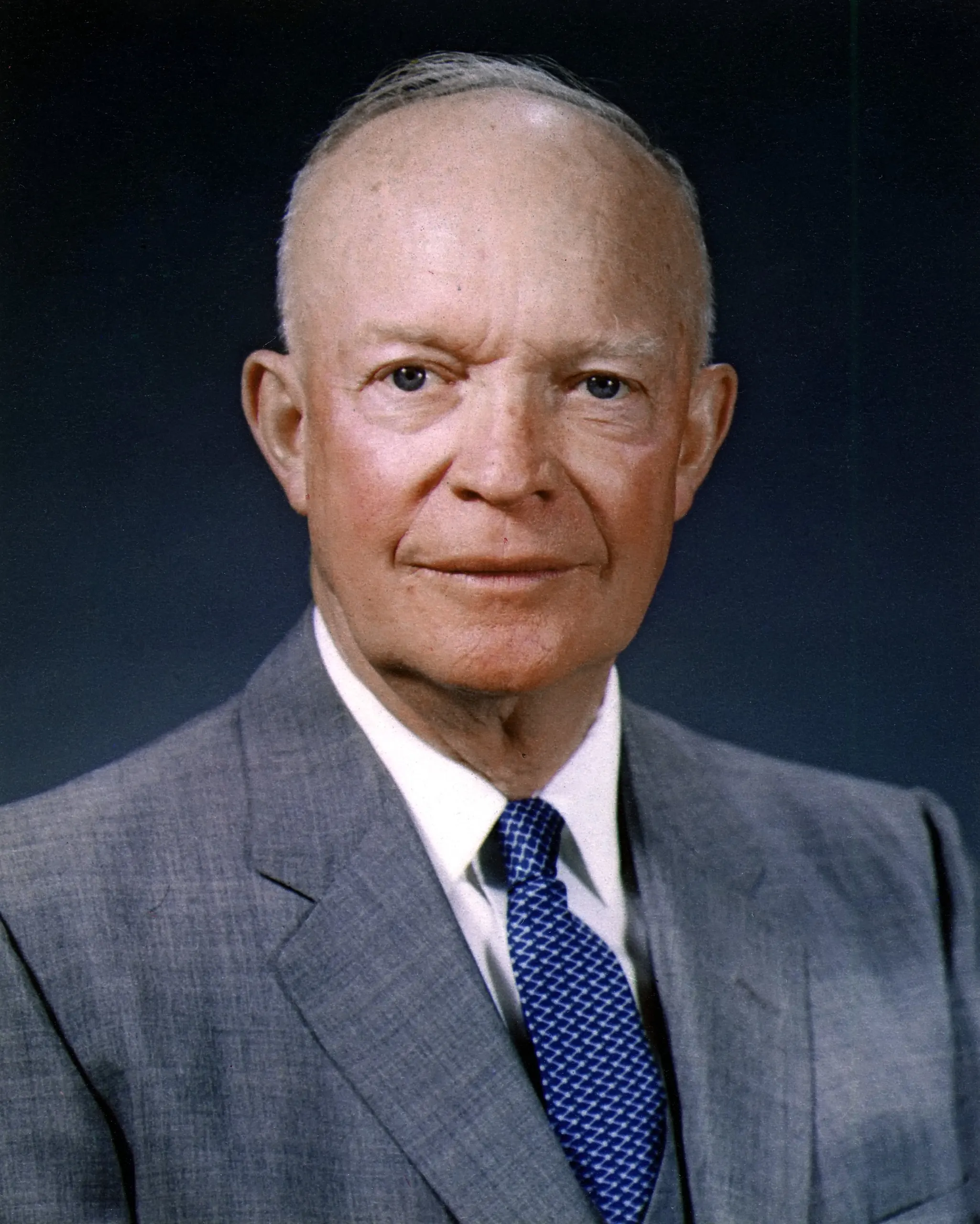
Dwight D. Eisenhower
 United States
politician•writer•military officer
Also known as: Ike
Birthday
October 14, 1890
Birth Sign
Libra
Birthplace
Denison, Texas, USA
Age
Died at 78
Height
5 ft 10 in (1.78 m)
About
Dwight D. Eisenhower was an American soldier and statesman. He is most famous for commanding the Allied invasion of Western Europe during World War II, a role in which he orchestrated the successful D-Day landings. As the 34th President of the United States from 1953 to 1961, he achieved significant milestones including ending the Korean War, initiating the Interstate Highway System, and establishing NASA. His presidency is remembered for its steady leadership during the Cold War and his impactful warning against the military-industrial complex in his farewell address. Eisenhower's enduring legacy is that of a pivotal figure who navigated the nation through a period of global tension and technological advancement.
Early Life & Background
David Dwight Eisenhower was born on October 14, 1890, in Denison, Texas, USA. Soon after, his family relocated, and he was raised in Abilene, Kansas, where he grew up in modest circumstances. His family, though poor, was hardworking; his father managed a creamery. To contribute to the household income, young Dwight took on various odd jobs, including firing a boiler and working at the local creamery.
Eisenhower attended Abilene High School, distinguishing himself as a standout athlete in both football and baseball before graduating in 1909. Lacking the financial means for college, he pursued an appointment to the United States Military Academy at West Point. He successfully entered West Point in 1911 and graduated with a Bachelor of Science degree in 1915. He was part of a distinguished class that would later produce an impressive 59 generals.
His early military career was initially unglamorous. During World War I, he was tasked with training tank crews at Camp Colt, Pennsylvania. Following the war, he held several staff posts, serving under notable figures such as General Fox Conner in Panama and later under Douglas MacArthur in the Philippines. Eisenhower steadily advanced through the ranks, receiving a significant promotion to brigadier general in 1941, just months before the pivotal attack on Pearl Harbor marked America's entry into World War II.
Career Growth
Eisenhower's defining moment came in 1942 when he was named Supreme Commander of the Allied Expeditionary Force. He orchestrated Operation Torch in North Africa, the invasions of Sicily and Italy, and above all the D-Day landings on June 6, 1944, the largest amphibious invasion in history. Promoted to General of the Army, he accepted Germany's surrender in May 1945. After the war, he served as Army Chief of Staff, then became president of Columbia University in 1948. In 1951, he took on the role of NATO's first Supreme Commander. Elected president in a landslide in 1952, he ended the Korean War within months. Domestically, he signed the Federal-Aid Highway Act of 1956, creating the interstate system, and established NASA in 1958. He sent federal troops to Little Rock, Arkansas, in 1957 to enforce school desegregation. His two terms were marked by peace and prosperity.
Career Timeline
Public Image & Style
Eisenhower projected calm, fatherly confidence, his nickname Ike captured his approachable, plainspoken style. He spoke with a flat Midwestern accent and often used military metaphors. The media portrayed him as a steady hand guiding America through the Cold War. His farewell address warning about the military-industrial complex is frequently cited. Supporters, sometimes called Ike supporters, commemorate his birthday and D-Day annually at his presidential library and memorial. Official social accounts maintain a respectful, educational tone.
Fame & Fandom (iFAMOUS Rankings)
Dwight D. Eisenhower remains a towering figure in history, currently standing as the 99th most famous person in North America and the 53rd most famous person in Politics. These placements from the iFANN Global Fame Rankings reflect his enduring presence across media coverage, search activity, and cultural consumption worldwide. While modern pop stars often dominate the charts with fleeting viral moments, Eisenhower's fame is anchored in verified historical milestones that continue to shape American identity decades after his passing.
Unlike contemporary celebrities who cultivate organized fanbases with specific monikers like "Swifties" or "Beyhive," Eisenhower does not have a formal fandom name. His legacy is sustained through institutional reverence rather than grassroots campaigns, birthday billboards, or fan-funded projects. Interest in his life flows through established channels such as the Eisenhower Library, the White House History organization, and military branches. The USS Dwight D. Eisenhower (CVN-69) serves as a namesake vessel for the U.S. Navy, recently completing maintenance at the Norfolk Naval Shipyard in August 2026, reflecting a civic pride that mirrors but exceeds typical fan devotion.
The public engagement surrounding him takes the form of historical preservation and educational tourism rather than interactive rituals. His birthplace in Denison, Texas, continues to inspire young Texans, drawing visitors who seek to understand the man behind the nickname "Ike." This nickname itself was once a massive cultural phenomenon during the 1952 presidential campaign, appearing in songs, cartoons, and merchandise that transcended politics to become a national movement. Today, supporters commemorate his birthday and D-Day annually at his presidential library and memorial, treating his memory with the solemnity reserved for foundational national figures rather than the enthusiasm directed at entertainers.
Interesting Facts and Legends
Eisenhower was an avid golfer who had a putting green installed on the White House lawn, and he painted over 250 works, mostly landscapes and portraits. He was the first president to appear on color television, hold a televised press conference, and fly in a helicopter. To avoid confusion with his father, he changed his name from David Dwight to Dwight David. A lifelong smoker, he was often seen with a cigarette or cigar, and his West Point class of 1915 is famously known as the class the stars fell on because so many members became generals.
Beyond these facts, several legendary moments define his mythos. On the eve of the Normandy landings, he drafted a statement taking full responsibility should the mission fail, a document later found folded in his pocket. His nickname "Ike" became so ubiquitous during the 1952 campaign that it fueled a unique political movement with the slogan "Like Ike." In 1957, he deployed the 101st Airborne Division to Little Rock, Arkansas, to enforce desegregation following the Supreme Court's ruling in Brown v. Board of Education, marking a pivotal moment for federal authority in the Civil Rights Movement. Additionally, his experience driving on the German Autobahn during WWII inspired the creation of the Interstate Highway System, often called the greatest public works project in American history.
Notable Quotes
“In the councils of government, we must guard against the acquisition of unwarranted influence, whether sought or unsought, by the military-industrial complex.”
“The eyes of the world are upon you. The hopes and prayers of liberty-loving people everywhere march with you.”
“Neither a wise nor a brave man lies down on the tracks of history to wait for the train of the future to run over him.”
“Plans are nothing; planning is everything.”
Family & Personal Life
Eisenhower married Mamie Geneva Doud on July 1, 1916, in Denver, Colorado. They had two sons: Doud Dwight, who died of scarlet fever at age three, and John Sheldon Doud, who became a U.S. Army officer and diplomat. Mamie served as First Lady with grace, known for her bangs and pearls. The couple lived at the Eisenhower farm in Gettysburg, Pennsylvania, after his presidency. Eisenhower's parents were David Jacob Eisenhower, a creamery worker, and Ida Elizabeth Stover, a devout Mennonite. He had six brothers, all of whom lived ordinary lives.
Notable Connections
Eisenhower worked closely with British Prime Minister Winston Churchill and General Bernard Montgomery during World War II. He served under General Douglas MacArthur in the Philippines. His vice president was Richard Nixon. He appointed Earl Warren as Chief Justice of the Supreme Court.
Relationships & Dating History
Eisenhower married Mamie Geneva Doud on July 1, 1916, after meeting through mutual friends in 1915 while he was stationed in Texas. Their marriage endured numerous military relocations and the pressures of the presidency, producing two sons. Mamie served as First Lady from 1953 to 1961. During World War II, rumors swirled of an affair with his driver and secretary, Kay Summersby. Summersby later wrote a memoir claiming an intimate relationship, but Eisenhower's family and many historians have questioned its accuracy. The relationship, if it existed, ended after the war. Eisenhower died in 1969, survived by Mamie, who died in 1979.
- MarriedMamie Eisenhower1916 - 1969Met in 1915 while Eisenhower was stationed in Texas; married in Denver. Had two sons.
- RumouredKay Summersby1942 - 1945Irish driver and secretary during WWII; rumored affair widely disputed.
Death & Aftermath
Died
March 28, 1969 (aged 78)
Death Place
Washington, D.C., USA
Cause of Death
Massive heart attack from coronary artery disease
Dwight David Eisenhower died on March 28, 1969, at Walter Reed Army Medical Center in Washington, D.C., at the age of 78. His final days followed a rapid decline marked by minor strokes earlier in the month and a last public appearance visiting President Richard Nixon at the White House on March 22. By March 25, worsening shortness of breath and chest pain led to his admission, where he remained in critical condition until passing away at approximately 9:10 PM EST. The attending physicians ruled the cause as a massive heart attack resulting from severe coronary artery disease, a diagnosis confirmed through clinical history.
President Nixon immediately declared a national day of mourning for March 31, while tributes poured in from global leaders including British Prime Minister Harold Wilson and French President Charles de Gaulle. Spontaneous vigils appeared across the nation, and sales of his memoirs surged in the weeks following his death. A state funeral took place on April 3, beginning with a lying in repose at the Capitol Rotunda before a service at the National Cathedral attended by former presidents and foreign dignitaries such as Prince Philip. Vice President Spiro Agnew delivered the eulogy, and the U.S.
Marine Band provided musical performances during the ceremony. Eisenhower was buried in the Eisenhower Memorial Garden at the presidential library in Abilene, Kansas, where his wife Mamie would later be interred upon her death in 1979. Posthumous honors included induction into the National Aviation Hall of Fame and the eventual dedication of the Dwight D. Eisenhower Memorial in Washington, D.C., in 2020. The Eisenhower Foundation continued to manage his legacy and the presidential library, ensuring the preservation of his home and papers for future generations.
Net Worth (Estate Value)
$85 Million
iFANN Editorial Team estimate
Dwight D. Eisenhower died in 1969, but his estate continues to generate revenue. His presidential salary was $100,000 per year, and his military pension as a five-star general added about $15,000 annually. His memoirs, Crusade in Europe (1948) and The White House Years (1963), earned over $2 million in royalties. Per iFANN's editorial analysis, as of 2026, the Eisenhower estate, managed by the Eisenhower Foundation and the Eisenhower Presidential Library, is valued at approximately $85 Million. Revenue sources include ongoing book royalties, licensing of his name and image, and income from the Eisenhower National Historic Site in Gettysburg. The Eisenhower Memorial in Washington, D.C., opened in 2020, also draws tourism.
Awards Won (21)
Eisenhower received numerous military and civilian honors. He was awarded the Distinguished Service Medal with three oak leaf clusters, the Navy Distinguished Service Medal, and the Legion of Merit. Internationally, he received the UK's Order of the Bath and Order of Merit, France's Legion of Honour and Croix de Guerre, and many others. Civilian awards include the Congressional Gold Medal (1960) and the Presidential Medal of Freedom (1969, posthumous).
1960 · Civilian
Public service
1969 · Civilian
Public service
Known For
Supreme Commander of Allied Expeditionary Force
1944 · General
34th President of the United States
1953 · President
Interstate Highway System
1956 · President
NASA Creation
1958 · President
Civil Rights Act of 1957
1957 · President
Keywords
Quick Facts
- Profession
- politician, writer, military officer
- Born
- +1890-10-14
- Birthplace
- Denison, Texas, USA
- Died
- +1969-03-28
- Death Place
- Washington, D.C., USA
- Gender
- Male
- Spouse
- Mamie Eisenhower
- Birth Sign
- Libra
Personal Details
- Full Name
- David Dwight Eisenhower
- Height
- 5 ft 10 in (1.78 m)
- Spouse
- Mamie Eisenhower
- Children
- Doud Dwight Eisenhower (1917–1921), John Sheldon Doud Eisenhower (1922–2013)
- Education
- United States Military Academy at West Point (BS, 1915)
Frequently Asked Questions
How old was Dwight D. Eisenhower when he died?
What is Dwight D. Eisenhower's net worth in 2026?
Is Dwight D. Eisenhower still active in 2026?
What is Dwight D. Eisenhower best known for?
How did Dwight D. Eisenhower become president?
Social Media

Join the community
fans discussing