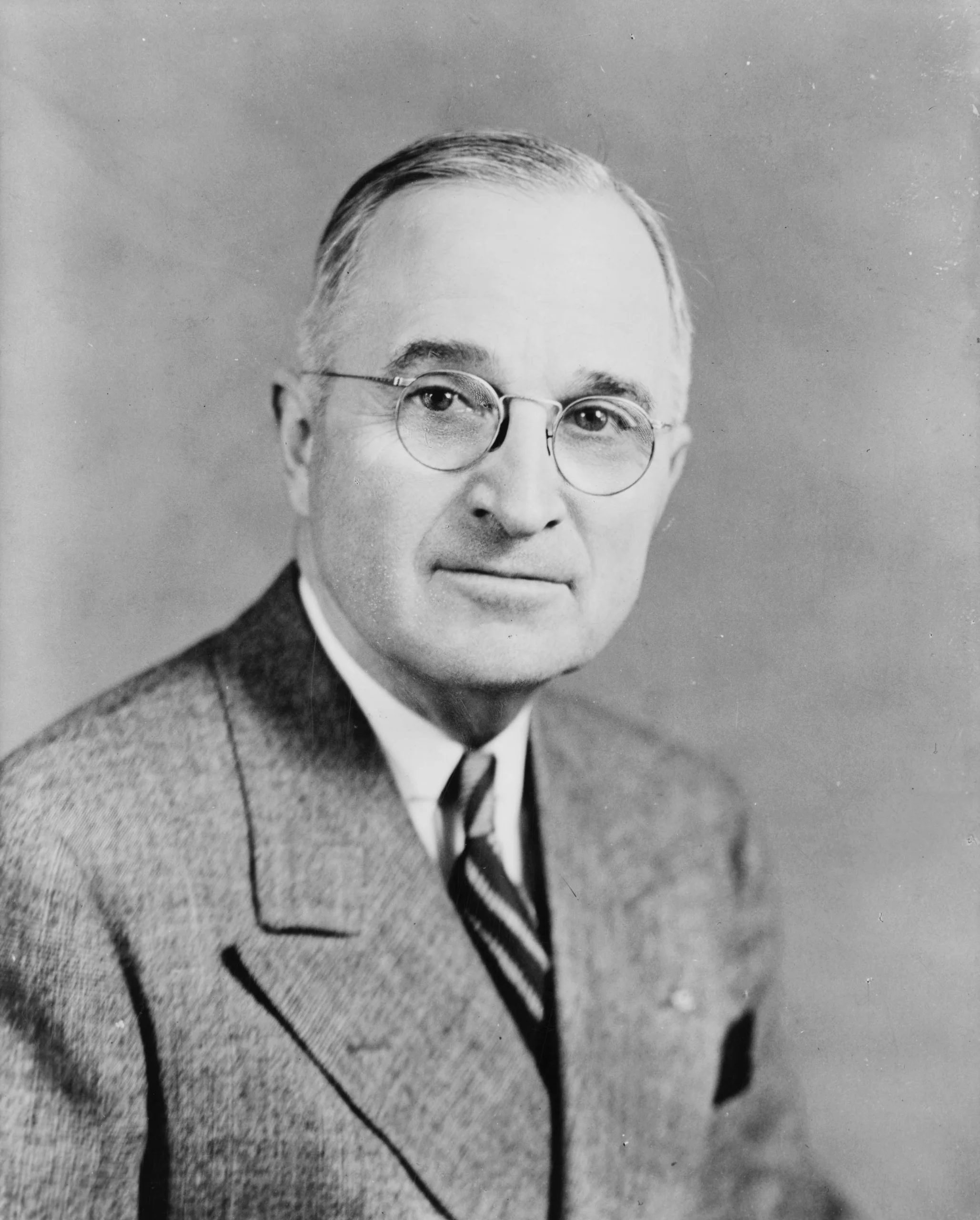
Harry S. Truman
politician•judge•businessperson
Also known as: HST, The Buck Stops Here
Birthday
May 8, 1884
Birth Sign
Taurus
Birthplace
Lamar, Missouri
Age
Died at 88
Height
5 ft 9 in (175 cm)
About
Harry S. Truman was the 33rd president of the United States, serving from April 12, 1945, to January 20, 1953. A Democrat from Missouri, he assumed office following the death of Franklin D. Roosevelt and oversaw the end of World War II, the beginning of the Cold War, and significant domestic reforms including the desegregation of the armed forces.
His presidency is defined by bold decisions that reshaped global politics and American society. He authorized the use of atomic weapons against Japan, established the Truman Doctrine to contain Soviet expansion, and launched the Marshall Plan to rebuild Western Europe. Domestically, he championed civil rights legislation and faced a massive political upset when he defeated Thomas E. Dewey in the 1948 election despite low polling numbers.
Early Life & Background
Harry S. Truman was born on May 8, 1884, in Lamar, Missouri, to John Anderson Truman and Martha Ellen Young. The family moved to Independence shortly after his birth, where he spent most of his childhood. He was the first in his immediate family to attend high school, graduating from Independence High School in 1901. After graduation, he worked various jobs including timekeeper for the Santa Fe Railroad and farmer before purchasing a haberdashery in Kansas City with a friend in 1919.
His early career path shifted dramatically with the outbreak of World War I. Truman served as a captain in the Field Artillery, commanding Battery D of the 129th Regiment in France. He saw action in the Meuse-Argonne Offensive and was awarded the Legion of Merit. Upon returning home, he married Elizabeth "Bess" Wallace in 1919. They had one daughter, Mary Margaret, born in 1924. The couple's marriage was private and stable, with Bess managing their household while Harry navigated local politics.
Truman entered public service in 1922 when he was elected as the presiding judge of Jackson County, Missouri. This role gave him oversight of road construction and other county projects, making him a powerful regional figure. He ran for the U.S. Senate in 1934 and won, holding the seat until he was selected as Vice President in 1944. His reputation as an honest and effective administrator grew during these years, setting the stage for his national rise.
Career Growth
Truman's rise to national prominence began in 1941 when he chaired the Senate Special Committee to Investigate the National Defense Program. Known as the "Truman Committee," it exposed waste and corruption in wartime contracts, saving taxpayers an estimated $15 billion and making him a household name. In 1944, Franklin D. Roosevelt chose him as his running mate. Following FDR's death on April 12, 1945, Truman became the 33rd president of the United States.
His tenure included several monumental decisions that defined the mid-20th century. In August 1945, he authorized the use of atomic weapons against Hiroshima and Nagasaki, ending World War II but initiating the nuclear age. He announced the Truman Doctrine in 1947, pledging U.S. support to nations threatened by Soviet communism, and approved the Marshall Plan in 1948 to rebuild Western Europe. He also supported the formation of NATO in 1949.
Domestically, Truman proposed the "Fair Deal," a set of reforms that included universal healthcare and civil rights measures. While much was blocked by Congress, his leadership energized the Democratic base. In 1948, he won a stunning presidential victory against Thomas E. Dewey despite unfavorable polls. He issued Executive Order 9981 in 1948 to desegregate the U.S. Armed Forces. In 1950, he committed U.S. forces to defend South Korea in the Korean War, a conflict that lasted until his term ended in 1953. After leaving office, he retired to Independence, Missouri, where he founded his presidential library and wrote his memoirs.
Career Timeline
Public Image & Style
Truman is portrayed as a man of plain speech, integrity, and decisive action. Often described as "honest Abe" for the modern era, he was seen as down-to-earth, stubborn, and unpretentious. His public image evolved from a controversial figure criticized for the atomic bombs and the Korean War to a respected leader recognized for his courage and moral clarity. He was known for his folksy campaigning style and energetic "Whistle Stop" tours across the country.
Fame & Fandom (iFAMOUS Rankings)
iFANN has not yet collected fame data for this person. Historical rankings consistently place Truman among the top U.S. presidents, often appearing in the top 10-15 in surveys by C-SPAN and the American Political Science Association. He was named Time Magazine's Man of the Year in 1945 and 1948.
There is no organized fandom for Harry S. Truman in the pop-culture sense. However, he maintains a dedicated following among historians, political science students, and enthusiasts of the mid-20th century. The informal group sometimes referred to as "Trumanites" admires his presidency, particularly his handling of the Cold War and civil rights. Fan activities are limited to visiting his library, attending historical reenactments, and academic study.
Interesting Facts and Legends
Truman never had a legal middle name; the "S" was a compromise to honor both grandfathers, Anderson Shipp Truman and Solomon Young. He disliked the period after the "S" and always signed his name without it. He placed a sign on his desk reading "The Buck Stops Here," symbolizing his refusal to pass blame to subordinates. This phrase became his signature motto throughout his presidency.
Contrary to popular belief, Truman did not die in poverty. Research conducted in the 1990s revealed he amassed a fortune through shrewd investments in real estate and oil leases in Kansas City and Oklahoma. His personal wealth at death was estimated between $200,000 and $250,000. He was the only president to authorize the use of nuclear weapons in war. His 1948 election victory over Thomas E. Dewey remains one of the greatest upsets in American political history.
Notable Quotes
“The buck stops here.”
“We're going to have to do something about the Dixiecrats.”
“If you can't stand the heat, get out of the kitchen.”
“I am not responsible for the mistakes of others, but I am responsible for my own.”
“It is better to be hated for what you are than to be loved for what you are not.”
Family & Personal Life
Harry S. Truman was married only once to Elizabeth Virginia "Bess" Wallace. They met as teenagers in Independence, Missouri, and were married on June 28, 1919. Truman proposed three times before she accepted. Their marriage was characterized by a strong, private bond, with Bess acting as his gatekeeper and managing the household. She famously refused to live in the White House during his presidency, preferring to stay at their home in Independence.
The couple had one child, Mary Margaret Truman Daniel, born in 1924. She became a successful singer and author. Bess Truman died in 1982, surviving her husband by ten years. She declined to have her husband's funeral services held in the White House, insisting on a private service in Independence. The family home remains a National Historic Site managed by the National Park Service.
Notable Connections
Bess Truman, Mary Margaret Truman Daniel, Franklin D. Roosevelt, Dwight D. Eisenhower, George Marshall, Dean Acheson, Thomas E. Dewey
Relationships & Dating History
Harry S. Truman was married only once. He wed Elizabeth Virginia "Bess" Wallace on June 28, 1919, in Independence, Missouri. The couple had met as teenagers and Truman proposed three times before she finally accepted. Their marriage was characterized by a strong, private bond, with Bess managing the household and acting as a gatekeeper for her husband's political career. She famously refused to live in the White House during his presidency, preferring to stay at their home in Independence.
They had one child, Mary Margaret Truman Daniel, born in 1924. She became a successful singer and author. Bess Truman died on November 18, 1982, ten years after her husband. There were no other public romantic relationships or affairs documented by credible sources. At the time of his death in 1972, Truman was widowed.
- MarriedElizabeth Virginia "Bess" Wallace1919 - 1972Married until his death; they had one daughter together.
Death & Aftermath
Died
December 26, 1972 (aged 88)
Death Place
Independence, Missouri, USA
Cause of Death
Myocardial infarction
President Richard Nixon declared a day of national mourning and ordered flags flown at half-staff, while former presidents Dwight D. Eisenhower, Lyndon B. Johnson, and Gerald Ford joined foreign leaders and members of Congress for a state funeral that honored the architect of the United Nations and the early Cold War order. The services held on December 29, 1972, at the National City Christian Church in Washington, D.C., featured religious hymns and scriptural readings before the body was interred alongside his wife, Bess, at the Harry S. Truman National Historic Site in Independence, Missouri.
This solemn conclusion followed a decline marked by pneumonia and age-related ailments that had confined the eighty-eight-year-old to bed at his home in Independence, Missouri, where he passed away peacefully on December 26, 1972, surrounded by his family. Medical certification confirmed the cause as a myocardial infarction occurring during rest. Posthumous recognition included the establishment of the Harry S. Truman Scholarship Foundation to support public service students and induction into the Hall of Great Westerners, ensuring his legacy endured through institutions like the presidential library.
Net Worth (Estate Value)
$250,000
iFANN Editorial Team estimate
For decades, it was believed that Truman died in financial hardship, necessitating a special pension act by Congress. However, research conducted in the 1990s revealed that Truman actually amassed a significant fortune through shrewd investments, particularly in real estate and oil leases in Kansas City and Oklahoma. The iFANN Editorial Team estimates his estate value at approximately $250,000 at the time of his death in 1972, which equates to roughly $2 million in today's currency.
Posthumous earnings have been substantial. Since his death, the Truman Library and the sale of his memoirs have generated millions. The "Harry S. Truman" brand continues to generate revenue through licensing, museum admissions, and book sales. As of 2026, the estate is managed by the Harry S. Truman Presidential Library and Museum Foundation. The library itself generates annual revenue in the tens of millions of dollars through tourism, grants, and endowments. There is no single net worth figure for a living individual, as the entity is now a non-profit institution.
Awards Won (3)
Truman received numerous state and military distinctions rather than entertainment awards. He was awarded the Legion of Merit for his service in World War I. Posthumously, he received the Congressional Gold Medal in 1972 and the Presidential Medal of Freedom. He was inducted into the Hall of Famous Missourians in 1973. His legacy is honored through the Harry S. Truman Presidential Library and Museum.
1945 · Military Service
World War I Service
1972 · Civilian Honor
Presidential Service
Known For
Harry S. Truman
1945 · President of the United States
The Truman Show
1998 · Inspiration for title character
Truman Capote
1924 · Namesake influence
Keywords
Sources
Quick Facts
- Profession
- politician, judge, businessperson
- Born
- May 8, 1884
- Birthplace
- Lamar, Missouri
- Died
- December 26, 1972
- Death Place
- Kansas City, Missouri
- Gender
- Male
- Spouse
- Bess Truman
- Birth Sign
- Taurus
Personal Details
- Full Name
- Harry S. Truman
- Height
- 5 ft 9 in (175 cm)
- Spouse
- Elizabeth Virginia Truman
- Children
- Mary Margaret Truman Daniel
- Education
- Independence High School
Filmography
1
Total
1
Film
0
TV
Frequently Asked Questions
How old was Harry S. Truman when he became president?
Did Harry S. Truman have any children?
What was Harry S. Truman's middle name?
When did Harry S. Truman die?
Why is Harry S. Truman famous?
Similar People
Join the community
fans discussing